Accuracy Tradeoffs in Compressed Large Language Models: What to Expect

When you hear that a large language model has been compressed to run on a single GPU, it sounds like magic. But here’s the truth: compressed LLMs don’t just shrink-they change. And those changes aren’t always obvious until you ask them to do something real.
Take a 70-billion-parameter model like Llama-3. Run it in full precision, and it costs $0.16 per hour on AWS. Compress it to 4-bit using AWQ, and that drops to $0.06. That’s a 62% cost cut. Sounds great. But what happens when you ask it to explain a regulatory compliance rule, debug a Python script, or follow a 7-step reasoning chain? That’s where the tradeoffs show up-not in speed, not in cost, but in reliability.
What Compression Actually Does to a Model
Model compression isn’t one trick. It’s a toolbox: quantization, pruning, low-rank approximation, distillation. Each cuts size differently-and each breaks something in its own way.
Quantization is the most common. It’s like reducing a 16-bit color image to 4-bit. You lose detail, but the overall shape stays recognizable. In practice, 4-bit quantization (using tools like GPTQ or AWQ) cuts model size by 4x to 8x. On standard benchmarks like MMLU or GLUE, these models keep 85-90% of their original accuracy. That’s why they’re the industry standard today.
But here’s what those benchmarks don’t tell you: perplexity-a measure of how well a model predicts the next word-can stay nearly unchanged while the model’s ability to reason collapses. Apple’s LLM-KICK benchmark found that 4-bit models showed only 0.5-1.2 perplexity points higher than full-precision versions. Yet, they lost 8.7-12.3% accuracy on knowledge-heavy tasks. Why? Because the model remembers the pattern of language, not the meaning behind it.
Pruning: The Silent Killer of Knowledge
Pruning removes weights-like deleting pixels from an image. At 50% sparsity, you’d think you’re just cutting the noise. But research from ICML 2025 shows that even at 25% sparsity, pruning causes catastrophic drops in knowledge-intensive tasks. Retrieval-augmented generation systems? They fall apart. Why? Because pruning doesn’t remove random weights-it removes the ones that hold key relationships between concepts. Once those are gone, the model can’t connect ideas it used to link effortlessly.
One developer on GitHub reported that after pruning a model for a medical QA system, it started giving conflicting answers about drug interactions. Not because it was wrong-it was inconsistent. That’s the hidden danger: compressed models don’t just get worse. They get unpredictable.
Why Quantization Wins for Most Use Cases
Compared to pruning, quantization holds up better on real-world tasks. The same ICML 2025 study found that 4-bit quantized models maintained 97-99% of full-precision performance on agentic tasks-like using tools, following workflows, or chaining API calls. That’s why companies like Hugging Face, NVIDIA, and Together AI all bet on quantization for production.
AWQ, for example, keeps the top 1% of most sensitive weights in 16-bit precision while quantizing the rest to 4-bit. This reduces quantization error by 37.8% compared to uniform methods. The result? A model that still feels “smart” in conversation, even if it’s running on a consumer GPU.
But don’t be fooled. That 97% number looks great-until you test it on long contexts. At over 32K tokens, 4-bit models lose 25-30% accuracy. Full-precision models? Only 15-20%. If your use case involves parsing long legal documents or multi-turn customer service logs, that gap matters.

The Hidden Cost: Accuracy That Doesn’t Show Up in Benchmarks
Most evaluations measure accuracy on multiple-choice tests. Real-world use? It’s messy. A customer support chatbot might answer 9 out of 10 simple questions correctly. But when a user asks, “Why did my insurance claim get denied last month, and what documents do I need to appeal?”-that’s where compressed models stumble.
On GitHub, a developer using AWQ-quantized Llama-3-70B for customer support reported a 12% increase in nonsensical responses for complex technical queries. On Reddit, 73% of practitioners said they’d seen “unexpected failure modes”-especially in tool usage and long-context reasoning. Financial services saw 18.3% higher error rates in compliance tasks. Healthcare apps saw misdiagnosis risks when models missed subtle context.
Dr. Jane Thompson from Anthropic put it bluntly: “Perplexity is dangerously misleading. A model can look perfect on paper and still lose 30% of its reasoning power.”
Can You Recover the Lost Accuracy?
Yes-but it’s not free.
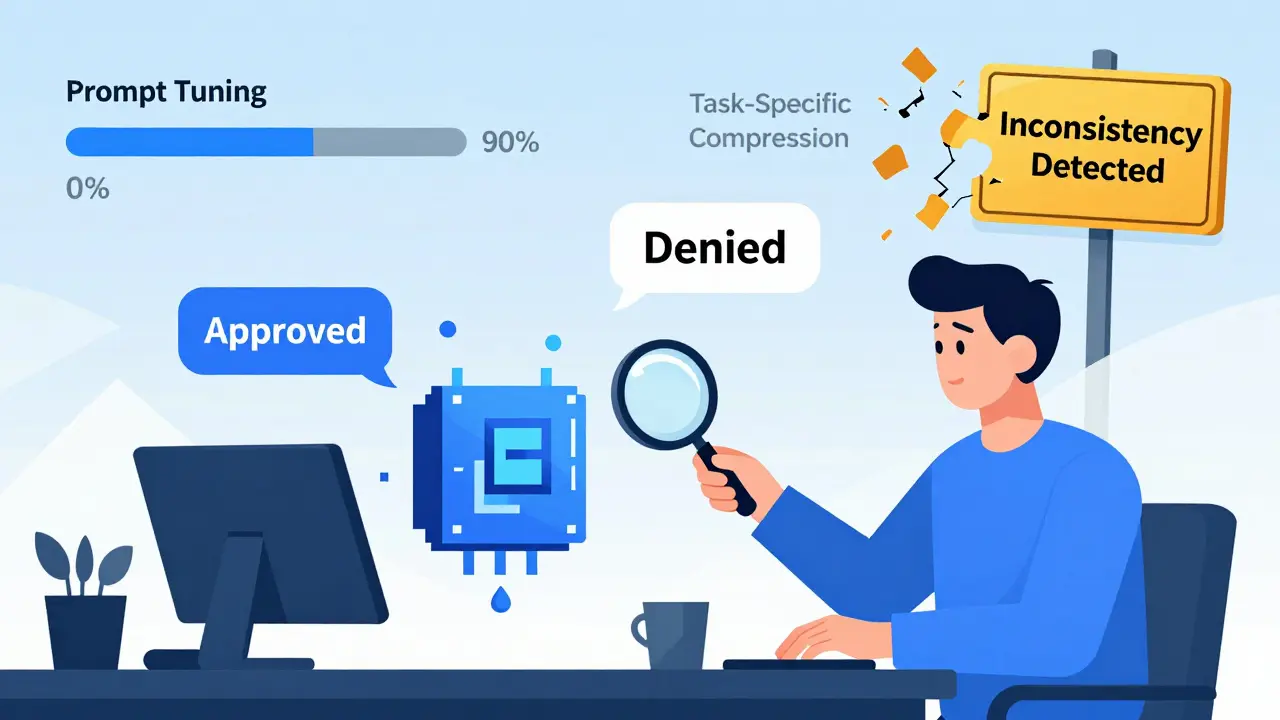
The “Compress, Then Prompt” method from Xu et al. (2023) shows that adding a few hours of prompt tuning can recover 80-90% of lost accuracy. It works by teaching the model how to “re-learn” its compressed self. You don’t retrain the whole model. You just fine-tune a small set of soft prompts-special input triggers that help the model access the right knowledge paths.
Companies like Together AI are already productizing this. Their new tool, PromptTune, recovers 76.4% of accuracy across 87 language pairs for 4-bit models. But here’s the catch: you need a good GPU, time, and expertise. Developers report spending 3-4 weeks learning quantization-aware training before hitting production quality. Documentation? AWQ scores 4.5/5 for clarity. LoSparse? 2.8/5.
What’s Next? Task-Specific Compression
The future isn’t one-size-fits-all compression. It’s smart compression.
Microsoft’s new TaskCompress system adjusts compression ratios based on the task. Simple queries? 8-bit. Complex reasoning? Keep it at 8-bit. The result? 3.8x average compression with 95%+ accuracy across 12 task types. That’s the real win: matching compression to need, not forcing one method on everything.
And the research is moving beyond 4-bit. SqueezeLLM cracked 3-bit quantization with only 2.1 perplexity degradation-8.7 points better than standard 3-bit methods. Hybrid approaches combining quantization with sparse experts (where only certain parts of the model activate for specific tasks) are showing promise too.
But here’s the sobering truth: compression is hitting a wall. As models grow to 100B, 200B, even 1T parameters, we can’t keep shrinking them without losing the very capabilities that make them useful. Stanford’s 2025 AI Index found that 68% of NLP researchers believe task-specific compression will be standard by 2027. The other 32% warn: without new architectures, we’re just delaying the inevitable.
What Should You Do?
If you’re deploying a compressed LLM today, here’s what actually matters:
- Use 4-bit quantization-not pruning-for most applications. AWQ and GPTQ are your best bets.
- Test on real tasks, not benchmarks. Run your own edge cases: long documents, multi-step reasoning, tool use.
- Expect 10-15% drop in complex task accuracy. Budget for that in your SLAs.
- Use prompt tuning if you need higher reliability. It’s worth the extra hours.
- Avoid pruning for knowledge-heavy systems. It’s too risky.
- Monitor for inconsistency. A model that gives different answers to the same question is broken-even if its accuracy score looks fine.
Compressed LLMs aren’t a magic bullet. They’re a tradeoff. You gain speed and cost savings. You lose depth, nuance, and sometimes, trust. The question isn’t whether you can compress your model. It’s whether you can afford to lose what it gives up.
Does quantizing a model to 4-bit always reduce accuracy by the same amount?
No. The accuracy loss depends on the model architecture, the quantization method, and the task. For example, AWQ preserves 97-99% of performance on agentic tasks but loses 10-15% on complex reasoning. GPTQ might perform better on general language tasks but worse on tool use. SqueezeLLM’s non-uniform quantization reduces loss by up to 8.7 points compared to standard 3-bit methods. Always test on your specific use case.
Can I use pruning on a medical or legal LLM?
Strongly discouraged. Apple’s LLM-KICK benchmark showed pruning causes catastrophic failure in knowledge-intensive tasks at just 25% sparsity. Medical and legal systems rely on precise, consistent recall of facts. Pruning removes critical connections between concepts, leading to unpredictable errors-even if the model seems to work on simple questions. Stick to quantization for regulated domains.
Why do compressed models fail on long contexts?
Quantized models need more context tokens to retrieve the same information. Apple’s research found they require 18-22% more context to match full-precision performance. At over 32K tokens, 4-bit models lose 25-30% accuracy, compared to 15-20% for full-precision. This happens because compressed weights lose fine-grained attention patterns needed to track long dependencies. If your app uses long documents, test at 64K+ tokens before deployment.
Is it worth doing prompt tuning after compression?
Yes, if accuracy matters more than speed. The ‘Compress, Then Prompt’ method recovers 80-90% of lost accuracy with just 2-3 hours of tuning on an RTX 4090. It’s far cheaper than retraining. Tools like Together AI’s PromptTune automate this and work across 87 languages. For enterprise use cases-customer support, compliance, research-this is often the difference between a usable system and a dangerous one.
What’s the best compression tool for beginners?
Start with Hugging Face’s Optimum and AWQ. AWQ has the clearest documentation (4.5/5 in user ratings), works out-of-the-box with popular models like Llama and Mistral, and gives strong results on most tasks. GPTQ is also solid but requires more manual setup. Avoid LoSparse or experimental methods until you’ve mastered the basics. Most production systems use AWQ or GPTQ-stick with what’s proven.
How do I know if my compressed model is safe for production?
Run three tests: First, check for consistency-ask the same question 10 times. If answers vary significantly, the model is unstable. Second, test edge cases: complex reasoning, long inputs, tool use. Third, compare error rates to your full-precision baseline. If errors increase by more than 15% on critical tasks, you need more tuning or a different compression method. Never rely on benchmark scores alone.
- Jan, 14 2026
- Collin Pace
- 9
- Permalink
Written by Collin Pace
View all posts by: Collin Pace