Adapters vs Full Fine-Tuning for LLMs: Cost, Speed, and Quality Comparison

Updating every single weight in a 70-billion parameter model is a financial nightmare for most companies. If you've ever looked at the VRAM requirements for full fine-tuning, you know it's not just about having a fast GPU-it's about having a massive, expensive cluster of them. But do you actually need to touch every parameter to get a model that follows your brand voice or understands your industry's jargon? Usually, the answer is no.
The industry has shifted toward Parameter-Efficient Fine-Tuning (PEFT). Instead of rebuilding the whole engine, these methods act like a high-performance tuning kit added to the existing machine. Whether you're deciding between a massive infrastructure investment or a lean, adapter-based approach, the choice comes down to three things: how much you want to spend, how fast you need to deploy, and whether a 1% drop in accuracy is a deal-breaker for your use case.
The Heavy Lift: Understanding Full Fine-Tuning
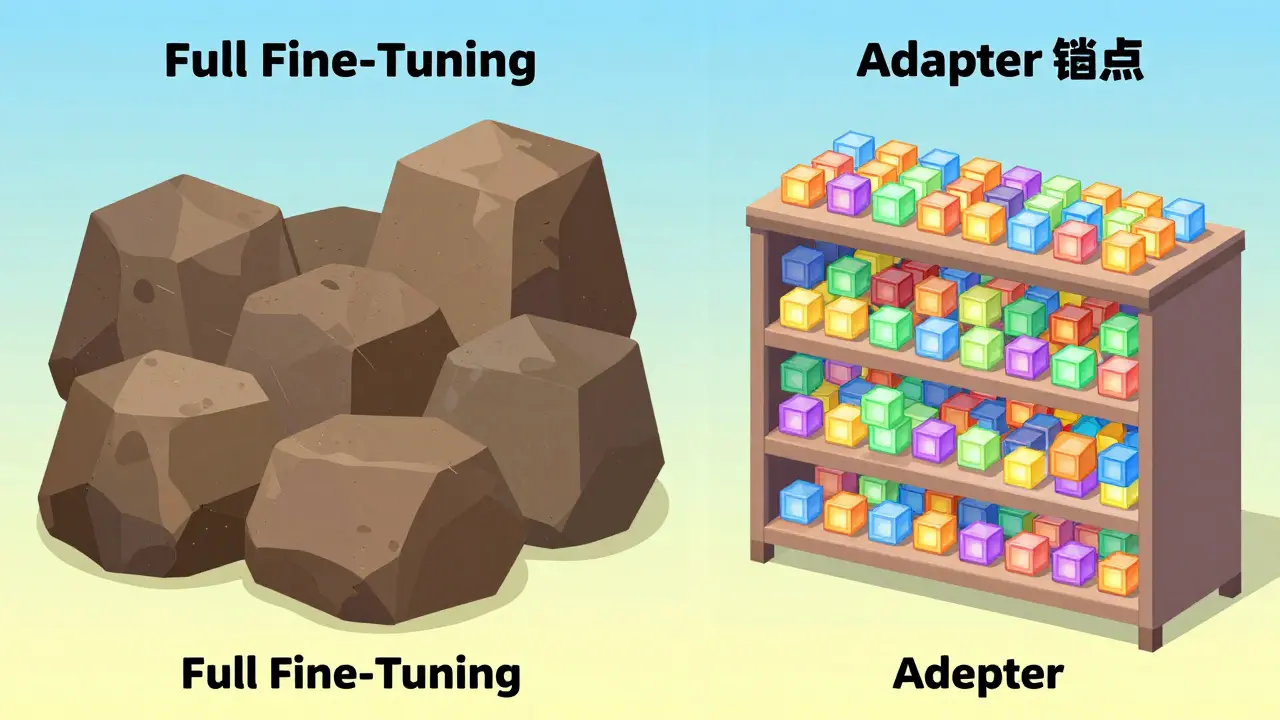
Full Fine-Tuning is a process where every single parameter in a Large Language Model is updated during training to adapt it to a new dataset. While this provides the most thorough customization, it's incredibly resource-intensive. For a 7-billion parameter model, you're looking at over 28 GB of GPU memory just to get started. If you're scaling up to a 70B model, the costs skyrocket, often requiring bare-metal servers with L40S GPUs that can cost over $3,200 per month just for the hardware.
The real danger here isn't just the cost; it's "catastrophic forgetting." When you force a model to learn new data by changing all its weights, it can actually forget the general knowledge it had from its original pre-training. It's like teaching someone to be a world-class cardiologist but accidentally making them forget how to speak English in the process.
The Lean Alternative: Adapters and PEFT
Adapters are small, trainable layers inserted between existing layers of a pre-trained model, allowing the base model weights to remain frozen. Instead of updating billions of parameters, you only train a few million. This is the core of PEFT (Parameter-Efficient Fine-Tuning), a family of techniques designed to make AI customization accessible to teams without a Google-sized budget.
Within the PEFT world, LoRA (Low-Rank Adaptation) has become the gold standard. It doesn't even add new layers; it uses a mathematical trick to represent weight updates as smaller matrices. In many cases, LoRA reduces the number of trainable parameters to as little as 0.01% of the original model. Other methods like Prefix Tuning and IA³ further push these limits, with IA³ requiring almost zero extra computation during the actual inference phase.
| Feature | Full Fine-Tuning | LoRA / Adapters | IA³ / Prefix Tuning |
|---|---|---|---|
| Trainable Params | 100% | < 1% | ~0.01% - 0.1% |
| VRAM Requirement | Very High (e.g., 30GB+) | Moderate (e.g., 10GB) | Low |
| Storage Cost | Gigabytes per version | Megabytes per version | Megabytes per version |
| Risk of Forgetting | High | Low | Very Low |

Breaking Down the Costs
If you're managing a budget, the financial gap between these two paths is staggering. Implementing LoRA or adapters typically leads to a 50-70% reduction in total costs. This isn't just about the hourly rate of a GPU; it's about the total GPU-hours required to reach convergence.
Consider a real-world cloud scenario using AWS SageMaker with g5.2xlarge instances. Training a 7-billion parameter model over 10 sessions might only cost about $13 in compute and $2 in storage when using PEFT. Compare that to the overhead of maintaining massive full-model checkpoints. Full fine-tuning produces files that are several gigabytes each. If you have ten different versions of a model for ten different clients, you're paying for massive amounts of high-speed storage. With adapters, those checkpoints are just a few megabytes. You can store a thousand versions of a model on a standard hard drive without breaking a sweat.
Speed and Performance: Is There a Trade-off?
The biggest fear with PEFT is that you're getting a "diet" version of the model that doesn't actually work as well. Fortunately, the data suggests otherwise. In most benchmarks, models tuned with LoRA or adapters hit 95-100% of the performance of a fully fine-tuned model. For the vast majority of business applications-like sentiment analysis, document summarization, or customer support bots-that difference is completely invisible to the end user.
When it comes to speed, the impact on inference (the time it takes for the model to generate a response) is negligible. Because adapter layers are so small, they add almost no latency to the forward pass. In the case of IA³, there is virtually zero inference penalty because it simply scales existing operations. This means you get the precision of a specialized model without making your users wait longer for an answer.
Which One Should You Choose?
Choosing the right method depends on where your organization sits in its AI journey. For most, the decision tree is simple: if you aren't a research lab with an unlimited budget and a need for deep architectural changes, go with PEFT.
Full fine-tuning is only the "right" answer when you are working with a very small model where the overhead is manageable, or when you are attempting a massive domain shift-like teaching a general model to understand a highly complex, proprietary legal or medical language from scratch. In those rare cases, the deep customization might justify the thousands of dollars in extra compute costs.
For everyone else, the ability to rapidly iterate is more valuable than the marginal gain of full tuning. Being able to train a model on a cheaper GPU, save a tiny checkpoint file, and deploy it in minutes allows you to fail fast and improve your prompts and datasets without burning through your entire quarterly budget.
Does LoRA actually perform as well as full fine-tuning?
Yes, in most practical applications. Research shows that LoRA and other adapter-based methods typically achieve 95% to 100% of the performance of full fine-tuning. The difference is often negligible unless you are performing a highly complex task that requires fundamental changes to the model's internal knowledge.
How much memory do I save using PEFT?
The savings are significant. For example, if full fine-tuning of a 7B model requires roughly 30 GB of VRAM, a parameter-efficient method like LoRA can reduce that requirement to around 10 GB, allowing you to use smaller, more affordable GPUs.
What is catastrophic forgetting?
Catastrophic forgetting occurs during full fine-tuning when the model updates all its weights to learn new information, accidentally overwriting the general knowledge it gained during pre-training. Adapters avoid this by freezing the original weights and only training small auxiliary layers.
Will using adapters slow down my model's response time?
Generally, no. The computational overhead of adapter layers is very small. In some cases, like with IA³, there is zero additional cost to inference speed. For most users, the latency difference between a fully fine-tuned model and an adapter-based one is imperceptible.
Can I switch between different adapters for different tasks?
Yes, and this is one of the biggest advantages of PEFT. Since adapter checkpoints are only a few megabytes, you can keep one base model in memory and quickly swap out different small adapter files depending on whether the user needs a "coding assistant" or a "creative writer" version of the model.
- Apr, 23 2026
- Collin Pace
- 10
- Permalink
Written by Collin Pace
View all posts by: Collin Pace