Attribution Challenges in Generative AI ROI: Isolating AI Effects from Other Changes
You’ve deployed the model. The team is using it. Productivity feels higher. But when the CFO asks for the return on investment, you’re stuck. Why? Because isolating generative AI ROI from other business changes is one of the hardest problems in modern enterprise strategy.
This isn’t just a feeling; it’s a documented crisis. According to MIT’s 2025 'GenAI Divide' report, 95% of organizations have failed to demonstrate measurable financial returns despite spending between $30 and $40 billion cumulatively on generative AI initiatives. The core issue isn’t that the technology doesn’t work-it’s that we are trying to measure a distributed, cognitive transformation using industrial-era metrics designed for discrete capital equipment purchases.
The Core Problem: Why Traditional ROI Fails for GenAI
Traditional ROI frameworks assume a linear cause-and-effect relationship. You buy a machine, it produces more units, you calculate the profit margin. Simple. Generative AI does not work this way. It enhances productivity, customer satisfaction, innovation velocity, and risk management simultaneously across multiple departments.
Dr. Erik Brynjolfsson, Director of the Stanford Digital Economy Lab, captured this perfectly in the MIT report: "The 95% failure rate isn't because AI doesn't work-it's because we're applying 20th-century ROI metrics to a 21st-century transformation. We're trying to measure the value of electricity by counting how many candles it replaces."
The problem is acute in knowledge work domains. When an engineer uses an AI coding assistant, the benefit isn’t just faster code generation. It’s fewer bugs, better architecture decisions, and less burnout. These are interdependent benefits that resist isolation. Gartner’s 2024 survey of 1,200 enterprise leaders found that 74% cite attribution challenges as their primary barrier to proving AI value. CFOs no longer accept vague promises of "efficiency gains"; they demand concrete evidence of contribution to financial outcomes.
Technical Barriers to Isolating AI Effects
If the conceptual challenge is complex, the technical execution is even harder. Organizations attempting to isolate AI effects face a 57% higher data collection burden compared to traditional technology implementations. Deloitte’s 2025 AI measurement study reveals that capturing end-to-end impact requires integrating data across 8-12 disparate systems.
Here are the specific technical constraints blocking accurate attribution:
- Inability to establish control groups: Cited by 68% of data science teams in an Informatica survey of 600 data leaders. Without a parallel group that operates without AI, you cannot statistically prove causality.
- Temporal misalignment: 42% of organizations use inappropriate 3-6 month ROI assessment windows. However, generative AI initiatives typically require 12-18 months to mature as users learn to prompt effectively and processes adapt.
- Insufficient data lineage: Missing in 51% of enterprise data stacks (Techverx, October 2024). If you can’t trace which specific AI output led to a specific business outcome, you can’t attribute value.
Furthermore, the infrastructure needed is costly. Robust data pipelines capable of capturing granular interaction data require 3-5x more storage than traditional analytics. Real-time feedback loops must connect AI outputs directly to business outcomes, a capability most legacy BI platforms lack.

The Gap Between Leaders and Laggards
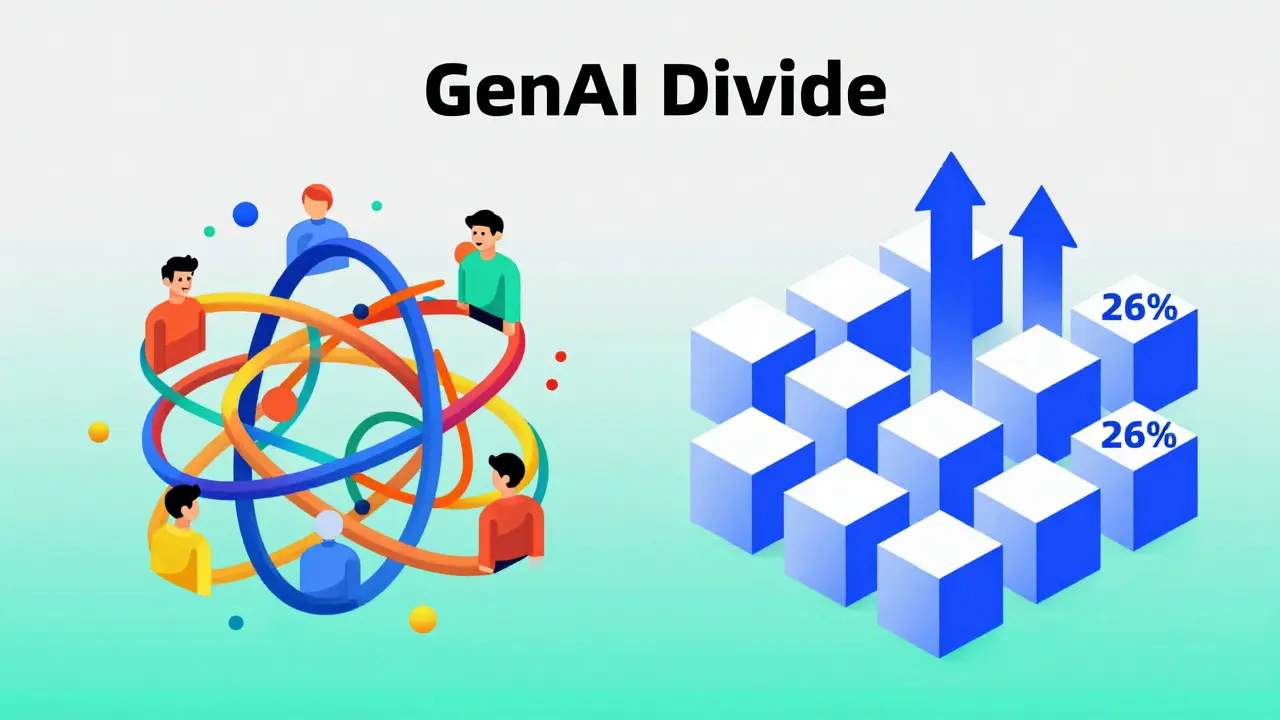
Not all organizations are failing. A distinct "GenAI Divide" has emerged. Approximately 26% of enterprises-those with mature measurement frameworks-are meeting or exceeding ROI targets. The remaining 74% remain trapped in "pilot purgatory," unable to scale because they cannot prove value.
What separates these groups? It’s not the model quality; it’s the measurement methodology.
| Metric / Practice | Top 26% (Leaders) | Bottom 74% (Laggards) |
|---|---|---|
| Pre-implementation Baselines | 92% establish clear baselines | 18% establish clear baselines |
| Attribution Metrics Used | 3.7x more attribution-specific metrics | Rely on single-metric ROI calculations (63%) |
| Assessment Timeframe | 12-18 months (aligned with maturation) | Within 6 months (67% assess too early) |
| Confounding Variables | Account for process reengineering | Overlooked by 78% of organizations |
| Advanced Techniques | Counterfactual analysis (22%), Causal inference (14%) | Rarely used |
For example, American Express successfully isolated a 22% reduction in customer service handling time through rigorous A/B testing. In contrast, a senior data scientist at a Fortune 500 company shared on Reddit (May 2025) that their team spent six months trying to isolate a GenAI chatbot’s impact on sales, only to discover that concurrent website redesign and pricing changes accounted for 82% of the observed improvement. They measured correlation, not causation.
Implementing Counterfactual Analysis and Multi-Touch Attribution
To move from the lagging majority to the leading minority, organizations must adopt advanced statistical techniques. Kanerika’s 2025 benchmarking study identified three critical methods:
- Counterfactual Analysis: This involves creating a "what if" scenario. What would have happened to productivity if the AI had not been deployed? Siemens implemented this framework for their engineering design assistant, isolating a 27% productivity gain with 95% statistical confidence that the improvement was attributable to AI rather than other factors.
- Time-Series Decomposition: This technique separates AI effects from broader market trends. If sales rise during an AI rollout, is it the AI or a seasonal spike? Only 18% of companies currently implement this.
- Causal Inference: Moving beyond last-touch attribution (which credits the final interaction) to multi-touch attribution models that recognize AI’s role across the entire value chain. MIT Sloan Professor Catherine Tucker argues this is essential for understanding AI’s distributed impact.
These methods require a shift in mindset. You are no longer just tracking usage; you are conducting scientific experiments on your business operations.

Practical Steps to Build an Attribution Framework
Building this capability takes time. Organizations typically need 4-6 months to establish proper measurement infrastructure before AI deployment, with data preparation consuming 58% of the initial effort. Here is how to start:
1. Establish Pre-Deployment Baselines
Before you turn on the AI, measure everything. Capture current cycle times, error rates, and output volumes. Only 31% of initiatives do this correctly. Without a baseline, any post-deployment change is anecdotal.
2. Implement Granular Usage Tracking
Don’t just track logins. Capture 15-20 data points per AI interaction. Did the user accept the suggestion? Did they edit it? How long did it save them? This granularity is required to connect AI outputs to business outcomes.
3. Create Control Groups
Where possible, roll out AI to one team while keeping another team on the old process. This allows for difference-in-differences analysis, adopted by 17% of mature practitioners. This is the gold standard for isolation.
4. Account for Learning Curves
Productivity often dips initially as users learn new tools. 73% of initiatives overlook this dip and declare failure prematurely. Plan for a 12-18 month maturation period. Berkeley Executive Education’s analysis shows that measuring only short-term ROI causes organizations to miss 73% of AI’s value.
5. Assemble Cross-Functional Teams
Data scientists alone cannot solve this. Successful programs include business analysts and domain experts who understand the context of the work. Present in 24% of successful programs, these teams ensure that metrics matter to the bottom line.
The Future of AI Measurement: Standards and Pressure
The landscape is shifting rapidly. Regulatory pressures are intensifying. The EU AI Act requires impact assessments that include ROI measurement for high-risk applications. Meanwhile, SEC disclosure rules now mandate explanations of AI’s contribution to financial performance for publicly traded companies.
In Q2 2025, the AI Measurement Consortium, comprising 47 Fortune 500 companies, released Version 2.1 of the Generative AI ROI Framework. This introduced standardized methodologies for isolating AI effects through multi-touch attribution and counterfactual analysis. Gartner predicts that by 2027, 60% of large enterprises will require AI initiatives to demonstrate isolated impact through statistically valid methods.
Specialized vendors like Censius and WhyLabs are emerging to address these attribution challenges, though adoption remains low at just 12% of enterprises. Manufacturing and financial services lead in maturity (41% and 38% respectively), while retail and healthcare lag significantly (22% and 19%).
The next 18-24 months represent a critical window. Wharton’s 2025 survey shows that 72% of executives now require specific ROI metrics before approving new generative AI spending. If you cannot isolate the effect, you will lose the budget. The technology is ready; the measurement must catch up.
Why is it so difficult to calculate ROI for generative AI?
Generative AI impacts multiple departments and processes simultaneously, making it hard to isolate its specific contribution. Unlike traditional software that automates a single task, GenAI enhances cognitive work across the value chain. Additionally, concurrent changes like process reengineering or market fluctuations often mask or mimic AI benefits, requiring complex statistical methods like counterfactual analysis to separate the signal from the noise.
What is the "GenAI Divide" mentioned in recent reports?
The GenAI Divide refers to the gap between the 26% of organizations that have mature measurement frameworks and can demonstrate clear ROI, and the 74% that cannot. Despite heavy spending, the majority of companies are stuck in "pilot purgatory" because they lack the attribution methodologies needed to prove financial value to stakeholders like CFOs and boards.
How long should I wait before assessing GenAI ROI?
You should plan for a 12-18 month assessment window. Most organizations make the mistake of measuring within 3-6 months, missing the learning curve where productivity may initially dip as users adapt. True value realization, including process optimization and advanced prompting skills, takes over a year to mature fully.
What is counterfactual analysis in the context of AI attribution?
Counterfactual analysis is a statistical method used to determine what would have happened if the AI had not been deployed. By comparing actual outcomes against this hypothetical baseline, organizations can isolate the specific impact of the AI tool from other variables like market trends or simultaneous process changes. Siemens used this to validate a 27% productivity gain with 95% confidence.
Do I need special tools to measure GenAI ROI?
While specialized vendors like Censius and WhyLabs exist, most organizations currently build custom solutions. Effective measurement requires robust data pipelines that capture granular interaction data (15-20 points per interaction) and integrate across 8-12 disparate systems. You also need analytics capabilities for time-series decomposition and causal inference, which standard BI tools often lack.
- Jul, 5 2026
- Collin Pace
- 6
- Permalink
- Tags:
- generative AI ROI
- attribution challenges
- isolate AI effects
- AI measurement frameworks
- GenAI Divide
Written by Collin Pace
View all posts by: Collin Pace