Biotech and Generative AI: Molecule Generation and Lab Notebooks
Imagine a world where designing a new life-saving drug takes weeks instead of years. That is the promise of Generative AI in biotechnology. For decades, pharmaceutical companies have struggled with a brutal reality: bringing a single drug to market costs roughly $2.6 billion and takes 10 to 15 years. The chemical space-the total number of possible drug-like molecules-is estimated at 10^60. Searching through that haystack for a needle using traditional methods is like trying to find a specific grain of sand on every beach on Earth by hand.
Enter generative artificial intelligence. Unlike older AI models that simply classify or predict outcomes, generative AI creates entirely new structures. It doesn't just look at existing drugs; it designs novel molecular candidates from scratch, tailored to hit specific biological targets. This shift has moved the industry from slow, manual screening to rapid, computational design. But generating a molecule on a screen is only half the battle. The other half is managing the data, experiments, and validation in the real world. This is where Electronic Lab Notebooks (ELNs) come into play.
The Evolution of Molecule Generation
The journey began around 2016-2017 with early applications of variational autoencoders (VAEs) and generative adversarial networks (GANs). These initial models could generate valid molecular strings, but they lacked precision. A breakthrough moment came with the 2016 paper "Molecular De Novo Design through Deep Reinforcement Learning" by Google researchers, which showed that AI could be trained to optimize molecules for specific properties.
Since 2020, the field has accelerated dramatically due to two key architectural shifts: diffusion models and transformers. Diffusion models, originally popular in image generation, have proven exceptionally effective for molecular structures. They work by gradually removing noise from a random signal to produce a clear, valid molecule. According to a 2023 review in *Briefings in Bioinformatics* by Zhang et al., these modern diffusion approaches achieve validity rates of over 92%, compared to just 77% for traditional GAN-based methods.
One standout system is PRODIGY (PROjected DIffusion for controlled Graph Generation), developed by researchers at the Georgia Institute of Technology and presented at ICML in July 2024. PRODIGY allows scientists to specify exact constraints-such as atom count or bond types-and generates molecules that meet those criteria with an 89% success rate. This level of control was previously impossible with standard diffusion models, which often produced chemically invalid structures when pushed too hard.
How Generative AI Changes Drug Discovery
Traditional drug discovery is linear and expensive. You identify a target, screen thousands of compounds, and hope one sticks. Generative AI flips this process. Instead of screening what exists, you generate what you need. Dr. Alex Zhavoronkov, CEO of Insilico Medicine, noted in a March 2024 interview that his company reduced the target identification phase from 4.5 years to just 18 months using these tools.
The speed difference is staggering. Modern systems can design candidate molecules in minutes rather than hours. A report from *Drug Target Review* in July 2024 highlighted that AI-driven design is up to 10 times faster than previous computational methods. However, speed brings its own challenges. Not every generated molecule can be synthesized in a lab. Current models estimate synthesizability with only 65-70% accuracy, meaning nearly half of the promising digital candidates might fail when chemists try to build them physically.
| Approach | Validity Rate | Therapeutic Relevance | Computational Cost |
|---|---|---|---|
| Target-Agnostic | 85-90% | Low | Low |
| Target-Aware | 70-75% | High | Medium |
| Graph-Based (JTVAE) | 93% | Medium | High |
| Diffusion Models (GCDM) | 94.2% | High | Very High |

The Role of Electronic Lab Notebooks (ELNs)
You can generate millions of molecules, but if you cannot track which ones were tested, how they performed, and why some failed, the data becomes useless. This is the critical role of Electronic Lab Notebooks. ELNs are the digital backbone of modern research, replacing paper notebooks with searchable, structured databases. Platforms like Benchling and LabArchives have become industry standards.
Benchling, founded in 2012 and acquired by Thermo Fisher Scientific for $3.5 billion in 2022, has been at the forefront of digitizing lab workflows. LabArchives, established in 2008, offers robust compliance features for regulated industries. However, integrating generative AI directly into these notebooks remains an emerging area. As of late 2024, only about 15% of major ELN platforms offered native generative AI capabilities, though 67% announced plans to integrate them within 18 months.
The gap between AI generation and ELN integration is a significant bottleneck. When an AI suggests a molecule, a researcher needs to seamlessly log the synthesis plan, record experimental results, and feed that data back into the AI model for improvement. Without this closed-loop connection, the AI remains a siloed tool rather than a collaborative partner.
Challenges and Limitations
Despite the hype, generative AI in biotech faces serious hurdles. The biggest issue is the "synthesis gap." While AI can design a molecule that looks perfect on a computer, real-world chemistry is messy. A 2023 analysis in *Nature Reviews Drug Discovery* found that only 30-40% of AI-generated molecules prove synthesizable in laboratory conditions. Researchers often spend weeks trying to build a compound that fails due to unanticipated reactivity.
Another limitation is scalability. Most current models struggle with large molecules containing more than 100 heavy atoms. Complex biologics, such as antibodies or protein therapeutics, remain difficult for these systems to handle accurately. Additionally, diversity is a concern. Generated compounds often show only 60-70% structural diversity compared to natural compounds, potentially limiting the range of therapeutic options discovered.
Professor Regina Barzilay of MIT warned in May 2024 that "current models still operate in a 2D chemical space fantasy when biology happens in 3D." This means AI often misses crucial spatial interactions that determine whether a drug will actually bind to its target in the human body. Improving 3D structure prediction and spatial reasoning is the next major frontier for developers.
Implementation and Infrastructure
Getting started with generative AI requires more than just software. It demands significant computational power and expertise. Training advanced diffusion models typically requires 4-8 NVIDIA A100 GPUs running for 3-7 days on standard datasets. For smaller biotechs, this hardware cost is prohibitive, leading many to rely on cloud services or specialized platforms.
The learning curve is steep. Computational chemists usually need 6-12 months to become proficient with frameworks like REINVENT or custom-built pipelines. Data preparation is another time sink. Curating high-quality datasets of 50,000 to 1 million molecules from sources like ChEMBL or ZINC is essential for training accurate models. Niche therapeutic areas may suffer from data scarcity, requiring transfer learning techniques that add weeks to implementation timelines.
Community support varies widely. Open-source projects like DeepChem, which boasts over 4,200 stars on GitHub, offer active forums and comprehensive tutorials. Commercial platforms provide polished interfaces but often lack transparency into their algorithms, making troubleshooting harder for users who encounter unexpected results.
Market Trends and Future Outlook
The market for generative AI in drug discovery is exploding. Valued at $1.34 billion in 2023, it is projected to reach $12.97 billion by 2030, growing at a 38.5% compound annual growth rate (CAGR). Major players include Insilico Medicine, Recursion Pharmaceuticals, and BenevolentAI. Adoption is highest among large pharmaceutical companies, with 87% of the top 20 having active AI initiatives, compared to only 32% of biotech startups.
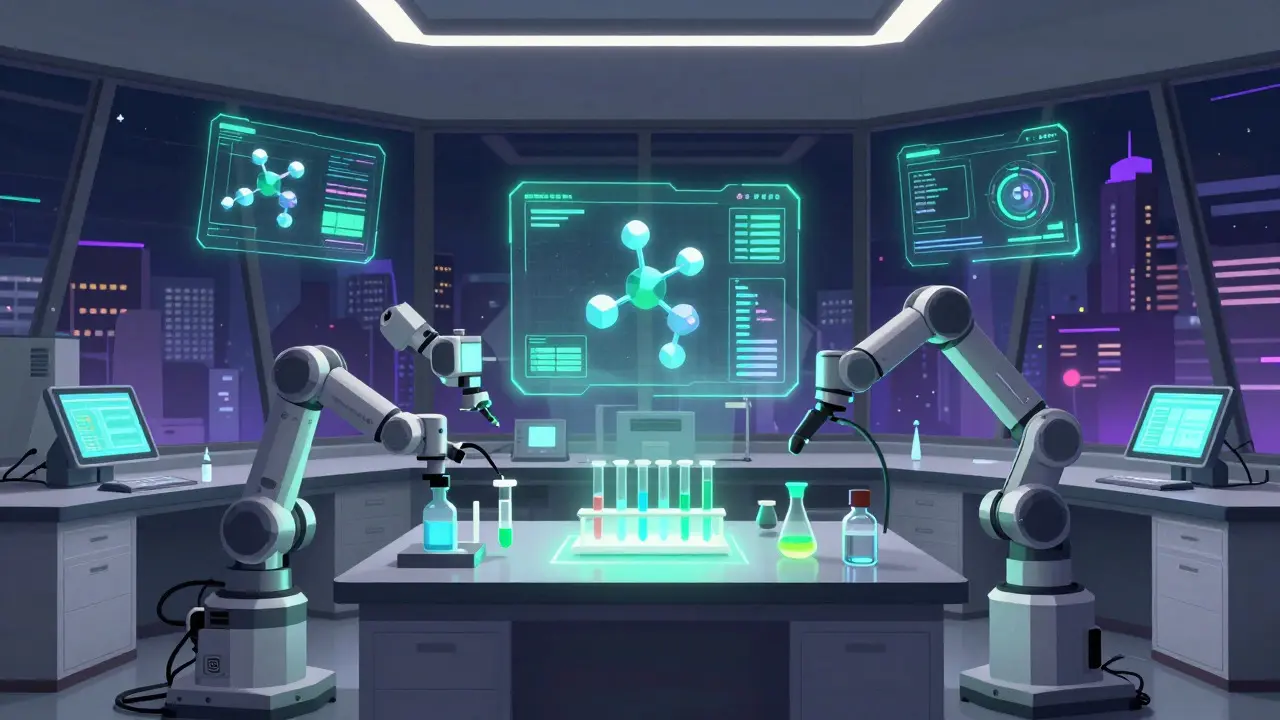
The future lies in closed-loop systems. Companies like Pfizer are building "AI-native" laboratories where robotic synthesis arms receive direct input from generative models. At Pfizer’s Cambridge facility, operational since September 2024, the design-make-test cycle has been reduced from weeks to 72 hours. Recursion Pharmaceuticals reports five times faster optimization cycles using similar integrated approaches.
Regulatory bodies are also adapting. The FDA released draft guidance in February 2024 acknowledging AI-generated molecules but requiring enhanced validation data packages. This adds 3-6 months to preclinical timelines but ensures safety and efficacy standards are met. By 2028, analysts predict that 40% of novel drug candidates will originate from AI-driven design processes. However, true success will depend on clinical outcomes. As of January 2025, only three AI-designed molecules had entered clinical trials, including Insilico’s ISM001-055 for fibrosis and Exscientia’s DSP-1181 for oncology.
What is molecule generation in biotech?
Molecule generation is the process of using artificial intelligence to create novel chemical structures with desired properties for drug discovery. Instead of screening existing libraries, AI models like diffusion networks design new molecules from scratch, optimizing for factors like binding affinity and synthesizability.
How do Electronic Lab Notebooks (ELNs) integrate with AI?
ELNs serve as the data repository for experimental results. Integration allows AI-generated molecule proposals to be logged, tested, and validated within the notebook. The resulting data feeds back into the AI model, creating a continuous learning loop that improves future predictions. Currently, only about 15% of ELNs offer native AI integration.
Why is the synthesis gap a problem?
The synthesis gap refers to the discrepancy between AI-designed molecules and those that can actually be built in a lab. Only 30-40% of AI-generated candidates are currently synthesizable. This forces researchers to waste time and resources testing compounds that fail during physical creation due to complex reactivity issues not predicted by 2D models.
Which AI architectures are best for molecule generation?
Diffusion models are currently considered state-of-the-art, achieving validity rates over 92%. Systems like PRODIGY and GCDM lead the field by allowing precise control over molecular constraints. Older methods like VAEs and GANs are less accurate, with validity rates around 77-80%, though they require less computational power.
What are the regulatory considerations for AI-designed drugs?
The FDA requires enhanced validation data packages for AI-generated molecules. This includes rigorous proof of synthesizability, stability, and biological activity. While AI speeds up design, the regulatory review process may take 3-6 months longer than traditional candidates due to the need for additional evidence to confirm the AI's predictions.
- Jul, 23 2026
- Collin Pace
- 0
- Permalink
Written by Collin Pace
View all posts by: Collin Pace