Budgeting for Vibe Coding Platforms: Licenses, Models, and Cloud Costs
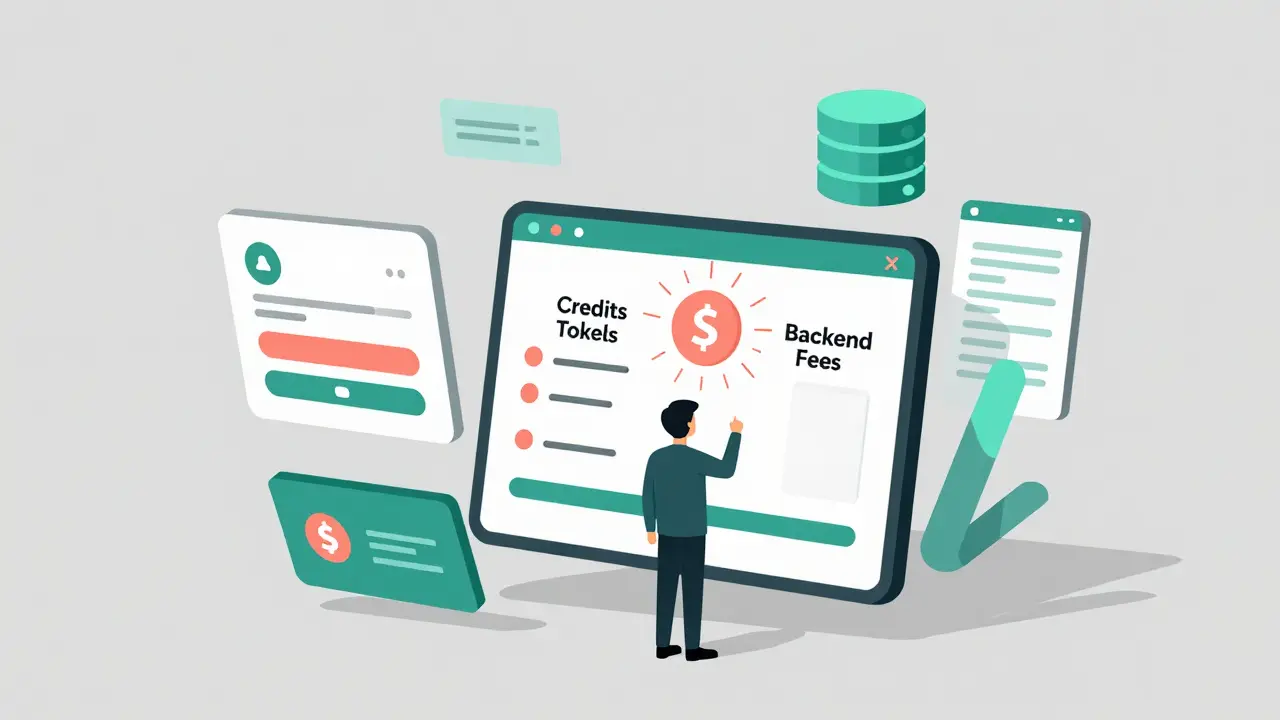
When you start building apps with vibe coding platforms, you think you’re saving money. You type a simple request like “Create a login page with Google auth and a dashboard”, and boom - code appears. No need to hire a dev. No long setup. Just click, tweak, and launch. But then the bill shows up. And it’s not $10. It’s $47. Or $89. Or more. And you didn’t even finish your MVP.
Here’s the truth: vibe coding platforms aren’t free. They’re not even cheap if you’re serious about building something real. The real cost isn’t the monthly subscription. It’s the hidden credits, the token burns, the backend services you didn’t know you needed, and the learning curve that eats your budget before you even ship. If you’re trying to build an app without knowing how these platforms charge, you’re setting yourself up to overspend - or worse, get stuck mid-project.
How Vibe Coding Platforms Actually Charge
These tools don’t work like traditional software. You’re not paying for a license. You’re paying for compute. Every time you ask the AI to generate code, fix a bug, or add a feature, it uses processing power. That’s tracked as credits, tokens, or prompts - and they all run out.
Take v0. It gives you 5 free credits a month. That’s enough for a simple homepage. But if you want to add user authentication, a database, and responsive layout tweaks? You’re looking at 15-20 credits. At $20/month for 20 credits, you’re already halfway to a paid plan. And if you’re iterating - which you will be - you’ll burn through credits fast.
Bolt.new uses tokens. Their Pro plan gives you 10 million tokens for $18/month. Sounds generous. But one complex feature - say, a real-time chat with push notifications - can use 3 million tokens. Do that three times, and you’re out. Then you pay $200 for another 120 million tokens. That’s not a subscription. That’s a pay-per-use rollercoaster.
Cursor goes a different route. $16/month gets you an API budget good for 200-600 prompts. That’s fine if you’re just writing code. But if you’re building full apps - not just snippets - you’ll hit limits fast. And upgrading to Ultra ($200/month) isn’t a step up. It’s a leap into enterprise pricing.
And then there’s Lovable. It’s one of the most popular for non-technical founders. Their Pro plan is $25/month with 100 monthly credits plus 5 daily credits (up to 150 total). Sounds simple. Until you realize you also get billed separately for backend services. If you’re building a full app, you’ll need Supabase or Firebase. That’s another $25-$50/month. So your $25 plan becomes $75+ before you even ship.
Free Tiers Are Just Trials
All major vibe coding platforms offer free plans. And yes, you can build a static landing page on them. Maybe even a basic form. But if you want authentication? A database? API integrations? You’re out of luck. Free tiers are designed to hook you - not to build real products.
One founder on Reddit built a SaaS MVP for $12.75 using Lovable’s free tier. How? She wrote 17 different prompts to get the same result. She spent 14 hours learning how to phrase requests so the AI didn’t waste credits. That’s not efficient. That’s a full-time job just to avoid paying.
Experts agree: free tiers are for testing. Not production. Justin from Technically says he built a simple app for free - but anything with user login, data storage, or real-time features? “You’re paying. No way around it.”
What You’re Not Budgeting For (But Should Be)
Most people think they’re budgeting for the AI tool. They forget everything else.
v0 generates frontends - HTML, CSS, React. But it doesn’t touch databases, APIs, or user auth. So you need Supabase or Firebase. That’s $25-$50/month. Then you need Netlify or Vercel to deploy. Another $10-$20. Then you need Stripe for payments. Another $10-$30 depending on volume.
That’s $75-$150/month just on infrastructure. And you haven’t even paid for the AI tool yet.
Compare that to GitHub Copilot. It’s $10/month. No credits. No tokens. Just unlimited code suggestions. But it doesn’t build apps. It helps you code. So if you’re a dev, it’s a steal. If you’re a founder trying to build a full-stack app? You’ll need Copilot plus a vibe coding tool plus backend services. Suddenly you’re at $50-$80/month - and you didn’t even realize you needed three tools.

Who Pays What? Real-World Scenarios
Let’s break it down by user type.
Non-technical founder building an MVP: You want a full app - login, dashboard, payments, database. You’ll likely use Lovable or Replit. Budget $40-$60/month: $25 for Lovable Pro, $25 for Supabase, $10 for Vercel. You’ll need to learn prompt efficiency. Otherwise, you’ll burn through credits in two days.
Professional developer using AI to speed up work: You’re not building from scratch. You’re writing code faster. GitHub Copilot at $10/month is your best bet. If you need more power, Cursor at $16/month gives you full IDE integration. You won’t need backend services unless you’re deploying - then add $20-$30.
Team of 3-5 developers: You need collaboration. Lovable Business at $42/month gives you unlimited users - a rare perk. But you’ll still need backend tools. Total: $100-$150/month. That’s cheaper than hiring one junior dev.
Startup trying to go from prototype to product: You’ll cycle through tools. Start with v0 for UI. Then switch to Lovable for logic. Then add Supabase. Then upgrade to Bolt.new for scaling. Your first month? $75. Your third month? $200+. That’s normal. But if you don’t track usage, you’ll be shocked.
The Hidden Cost: Time and Mistakes
The biggest budget killer isn’t the credit. It’s the time you waste guessing how the system works.
One user on Hacker News spent 3 days trying to build a search feature on Bolt.new. He used 8 million tokens - $16 in overage fees - and still got a buggy result. He had to start over. Another spent $47 on v0 credits only to realize the generated code didn’t work with their existing API. They had to hire a dev to fix it. That cost $300.
Emergent Research found that novice users consume 2-3x more credits than experienced ones. Why? Bad prompts. Over-asking. Not testing small steps. If you don’t learn how to break requests into tiny pieces - “Make a button,” then “Make it blue,” then “Add hover effect” - you’ll burn cash.
And documentation? It’s hit or miss. GitHub Copilot has great guides. v0’s docs? 37% of users called them “inadequate.” You’re on your own.
What’s Changing in 2026
Platforms are listening. In January 2026, Lovable added daily credit rollover. v0 launched usage analytics. GitHub announced Copilot Workspace - a flat $19/month plan that includes full app building. That’s a game-changer.
By Q2 2026, every major vibe coding tool will have a real-time dashboard showing exactly how many credits you’ve used, what feature burned them, and how to cut costs. That’s good news. But it’s also a warning: if your platform doesn’t show this by June, you’re risking your budget.
Forrester predicts 30% of these tools will be bought by big IDEs like JetBrains or Microsoft by 2027. That means pricing will stabilize. But for now? It’s wild west.
How to Budget Smart
Here’s how to avoid getting burned:
- Start with free tiers - but treat them like a demo. Don’t plan to ship.
- Track usage daily. Set a $10/day limit. If you hit it, stop and rethink.
- Build in stages. Get one feature working before adding the next.
- Always budget for backend services. Assume you’ll need $25-$50/month extra.
- Use GitHub Copilot for coding help - not app building. Save vibe tools for full-stack work.
- Test one platform for 2 weeks. Then compare. Don’t commit until you’ve burned through a few credits.
And remember: the cheapest tool isn’t the one with the lowest price. It’s the one that lets you build without surprises.
Final Thought
Vibe coding platforms are powerful. But they’re not magic. They’re tools with hidden costs, opaque pricing, and steep learning curves. If you treat them like a subscription service, you’ll get burned. If you treat them like a power tool - one that eats electricity when you use it - you’ll save money, time, and stress.
Know your usage. Track your credits. Budget for everything - not just the AI. And don’t assume free means free forever. It never does.
- Feb, 8 2026
- Collin Pace
- 7
- Permalink
- Tags:
- vibe coding platforms
- AI coding tools
- budgeting for AI development
- cloud costs for AI coders
- licensing models AI platforms
Written by Collin Pace
View all posts by: Collin Pace