Build vs Buy for Generative AI Platforms: Decision Framework for CIOs
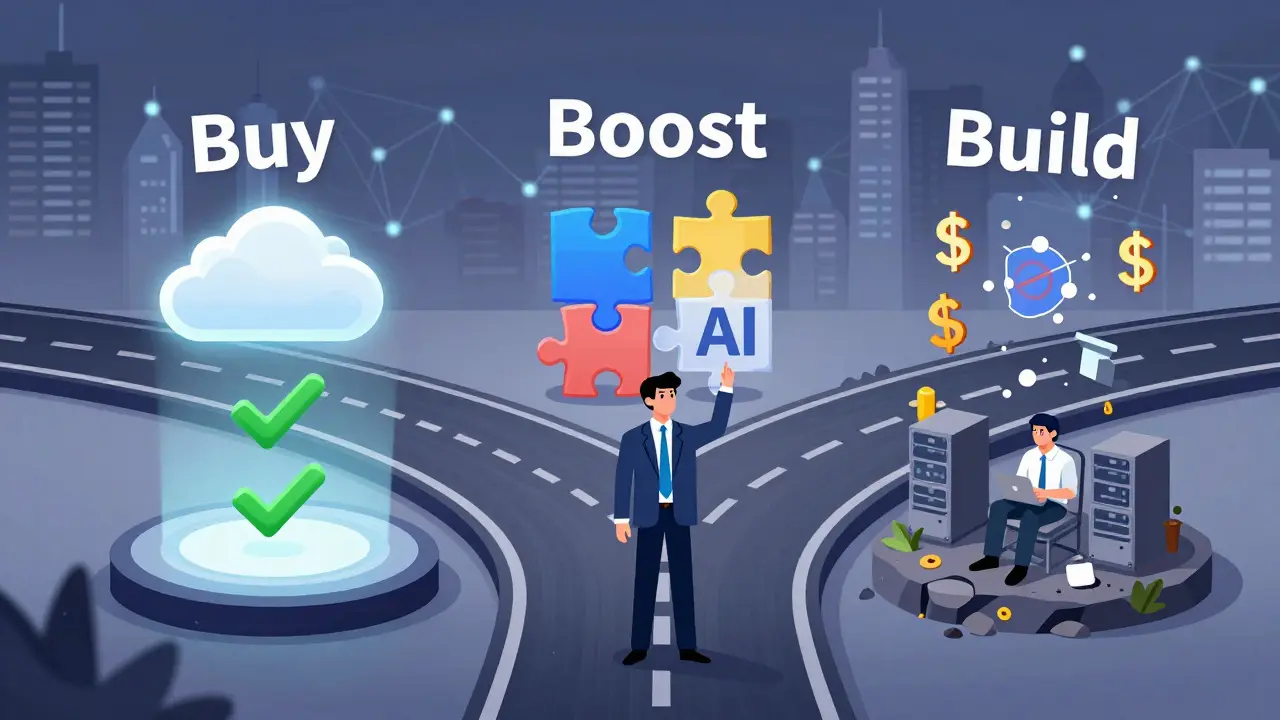
When your company is considering generative AI, the biggest question isn’t whether to use it - it’s whether to build or buy. Too many CIOs jump into this decision thinking it’s about technology. It’s not. It’s about business outcomes, risk, and where you can actually gain an edge. The truth? Most organizations don’t need to build their own AI models. But some absolutely do. Getting this wrong can cost millions and delay real value by years.
Why the Build vs Buy Decision Matters More Than Ever
In 2025, you can’t ignore generative AI. But you also can’t afford to treat it like a generic tool you plug in everywhere. The market has shifted. Back in 2023, companies were rushing to train their own models. Now, 83% of enterprises use hybrid approaches - buying platforms and layering in custom tweaks. Why? Because building from scratch is expensive, slow, and risky.Training a 70-billion-parameter model like GPT-4 or Gemini costs $20-30 million in hardware alone, according to NVIDIA’s 2024 infrastructure report. That’s not counting the team of 15-20 specialized roles - ML engineers, data scientists, MLOps specialists - who earn $2.5-3.5 million per year in salaries. And even then, 68% of organizations exceed their initial budget by 40% or more, according to EY’s 2024 implementation survey.
Meanwhile, buying a platform like Microsoft Azure OpenAI or Anthropic’s Claude Enterprise lets you go live in 2-8 weeks. The cost? Pay-as-you-go pricing: $0.0001 per 1,000 input tokens, $0.0003 per 1,000 output tokens. No upfront capex. No hiring frenzy. No six-month wait for your first working prototype.
The Three Paths: Buy, Boost, Build
MIT Sloan’s research broke this down into three clear strategies - not just buy or build, but buy, boost, build. Each fits different business needs.- Buy: Use a commercial platform as-is. Best for standardized tasks like drafting emails, summarizing reports, or basic customer service chatbots. Companies like GitHub Copilot saw 85-90% adoption because outputs are constrained and errors are easy to catch.
- Boost: Take a commercial model and fine-tune it with your proprietary data. This is where most smart companies play. You get speed and reliability, plus enough customization to handle domain-specific language - like legal contracts or medical records. Writer.com’s case studies show this cuts implementation time to 30-45% of a full build.
- Build: Train your own model from the ground up. Only justified when the cost of failure is astronomical - think diagnosing rare diseases, assessing financial fraud, or managing critical infrastructure. Forrester found custom-built AI delivers 27% higher competitive advantage in these high-stakes scenarios.
Here’s the catch: 95% of GenAI pilots fail - not because the models are bad, but because the strategy is mismatched, according to EY. A hospital that buys a generic documentation tool? Great. A bank that tries to use that same tool to detect insider trading? Disaster.
When to Buy: Speed, Compliance, and Low-Risk Use Cases
If your goal is to save time, reduce risk, or automate routine tasks - buy. The data is clear. IDC reports organizations using purchased GenAI tools achieve 3.2x faster time-to-value than those building in-house. And compliance? Non-negotiable in finance and healthcare.Commercial platforms come with SOC 2 Type II, GDPR, HIPAA, and other certifications built in. Deloitte found it takes 12-18 months to get equivalent compliance for a custom model. In regulated industries like banking, 72% of organizations choose commercial platforms specifically because they can’t afford to wait or risk a violation.
Use cases that scream “buy”:
- Automated customer service responses
- Internal document summarization
- Marketing copy generation
- Code assistance (GitHub Copilot, Amazon CodeWhisperer)
- Basic HR screening and onboarding workflows
These tasks have low consequences for errors. A slightly awkward email? Edit it. A poorly worded product description? Rewrite it. The ROI is immediate. G2 Crowd data shows commercial GenAI platforms average 4.3/5 stars across 1,200+ reviews. The top complaints? Unexpected usage costs and limited customization - not the platform itself.

When to Build: High-Stakes, Proprietary, and Unique Workflows
Building your own model isn’t about being cool. It’s about survival. If your business depends on unique data patterns that no vendor can access - and mistakes cost over $500,000 per incident - then you need a custom solution.Deloitte’s 2024 risk framework says error costs above $500,000 per incident justify custom AI. That’s the threshold. Examples:
- Real-time fraud detection in high-value transactions
- Diagnostic support for rare genetic conditions
- Supply chain optimization based on proprietary logistics data
- Regulatory compliance monitoring in complex financial products
Amazon built its own AI for supply chain forecasting. It saved $2.1 billion annually, according to their 2023 shareholder report. That’s the kind of return that justifies the cost. But here’s the reality: only 1 in 4 enterprises need this level of control. For the rest, it’s a money pit.
Custom builds require constant upkeep. Model drift? 78% of implementations suffer from it, according to IEEE’s 2024 AI reliability study. Talent retention? 63% lose key AI staff within 18 months, per EY. And maintenance? Average annual cost: $1.8 million. You’re not just building a model - you’re building a team, a data pipeline, a monitoring system, and a support structure.
Boost: The Sweet Spot for Most Companies
The real winner isn’t buy or build - it’s boost. Take a commercial model. Fine-tune it with your internal data. Keep the reliability. Add your expertise.Microsoft’s Azure OpenAI Studio, released in November 2024, lets you upload your documents, training examples, and internal knowledge bases to customize GPT-4 without touching the base model. Anthropic’s December 2024 “Claude Enterprise Custom” lets you run a dedicated instance with your proprietary training data - at a 35% premium over standard pricing.
Why this works:
- You avoid the $20M hardware bill
- You don’t need a 20-person AI team
- You get enterprise-grade security and compliance
- You retain control over how the model responds to your data
Writer.com’s case studies show companies using boosted models cut implementation time by 55% compared to full builds. Operational costs go up - because fine-tuning uses more tokens - but the trade-off is worth it. You get 80-90% of the benefit of a custom model with 30% of the effort.
Hidden Costs No One Talks About
People focus on upfront price tags. But the real cost killers are hidden.For bought platforms:
- Usage-based pricing can spiral. A single department using AI for 10,000 document summaries/month? That’s $1,000+ in token costs - and no one’s budgeted for it.
- Integration headaches. 67% of CIOs say connecting GenAI to legacy systems is harder than expected (CIO.com, August 2024).
- Vendor lock-in. 58% of CIOs worry about being trapped if the vendor changes pricing or drops features.
For built platforms:
- Model drift. Your AI starts giving weird answers because your data changed. You didn’t train it on that.
- Documentation gaps. Custom AI teams rarely write good docs. 89% of negative GitHub reviews cite “unmaintainable code.”
- Talent burnout. AI engineers are in short supply. Once you hire them, they leave for better opportunities - and you lose institutional knowledge.
The biggest hidden cost? Time. Building takes 6-12 months. Buying takes 2-8 weeks. In a fast-moving market, waiting 9 months means you’re already behind.
Real Stories: What Actually Worked
A Fortune 500 bank spent $4.2 million and 9 months building a custom customer service AI. Then they tested it against Anthropic’s Claude Enterprise. The commercial tool handled 85% of their cases - with better accuracy. They switched. Saved $3.5 million. Reduced response time by 60%.A healthcare provider bought a commercial documentation assistant for physicians. It cut note-taking time by 45%. Then they built a custom diagnostic model for rare pediatric conditions - where a misdiagnosis could cost over $1 million in lawsuits and lost trust. That custom model? It’s now their most valuable asset.
On Reddit, a data scientist wrote: “We bought Claude for HR onboarding. It worked great. We tried to use it for legal contract review. It hallucinated clauses. We had to build a custom version. Lesson: don’t force one tool everywhere.”
Your Decision Framework: 5 Questions for CIOs
Don’t guess. Ask these five questions before spending a dollar.- What’s the cost of a mistake? If it’s under $50,000 - buy. If it’s over $500,000 - consider building.
- Do you have unique data no one else has? If yes, and it’s critical to your business - boost or build. If no - buy.
- How fast do you need results? Need it in 30 days? Buy. Can you wait 9 months? Only if you’re in a high-stakes domain.
- Do you have the talent to maintain it? Can you hire and retain 15+ AI specialists? If not, don’t build.
- Is compliance built-in? If you’re in finance, healthcare, or government - commercial platforms have certifications you can’t replicate in-house without years of work.
Most CIOs pick one approach and apply it everywhere. That’s why 9 out of 10 fail, according to Gartner. The winning play? Mix them. Buy for routine tasks. Boost for domain-specific workflows. Build only where your business lives or dies on the outcome.
What’s Next: The Hybrid Future
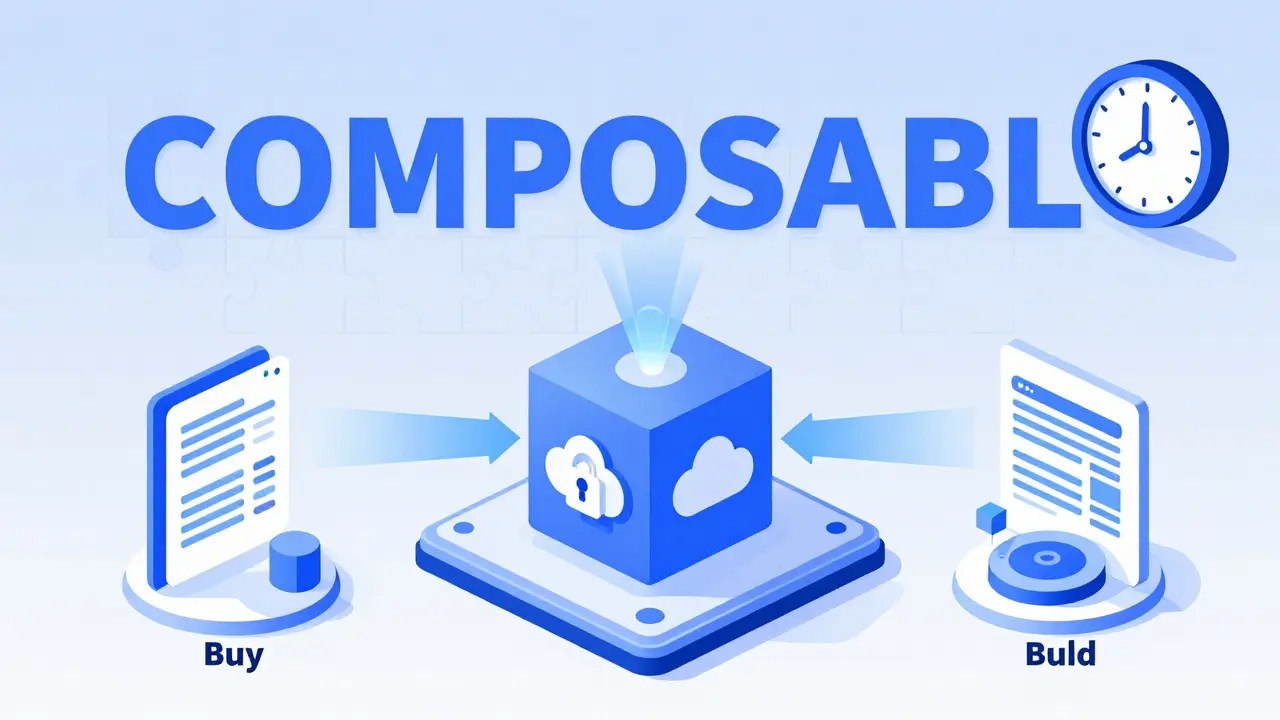
The future isn’t buy or build. It’s composable AI. Buy the foundation. Build the differentiator. MIT CISR found 89% of successful GenAI implementations follow this pattern.Cloud providers are making it easier. Microsoft, Google, and AWS now offer fine-tuning, private instances, and secure data pipelines - all within their commercial platforms. You’re not choosing between vendor lock-in and chaos. You’re choosing between control and convenience.
By 2027, Gartner predicts 60% of current GenAI vendors will disappear. But the platforms that survive will be the ones offering flexible, hybrid-ready architectures. The companies that win will be the ones who treat AI not as a product, but as a strategic lever - applied precisely where it matters.
Don’t build because you can. Don’t buy because it’s easy. Build because you must. Buy because it makes sense. And always - always - boost in between.
- Nov, 14 2025
- Collin Pace
- 8
- Permalink
- Tags:
- build vs buy generative AI
- CIO AI strategy
- generative AI platforms
- enterprise AI decision
- AI buy or build
Written by Collin Pace
View all posts by: Collin Pace