Chain-of-Thought Prompting in Generative AI: Master Step-by-Step Reasoning for Complex Tasks
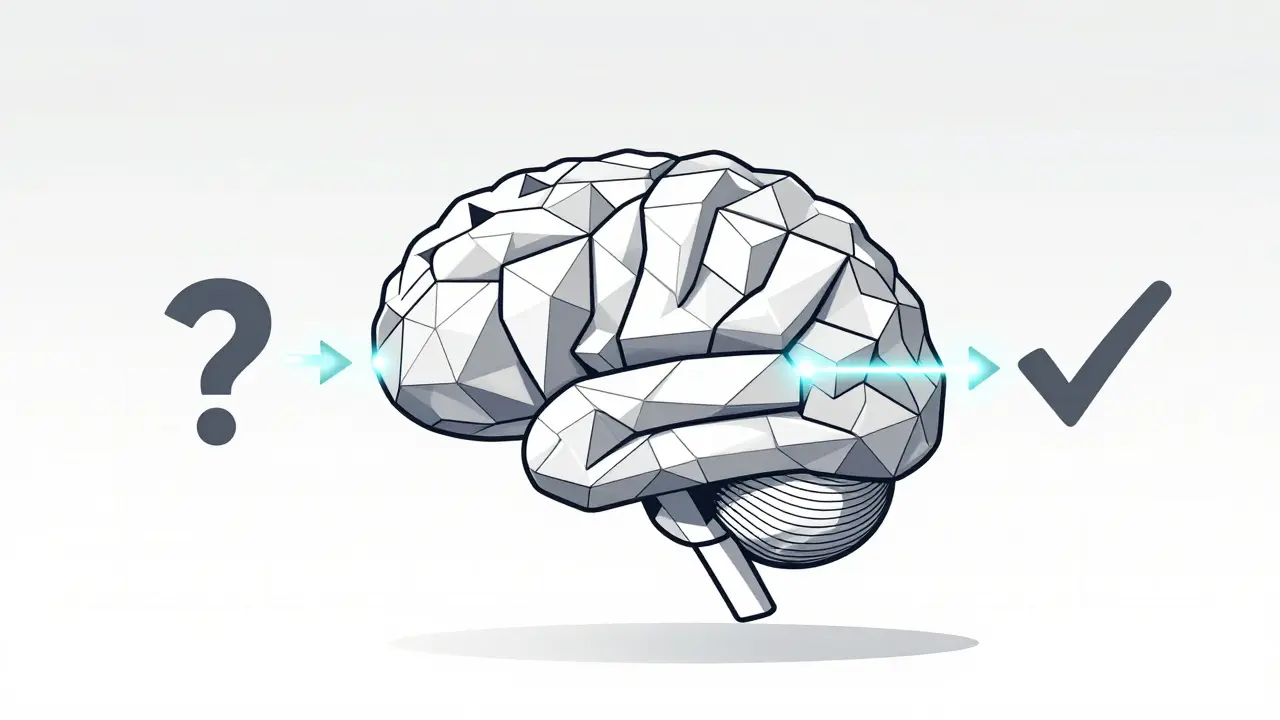
Ever asked an AI a complex question-like calculating taxes for a freelance gig with deductions, or figuring out if a medical symptom matches a rare condition-and got a confident but totally wrong answer? That’s not the AI being lazy. It’s not thinking at all. It’s guessing. And that’s where chain-of-thought prompting changes everything.
What Chain-of-Thought Prompting Actually Does
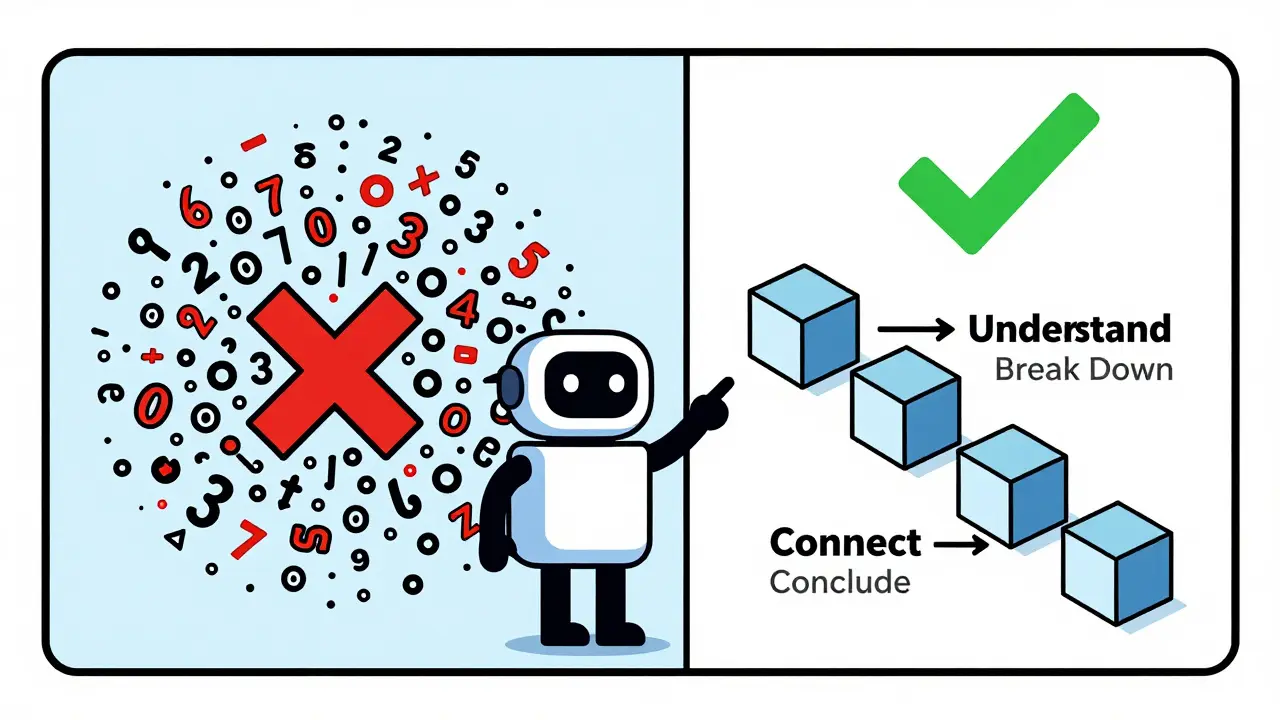
Chain-of-thought prompting (CoT) is a simple idea with huge impact: make the AI show its work. Instead of jumping straight to an answer, you ask it to break down the problem into steps. Think of it like asking a student to write out their math solution, not just circle the final number. This wasn’t always how AI worked. Early models would spit out answers based on patterns they’d seen before-often mixing up facts, skipping steps, or making up logic that sounded right but wasn’t. In 2022, researchers at Google proved that adding a few words like “Let’s think step by step” to a prompt could boost accuracy on math problems by over 50%. Suddenly, models could solve multi-step arithmetic, logic puzzles, and even medical diagnostics better than before. The secret? It tricks the model into using its own internal reasoning path. LLMs don’t understand like humans do. But they’re great at predicting the next word. CoT prompting gives them a structure: interpret the problem → break it into parts → connect the dots → conclude. That structure turns randomness into reliability.How It Works: The Four-Step Process
When you use chain-of-thought prompting, the AI follows a clear internal flow:- Problem Understanding - The model reads your question and identifies what’s being asked. Is this a math problem? A logic puzzle? A medical differential diagnosis?
- Intermediate Reasoning - This is the core. The AI generates a sequence of logical steps. For a math problem, it might write: “First, calculate the base income. Then subtract allowable deductions. Then apply the tax rate.”
- Final Answer - Only after the steps are laid out does it give the conclusion. No guessing. No shortcuts.
- Feedback Loop (Optional) - Advanced users add checks: “Is step 2 consistent with step 1?” or “Does this match known data?” This catches errors before they’re delivered.
Zero-Shot vs. Few-Shot vs. Auto-CoT
Not all chain-of-thought prompting is the same. There are three main types:- Zero-shot CoT - You add a simple phrase like “Let’s think step by step” and let the model figure out the rest. Works well for straightforward problems. Easy to use. No examples needed.
- Few-shot CoT - You give the model 2-5 examples of problems solved step by step. This is powerful for complex or domain-specific tasks, like legal contract analysis or financial forecasting. The model learns the pattern from your examples.
- Auto-CoT - Introduced in 2023, this version automatically generates its own examples. Instead of you providing steps, the AI creates a few reasoning paths on its own, picks the best one, and uses it to answer your question. Reduces your workload by 70% while keeping 90% of the accuracy of manual few-shot prompting.
Where It Shines (and Where It Falls Short)
Chain-of-thought prompting isn’t magic. It’s a tool with clear strengths and limits. Where it works best:- Math problems - On the GSM8K benchmark (grade-school math word problems), CoT improves accuracy from 41% to 78%.
- Logical reasoning - Tasks like “If all birds can fly and penguins are birds, can penguins fly?” show 30%+ improvement when the AI walks through the logic step by step.
- Medical and legal analysis - When asked to interpret symptoms or contract clauses, CoT reduces hallucinations by up to 41%, according to Anthropic’s internal testing.
- Factual recall - “Who won the 2023 Nobel Prize in Physics?” No need for steps. CoT adds nothing.
- Simple yes/no questions - “Is water wet?” The model overthinks it.
- Small models - Models under 10 billion parameters show almost no improvement. CoT needs brainpower to use it.
The Hidden Costs: Tokens, Time, and Hallucinations
Chain-of-thought prompting isn’t free. Every step the AI writes adds tokens. And tokens cost money.- Token usage - CoT prompts use 35-60% more tokens than standard prompts. On a $0.01 per 1K token API, that’s a 42% cost increase per query.
- Response time - Generating steps adds 220-350ms per answer. For real-time apps, that’s noticeable.
- Reasoning hallucinations - Here’s the scary part: the AI can make up steps that sound perfect but lead to wrong answers. A 2024 University of Washington study found 18.7% of CoT responses contained logical errors-even when the final answer was right.
Real-World Use Cases
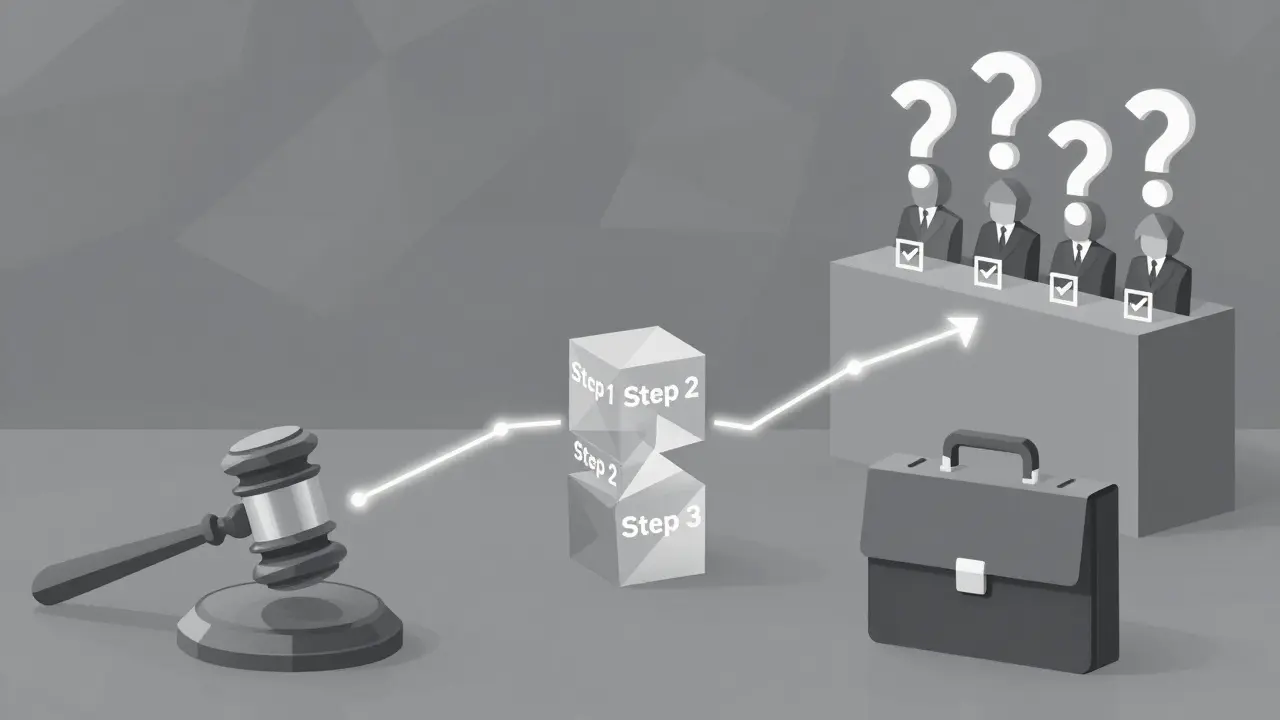
Here’s how companies are using CoT right now:- Financial services - Banks use it to explain loan denials. Instead of “Your credit score is low,” the AI says: “Your debt-to-income ratio is 48%. The bank’s limit is 40%. Your recent late payment adds risk. Here’s how to improve.”
- Healthcare - AI assistants in clinics list possible diagnoses in order of likelihood, with symptoms matched to each. Reduces diagnostic errors by 27% in pilot studies.
- Legal tech - Contract review tools highlight risky clauses and explain why: “This clause overrides state law. Under California Civil Code § 1670.5, this is unenforceable.”
- Education - Tutoring bots now show math solutions step by step-just like a teacher would.
How to Implement It Right
Want to start using chain-of-thought prompting? Here’s how:- Start simple - Add “Let’s think step by step” to any complex query. Test it on math, logic, or decision-making tasks.
- Limit steps - Too many steps = confusion. Stick to 3-7. More than that, and the AI starts drifting.
- Use examples - For high-stakes tasks, give 2-3 examples of good reasoning. Show the format you want.
- Add verification - End with: “Is this consistent with [known fact]?” or “Are there any contradictions in these steps?”
- Monitor cost - Track token usage. If costs jump 40% and accuracy only improves 10%, you’re wasting money.
The Bigger Picture: Trust, Transparency, and Ethics
Chain-of-thought prompting isn’t just about accuracy. It’s about trust. When an AI shows its work, you can see where it went wrong. You can question its assumptions. You’re not just getting an answer-you’re getting a reasoning trail. That’s huge for accountability. But there’s a dark side. A 2024 paper by Emily Bender warned that CoT creates an “illusion of reasoning.” The AI isn’t thinking. It’s mimicking. And that’s dangerous when people trust it too much. That’s why the EU is now requiring audit trails for high-risk AI systems. If an AI denies you a loan using CoT, you have the right to see every step it took. The future? New variants are already here. Tree-of-Thought lets the AI explore multiple reasoning paths at once. Graph-of-Thought connects ideas like a web, not a line. Self-Refine CoT lets the AI edit its own steps for better accuracy. But the core idea stays the same: make the AI show its work. Because when you can see how it got there, you can decide whether to believe it.What is chain-of-thought prompting in AI?
Chain-of-thought prompting is a technique where you ask an AI to explain its reasoning step by step before giving a final answer. Instead of jumping to a conclusion, the model breaks down complex problems into logical parts-like showing your work in math class. This improves accuracy on multi-step tasks like math, logic, and decision-making.
Does chain-of-thought prompting work with all AI models?
No. It works best with large models-typically those with 50 billion parameters or more. Smaller models (under 10 billion) show little to no improvement. Models like Claude 3, GPT-4 Turbo, and Llama 3 70B support it well, but performance varies. Anthropic’s Claude handles it more naturally than Meta’s Llama without extra tuning.
How much more does chain-of-thought prompting cost?
It increases token usage by 35-60%, which directly raises API costs. For example, if a standard query costs $0.02, a CoT version might cost $0.03 to $0.035. On high-volume applications, that adds up fast. Many companies use it only for critical tasks-like medical or financial advice-where accuracy justifies the cost.
Can chain-of-thought prompting make AI more reliable?
Yes, but not perfectly. Studies show it reduces errors by 27-41% on complex tasks. However, it can also create “reasoning hallucinations”-plausible but false steps that lead to wrong answers. To fix this, add verification steps like “Does this match known data?” or use tools like Anthropic’s Verifiable CoT that cross-check reasoning against trusted sources.
What’s the difference between chain-of-thought and prompt chaining?
Chain-of-thought is one prompt, one response with multiple reasoning steps. Prompt chaining is multiple back-and-forth exchanges between user and AI. CoT is faster and cheaper-it keeps everything in one go. Prompt chaining can be more flexible but adds latency and complexity. For most tasks, CoT is the better choice.
Should I use zero-shot or few-shot CoT?
Start with zero-shot-just add “Let’s think step by step.” It works for 70% of tasks. If accuracy is below 80%, switch to few-shot: give the AI 2-5 examples of how to break down similar problems. Few-shot works best for domain-specific tasks like legal or medical analysis. Auto-CoT can automate this for you if you’re doing it at scale.
- Jan, 29 2026
- Collin Pace
- 7
- Permalink
Written by Collin Pace
View all posts by: Collin Pace