Choosing Model Families for Scalable LLM Programs: A Practical Guide
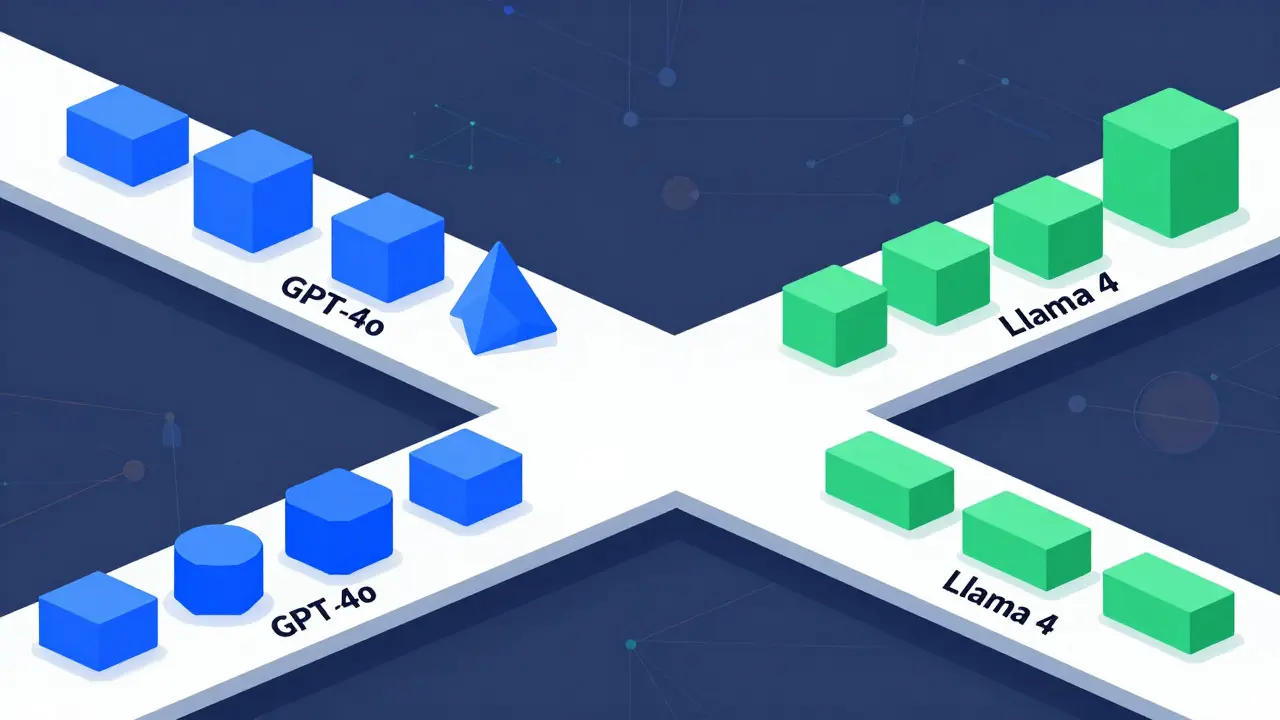
You have a choice that will define your company’s technical debt for the next three years. Do you lock into GPT-4o’s polished API, or do you bet on Llama 4’s open-source flexibility? As of mid-2026, this isn’t just a technical decision; it is a strategic one that impacts your budget, your privacy compliance, and your ability to scale without hitting a vendor wall.
The landscape has shifted dramatically. In early 2025, picking an LLM felt like choosing between two similar cars. Today, with dozens of major players and hundreds of niche models, the gap between proprietary and open-source options has narrowed to a mere 8-12% on key benchmarks like the Epoch AI Capabilities Index (ECI). This convergence means you can no longer default to the biggest name in the room. You need a framework to match specific model families to your actual business jobs-to-be-done.
The Big Five Model Families Dominating 2026
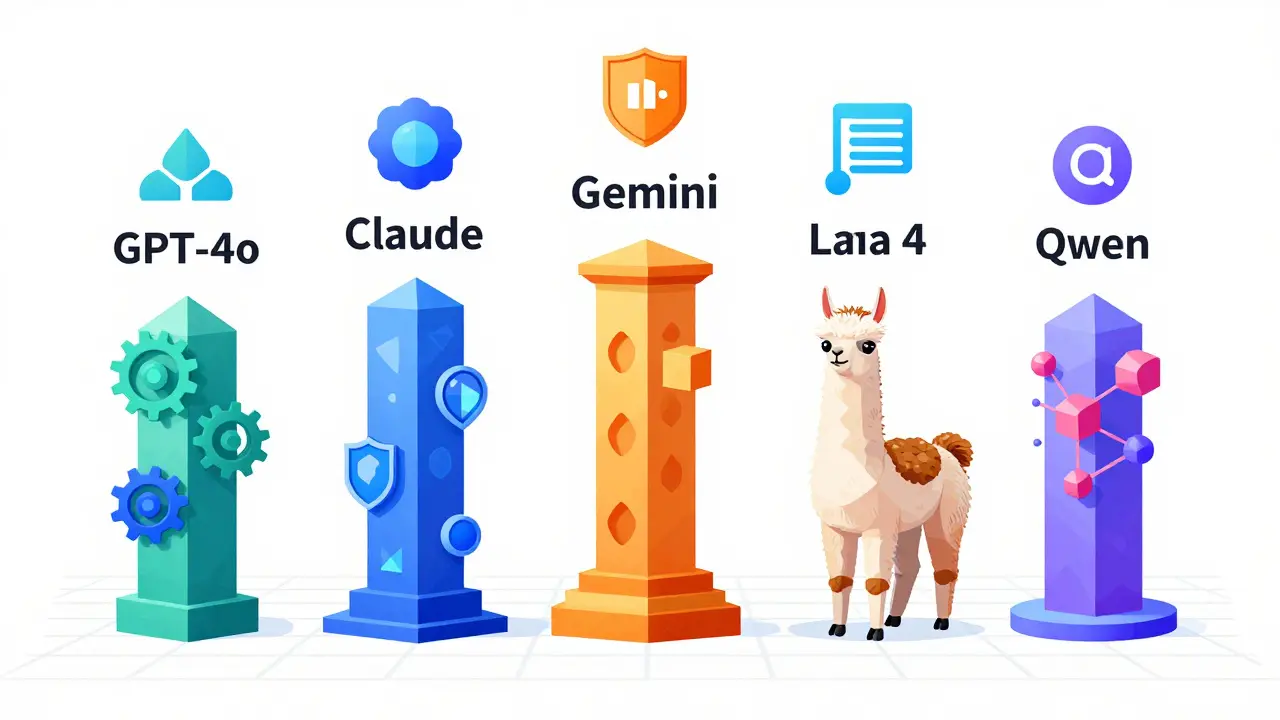
While there are technically over 188 distinct LLMs tracked by benchmark datasets, enterprise deployments heavily consolidate around five primary families. Each has a distinct personality, pricing structure, and ideal use case.
| Model Family | Key Strength | Context Window | Best For | Cost Profile |
|---|---|---|---|---|
| GPT-4o | Deep reasoning, complex planning | Standard (undisclosed) | Critical logic tasks, customer-facing apps | High per-token cost |
| Claude (Sonnet/Haiku) | Safety posture, clean documentation | Tiered variants | Writing-heavy workflows, regulated industries | Complex multi-rate pricing |
| Gemini (Flash/Pro) | Multimodal integration, Google ecosystem | Up to 1 million tokens | Video/image analysis, caching-heavy loads | Competitive with caching benefits |
| Llama 4 | Open-source flexibility, MoE architecture | Up to 10 million (Scout) | Self-hosted solutions, heavy customization | Low API cost, high infra cost |
| Qwen | Multilingual, coding, math | Up to 1 million tokens | Specialized technical tasks, global reach | Variable, often low for open tiers |
GPT-4o remains the gold standard for "hard" reasoning tasks where you cannot afford errors. However, its operational costs are steep. If you are running millions of queries, every token adds up quickly. Claude, particularly the Sonnet variant, offers a compelling middle ground with a strong safety posture and cleaner documentation, though its pricing structure requires careful monitoring due to multiple rate dimensions.
On the other side of the spectrum, Llama 4 has become the king of open-source adoption. With variants ranging from the lightweight Scout to the massive Behemoth (2 trillion parameters), Meta provides unprecedented control. The trade-off? You need Kubernetes expertise and GPU provisioning knowledge that many mid-sized teams lack. Meanwhile, Gemini shines if you are already deep in the Google Cloud ecosystem, especially because its caching mechanisms can drastically reduce costs at scale.
Scaling Laws: Why Context Windows Matter More Than Parameters
In 2023, we obsessed over parameter counts. In 2026, context windows are the new battleground. The ability to ingest entire codebases, legal contracts, or long-form video transcripts in a single pass changes how you architect your applications.
Consider the difference between Llama 4 Scout with its 10 million token context window and standard models capped at 128k. If your application involves analyzing longitudinal patient records or auditing large-scale financial transactions, smaller context windows force you to build complex chunking and retrieval systems. These systems introduce latency and potential data loss. A model like Grok 4.1 (2 million tokens) or Llama 4 Maverick (1 million tokens) allows you to simplify your architecture significantly.
However, larger context windows are not free. They increase memory pressure and inference time. For most general-purpose tasks, a 128k window (supported by Phi-4, Magistral Small, and Gemma 3) is more than sufficient. Only when your job explicitly requires holistic understanding of massive datasets should you prioritize these ultra-long-context models.
The Open Source vs. Proprietary Cost Equation
There is a myth that open-source models are always cheaper. This is only true if you already have the infrastructure. If you are paying for cloud GPUs to run Llama 4 or Gemma 3, your break-even point against using GPT-4o or Claude APIs depends entirely on your volume.
Here is a rough rule of thumb based on Q4 2025 enterprise data:
- Low Volume (< 1M tokens/month): Stick with proprietary APIs. The engineering overhead of managing open models outweighs the savings.
- Medium Volume (1M - 10M tokens/month): Evaluate hybrid approaches. Use proprietary models for critical reasoning steps and open models for summarization or classification.
- High Volume (> 10M tokens/month): Self-hosting open models like Llama 4 or fine-tuned Qwen variants typically becomes the most cost-effective path, provided you have dedicated MLOps support.
Additionally, consider vendor lock-in. Relying solely on GPT-4o means your business is hostage to OpenAI’s pricing changes and availability. By building a pipeline that supports Llama 4 or Phi-4 as fallbacks, you gain negotiating power and resilience.
Matching Models to Specific Jobs
Don't deploy a sledgehammer to crack a nut. One of the biggest mistakes teams make in 2026 is routing all traffic through their most powerful model. Instead, implement a tiered strategy.
For coding assistance, specialized models outperform generalists. Qwen3-Omni and Phi-4-mini-flash show exceptional performance on coding benchmarks relative to their size. If your app is a developer tool, these models offer faster inference and lower costs without sacrificing accuracy.
For creative writing or customer support where safety is paramount, Claude remains the top choice due to its robust safety filters and consistent tone. Conversely, if you need multimodal capabilities-processing images, audio, and text simultaneously-Gemini 2.5 Pro is currently leading the pack, capturing 27% of the enterprise multimodal market share.
Use this simple decision tree:
- Is data privacy non-negotiable? Yes → Choose open-source (Llama 4, Gemma 3) for self-hosting.
- Do you need complex reasoning or planning? Yes → Choose GPT-4o or DeepSeek reasoning models.
- Is speed/cost the primary constraint? Yes → Choose smaller efficient models like Phi-3 Mini or Haiku.
- Are you processing media (video/audio)? Yes → Choose Gemini or Qwen3-Omni.
Infrastructure Realities: What It Takes to Scale
Choosing a model family dictates your infrastructure needs. Integrating a proprietary API like GPT-4o can be done in 3-5 business days. Deploying Llama 4 at scale typically takes 2-3 weeks of initial setup, including fine-tuning and monitoring configuration.
If you opt for open-source, ensure your team has experience with container orchestration. Reddit discussions from January 2026 highlight that many mid-sized enterprises struggle with "context overflow errors" when deploying models like Qwen without proper resource management. Documentation quality also varies wildly; Anthropic’s docs are consistently praised for clarity, while some users report incomplete API documentation for Mistral’s Magistral enterprise features.
Plan for monitoring. As you scale, latency spikes and cost anomalies will occur. Implement observability tools that track token usage, response times, and error rates per model family. This data will help you refine your routing strategy over time.
Future-Proofing Your AI Program
The market is consolidating. By Q4 2026, analysts predict the top three open models will match current proprietary performance on 80% of enterprise tasks. This means open-source is no longer a compromise; it is a viable primary option for many workloads.
To future-proof your program, avoid hardcoding dependencies on a single provider. Build abstraction layers in your codebase that allow you to swap out GPT-4o for Llama 4 or Claude with minimal refactoring. This flexibility will save you significant engineering effort as the landscape continues to evolve.
Finally, keep an eye on emerging players. While the big five dominate today, specialized models in niches like healthcare or finance may rise to prominence. Stay agile, monitor benchmark indices like the ECI, and be ready to pivot as new capabilities emerge.
Which LLM family is best for cost-sensitive startups in 2026?
Startups should prioritize open-source models like Llama 4 or Gemma 3. Data shows 82% of Series A-funded startups leverage open models for cost control. These models eliminate per-token API fees, though they require upfront infrastructure investment.
Is GPT-4o still worth the premium price?
Yes, for specific high-stakes tasks. GPT-4o excels in deep reasoning and complex planning where errors are costly. For general tasks like summarization or basic Q&A, cheaper alternatives like Claude Haiku or Phi-4 provide sufficient performance at a fraction of the cost.
How do I handle data privacy with LLMs?
If data privacy is critical, avoid sending sensitive information to proprietary APIs. Instead, self-host open-source models like Llama 4 or Qwen on your own infrastructure. This ensures data never leaves your controlled environment.
What is the significance of context window size?
Larger context windows (e.g., 1 million+ tokens in Llama 4 Maverick) allow models to process entire documents or codebases in one go, reducing the need for complex retrieval systems. This simplifies architecture but increases computational load.
When should I choose Gemini over other models?
Choose Gemini if you are heavily integrated with Google Cloud or need strong multimodal capabilities (processing text, image, audio, video together). Its caching features also offer significant cost advantages for repetitive queries.
- May, 16 2026
- Collin Pace
- 0
- Permalink
- Tags:
- LLM model families
- scalable AI programs
- Llama 4 vs GPT-4o
- open source LLMs
- enterprise AI strategy
Written by Collin Pace
View all posts by: Collin Pace