Clean Architecture in Vibe-Coded Projects: How to Keep Frameworks at the Edges
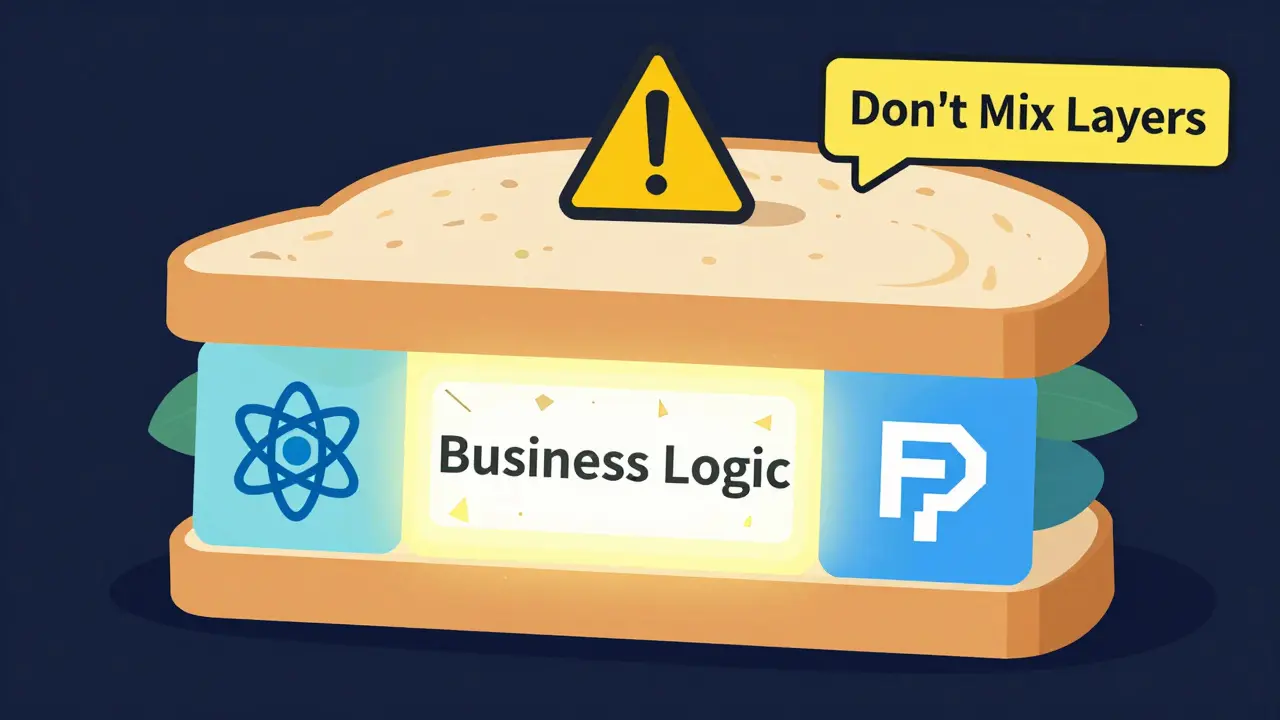
When you let an AI assistant write your code, it’s easy to forget you’re building a house-not just a single room. You ask for a login screen, and it gives you one-with React hooks buried in your user validation logic. You ask for a data fetcher, and suddenly your core business rules are calling a database directly. This isn’t laziness. It’s what AI does by default. And if you don’t stop it, your project will collapse under its own weight in six months. That’s not speculation. It’s what 63% of early vibe-coded projects experienced, according to Metronome’s December 2024 analysis.
Why Clean Architecture Matters More Than Ever
Clean Architecture isn’t about being fancy. It’s about survival. Robert C. Martin laid out the idea over a decade ago: keep your business logic pure, and shove all the framework junk-React, Node, Firebase, PostgreSQL-to the outer edges. Think of it like a sandwich. The meat and cheese (your business rules) stay in the middle. The bread (the UI) and the pickles (the database) go on the outside. You can swap out the bread without touching the filling. In traditional coding, you might spend weeks setting up layers. In vibe coding, you’re typing prompts like, "Make a form that saves to the cloud." The AI doesn’t know you want to keep it clean. It just knows you want it working. And that’s dangerous. A developer on Reddit, "ArchDev42," had 73% of their core logic tied to React. Switching to Svelte was going to take 320 hours. After adding architectural guardrails, they got it down to 47. That’s not a productivity win. That’s a career saver.The Three Layers You Can’t Skip
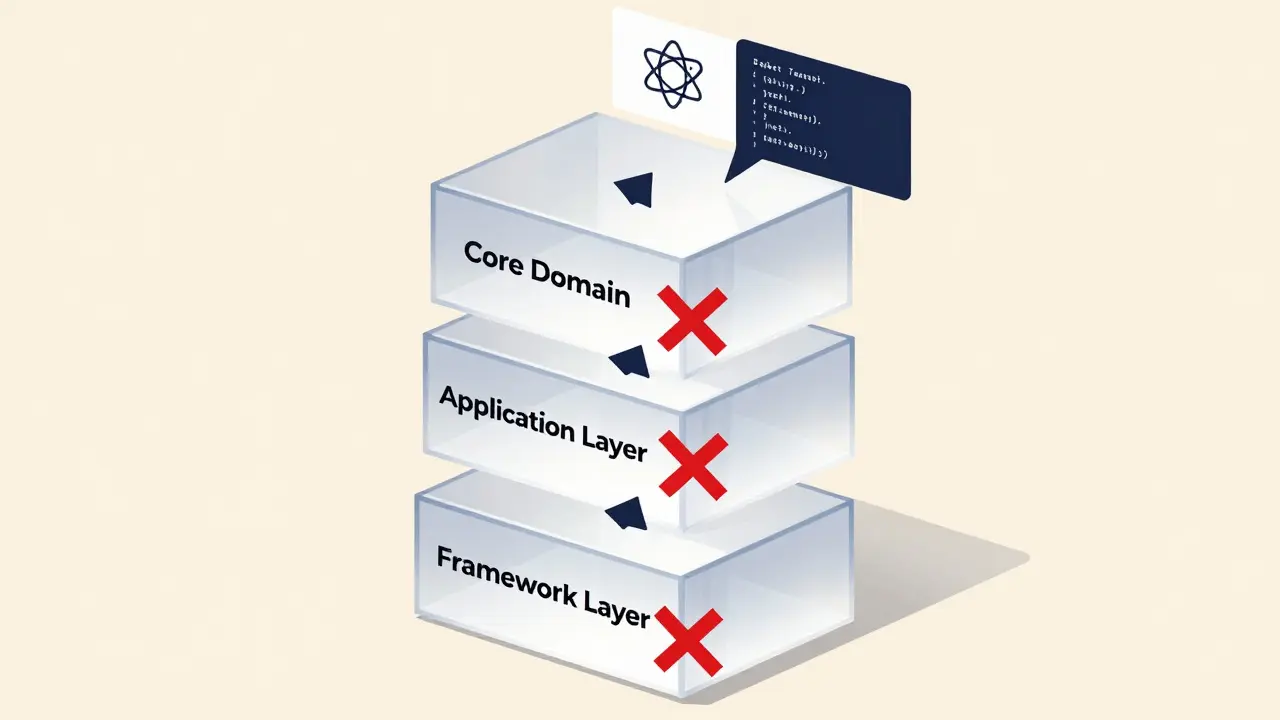
Forget MVC. Forget "just get it done." In vibe coding, you need three clear layers:- Core Domain Layer - This is where your business logic lives. No imports from React. No database calls. No HTTP clients. Just pure functions that say, "If the user has credits, allow the purchase." If you can’t run this code without a web server, you’re doing it wrong.
- Application Layer - This is the translator. It takes requests from the outside world (a button click, an API call) and tells the core layer what to do. It defines interfaces: "I need a way to validate a user." But it doesn’t say how. That’s the job of the next layer.
- Framework Layer - This is where the magic happens. React components. API endpoints. Database drivers. Authentication middleware. Everything that ties your app to the outside world lives here. And it should never, ever reach into the core.
How to Stop AI From Ruining Your Architecture
AI assistants don’t think in layers. They think in examples. If you say, "Create a login system," it’ll give you a file with React, useState, and Firebase auth all tangled together. That’s not a bug. That’s how it works. To fix this, you need to change your prompts:- Instead of: "Make a user login page."
- Say: "Generate a function that validates a user’s email and password. Return true or false. Do not use any framework-specific libraries. Assume the UI will call this function later."
- Domain layer cannot import anything from the framework layer.
- Application layer can only depend on domain layer and interface contracts.
- Framework layer must only depend on application layer.
Architectural Guardrails: The Silent Enforcer
You can’t rely on discipline alone. You need tools. Sheriff, an open-source module boundary enforcer, scans every line of code your AI generates and flags violations in real time. If your AI tries to import a React component into a domain model, Sheriff stops you. It doesn’t ask. It doesn’t wait. It just says: "No." Teams using Sheriff reduced framework leakage by 89%. That’s not a nice-to-have. That’s the difference between a project that lasts and one that gets scrapped. GitHub added architectural guardrails to Copilot Workspaces in December 2024. Cursor now lets you load your boundary rules before coding starts. These aren’t gimmicks. They’re becoming standard. The best teams don’t just use these tools-they share their rules with the AI. Before each session, they paste their boundary definitions into the prompt: > "Here are our architectural rules: Domain layer cannot import framework code. All external dependencies must go through the application layer. Enforce this in all generated code." It sounds tedious. It’s not. It takes 15 seconds. And it prevents weeks of rework.The Real Cost of Skipping Architecture
Some say: "Why bother? I’m building an MVP." But here’s what happens when you skip it:- You can’t switch from Firebase to PostgreSQL without rewriting half your app.
- You can’t test your business logic without spinning up a full UI.
- You can’t onboard a new dev because no one remembers where the logic actually lives.
- You can’t fix a bug because the same function is copied across three files.

What Happens When You Do It Right
Metronome’s design team did something wild. They built 47 UI components in 11 hours using vibe coding-while keeping every single one decoupled from the core logic. Their secret? They planned the architecture first. They defined interfaces. They used Sheriff. They didn’t let AI write the first line until the boundaries were locked in. Compare that to the "just get it working" approach: 38 hours for the same output, with no path to scaling. This isn’t about being perfect. It’s about being predictable.Start Small. But Start Now.
You don’t need to overhaul your whole project. Start with one feature. Define the core logic. Write the interface. Then let the AI fill in the framework part. Use Sheriff. Set your rules. Watch what it catches. Most developers need 15-20 hours of practice to get good at this. That’s not a lot. It’s less than a single weekend. But it’s the difference between building something that lasts-and building something that breaks when you blink. The future of coding isn’t AI writing everything. It’s AI writing the boring parts-while you focus on the structure. Because if you don’t control the architecture, the AI will. And it won’t care when it collapses.Key Takeaways
- Framework code belongs at the edges-never in your business logic.
- Use Sheriff or similar tools to auto-enforce boundaries-don’t rely on memory.
- Prompt your AI with architecture in mind: "Generate framework-agnostic logic."
- Start with 3 simple rules: no framework imports in domain, no direct database calls in core, interfaces over implementations.
- Invest 15-20% of your time upfront. You’ll save 3x that later.
Can vibe coding work without Clean Architecture?
Yes-but only for throwaway projects. If you plan to keep, scale, or maintain the code, skipping Clean Architecture is like building a house without a foundation. AI tools generate code fast, but they don’t prevent architectural debt. Teams that skip structure see 63% more failures within six months. The speed of vibe coding amplifies bad decisions, not fixes them.
What if my AI keeps generating framework code in the wrong place?
You’re not alone. AI defaults to framework-specific patterns because that’s what it’s trained on. The fix is simple: explicitly state your constraints in every prompt. Say: "Do not import any UI or database libraries into this file." Then use a tool like Sheriff to catch violations automatically. After 3-5 sessions, you’ll start noticing patterns and can refine your prompts.
Is Clean Architecture too slow for vibe coding?
It feels slow at first-but only because you’re used to chaos. Teams that set up boundaries upfront report 40% faster feature delivery after the first 3-4 features. The initial 15-20% time investment pays off by preventing rewrites. Think of it like wearing a seatbelt: it slows you down for 2 seconds, but saves you from disaster later.
Which tools are best for enforcing boundaries in vibe coding?
Sheriff is the most widely adopted open-source tool-it works with any codebase and integrates with VS Code, Cursor, and GitHub Copilot Workspaces. Teams using Sheriff saw 89% fewer architecture violations. For enterprise teams, vFunction’s AI-driven analysis platform now offers automated feedback loops that turn violations into optimized prompts. Both are free to start. The key isn’t the tool-it’s using one consistently.
Do I need a senior architect to make this work?
No-but you do need clarity. You don’t need a title. You need to know the difference between business logic and implementation. Many junior developers succeed at this because they’re not yet used to "magic" frameworks. The real bottleneck is not experience-it’s awareness. Use the AIBD guidelines or PACT Framework templates. They’re designed for teams without senior architects.
- Feb, 10 2026
- Collin Pace
- 0
- Permalink
- Tags:
- clean architecture
- vibe coding
- framework boundaries
- AI coding assistants
- architectural guardrails
Written by Collin Pace
View all posts by: Collin Pace