Compute Budgets and Roadmaps for Scaling LLM Programs
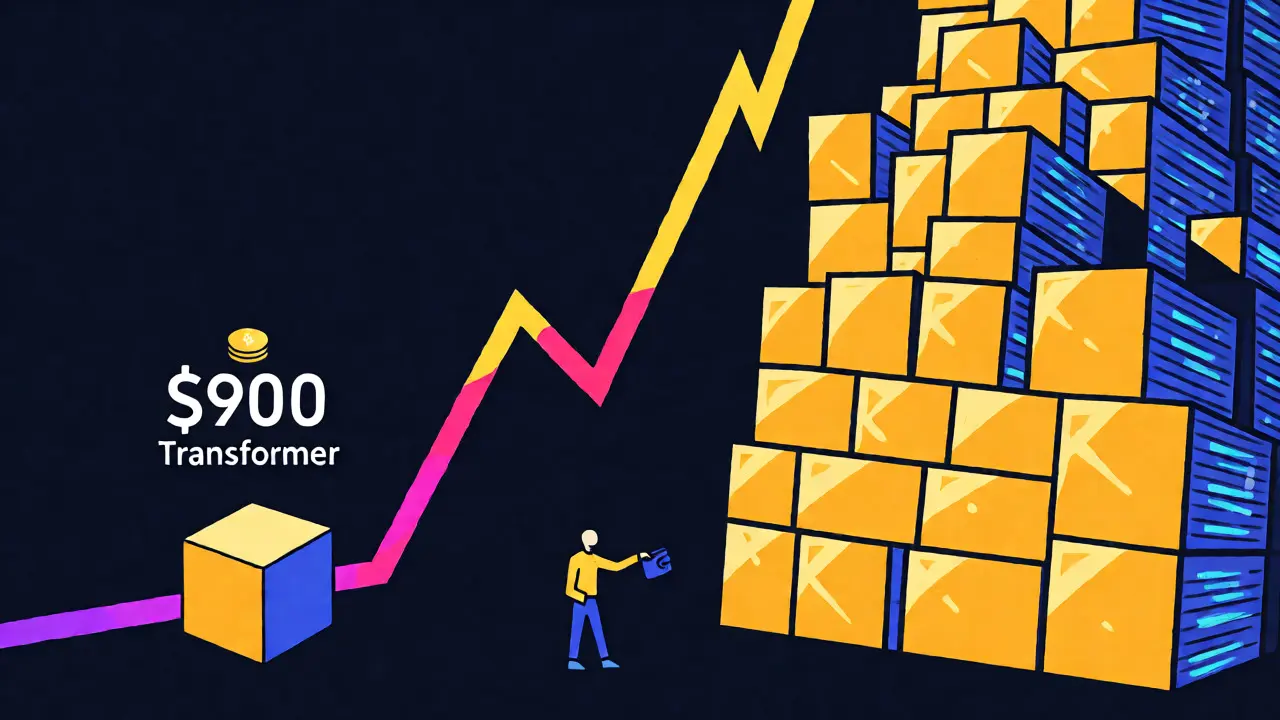
Remember when training a state-of-the-art language model cost about $900? That was the price tag for Google’s original Transformer back in 2017. Fast forward to today, and you’re looking at compute budgets that stretch into the hundreds of millions. OpenAI’s GPT-4 reportedly burned through between $78 million and $100 million just to train. Google’s Gemini Ultra? Estimates suggest it hit $191 million. If you are planning an Large Language Model (LLM) program, you aren’t just managing code; you are managing a financial fire hose.
The numbers are staggering. According to IBM’s Institute for Business Value, average computing costs are projected to climb 89% between 2023 and 2025. Seventy percent of executives surveyed pointed directly to generative AI as the culprit. It’s no surprise that every single executive in that survey admitted to canceling or delaying at least one AI initiative because the bill got too high. So, how do you build a roadmap that scales without bankrupting your company? You need a strategy that balances raw power with cold, hard economics.
The Exponential Reality of Training Costs
Let’s look at the trajectory. Epoch AI analyzed this trend and found that training compute for the largest models doubles every eight months. Spending on large-scale machine learning is growing at 2.4 times annually. This isn’t linear growth; it’s a hockey stick that keeps getting steeper. To put this in perspective, GPT-3, which seemed massive in 2020, cost between $500,000 and $4.6 million depending on hardware optimization. Today, we are talking about orders of magnitude higher.
Why does it cost so much? It comes down to FLOPs-floating-point operations per second. GPT-4 consumed approximately 2.1 × 10^25 FLOPs during training. Models like Gemini Ultra may require around 5.0 × 10^25 FLOPs. That requires thousands of high-end GPUs running in parallel for weeks or even months. Energy consumption alone accounts for roughly 50% of total training costs, according to Epoch AI. The other half covers hardware depreciation, cooling, and facility maintenance. If you ignore energy efficiency, you’re leaving half your budget on the table.
Hardware Choices: Cloud vs. On-Premise
You have two main paths for infrastructure: cloud providers or owning your own metal. For most organizations, the decision hinges on scale and predictability. A single data-center-grade NVIDIA A100-80GB GPU costs approximately $15,000. If you want to run medium-scale models like Llama-3.3-70B or GLM-4.5-Air efficiently, you might get away with just two of them. That’s a $30,000 hardware investment. Surprisingly, recent arXiv analyses show these setups lose less than 10% accuracy compared to massive clusters, making them viable for many enterprise applications.
| Model Tier | Example Models | GPU Requirement | Est. Hardware Cost | Best Use Case |
|---|---|---|---|---|
| Small/Medium | Llama-3.3-70B, GLM-4.5-Air | 2x A100-80GB | $30,000 | On-prem inference, fine-tuning |
| Large | Qwen3-235B | 4x A100-80GB | $60,000 | High-volume enterprise apps |
| Massive | Gemini Ultra, GPT-4 Class | Hundreds/Thousands | Millions | Frontier research, API providers |
Owning hardware gives you control over long-term costs if utilization stays high. But if your usage spikes unpredictably, cloud elasticity saves you from paying for idle iron. Prosumer-grade cards like the RTX 5090 are great for small teams or research prototypes because they are cheaper, but they lack the scalability for multi-user production environments. Don’t try to scale a global service on workstation GPUs unless you enjoy downtime.

Inference: The Hidden Budget Killer
Training gets all the headlines, but inference is where the money goes out the door every day. Think of training as building the factory; inference is running the assembly line. And the assembly line never stops. McKinsey reports that OpenAI’s o1 model costs six times more for inference than GPT-4o. Why? Because advanced reasoning requires more compute per token. Tom Tunguz quantified this: a typical AI query resulting in a few hundred words might cost anywhere from 0.03 cents up to 3.6 cents in compute. Multiply that by millions of queries, and it adds up fast.
This creates a trade-off. Do you want a model that thinks deeply but costs more per user interaction? Or do you want a faster, cheaper model that handles simple tasks well? AIMultiple’s analysis suggests that in high-usage environments, smaller models trained on more data can often match the performance of larger models at a lower total cost. Parameter count strongly affects inference costs, while training tokens only affect training compute. If you expect heavy usage, optimize for parameter efficiency.

Strategic Roadmapping and Efficiency Tricks
You don’t need to use the biggest model for everything. IBM experts recommend LLM routing, which intelligently directs incoming requests to the most suitable model based on complexity and cost. If a user asks a simple factual question, route it to a small, cheap model. Save the big, expensive reasoning models for complex coding or analytical tasks. This approach, known as model cascading, ensures you aren’t using a sledgehammer to crack a nut.
Another critical strategy involves predicting performance before you spend millions. Researchers at the MIT-IBM Watson AI Lab developed a universal guide for estimating LLM performance based on smaller models. Their finding? You can save significant costs by partially training the target model to about 30% of its dataset. This lets you gauge if a scaling path is worth pursuing before committing the full budget. If the curve flattens early, you know to pivot.
- Quantization: Reduce memory requirements by lowering precision formats. This allows larger models to fit on fewer GPUs.
- Efficient Fine-Tuning: Instead of retraining from scratch, adapt existing weights. LLaMA 2 (70B parameters) fine-tuning costs tens of thousands, not millions.
- Framework Optimization: Use tools like DeepSpeed or Fully Sharded Data Parallel (FSDP). These shard model components across limited hardware, allowing greater efficiency.
Future Outlook: The $6.7 Trillion Question
The road ahead is expensive but promising. McKinsey projects that by 2030, data centers will require $6.7 trillion worldwide to keep pace with compute demand, with $5.2 trillion specifically allocated for AI infrastructure. This assumes we need 156 gigawatts of additional capacity. That’s a lot of electricity and silicon.
However, efficiency breakthroughs are counterbalancing the cost. Chinese player DeepSeek reported in February 2025 that its V3 model achieved substantial improvements, reducing training costs by approximately 18 times and inferencing costs by about 36 times compared to GPT-4o. This proves that architectural innovation can beat brute force. As regulatory frameworks like the EU’s AI Act begin to incorporate computational efficiency requirements, sustainability will become a core part of the roadmap.
Your job as a leader is to stop chasing the biggest number and start chasing the best value. Build a roadmap that prioritizes right-sizing, leverages routing, and monitors energy consumption. The models will keep getting bigger, but your budget doesn’t have to grow exponentially if you plan smart.
How much does it actually cost to train a modern LLM?
It varies wildly based on size and architecture. Small specialized models might cost under $100,000. Medium-scale open-source models like Llama-3-70B can be fine-tuned for tens of thousands. Frontier models like GPT-4 or Gemini Ultra range from $78 million to over $190 million in pure compute costs, excluding R&D salaries and data acquisition.
Is it cheaper to rent GPUs or buy them?
For sporadic experimentation or startups, renting (cloud) is almost always cheaper because you avoid upfront capital expenditure and maintenance. For established companies with consistent, high-utilization workloads, buying on-premise hardware can break even within 12-18 months and offer lower long-term marginal costs, provided you have the technical team to manage the infrastructure.
What is the biggest hidden cost in LLM programs?
Inference costs. Many teams budget heavily for training but underestimate the ongoing cost of serving the model to users. Advanced reasoning models can increase inference costs by 6x compared to standard models. Additionally, energy consumption accounts for roughly 50% of total training costs, which is often overlooked in initial projections.
Can I use smaller models instead of huge ones?
Yes, and you often should. Research shows that smaller models trained on high-quality, domain-specific data can outperform generic giant models for specific tasks. Using techniques like quantization and model routing allows you to deploy smaller, cheaper models that handle 80% of queries, reserving the large model for the complex 20%.
How do I predict training costs before starting?
Use scaling laws derived from smaller proxy models. The MIT-IBM Watson AI Lab suggests training a smaller version of your target model to about 30% of the dataset. Extrapolate the loss curves to estimate the final performance and compute needs. This prevents wasting millions on a dead-end architecture.
- Nov, 28 2026
- Collin Pace
- 0
- Permalink
Written by Collin Pace
View all posts by: Collin Pace