Confidence and Uncertainty in Generative AI: How to Communicate Reliability
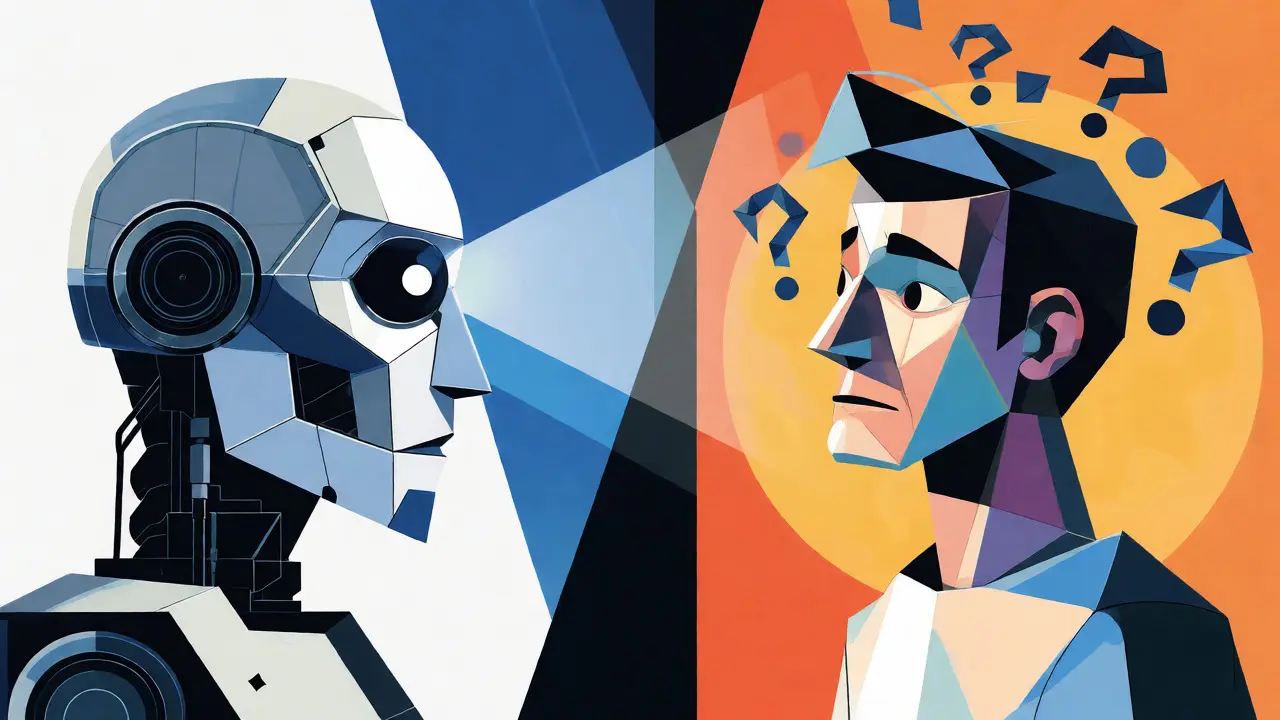
Imagine asking a doctor for a diagnosis. They say, "You have the flu," with the same flat tone they’d use if they were guessing between the flu and pneumonia. You wouldn’t feel very confident handing over your health insurance card, right? Yet, this is exactly how most Generative AI systems behave today. They deliver answers with unwavering certainty, even when they’re making things up. This phenomenon, often called the "confidence illusion," is creating a dangerous gap between what AI knows and what we think it knows.
The problem isn’t just technical; it’s psychological. When an AI sounds sure of itself, we tend to believe it. Research shows that 58% of people who are generally skeptical of AI actually start trusting it more when uncertainty is visualized, but only if done correctly. If you’re deploying AI in business or using it for critical decisions, understanding how to communicate uncertainty is no longer optional-it’s essential for survival in an era of hallucinations.
Why AI Sounds Confident Even When It’s Wrong
Traditional statistics give us tools like confidence intervals to show how sure we are about a result. Generative AI, specifically Large Language Models (LLMs) like ChatGPT or Claude, doesn’t work that way by default. These models predict the next likely word based on patterns. They don’t inherently "know" facts; they calculate probabilities. But because their output is fluent text, it reads like fact.
This creates a troubling dynamic. As Brian Middleton, a Yale-trained epidemiologist, pointed out, "the system's confidence becomes our confidence." We outsource our judgment to the machine because the machine speaks so clearly. In reality, there are two types of uncertainty at play here:
- Aleatoric uncertainty: This is inherent randomness in the data. Think of it as noise in the signal.
- Epistemic uncertainty: This comes from the model’s limitations. It’s the AI saying, "I haven't seen enough examples of this to be sure."
Most commercial tools hide both. A study by MIT’s Human-Data Interaction Lab found that 14 out of 15 major LLMs provide zero visual or textual indicators of response confidence. Only Anthropic’s Claude implements a basic scale in a small fraction of enterprise responses. For users, this means every answer looks equally reliable, whether the AI is reciting basic history or inventing a legal precedent.
The Real Cost of Overconfidence
What happens when we trust an overconfident AI? The consequences range from minor annoyances to major financial losses. In healthcare, finance, and supply chain management, accuracy matters more than fluency. Panorama Consulting’s audit of Fortune 500 companies revealed that 89% of generative AI tools sound confident even when their answers lack context. In ERP selection projects, 63% of AI recommendations contained unacknowledged uncertainty. That’s nearly two-thirds of advice given without a warning label.
Consider a supply chain director relying on an AI forecast for Q3 demand. The system predicts a 22.7% increase. Sounds precise, right? But if that prediction is based on incomplete data from only three of twelve regional warehouses, and the AI doesn’t flag that limitation, the company might overstock inventory by millions. One user rated their AI tool 2.3 out of 5 stars specifically because it failed to indicate that its "high-confidence" forecast was built on shaky ground.
There’s also a cognitive cost. The Center for Engaged Learning found that students using standard AI tools showed reduced critical thinking. Confidence in the AI replaced self-confidence in their own reasoning. When the AI says something with authority, we stop checking. This leads to misinformation amplification, where errors spread faster than corrections because nobody questions the source.

How Humans Actually Process Uncertainty
So, how do we fix this? We can’t just dump probability distributions on users. Most people don’t know what a Bayesian neural network is, and they definitely don’t want to see one when they’re trying to make a quick decision. The solution lies in matching the visualization to human cognition.
Research published in Frontiers in Computer Science tested different ways to show uncertainty. They found that size-making text larger for high-confidence answers and smaller for low-confidence ones-was the most effective method. It impacted trust decisions by 37.8 percentage points. Color saturation was less effective (22.1 points), and transparency was worse (18.4 points). Why? Because size is intuitive. Big means important/certain. Small means tentative/uncertain. It requires almost no training to understand.
| Visualization Method | Impact on Trust Decisions | Developer Effort (Hours) | User Comprehension |
|---|---|---|---|
| Text Size Variation | 37.8 percentage points | 72 | High (Intuitive) |
| Color Saturation | 22.1 percentage points | 105 | Moderate (Requires legend) |
| Transparency/Opacity | 18.4 percentage points | 120 | Low (Hard to distinguish) |
Another key finding: alignment with expertise matters. If you show complex statistical uncertainty to a beginner, they get confused. If you show simple cues to an expert, they get bored. University of Manchester researchers found that mismatched visualizations decreased decision accuracy by 22.7%. Context-aware systems that adapt to the user’s knowledge level improved accuracy by 39.4%.

Implementing Reliability Signals in Your Workflow
If you’re building or buying AI tools, you need to demand better communication. Here is a practical checklist for integrating uncertainty into human-AI interactions:
- Start with binary flags: Before getting fancy, add a simple "Confidence Score" or "Needs Review" tag. This is the baseline. Currently, only 22% of organizations have formal policies for this, despite 78% admitting past failures due to overconfident AI.
- Use size-based cues: As the research suggests, varying font size or UI element prominence is the most efficient way to signal reliability. It takes about 72 hours of developer time to integrate into existing dashboards.
- Contextualize the risk: Not all errors are equal. A wrong recipe suggestion is low-risk. A wrong medical dosage is high-risk. High-stakes domains like healthcare (where 37% of orgs already implement these features) need explicit warnings. Low-stakes content generation can get away with subtler cues.
- Avoid information overload: Don’t clutter the interface. Optimal uncertainty visualization should occupy 22-35% of the screen real estate. More than that, and users ignore it. Less than that, and they miss it.
Be aware of the computational cost. Adding robust uncertainty quantification can increase inference time by 40-60%. Google’s Metacognition in Generative AI project highlights this trade-off. You have to decide if the speed loss is worth the trust gain. For many enterprise applications, the answer is yes.
The Future: Adaptive and Regulatory Pressure
We are moving toward adaptive uncertainty communication. Imagine an AI that knows you’re a novice and gives you big, bold warnings, while giving experts subtle footnotes. Google and MIT are pioneering frameworks like the "Contextual Confidence Framework," which categorizes communication contexts to determine appropriate signaling. Early tests show this reduces context violation incidents by over 50%.
Regulation is forcing this change too. The EU AI Act, implemented in July 2024, requires "appropriate communication of system limitations" for high-risk AI applications. If your AI doesn’t tell users when it’s unsure, you might soon be out of compliance. The market for AI explainability tools is projected to hit $1.2 billion by 2027, growing at nearly 44% annually. Companies that ignore this trend risk reputational damage and operational inefficiency.
Ultimately, the goal isn’t to make AI perfect. It’s to make AI honest. We need systems that say, "Here is my best guess, but I’m only 60% sure because I lack data on X." That humility builds trust. And in a world flooded with synthetic content, trust is the only currency that matters.
Why do LLMs sound so confident even when they are wrong?
Large Language Models generate text based on probability patterns learned during training, not factual lookup. They produce fluent sentences regardless of accuracy. Since the output format is natural language, which humans associate with authoritative speech, users perceive fluency as correctness unless specific uncertainty indicators are provided.
What is the most effective way to visualize AI uncertainty?
Research indicates that varying text size is the most effective method, impacting trust decisions by 37.8 percentage points. Larger text signals higher confidence, while smaller text signals lower confidence. This method is intuitive, requires minimal user training, and is easier to implement than color or transparency changes.
Does showing uncertainty reduce user trust in AI?
Not necessarily. Studies show that for skeptics, visualizing uncertainty actually increases trust by demonstrating honesty and transparency. However, for users who rely heavily on AI, excessive uncertainty signals can lead to hesitation or rejection of the tool. The key is calibrating the signal to the user's expertise and the task's risk level.
How does uncertainty communication affect critical thinking?
Standard AI outputs that appear overly confident can suppress critical thinking, as users accept answers without verification. Tools that explicitly communicate uncertainty encourage users to evaluate the evidence themselves. Research found that students using uncertainty-aware prototypes exhibited significantly higher levels of critical thinking compared to those using standard tools.
Are there regulatory requirements for AI uncertainty disclosure?
Yes, particularly under the EU AI Act, which mandates appropriate communication of system limitations for high-risk AI applications. While global regulations vary, the trend is toward requiring transparency in how AI systems handle uncertainty, especially in sectors like healthcare, finance, and law.
- Oct, 12 2026
- Collin Pace
- 0
- Permalink
- Tags:
- generative AI uncertainty
- AI confidence scores
- hallucination risk
- human-AI trust
- LLM reliability
Written by Collin Pace
View all posts by: Collin Pace