Consent Management in Generative AI: User Rights and Data Choices

Imagine you share a photo on social media years ago. Today, a Generative AI system uses that image to train a model that creates deepfakes or personalized ads. You never agreed to this specific use. This is the core tension of modern data privacy. Traditional consent models-simple checkboxes saying "I agree"-are broken for Gen AI. These systems evolve, learn, and repurpose data in ways their creators didn't predict when they first collected it.
Consent management in generative AI is no longer just a legal checkbox. It is a dynamic, ongoing relationship between users and technology providers. As we move through 2026, regulations like the EU AI Act and updated GDPR guidelines demand more than static permission. They require transparency, control, and the ability to withdraw consent as AI capabilities shift. If you are building or using AI tools, understanding these rights is critical to maintaining trust and avoiding severe penalties.
The Shift from Static to Dynamic Consent
In traditional software, consent was often a one-time event. You clicked "Accept," and the terms were set in stone. But Generative AI is different. It ingests vast amounts of text, images, audio, and code to generate new content. The purpose of processing can change over time. A model trained for customer service chat might later be adapted for marketing analysis. Under old rules, this would violate the original consent scope.
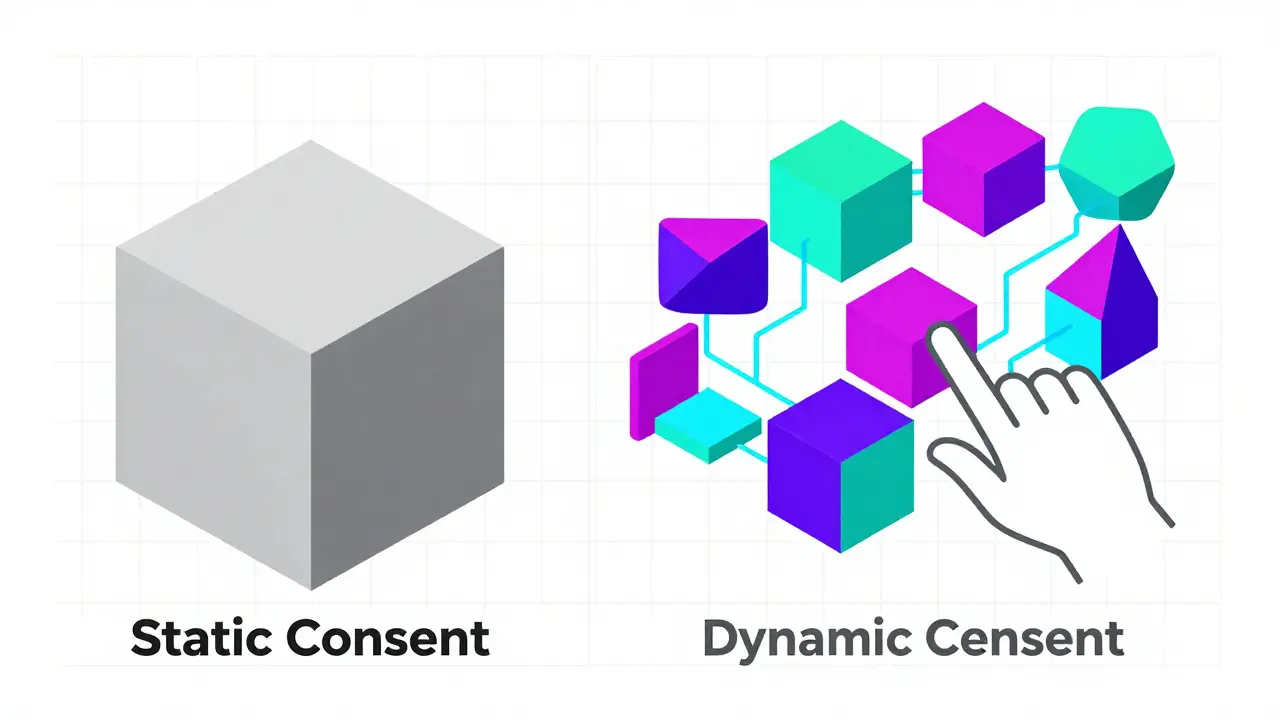
This is where dynamic consent becomes essential. Unlike static agreements, dynamic consent allows users to update their preferences as the AI system evolves. It provides ongoing control. For example, if an AI company decides to use your voice data for a new feature, they must ask again. This approach aligns with the principle of purpose limitation, ensuring data is only used for what the user explicitly agreed to at that moment.
Consider the difference:
- Static Consent: "I agree to all current and future uses." (Vague, non-compliant with modern standards)
- Dynamic Consent: "You may use my text data for training Chatbot X. If you want to use it for Ad Targeting Y, please notify me and seek renewed consent." (Specific, transparent, compliant)
Implementing this requires robust infrastructure. Companies need systems that track not just initial consent, but every modification, withdrawal, and new request throughout the data lifecycle.
Regulatory Landscape: GDPR, AI Act, and Beyond
The legal framework governing AI consent has tightened significantly by 2026. The General Data Protection Regulation (GDPR) remains the gold standard globally. Article 6 requires a lawful basis for processing, and for many AI applications, explicit consent is the only valid option. Article 7 sets strict conditions for valid consent: it must be freely given, specific, informed, and unambiguous.
Crucially, GDPR Article 22 addresses automated decision-making. If an AI makes decisions with legal or significant effects on individuals-like denying a loan or hiring-they have the right to human review. Organizations must provide meaningful information about the logic involved. This isn't just about hiding behind proprietary algorithms; it's about explaining how the AI reached its conclusion in plain language.
The EU AI Act adds another layer. It classifies AI systems by risk level. High-risk AI systems face stringent requirements for data governance, including high-quality datasets and human oversight. For generative AI specifically, the Act mandates transparency. Providers must disclose when content is AI-generated. Users have the right to know if they are interacting with a machine and how their data contributes to the model.
Other regions are following suit. The California Consumer Privacy Act (CCPA) and its successor, the California Privacy Rights Act (CPRA), give residents similar rights to opt-out of sale and sharing of personal information. Global companies must navigate this patchwork of laws, often requiring geo-specific consent banners and policies.
| Framework | Key Requirement for AI | User Right Highlight |
|---|---|---|
| GDPR (EU) | Explicit consent for automated decision-making | Right to explanation and human intervention |
| EU AI Act | Transparency of AI-generated content | Right to know if interacting with AI |
| CCPA/CPRA (USA) | Opt-out of data sale/sharing | Right to access and delete personal info |
Role of Consent Management Platforms (CMPs)
Managing consent manually is impossible at scale. This is where Consent Management Platforms (CMPs) come in. These tools automate the collection, storage, and enforcement of user preferences. But not all CMPs are built for AI. Many still treat consent as a binary cookie choice. For generative AI, you need advanced features.
A modern CMP for AI must handle granular permissions. Users should be able to say yes to training a medical diagnosis tool but no to using their health data for insurance profiling. The platform needs to store these choices securely and sync them across all connected systems-CRM, analytics, advertising pixels, and AI model trainers.
Key functionalities include:
- Geolocation Detection: Automatically showing GDPR-compliant options to EU users and CCPA options to Californians.
- Granular Preference Centers: Dashboards where users can review and adjust their consent settings anytime.
- Audit Trails: Immutable records of when consent was given, changed, or withdrawn. This is vital for proving compliance during regulatory audits.
- Integration with AI Systems: Real-time signals sent to AI pipelines to exclude data from users who opted out.
Without a sophisticated CMP, organizations risk "consent fatigue"-where users blindly click accept because the process is confusing-or worse, non-compliance due to outdated preferences.

Technical Implementation: Building Trust Through Design
Effective consent management starts with architecture. Before collecting any data, organizations must map their AI systems. What data sources are used? What is the purpose? Are there automated decisions involved? This inventory helps identify where consent is legally required.
Designing the consent interface is equally important. Avoid legal jargon. Use plain language. Explain *why* data is needed and *how* it will be used. For example, instead of saying "We process biometric data for facial recognition," say "We use your face scan to unlock your account securely. You can turn this off anytime."
Implementing granular permission configuration allows users to mix and match services. Maybe they want personalized recommendations but not behavioral tracking. Your system must respect these nuances. When a user withdraws consent, the action must be immediate. Data should be deleted or anonymized according to policy, and the AI model should stop learning from that user's inputs.
Regular audits are non-negotiable. Check if consent logs match actual data processing. Ensure that third-party vendors also comply. As AI models update, trigger re-consent mechanisms if the new version processes data differently than before.
Future Trends: Blockchain and Predictive Consent
As AI grows more powerful, so do the tools for managing consent. One promising development is blockchain-based consent records. Blockchain offers an immutable ledger. Once a consent record is written, it cannot be altered. This provides undeniable proof of user agreement, which is invaluable in disputes or investigations.
Another trend is AI-powered consent personalization. Imagine a system that adapts its consent requests based on your comprehension level. If you're a tech expert, it shows detailed technical specs. If you're a casual user, it uses simple analogies. However, this must be done carefully to avoid creating new privacy risks or manipulating choices.
Predictive consent modeling is also emerging. By analyzing user behavior, systems can anticipate when someone might want to change their settings. For instance, if a user rarely engages with personalized ads, the system might proactively suggest opting out. This shifts consent from reactive to proactive, enhancing user experience while maintaining compliance.
Ultimately, consent management in generative AI is about empowerment. It’s about giving people real control over their digital identities. As regulations tighten and technology advances, organizations that prioritize transparency and user choice will build lasting trust. Those that ignore these principles will face legal consequences and reputational damage. The future of AI depends on getting consent right-not just once, but continuously.
What is the difference between static and dynamic consent in AI?
Static consent is a one-time agreement that doesn't change, even if the AI system's use of data evolves. Dynamic consent allows users to update, modify, or withdraw their permissions as the AI's capabilities and purposes change over time, ensuring ongoing alignment with user preferences.
How does the EU AI Act affect consent for generative AI?
The EU AI Act requires transparency in AI-generated content and mandates that high-risk AI systems undergo strict data governance checks. For generative AI, it emphasizes the need for clear disclosure when users interact with AI and ensures that training data respects copyright and privacy norms, often requiring explicit consent.
Why are Consent Management Platforms (CMPs) necessary for AI?
CMPs automate the complex process of collecting, storing, and enforcing user consent across multiple systems. For AI, they ensure that data from users who opted out is excluded from training models and that audit trails are maintained for regulatory compliance, handling geographic variations in law automatically.
What happens if an AI system violates user consent?
Violations can lead to severe fines under regulations like GDPR (up to 4% of global annual turnover). Additionally, organizations face reputational damage, loss of user trust, and potential lawsuits. In cases involving automated decision-making, users may demand human review and correction of outcomes.
Can users withdraw consent after an AI model has been trained?
Yes, users have the right to withdraw consent at any time. While removing data from an already-trained model is technically challenging, organizations must implement processes to delete raw data and, where possible, mitigate the influence of that data in future model updates or outputs.
- Jun, 13 2026
- Collin Pace
- 5
- Permalink
Written by Collin Pace
View all posts by: Collin Pace