Data Residency for Global LLM Deployments: A Practical Guide

You built a killer Large Language Model (LLM) application. It works great in the US. Then you try to deploy it in Frankfurt or Beijing, and suddenly your legal team is having palpitations. Why? Because data residency isn't just a buzzword-it's a hard constraint that dictates where your bits can physically live.
If you're deploying generative AI globally, you aren't just fighting latency; you're fighting geography. The rules changed recently. In 2018, GDPR set the stage. By 2021, China’s PIPL raised the stakes. Today, in 2026, regulations like the EU AI Act have made "keeping data local" non-negotiable for high-risk systems. Ignoring this doesn't just mean bad vibes with regulators; it means fines up to 4% of global turnover. Let's break down how to actually make this work without bankrupting your infrastructure budget.
The Regulatory Landscape Is Fragmented
It used to be simple: keep user data in one place. Now, every major economy has its own map. The European Union demands strict control over personal data under GDPR. If your LLM processes PII (Personally Identifiable Information), that data generally cannot leave the EEA unless specific safeguards are in place.
Then there's China. Their Personal Information Protection Law (PIPL), effective since late 2021, requires security assessments for any cross-border transfer of Chinese citizens' data. This effectively forces you to run separate AI infrastructure within China's borders.
North America is looser but tightening. While the US lacks a single federal equivalent to GDPR, sector-specific laws (like HIPAA for healthcare) and state-level acts (like CCPA in California) create a patchwork. Australia’s Privacy Act 1988 also imposes strict notification duties if data leaves the country. You can't treat the world as one big cloud bucket anymore.
Why Standard Cloud APIs Often Fail Compliance
Most companies start by calling an API from a major provider like OpenAI or Anthropic. Easy, right? But here is the catch: when you send a prompt, that data often travels to servers in the US or other regions for processing. Even if the provider claims they don't store your data, the physical movement of packets across borders can trigger regulatory scrutiny.
Worse, recent research from the University of Cambridge suggests that LLMs memorize between 0.1% and 10% of their training data. If your model inadvertently leaks a snippet of personal data during inference, and that data was processed outside its home jurisdiction, you might be facing a data breach violation, even if no human ever read the output. Dr. Anja Müller from the European Data Protection Supervisor noted in 2025 that storing personal data in model parameters is a systemic compliance challenge. Policy patches won't fix architectural flaws.
Three Architectural Patterns for Data-Resident AI
You have three main options to keep your data where it belongs. Each comes with trade-offs in cost, complexity, and performance.
| Deployment Model | Data Location | Cost Implication | Complexity | Best For |
|---|---|---|---|---|
| Cloud Sovereign Regions | Local cloud region (e.g., AWS Frankfurt) | High (Premium pricing for isolated infra) | Medium | Enterprises needing scale + compliance |
| Hybrid Edge/Hybrid RAG | Data stays local; inference may vary | Medium-High | High | Balanced performance and compliance |
| Fully Local SLMs | On-premises or private VPC | Low-Medium (Hardware heavy) | Very High | Strictest privacy needs / Low volume |
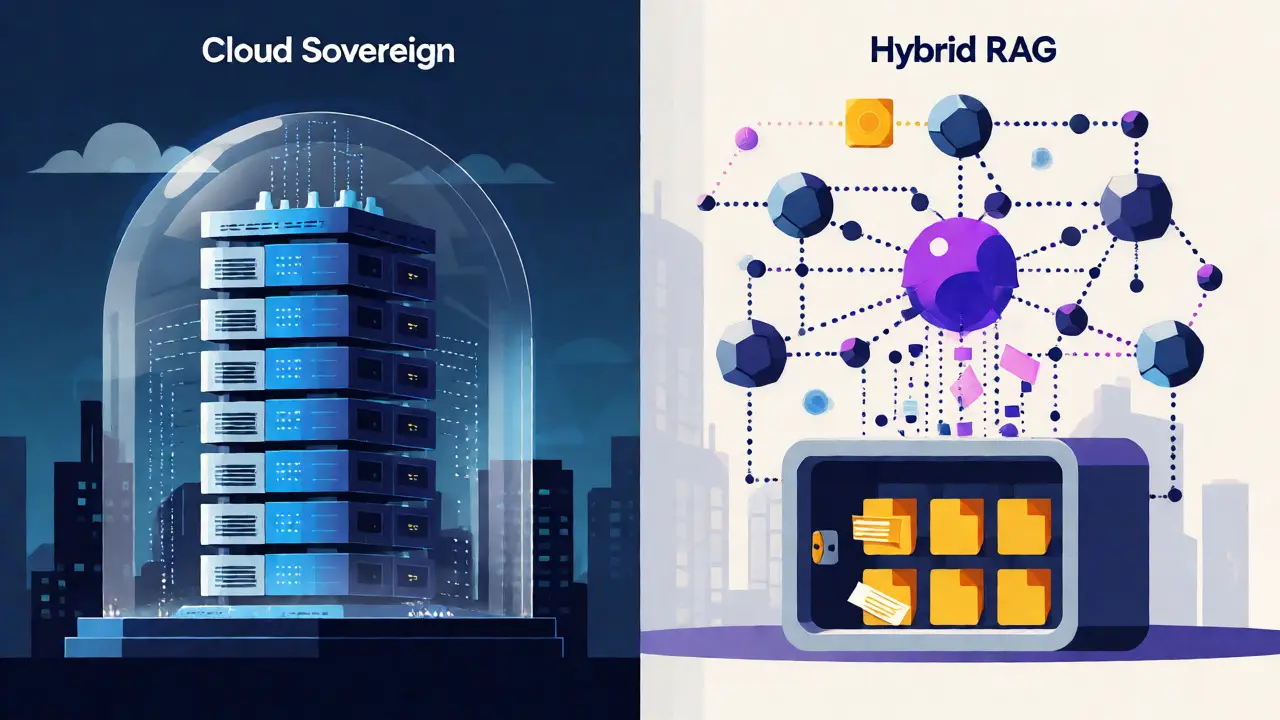
Option 1: Cloud Sovereign Regions
Major providers like AWS, Azure, and Google Cloud now offer "sovereign" or localized regions. For example, AWS introduced Bedrock Sovereign Regions in 2025, offering physically isolated infrastructure in countries like Germany, France, and Japan. The key benefit here is zero data transfer outside national borders. You get the power of massive models like GPT-4 or Claude 3, but the compute happens inside the country.
The downside? Cost. These dedicated environments often come with a premium. As of mid-2025, minimum commitments for such setups could hit $15,000 monthly for smaller deployments. But for banks or healthcare providers, that's cheaper than a lawsuit.
Option 2: Hybrid RAG with Local Embeddings
This is the sweet spot for many. You use Retrieval-Augmented Generation (RAG). Your sensitive documents stay in a local vector database (like Pinecone or Amazon OpenSearch on Outposts). When a user asks a question, you embed the query locally, search your local docs, and then send only the relevant context chunks to a cloud LLM for generation.
AWS documented this workflow extensively. They showed that using AWS Outposts or Local Zones allows you to run embedding models on local hardware (like NVIDIA T4 GPUs) while keeping the heavy lifting of the LLM in a compliant region. Latency drops to 200-300ms compared to 500-700ms in pure cloud setups. It’s a technical win and a compliance shield.
Option 3: Fully Local Small Language Models (SLMs)
If you truly cannot let data leave your server room, you host everything yourself. Enter Small Language Models. Models like Microsoft’s Phi-3-mini (3.8B parameters) or Mistral 7B are surprisingly capable. They require far less RAM-around 8GB vs. 140GB for larger models-making them feasible on standard enterprise hardware.
CloverDX reported that Phi-3 achieves about 78% of GPT-4’s accuracy on financial compliance tasks. That’s not perfect, but it’s often good enough for summarization or classification. However, creative writing or complex reasoning suffers, dropping to 62% accuracy. You save on data egress fees, but you pay in ML engineering time.
Technical Implementation Pitfalls
Don't underestimate the engineering lift. Moving from a simple API call to a data-resident architecture introduces new failure modes.
- Version Drift: If you run different instances of the same model in different regions, they might behave differently due to minor configuration differences. Forrester found that 57% of enterprises struggle with maintaining consistency across regional deployments. Tools like DataRobot’s GeoSync help by containerizing models with cryptographic verification to ensure every instance is identical.
- Embedding Mismatch: Your query embeddings must match your document embeddings. If you change your embedding model, you have to re-index your entire local knowledge base. This takes time and compute. Plan for re-indexing windows.
- Access Control Complexity: Just because data is local doesn't mean everyone should see it. Implement Context-Based Access Control (CBAC). Lasso Security recommends filtering retrieved content based on user role and sensitivity before it hits the LLM. This reduces unauthorized access risks by up to 92%.

Cost-Benefit Analysis: Is It Worth It?
Let's look at the numbers. MIT estimates that fully compliant data-resident AI can increase operational costs by 220-350% compared to centralized cloud deployments. That sounds scary. But compare that to the risk.
In 2025, 87% of European institutions delayed AI adoption due to GDPR concerns. Those who adopted early faced challenges. A German bank reported that deploying Llama 2 on-prem took 14 months and required three dedicated engineers. Yet, they reduced their regulatory risk rating from 'high' to 'medium'. Atlassian migrated to a hybrid RAG setup, accepting a 40% increase in implementation complexity to satisfy Australian privacy laws.
If your data is low-sensitivity (e.g., public product descriptions), stick to the cloud. If it’s high-sensitivity (patient records, financial transactions), the premium for sovereignty is your insurance policy.
Future Trends: More Fragmentation Ahead
We are heading toward a fragmented AI landscape. IDC predicts that by 2027, the global AI market will split into 15+ sovereign cloud environments, each with distinct rules. You won't just manage one codebase; you'll manage a mesh of regional deployments.
Expect more innovation in "selective parameter freezing," a technique from Google Research that reduces data memorization by 73% without hurting performance. Also, watch for automated synchronization tools becoming standard. Managing 10 different model versions manually is unsustainable. Automation is the only way forward.
Start small. Pick one regulated market. Deploy a hybrid RAG system there. Measure the latency, the cost, and the compliance audit results. Then scale. Don't try to boil the ocean on day one.
Does using an LLM API violate data residency laws?
Not necessarily, but it depends on where the data is processed. If you send personal data to a server in another country, you may need specific legal mechanisms (like Standard Contractual Clauses in the EU) to justify the transfer. Using cloud providers' sovereign regions eliminates this risk by keeping processing local.
Can I use open-source models like Llama 3 for data residency?
Yes. Open-source models give you full control. You can host them on-premises or in a private cloud within your target jurisdiction. This ensures no data leaves your environment. However, you bear the burden of maintenance, updates, and hardware management.
What is the biggest technical challenge in hybrid RAG deployments?
Consistency and latency. Ensuring that local embeddings match the expectations of the remote LLM is tricky. Additionally, network latency between local storage and remote inference can degrade user experience if not optimized properly. Using edge locations helps mitigate this.
How much does data-resident AI cost compared to standard cloud AI?
It varies, but expect 2-3x higher operational costs. This includes premiums for isolated infrastructure, additional engineering hours for integration, and potential performance trade-offs requiring more robust hardware to achieve similar response times.
Do small language models (SLMs) compromise quality too much?
For structured tasks like extraction, summarization, or compliance checking, modern SLMs perform very well (often >75% parity with larger models). For complex reasoning or creative generation, they lag behind. Choose based on your specific use case requirements.
- Sep, 13 2026
- Collin Pace
- 0
- Permalink
Written by Collin Pace
View all posts by: Collin Pace