Data Residency Requirements and LLM Deployment Choices: API vs Open-Source

Imagine you built a brilliant customer service bot. It answers questions in seconds, handles complex queries with ease, and your users love it. Then, a regulator from Germany asks for the logs of every conversation involving an EU citizen. You check your server location. The data is sitting in Virginia. Suddenly, that "brilliant" bot is a liability worth millions in fines. This is the reality of data residency in 2026.
Data residency refers to the physical or geographic location where business data is stored and processed. It’s not just about where the file lives; it’s about where the processing happens. With the EU AI Act taking effect on August 15, 2026, this concept has shifted from a legal preference to a hard technical requirement. If you are deploying Large Language Models (LLMs), you face a critical fork in the road: do you rent intelligence via API, or do you own the engine through open-source deployment? The answer depends entirely on where your data must stay.
The Regulatory Landscape in 2026
The rules of the game changed significantly over the last year. Before 2025, many companies assumed that if they anonymized data before sending it to a cloud provider, they were safe. That assumption is now risky. Dr. Elena Rodriguez, Chief Data Officer at InCountry, noted in January 2026 that some APAC jurisdictions are beginning to view model training as a form of processing. This means the physical location of the infrastructure matters, even if the data looks "clean."
Here is how major regions stand today:
- European Union: The GDPR combined with the new AI Act creates a comprehensive framework. High-risk AI systems require thorough risk assessments. Fines can reach 4% of global revenue.
- China: The Personal Information Protection Law (PIPL) mandates absolute data localization. Personal data from Chinese citizens generally cannot leave the country without specific security assessments.
- Australia: Strict localization applies to government data and regulated industries like healthcare. Critical infrastructure reforms now require demonstrating data residency down to the physical data hall level.
- UAE: Financial institutions must house all customer records on servers physically located within the country.
This fragmentation creates what Gartner calls "impossible compliance scenarios" for global deployments. You can’t have one single server handling everything for everyone anymore.
API vs. Open-Source: The Core Trade-Off
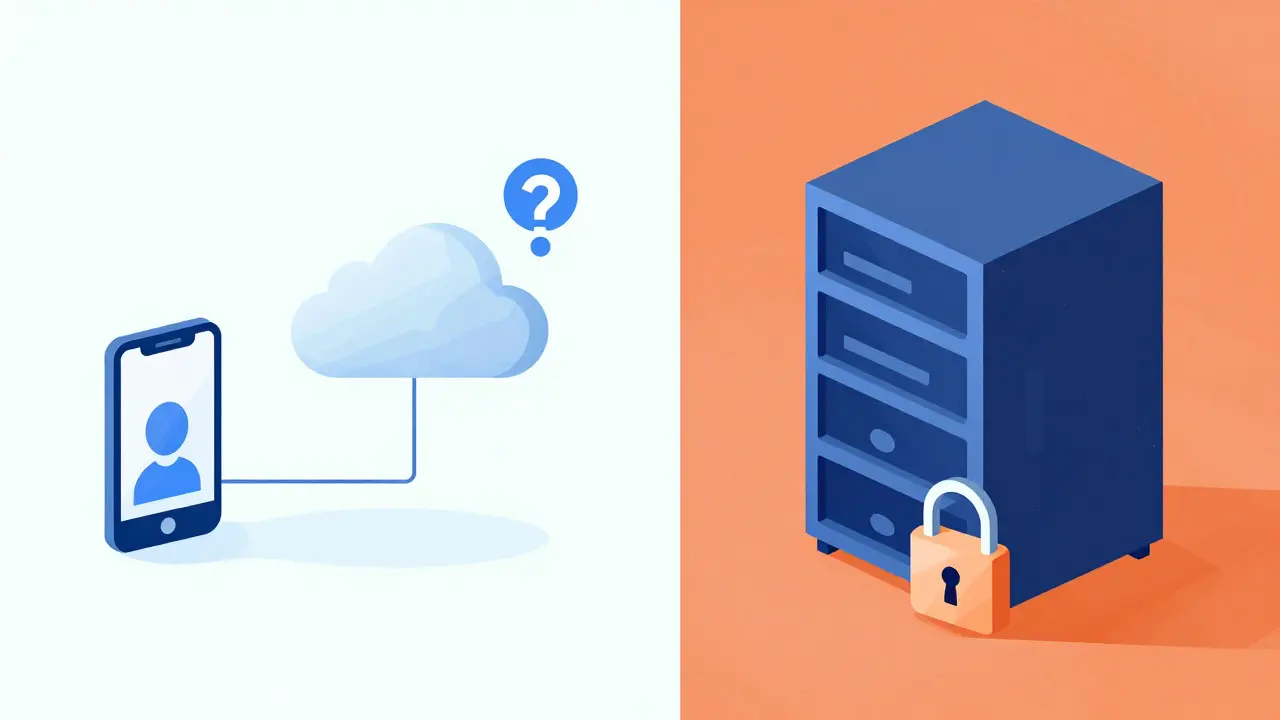
When choosing between using a managed API (like those from major cloud providers) and deploying open-source models (like Llama or Mistral variants), you are really choosing between convenience and control.
Managed APIs are services where the vendor hosts the model and processes your data in their data centers. The advantage is speed. You get state-of-the-art models without managing GPUs. The disadvantage is opacity. Unless the contract explicitly guarantees regional processing, your data might travel across borders during inference. For example, if you use a US-based API but serve EU customers, you need to ensure the inference happens in an EU region. Most major providers offer this, but it requires careful configuration and verification.
Open-Source LLMs are models you download and run on your own infrastructure, giving you full control over data location. Here, you decide exactly where the hardware sits. If you need data to stay in Frankfurt, you put the GPU cluster in Frankfurt. No third-party handoff. No cross-border transfer. This is the gold standard for strict data sovereignty. However, you take on the burden of maintenance, scaling, and optimization.
| Feature | Managed API | Open-Source Self-Hosted |
|---|---|---|
| Control Over Location | Moderate (Depends on vendor region options) | Full (You choose the data center) |
| Initial Setup Time | Days to Weeks | Months (Average 4.7 months for compliant setup) |
| Operational Complexity | Low | High (Requires ML Ops expertise) |
| Cost Structure | Per-token usage fees | CapEx (Hardware) + OpEx (Energy/Labor) |
| Compliance Risk | Medium (Vendor dependency) | Low (Direct control) |
| Model Freshness | Always latest | Lagging behind frontier models |
Technical Requirements for Compliant Deployment
Whether you choose API or open-source, "just putting the server in the right place" isn't enough. You need a robust architecture. According to TrueFoundry's 2026 technical specifications, three capabilities are non-negotiable:
- Jurisdiction-Aware Routing: Your application needs a gateway that detects the user's location and directs the request to the appropriate regional endpoint. If a user in Brazil hits your site, the LLM call must go to a Brazilian node, not a US one.
- Regionalized Logging: Prompts, responses, and usage logs must be stored in the same jurisdiction as the end-user. Many companies forget this. They host the model locally but send logs to a central analytics dashboard in another country. That’s a breach.
- Customer-Managed Encryption Keys (CMEK): Ensure that decryption only occurs within your control. If the vendor holds the keys, they technically have access to your plaintext data, which may violate sovereignty requirements in strict jurisdictions.
One hidden trap is Disaster Recovery (DR). Lyceum Technology found that 78% of enterprises had to redesign their failover systems after discovering their DR plans routed data to out-of-region backups. If your primary server is in Singapore and your backup is in Sydney, does that violate local laws? Often, yes. You need region-specific DR configurations.
Cost and Performance Realities
Compliance isn't free. Signzy’s study of 200 enterprise deployments in January 2026 revealed that strictly localized LLM deployments typically incur 15-22% higher latency compared to centralized models. Why? Because you can’t route requests to the nearest available GPU globally; you must stick to the regional pool. This means smaller pools, potentially more queuing, and less optimal resource utilization.
On the cost side, 63% of enterprises reported 30-45% higher operational costs when implementing tiered residency models. You are paying for redundancy, specialized compliance tooling, and often, premium pricing for regional data centers. For a small startup, this can be prohibitive. This is why 67% of businesses with under 500 employees now leverage third-party residency compliance services rather than building their own infrastructure.

Strategic Recommendations by Sector
There is no one-size-fits-all answer. Your choice should align with your industry's risk profile.
Financial Services and Healthcare: These sectors face the harshest penalties. Australia imposes fines up to 28% of annual turnover for breaches. For these organizations, open-source self-hosting or dedicated private cloud instances are often the safest bet. The overhead is justified by the risk mitigation. Adoption rates reflect this: 89% of EU financial institutions have implemented region-specific deployments.
E-Commerce and Consumer Apps: These companies deal with high volumes but lower sensitivity per transaction. Managed APIs with regional routing are usually sufficient. The agility of switching models quickly outweighs the slight compliance risk, provided you have solid contracts with vendors guaranteeing regional processing.
Global Enterprises: You will likely need a hybrid approach. Use open-source models for internal tools where data sensitivity is high, and managed APIs for customer-facing features where speed matters. Expect to maintain at least three separate LLM deployment environments by 2027, as predicted by the IAPP.
Frequently Asked Questions
Does using an API always mean my data leaves the country?
Not necessarily. Major cloud providers offer regional endpoints. If you explicitly configure your API calls to use the EU region, the data stays in the EU. However, you must verify this in the service level agreement (SLA) and monitor the actual traffic paths to ensure no fallback to other regions occurs during outages.
Is open-source LLM deployment cheaper in the long run?
It depends on scale. For low-to-medium usage, APIs are cheaper because you pay per token. For high-volume, consistent workloads, self-hosting open-source models can reduce per-unit costs significantly. However, you must factor in the cost of ML engineers and hardware maintenance, which can offset savings if your team lacks expertise.
What about metadata? Does it count as personal data?
Yes, often. Professor Kenji Tanaka warned that metadata, derived analytics, and model outputs can carry enough identifying information to trigger localization requirements. Even if you remove names, credit risk scoring patterns or behavioral data can be linked back to individuals. Treat metadata with the same residency constraints as raw data.
How long does it take to set up a compliant LLM environment?
The average time for initial compliant LLM deployment is 4.7 months. This includes designing jurisdiction-aware infrastructure, setting up region-specific logging, and configuring encryption key management. Simple API setups can take weeks, but full compliance with audit trails takes longer.
Which regions have the strictest data residency laws in 2026?
China and Australia are currently the strictest. China requires absolute localization for personal data. Australia requires physical data hall-level proof for critical infrastructure. The EU is comprehensive but focuses more on adequacy and risk assessment rather than absolute border restrictions for all data types.
- Aug, 28 2026
- Collin Pace
- 0
- Permalink
Written by Collin Pace
View all posts by: Collin Pace