Debugging Prompts: Systematic Methods to Improve LLM Outputs

You send a prompt to your Large Language Model (LLM). The response comes back. It is wrong. Maybe it hallucinated a fact, ignored a constraint, or just gave you generic fluff instead of the specific insight you needed. Now what? You tweak the words slightly. "Please be more accurate." You try again. Still wrong. This loop-prompt, fail, tweak, repeat-is where most AI projects die. It feels like guessing rather than engineering.
But here is the truth: LLM debugging is not an art; it is a systematic process. Just like traditional software debugging, there are specific methods to isolate errors, understand root causes, and fix them reliably. If you treat prompt engineering as random experimentation, you will burn time and money. If you treat it as a structured pipeline, you can build systems that actually work in production.
| Method | Best For | Core Mechanism |
|---|---|---|
| Task Decomposition | Complex multi-step tasks | Breaking one big prompt into smaller, focused subtasks |
| Chain-of-Thought | Logical reasoning problems | Forcing the model to show its step-by-step work |
| RAG | Factual accuracy & freshness | Retrieving external data before generating text |
| Fine-Tuning | Style & domain specialization | Training the model on specific examples |
| Structured Output | Parsing & validation | Forcing JSON/XML formats for easy error detection |
Stop Asking for Everything at Once
The biggest mistake I see is the "God Prompt." You ask the model to analyze data, find trends, compare benchmarks, and write recommendations all in one go. When it fails, you have no idea which part broke. Did it miss the trend? Did it misinterpret the benchmark? Or did it just forget the formatting instructions?
Task decomposition fixes this. It involves breaking a complex request into sequential, manageable steps. Think of it like dividing code into functions. Instead of one massive block, you create small units with clear inputs and outputs.
Let's look at a real example. Imagine you want a financial analysis. A bad prompt looks like this:
- "Analyze Company X's financials over 5 years and give advice."
A decomposed approach looks like this:
- Step 1: "List the key financial metrics for Company X for each of the past 5 years."
- Step 2: "Identify trends in these metrics."
- Step 3: "Compare these trends to industry benchmarks."
- Step 4: "Suggest three areas for improvement based on the comparison."
Why does this help debugging? Because if Step 3 gives a weird result, you know exactly where the failure occurred. You didn't waste tokens on Steps 1, 2, and 4. You isolated the bug. This reduces the cognitive load on the model and makes failures localized. If you are building a production system, this structure is non-negotiable. It turns a black box into a transparent pipeline.
Make the Model Show Its Work
Sometimes, the answer is right, but the path to get there was shaky. Or worse, the answer is wrong, but it looks plausible. How do you debug logic when the output hides the reasoning?
You use Chain-of-Thought (CoT) prompting. This technique instructs the LLM to explicitly break down its problem-solving process into discrete steps before giving the final answer. It sounds simple, but it changes everything. By forcing the model to articulate its logic, you expose gaps in reasoning. If the model says, "I calculated X, then Y, so Z," and Z is wrong, you can check if the calculation of X or Y was flawed.
Research from institutions like Savas Labs confirms that CoT significantly improves performance on complex logical tasks. But beyond accuracy, it is a debugging tool. When a model hallucinates, it often skips steps. CoT forces it to slow down. You can inspect the intermediate steps. Did it retrieve the correct data? Did it apply the right formula? If the reasoning trace shows a logical leap, you know you need to add more context or constraints to that specific step.
Here is a practical tip: Do not just ask for the answer. Ask for the answer *and* the reasoning. Then, programmatically check if the reasoning aligns with known facts. If the reasoning is sound but the conclusion is off, you might have a parsing issue. If the reasoning is nonsense, you have a knowledge or instruction issue.

Fix Hallucinations with Retrieval-Augmented Generation
Hallucinations are the enemy of trust. An LLM confidently states a fact that simply isn't true. Why? Because the model predicts the next word based on patterns, not truth. It doesn't "know" facts; it mimics knowing them.
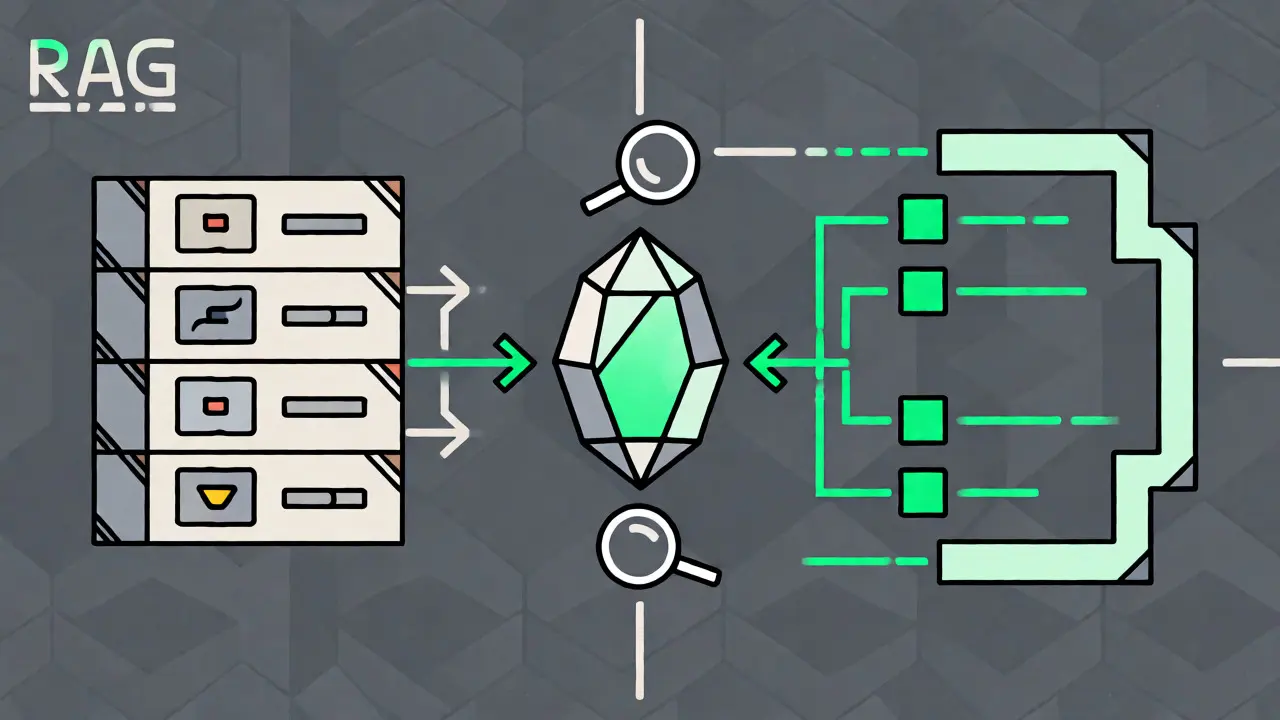
To debug this, you stop relying on the model's internal memory. You bring in external data. This is Retrieval-Augmented Generation (RAG). RAG works by searching a database for relevant information first, then feeding that information to the LLM along with your question.
Think of RAG as giving the student an open-book exam. Without RAG, the model guesses. With RAG, it cites sources. Products like Perplexity and Phind rely on this. If your LLM keeps making up dates or statistics, RAG is likely your fix.
But how do you debug RAG itself? It’s not magic. You need to trace the retrieval. Did the search engine pull the right document chunk? Did the LLM ignore the retrieved info and stick to its training data? Maxim AI suggests breaking RAG into stages: Retrieval → Evidence Selection → Grounding → Synthesis → Verification. If the final answer is wrong, check the earlier stages. Was the evidence irrelevant? Was it ignored during synthesis? Tools that track which document chunks influenced the final answer are invaluable here. They let you see exactly what the model "read" before writing.
Standardize Outputs for Easier Validation
One of the hardest parts of debugging is parsing the response. If the model writes a paragraph, you have to use regex or another LLM to extract the data. That introduces new points of failure. What if the format changes slightly? Your parser breaks.
Solve this by enforcing structured output formatting. Instruct the model to return JSON, XML, or YAML. Modern models like GPT-4o and Claude handle this well. When you demand JSON, you get a predictable schema. You can validate this schema programmatically. If a required field is missing, you catch it immediately. If a value is out of range, you flag it.
This shifts debugging from "is the text good?" to "does the data match the schema?" It is much easier to automate. You can set up alerts for invalid schemas. You can log every input and output pair. Over time, you build a dataset of failures. This dataset becomes gold for further optimization.
When Prompts Aren't Enough: Fine-Tuning and Steering
Sometimes, no matter how clever your prompt, the model just won't behave the way you want. Maybe it refuses to adopt a specific tone. Maybe it struggles with a niche domain vocabulary. This is where you move beyond prompt engineering.
Fine-tuning involves training the model on a specific dataset of examples. Unlike few-shot learning, where you paste examples in the prompt, fine-tuning updates the model's weights. This is expensive and time-consuming, but powerful. GitHub Copilot is fine-tuned for code. DALL·E is tuned for image prompts. If you need consistent style or deep domain expertise, fine-tuning reduces prompt complexity. You spend fewer tokens explaining the basics because the model already knows them.
There is also a newer, more experimental method called mathematical steering. Researchers at UC San Diego, led by Professor Mikhail Belkin, showed that we can manipulate specific concepts inside LLMs using Recursive Feature Machines. They identified 512 concepts, like fears or locations, and could increase or decrease their importance mathematically. This is not yet mainstream for daily debugging, but it hints at a future where we debug models by adjusting internal vectors rather than just tweaking text prompts.
Building a Debugging Workflow
So, how do you put this together? You don't pick one method. You build a workflow.
- Start Simple: Use a single prompt. See if it works.
- Decompose: If it fails, break it into steps. Isolate the failing step.
- Add Reasoning: If logic is wrong, add Chain-of-Thought instructions.
- Add Context: If facts are wrong, implement RAG. Check retrieval quality.
- Structure: Force JSON output. Validate against a schema.
- Evaluate: Log everything. Analyze failures. Adjust prompts or consider fine-tuning if the pattern persists.
Remember, neural networks deal with math, not English. We communicate in English, but the model processes numbers. Our job is to bridge that gap. By using systematic methods, you reduce the noise. You stop guessing and start engineering. Your LLM outputs become reliable, measurable, and maintainable. And that is what separates a toy demo from a production system.
What is the difference between prompt chaining and task decomposition?
They are closely related but distinct. Task decomposition is the conceptual act of breaking a large problem into smaller sub-problems. Prompt chaining is the implementation mechanism where the output of one prompt becomes the input for the next. You use decomposition to design the flow, and chaining to execute it sequentially.
Does Chain-of-Thought always improve accuracy?
Not always. CoT helps significantly with complex logical reasoning and multi-step arithmetic. However, for simple factual questions or creative writing, it can sometimes introduce unnecessary verbosity or even errors if the model's reasoning path wanders. Always test whether CoT adds value for your specific task.
How does RAG help with debugging hallucinations?
RAG grounds the model's responses in external, verifiable data. Instead of relying on the model's parametric memory (which can be outdated or fuzzy), RAG provides specific snippets of text. If the model ignores this provided context, you can detect that as a grounding failure. It shifts the source of truth from the model's weights to your database.
Is fine-tuning better than prompt engineering for debugging?
Fine-tuning is not necessarily "better," but it solves different problems. Prompt engineering is faster and cheaper for iterating on instructions and logic. Fine-tuning is better when you need consistent style, specialized vocabulary, or reduced latency. Often, you debug with prompts first, and only fine-tune when prompt-based solutions hit a ceiling.
What tools help visualize LLM debugging traces?
Platforms like LangSmith, Arize Phoenix, and Weights & Biases allow you to trace LLM calls. They show the full chain of prompts, intermediate outputs, token usage, and latency. These visualizations are critical for identifying bottlenecks and understanding why a specific step failed in a complex pipeline.
- Nov, 1 2026
- Collin Pace
- 0
- Permalink
Written by Collin Pace
View all posts by: Collin Pace