Document Intelligence Using Multimodal Generative AI: PDFs, Charts, and Tables

Most of us have stared at a messy PDF, a scanned invoice, or a technical manual and felt that familiar spike of frustration. You need one specific number from a table, but the text is locked in an image. Or you’re trying to match a date format against a signature stamp, but your standard tool just sees them as separate, unrelated blobs of data. Traditional Optical Character Recognition (OCR) was supposed to solve this, yet it often fails when documents get complex. It reads words, sure, but it doesn’t understand context.
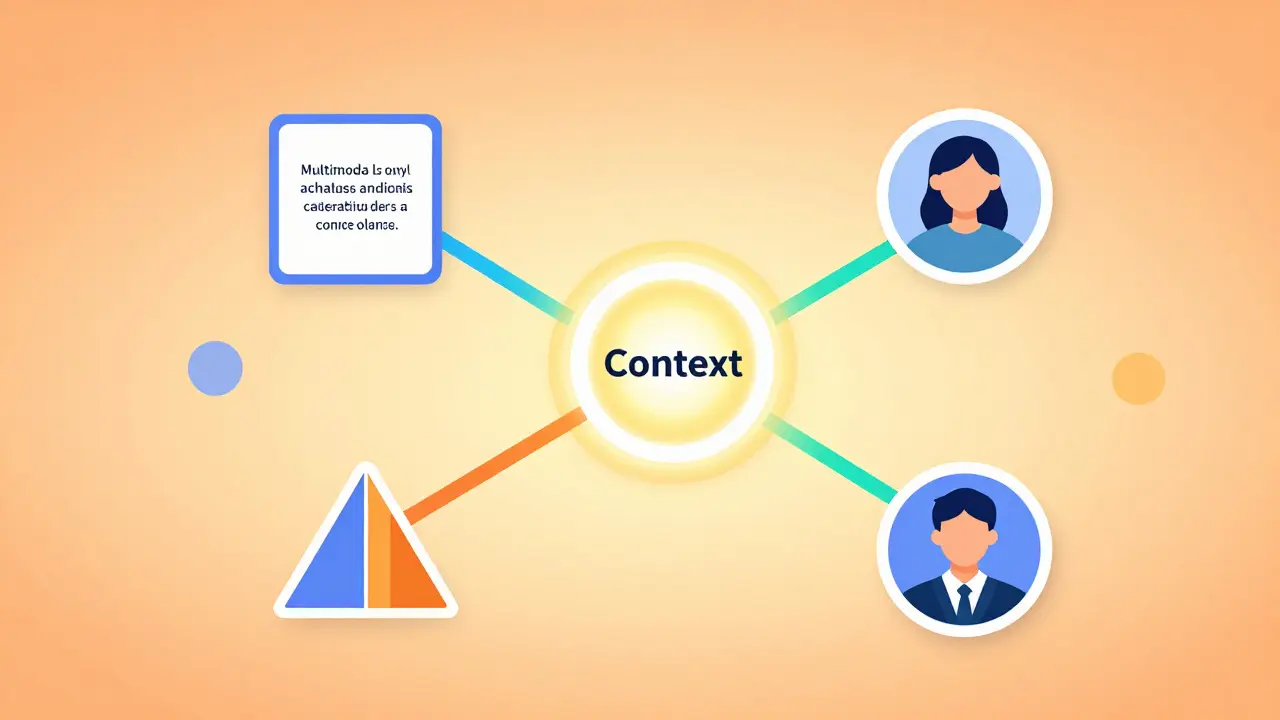
This is where Multimodal Generative AI is an advanced technology that processes text, images, tables, and charts simultaneously to understand document context changes the game. Unlike older systems that treat text and visuals as separate tracks, multimodal models look at the whole page. They see how a chart relates to the paragraph above it, or how a handwritten note on a blueprint connects to a tolerance value in a nearby table. For enterprises drowning in unstructured data, this isn't just a nice-to-have feature; it’s becoming essential infrastructure for accurate document processing.
The Core Problem with Traditional Document Processing
To appreciate why multimodal AI is such a big deal, we first need to look at why legacy systems fall short. Standard OCR tools are essentially digitizers. They scan pixels and convert them into characters. If you feed them a clean, typed Word document, they work fine. But real-world documents are rarely clean. They contain stamps, handwritten revisions, complex layouts, and embedded graphics.
Consider a manufacturing engineering change order. It might have a CAD snippet showing a part modification, a table listing new tolerance bands, and a hand-annotated revision number scribbled near the diagram. A traditional OCR system extracts the text from the table and the handwriting separately. It has no idea that the handwritten note modifies the values in the table. The relationship is lost. This forces human workers to manually cross-reference these elements, leading to errors and slow processing times.
Furthermore, legacy solutions lack scalability. As document volumes grow and formats vary-from invoices to medical records to legal contracts-rule-based systems break down. They cannot adapt intelligently. Multimodal generative AI, by contrast, uses contextual understanding to interpret relationships between different elements, allowing it to handle structured, semi-structured, and unstructured data with equal proficiency.
How Multimodal Document Intelligence Works
The magic behind this technology lies in its architecture. Instead of a single linear process, multimodal document intelligence follows a structured pipeline that mimics human cognitive processing. According to industry experts at N-iX, this involves three core stages: input processing, representation fusion, and content generation.
1. Input Processing and Parallel Extraction
The system first breaks down the document into its constituent modalities. C3.ai describes this as a two-stage process where Stage 1 involves extracting text, tables, and images using parallel processing pipelines. Crucially, specialized encoders are used here. While general vision models struggle with small text in logos or road signs, document-specific pipelines use layout-aware vision models for tables and diagrams, alongside high-accuracy OCR for text. This ensures that the raw data extracted is precise before any reasoning begins.
2. Representation Fusion and Information Graphs
Once the elements are extracted, they need to be connected. Microsoft Azure notes that effective multimodal search requires preserving the order of information as it appears in the document. Systems like those described by C3.ai construct an "information graph"-a directed bipartite graph where edges connect Text nodes to other modality nodes (like images or tables). This creates a semantic map of the document. By embedding both text and images into a shared vector space, the model can calculate distances and relationships between disparate elements. For example, it can determine that a specific icon in a flowchart corresponds to a step described in the adjacent paragraph.
3. Content Generation and Reasoning
Finally, the model generates insights. Google Cloud’s Gemini model, designed from the ground up for multimodal reasoning, can extract text from images, convert it to JSON, and answer questions about uploaded images. Because the model understands the context, it can perform tasks like summarization or decision-making. Duco highlights that generative agents can now interact with ERP and CRM systems, making interpretative decisions based on the total context of a document rather than viewing validation rules field-by-field.
Key Advantages Over Legacy OCR
The shift from text-only AI to multimodal systems brings distinct benefits, particularly in accuracy and contextual awareness. Here is how they compare:
| Feature | Traditional OCR / Text-Only AI | Multimodal Generative AI |
|---|---|---|
| Context Awareness | Limited to written descriptions; ignores visual layout. | Grounded in visual, numerical, and spatial context. |
| Cross-Modal Reasoning | Cannot link images to text or tables automatically. | Correlates charts, stamps, and text seamlessly. |
| Date/Format Interpretation | Often misinterprets dates (US vs. EU formats) without context. | Uses surrounding document context to resolve ambiguity. |
| Scalability | Requires manual rule updates for new document types. | Adapts intelligently to diverse document structures. |
| Error Handling | High error rate in complex layouts; requires heavy human review. | Reduced manual checks due to holistic understanding. |
One of the most practical examples of this advantage is date interpretation. A standalone field reading "05/06/2026" is ambiguous. Is it May 6th or June 5th? A text-only AI guesses. A multimodal agent looks at the rest of the document-perhaps a letterhead from a European company or a reference to a US holiday-and deduces the correct format. This reduces the need for humans to manually verify every entry.
Technical Challenges and Limitations
Despite the hype, multimodal document intelligence is not a silver bullet. There are significant technical hurdles that developers and architects must navigate. The primary challenge is accuracy in text recognition within images.
Duco points out a critical gap: current state-of-the-art multimodal foundation models are heavily focused on photographs and natural scenes, not documents. These models are notoriously bad at "reading" small text, even in logos or captions. In document processing, especially for financial or legal records, a single misrecognized character in a bank account number or a contract clause can be catastrophic. Specialized OCR models still shine here because they are optimized for near-perfect text accuracy.
Therefore, the best implementations do not replace OCR entirely; they augment it. Microsoft Azure recommends a pattern where inline images are extracted, described in natural language by a GenAI Prompt skill, and then embedded alongside the text. This hybrid approach combines the pixel-perfect accuracy of specialized OCR with the contextual reasoning of large language models (LLMs). However, this adds complexity. Building a robust pipeline requires managing multiple components: OCR engines, layout parsers, LLMs, and vector databases. Preserving the original order of information while executing hybrid queries that combine full-text search with vector search is non-trivial.
Implementation Strategies for Enterprises
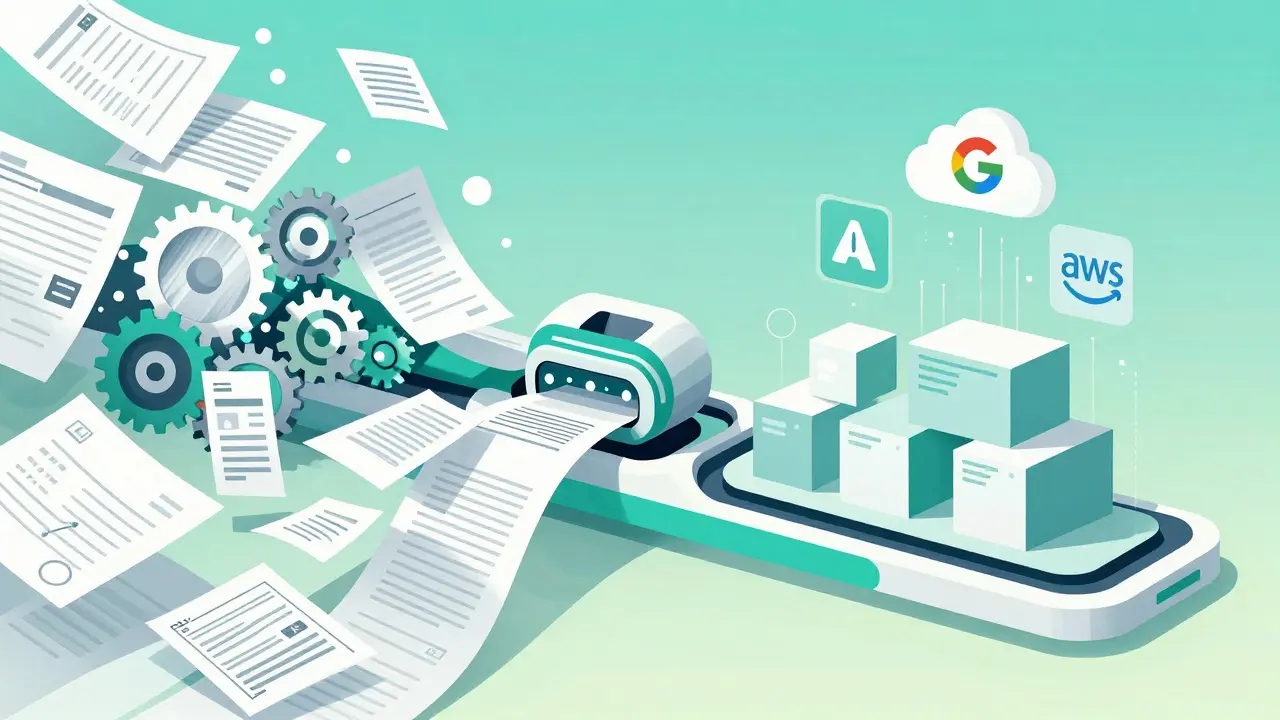
If you are looking to implement multimodal document intelligence, you don't necessarily need to build everything from scratch. Major cloud providers offer mature platforms that abstract much of the complexity.
Google Cloud Vertex AI with Gemini
Google’s approach leverages its Gemini models, which were designed to reason across text, images, video, audio, and code. Vertex AI provides a unified API for multimodal processing. You can prompt the model with text and images to generate answers or extract structured data. This is ideal for organizations already invested in the Google ecosystem who need rapid prototyping and strong native multimodal capabilities.
Microsoft Azure Document Intelligence
Azure offers a highly structured pipeline. Their documentation outlines a clear path: extract inline images and page text, chunk the text using a Text Split skill, and generate image descriptions using a GenAI Prompt skill. This modular approach allows developers to customize each stage. Azure Document Intelligence is positioned as a Foundry Tool within their broader AI ecosystem, making it a strong choice for enterprises needing deep integration with Microsoft 365 and Dynamics 365.
AWS Intelligent Document Processing (IDP)
AWS combines OCR, computer vision, NLP, and machine learning with generative AI capabilities. Their solution focuses on simplifying the finding of specific information within documents and transforming it into actionable insights. AWS IDP is well-suited for organizations requiring high scalability and security, leveraging the broader AWS infrastructure for backend processing.
When choosing a platform, consider your team's expertise and existing infrastructure. If your data is primarily in Microsoft environments, Azure’s seamless integration might save months of development time. If you need cutting-edge reasoning capabilities for complex, unstructured documents, Google’s Gemini might offer superior performance out of the box.
Real-World Applications
Multimodal AI is already transforming several industries by handling documents that were previously too complex for automation.
- Manufacturing: Engineers use multimodal AI to interpret technical documents containing tables, flow diagrams, stamps, signatures, and marginal notes. The system can correlate a spoken feedback recording with dashboard metrics or link equipment noise recordings to known failure signatures in maintenance logs.
- Finance: Banks process complex forms and loan applications that include handwritten signatures, ID photos, and typed financial statements. The AI verifies that the signature matches the ID photo and that the income figures in the statement align with the summary table.
- Healthcare: Medical records often mix typed clinical notes with scanned lab results and X-ray images. Multimodal models can extract patient history from text, analyze lab values from tables, and identify anomalies in radiology images, providing a holistic view for doctors.
- Legal: Contracts frequently contain annexes, charts, and handwritten amendments. Legal tech firms use multimodal AI to ensure that a handwritten addendum is correctly interpreted in the context of the main agreement, reducing liability risks.
Future Trajectory
The market for multimodal document intelligence is rapidly evolving. With major players like Google, Microsoft, and AWS all investing heavily, we can expect continued convergence between specialized document processing and general multimodal AI. N-iX predicts that multimodal generative AI will become essential infrastructure for enterprises handling complex documentation.
Future developments will likely focus on closing the accuracy gap identified by researchers. We may see more specialized foundation models trained specifically on document layouts rather than natural images. Additionally, the integration of these systems with enterprise software like ERPs and CRMs will become deeper, allowing AI agents to not just read documents but act on them autonomously-triggering payments, updating inventory, or scheduling appointments based on the insights derived from multimodal analysis.
For now, the key takeaway is that document processing is no longer just about recognizing text. It’s about understanding meaning. By leveraging multimodal generative AI, businesses can unlock insights hidden in the relationships between words, numbers, and images, turning chaotic document piles into structured, actionable data.
What is the difference between traditional OCR and multimodal generative AI?
Traditional OCR converts images of text into machine-readable characters but lacks contextual understanding. It treats text, tables, and images as separate entities. Multimodal generative AI analyzes all these elements simultaneously, understanding the relationships between them (e.g., linking a chart to its description) and interpreting context to resolve ambiguities like date formats.
Is multimodal AI better at reading text than specialized OCR?
Not necessarily. General multimodal models can struggle with small text or precise character recognition compared to specialized OCR engines. Best practices involve a hybrid approach: using specialized OCR for high-accuracy text extraction and multimodal AI for layout understanding and contextual reasoning.
Which cloud provider is best for implementing multimodal document intelligence?
It depends on your ecosystem. Google Cloud Vertex AI with Gemini offers strong native multimodal reasoning. Microsoft Azure Document Intelligence provides a highly structured, modular pipeline ideal for Microsoft-centric enterprises. AWS Intelligent Document Processing leverages broad ML capabilities for scalable solutions. Evaluate based on your existing infrastructure and specific accuracy needs.
How does multimodal AI handle date format ambiguities?
Multimodal AI uses the surrounding context of the entire document to interpret ambiguous dates. For example, if a document contains a letterhead from a UK company, the AI infers that "05/06/2026" likely means June 5th (DD/MM/YYYY), whereas a US-based document would imply May 6th. Text-only AI often fails at this without explicit rules.
Can multimodal AI process handwritten notes on documents?
Yes, multimodal AI can recognize and interpret handwritten annotations, especially when combined with layout-aware vision models. It can correlate handwritten revisions with typed content in tables or diagrams, ensuring that manual edits are captured and understood in the final data extraction.
- May, 20 2026
- Collin Pace
- 0
- Permalink
Written by Collin Pace
View all posts by: Collin Pace