Evaluation Protocols for Compressed Large Language Models: What Works, What Doesn’t, and How to Get It Right

When you shrink a large language model down to fit on a phone or run cheaply in the cloud, you don’t just save memory-you risk breaking it. You might think a model that still scores 92% on perplexity is fine. But here’s the truth: compressed LLMs can look perfect on paper and still give you nonsense when you ask them to reason, translate, or answer a customer’s real question. This isn’t theory. It’s what happened to engineers at a Fortune 500 company who spent three weeks deploying a 4-bit quantized model-only to watch it fail catastrophically on their support chatbot. The model passed every standard test. It just didn’t know when it was wrong.
Why Old Evaluation Methods Are Lying to You
For years, the go-to metric for judging language models was perplexity. It measures how surprised a model is by the next word in a sentence. Lower perplexity = better. Simple. Clean. But after 2023, researchers realized this number was hiding a dangerous flaw. Apple’s LLM-KICK benchmark, released in late 2023, tested compressed models on 15 knowledge-heavy tasks-like answering obscure historical facts or solving multi-step logic puzzles. What they found shocked even seasoned AI teams. Some models maintained the same perplexity score as their full-sized versions, yet failed 60% of the time on tasks requiring real understanding. Perplexity didn’t care. It only saw smooth word predictions. It missed the silent failures: the plausible-sounding lies, the wrong dates, the made-up citations. A 2025 study from arXiv showed that compressed models often have polarized confidence. One token might be predicted with 99% certainty, even when it’s completely wrong. Another might be guessed with 12% confidence, even when it’s correct. Perplexity doesn’t track that. Neither do BLEU scores for translation or standard accuracy benchmarks. These metrics assume models are consistent. Compressed models aren’t.The New Evaluation Trinity: Size, Speed, and Substance
Today’s best practices don’t rely on one number. They use three pillars:- Size: How much disk space and GPU memory does it use? A 7B model compressed to 3.2GB is great-if it still works. But if it drops from 48GB vRAM to 12GB and loses half its reasoning power, you didn’t win. You just made a fragile model.
- Speed: How many milliseconds per token? Real-time apps need under 50ms. Edge devices need under 20ms. If your compressed model runs 4x faster but takes 10x longer to give a correct answer because it’s hallucinating, speed means nothing.
- Substance: Can it actually do the job? This is where the new benchmarks come in.
LLM-KICK: The Benchmark That Catches Silent Failures
If you’re deploying a compressed model for anything important-customer service, medical summaries, legal drafting-you need LLM-KICK. Developed by Apple researchers, it’s designed to expose the gaps that perplexity hides. It doesn’t test if the model knows the capital of Finland. It tests if it knows why the capital matters in a geopolitical context. It gives it a multi-step reasoning problem and watches how it breaks down. The results are brutal. In one test, a model compressed with quantization scored 93.1% perplexity on WikiText-2-the same as the original. But on LLM-KICK, its accuracy dropped from 81% to 49%. That’s not a 32% performance hit. That’s a model that’s now dangerously unreliable. And perplexity never saw it coming. LLM-KICK correlates strongly with human judgment-Spearman’s ρ=0.87. Perplexity? ρ=0.32. That’s barely better than random. If you’re choosing between two models based only on perplexity, you’re gambling.
LLMCBench: The Heavyweight for Enterprise Teams
For companies running compressed models at scale, LLMCBench is becoming the gold standard. It’s not easy. It takes nearly 19 hours to run on a single 7B model. But it evaluates five dimensions at once:- Knowledge and inference ability
- Generalization across model architectures
- Training and inference cost
- Hardware compatibility (like NVIDIA Tensor Cores)
- Trustworthiness under adversarial prompts
Real-World Failures: What Happens When You Skip Proper Testing
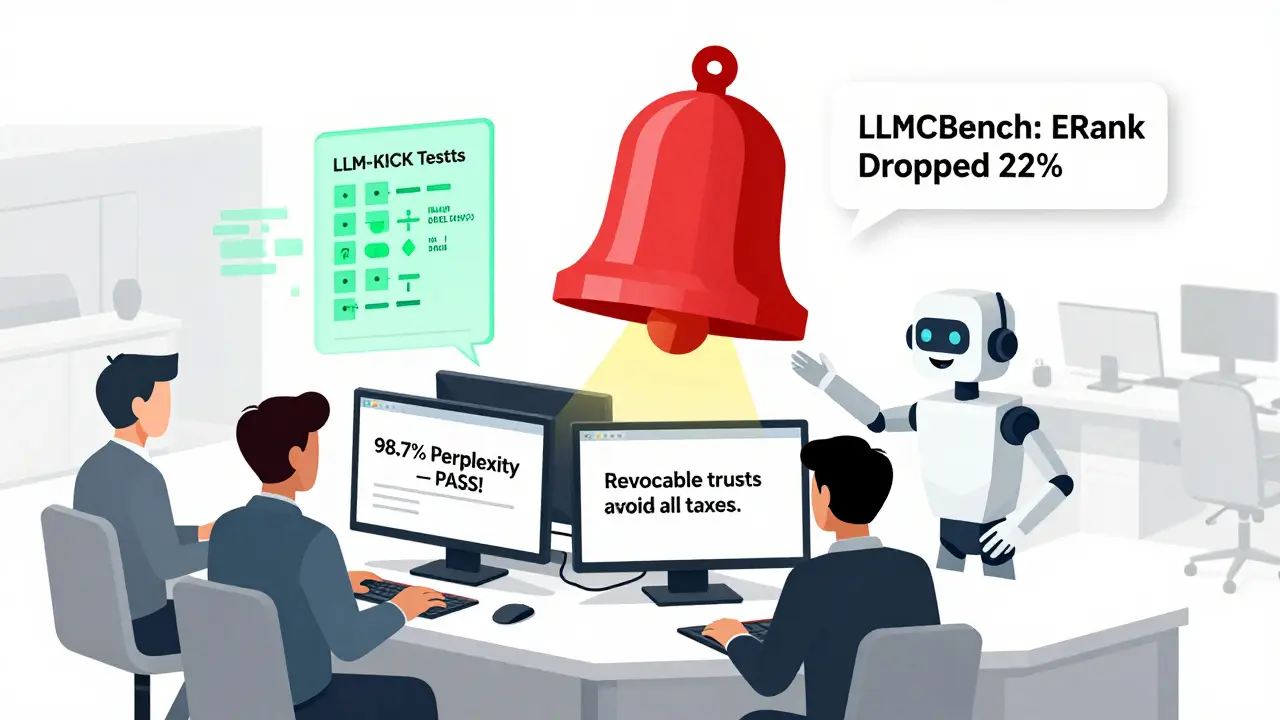
The GitHub issue #442 on the vLLM repo tells a story many teams have lived. A pruned model kept 98.7% of its original perplexity. On paper, it was nearly identical. But when tested on chain-of-thought reasoning tasks-like explaining how a bank loan approval works-it failed 41.2% of the time. It gave confident, well-structured answers that were completely wrong. A Hugging Face user wrote in January 2025: “I used a model that scored 95 on LM Harness. It passed every test. Then a customer asked, ‘What’s the difference between a revocable and irrevocable trust?’ The model gave a textbook definition… but mixed up the tax implications. It was wrong, but sounded perfect.” That’s the trap. Compression doesn’t just reduce size. It distorts reasoning. And if you’re only checking perplexity, you’ll never see it until your users start complaining-or worse, making decisions based on bad answers.What You Should Actually Do (Step by Step)
Here’s a realistic, practical plan based on what top teams are doing in 2025:- Start with perplexity. Run your compressed model on WikiText-2 and C4. If it’s more than 1.5 points worse than the original, stop. Something’s broken.
- Run EleutherAI LM Harness. Test on at least 10 core tasks: MMLU (multi-task language understanding), GSM8K (math), HumanEval (coding), ARC (reasoning), and TruthfulQA. If it drops more than 10% on any of these, reconsider the compression level.
- Test with LLM-KICK. If this is for a high-stakes application (healthcare, finance, legal), this is non-negotiable. Use the 15 knowledge-intensive tasks. If accuracy falls below 60%, the model isn’t ready.
- Check hardware performance. Measure inference time on your target device. Don’t just test on an A100. Test on an RTX 4090, a Jetson Orin, or even a Raspberry Pi 5 with a quantized model. Real-world speed matters more than lab benchmarks.
- Run adversarial prompts. Ask the model to contradict itself. Give it conflicting facts. See if it holds its ground or just makes things up. LLMCBench’s trustworthiness dimension helps here.
The Big Picture: Why This Matters in 2025
The global market for compressed LLMs is projected to hit $4.7 billion by 2027. Companies aren’t just testing models-they’re deploying them in production. The EU AI Act now requires “comprehensive capability validation” for any compressed model used in high-risk systems. That means legal liability if you skip proper evaluation. In January 2025, McKinsey found 68% of Fortune 500 companies use compressed models in production. That’s up from 29% two years ago. But only 47% use LLM-KICK. Only 33% use LLMCBench. Most are still relying on perplexity and basic accuracy scores. That’s like flying a plane with only a speedometer and no altimeter. You might think you’re fine-until you hit the ground.What’s Coming Next
By July 2025, LLM-KICK will be integrated into Hugging Face’s official evaluation suite. That means easier access. By September, MLCommons will release standardized APIs for compression evaluation-finally making it possible to compare apples to apples across different tools. There’s also the “Lottery LLM Hypothesis,” a new idea from April 2025. It suggests that compressed models don’t just lose ability-they learn to compensate. They start relying on external tools, retrieval systems, or human feedback loops to make up for what they’ve lost. That’s a whole new layer of evaluation: not just what the model knows, but how it *uses* what it has.Final Advice: Don’t Trust the Numbers. Trust the Test.
Compression isn’t magic. It’s trade-offs. Every percentage point of size saved is a risk you’re taking. The old ways of measuring success are obsolete. Perplexity is a relic. Accuracy on simple tasks is misleading. If you’re evaluating a compressed LLM, you need to ask: Can it do the job when it matters? Not when it’s easy. Not when the data is clean. But when it’s messy, ambiguous, or high-stakes. Use LLM-KICK. Use EleutherAI. Use LLMCBench if you can afford the time. And never, ever trust a compressed model that hasn’t been tested on real reasoning, not just word prediction. The models are getting smaller. The stakes are getting higher. Your evaluation protocol has to grow up too.Is perplexity still useful for evaluating compressed LLMs?
Perplexity is still useful as a first filter-it tells you if a model is fundamentally broken. But it’s not enough. A compressed model can have near-identical perplexity to the original while failing dramatically on reasoning, knowledge recall, or adversarial prompts. Use perplexity to catch obvious failures, but never rely on it alone.
What’s the best free tool to evaluate compressed LLMs?
EleutherAI LM Harness is the most widely used and well-documented free tool. It supports 62 benchmarks across 350+ tasks and integrates easily with Hugging Face models. For more advanced testing, LLM-KICK is also free and open-source, though it requires more setup and computational power.
Do I need to run all three benchmarks (EleutherAI, LLM-KICK, LLMCBench)?
No. For most teams, start with EleutherAI LM Harness. If your model is for a high-risk use case-like legal advice, medical summaries, or financial analysis-add LLM-KICK. LLMCBench is overkill unless you’re deploying at enterprise scale and need to optimize for hardware, cost, and trustworthiness across multiple dimensions.
How much GPU memory do I need to test LLM-KICK?
LLM-KICK requires at least 48GB of vRAM to evaluate a 7B-parameter model fully. Smaller models (2.7B-3.5B) can run on 24GB, but you’ll need to reduce batch size and test time. If you don’t have that hardware, consider using cloud instances like AWS p3.2xlarge or Lambda Labs’ 4x A100 nodes.
Why do compressed models perform worse on low-resource languages?
Compression techniques like pruning and quantization remove redundant patterns. But low-resource languages already have fewer training examples, so the model has less redundancy to begin with. When you compress it, you’re removing the last bits of signal it had. Studies show compressed models degrade 15.8-22.3% more on low-resource languages than on English or Mandarin, which is why evaluation protocols must include multilingual benchmarks.
- Dec, 8 2025
- Collin Pace
- 10
- Permalink
- Tags:
- compressed LLM evaluation
- LLM quantization
- model compression benchmarks
- LLM-KICK
- EleutherAI LM Harness
Written by Collin Pace
View all posts by: Collin Pace