Factuality and Faithfulness Metrics for RAG-Enabled Large Language Models

You’ve built your Retrieval-Augmented Generation (RAG) system. It looks good in the demo. But when you push it to production, users start asking tricky questions. The model answers confidently, but is it right? More importantly, is it sticking to the documents you fed it, or is it making things up?
This is where most teams hit a wall. Traditional metrics like BLEU or ROUGE tell you if the output sounds like a reference answer, but they don’t tell you if the answer is true or if it’s grounded in your specific data. To build trust, especially in high-stakes fields like healthcare or finance, you need to measure two distinct things: factuality and faithfulness.
The Core Problem: Why Standard Metrics Fail
Let’s be clear about why this matters. In 2023, Gartner predicted that 70% of enterprise LLM deployments would incorporate RAG by 2025. That number is already shifting as we move through 2026. But with adoption comes risk. A hallucinated medical diagnosis or a fabricated legal citation isn’t just a bug; it’s a liability.
Standard natural language processing metrics are blunt instruments. BLEU and ROUGE compare n-gram overlaps between your model’s output and a "gold" reference text. This works for translation tasks where there’s one correct phrasing. But in open-ended Q&A, there are many ways to phrase a correct answer. Worse, these metrics ignore the retrieval step entirely. They can’t tell you if the model ignored the retrieved context and relied on its pre-trained memory instead.
That’s why the industry has shifted toward semantic evaluation. We need metrics that understand meaning, not just word matching. We need to know if the model is lying (lack of factuality) or if it’s misrepresenting your source material (lack of faithfulness).
Defining the Difference: Factuality vs. Faithfulness
These terms are often used interchangeably, but they measure different failures. Understanding the distinction is the first step in building a robust evaluation pipeline.
| Metric Type | Definition | What It Checks | Failure Example |
|---|---|---|---|
| Faithfulness | Does the generated answer strictly adhere to the retrieved context? | Checks for unsupported claims, contradictions, or information added from outside the provided snippets. | The retrieved doc says "Company X revenue was $1B." The model says "Company X revenue was $1.5B because of new sales." (The "new sales" part is ungrounded). |
| Factuality | Is the generated answer true according to real-world knowledge? | Checks against external, verifiable truth, regardless of whether the retrieved context was correct or complete. | The retrieved doc is wrong and says "Paris is in Germany." The model faithfully repeats this error. It is faithful to the context, but not factual. |
As noted by researchers at Aman.ai, a model can be perfectly faithful to a bad document. If your retrieval system pulls an irrelevant or outdated snippet, and the model quotes it verbatim, your faithfulness score will be high, but your factuality score will crash. You need both metrics to get a full picture of system health.
Key Metrics for Evaluating Retrieval Quality
Before the model even generates text, the retrieval engine must do its job. If the right documents aren’t found, no amount of prompt engineering will save you. Two critical metrics here are Context Precision and Context Recall, popularized by frameworks like RAGAS (Retrieval-Augmented Generation Assessment Suite).
- Context Precision: This measures how much of the retrieved evidence is actually relevant. It’s calculated as the number of relevant evidence chunks divided by the total number of retrieved chunks. High precision means the model isn’t distracted by noise.
- Context Recall: This measures whether all necessary evidence was retrieved. It’s the number of relevant evidence chunks used divided by the total relevant chunks available in your corpus. Low recall means the model might be missing key facts needed to answer the question fully.
There’s a trade-off here. As Weights & Biases highlights, boosting Recall@k (retrieving more documents) can hurt answer precision if the model gets confused by irrelevant information. Conversely, too low recall misses critical evidence. Finding the sweet spot requires testing both metrics simultaneously.

Measuring Faithfulness: Grounding the Output
Once the context is retrieved, we need to ensure the generation step stays honest. The gold standard for this is Claim Verification.
Instead of judging the whole response, modern approaches break the answer down into atomic claims. For example, if the model says "Apple released the iPhone in 2007, designed by Steve Jobs," that’s two claims. Each claim is checked against the retrieved context.
Frameworks like AttributionEval use citation entailment accuracy. They check if the cited snippets logically entail the corresponding claims. A simple but effective method is string-match checking, such as Precision@k of source citation, which verifies if the answer contains sentences found in the top-k retrieved documents. However, this is brittle. Paraphrasing breaks it.
This is why LLM-as-a-Judge has become the dominant approach. You prompt a separate, powerful LLM (like GPT-4 or Claude 3) to act as an evaluator. A typical prompt from Evidently AI looks like this:
"Is the answer faithful to the retrieved context, or does it add unsupported information, omit important details, or contradict the source? Return 'faithful' or 'not faithful'."
This method is flexible and understands nuance, but it adds cost and latency. Every evaluation query requires an additional API call. For high-volume applications, this computational overhead is a significant consideration.
Measuring Factuality: Checking Against Truth
Faithfulness ensures the model uses your data. Factuality ensures the data (and the model’s internal knowledge) is correct. This is harder because "truth" is dynamic.
FactScore, developed by Dr. Percy Liang’s team at Stanford, is a leading benchmark. It breaks responses into atomic claims and verifies them against a large knowledge base. However, studies by Wang et al. (2023) show that even state-of-the-art verifiers using GPT-4 plus search tools only achieve an F1 score of 0.63 in identifying false claims. Human annotators still outperform automatic systems.
A major breakthrough came with the SAFE (Search-Augmented Factuality Evaluator) framework introduced by Wei et al. (2024). SAFE addresses the issue of "reference independence." Old methods compared outputs to a static reference text. SAFE dynamically retrieves evidence during evaluation, mimicking how a human fact-checker would work. This is crucial for RAG systems where the retrieved corpus changes over time.
Benchmarks and Datasets: How to Test Your System
You can’t evaluate what you can’t measure. The community has standardized several datasets for testing RAG factuality and faithfulness. Choosing the right one depends on your application’s complexity.
- TruthfulQA: Contains 817 questions designed to test if models propagate common false beliefs. Good for measuring general knowledge bias.
- HotpotQA: Features 113,000 questions requiring multi-step reasoning across multiple documents. Essential for testing complex RAG chains.
- MMLU (Massive Multitask Language Understanding): Includes 15,700 questions covering diverse subjects from elementary math to US history. Useful for broad knowledge assessment.
- FRANQ: Introduced in May 2025, this dataset specifically annotates long-form QA for both factuality and faithfulness, addressing the gap in evaluating detailed, nuanced responses.
If your app handles medical or legal queries, generic benchmarks aren’t enough. You need domain-specific fine-tuning and evaluation. Research shows that supervised fine-tuning (SFT) with knowledge injection can improve accuracy by 15-22% in these verticals, but only if paired with rigorous factuality metrics.
Implementation Challenges and Best Practices
Implementing these metrics isn’t plug-and-play. Teams report a learning curve of 2-3 weeks to set up basic pipelines. Here are the biggest hurdles:
- Ambiguity: Some claims are subjective or lack clear ground truth. Human annotators often disagree, making automated scoring noisy.
- Cost: Using LLM-as-a-judge for every inference is expensive. Most organizations adopt a hybrid approach: run heavy evaluation during development and training, then use lighter, rule-based checks in production.
- Fast-Changing Facts: Static benchmarks rot quickly. A fact about a CEO’s tenure might be true today and false next month. Systems like SAFE help, but continuous monitoring is required.
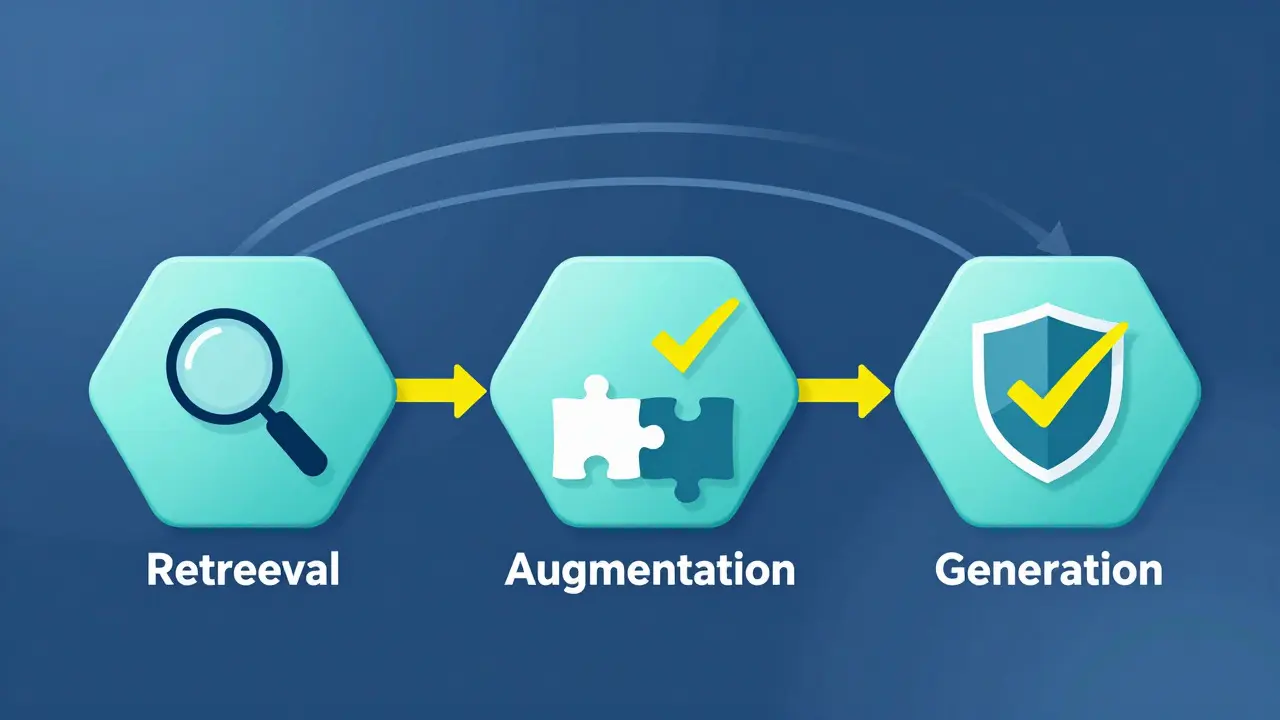
The best practice emerging in 2026 is modular evaluation. Don’t just score the final answer. Score the retrieval (precision/recall), the augmentation (context sufficiency), and the generation (faithfulness/factuality) separately. This allows you to pinpoint exactly where the failure occurred. Did the retriever fail? Or did the generator hallucinate despite good context?
The Future of RAG Evaluation
We’re moving toward integrated platforms. By 2027, comprehensive factuality evaluation is expected to become mandatory for high-risk AI applications under emerging regulations in the EU and US. NIST’s AI Risk Management Framework is already pushing for standardized protocols.
Future developments include uncertainty quantification. Instead of just saying "true" or "false," models will flag low-confidence responses. Tools like FRANQ are paving the way for this. The goal is an F1 score above 0.85 for automatic verifiers by 2026, closing the gap with human judgment.
For now, start simple. Implement context relevance and answer relevance scores. Then layer on faithfulness checks using an LLM judge. Finally, integrate factuality benchmarks like FactScore or SAFE for your most critical use cases. Remember, in high-stakes domains, accuracy isn’t optional-it’s life-critical.
What is the difference between factuality and faithfulness in RAG?
Faithfulness measures whether the model's output is supported by the retrieved context, ensuring it doesn't add unsupported information. Factuality measures whether the output corresponds to real-world truth, regardless of the retrieved context. A model can be faithful to a wrong document (high faithfulness, low factuality).
Which metrics should I use to evaluate my RAG system?
Start with Context Precision and Context Recall to evaluate retrieval quality. Use Faithfulness metrics (like citation entailment) to ensure grounding. Use Factuality benchmarks (like FactScore or TruthfulQA) to check for real-world accuracy. For production, consider LLM-as-a-judge approaches for nuanced evaluation.
What is RAGAS and how does it help?
RAGAS (Retrieval-Augmented Generation Assessment Suite) is an open-source framework that provides standardized metrics for evaluating RAG systems. It simplifies the calculation of context precision, recall, faithfulness, and answer relevance, allowing developers to benchmark their systems easily.
Why are traditional metrics like BLEU insufficient for RAG?
BLEU and ROUGE rely on n-gram overlap with a reference text. They don't account for semantic meaning, retrieval grounding, or factual correctness. A model can get a high BLEU score by repeating a reference answer even if it ignores the retrieved context or produces a hallucinated but similar-sounding sentence.
How can I reduce the cost of evaluating RAG factuality?
Use a tiered approach. Run lightweight, rule-based checks (like string matching) for high-volume traffic. Reserve expensive LLM-as-a-judge evaluations for development, testing, and high-stakes queries. Additionally, cache evaluation results for repeated queries to avoid redundant API calls.
- Aug, 8 2026
- Collin Pace
- 0
- Permalink
Written by Collin Pace
View all posts by: Collin Pace