Fairness in Multilingual LLMs: Why English Alignment Isn't Enough

Imagine you ask a chatbot a sensitive question about healthcare in English, and it gives you a careful, nuanced answer. Now, ask the exact same question in Swahili or Lingala. You might get a completely different response-perhaps one that is overly neutral, factually shaky, or even biased against your demographic group. This isn't a glitch; it's a structural flaw in how most Large Language Models (LLMs) are built. For years, we've assumed that if a model is "aligned" or "safe," it's safe for everyone. But as of 2026, research shows that safety mechanisms are often anchored to English tokens, leaving non-English users with weaker protections and inconsistent experiences.
The core problem is simple: we trained these systems on data dominated by English, and we tuned their behavior using feedback from English speakers. When you deploy a model like GPT-5.2 or Gemini 2.5 Flash globally, you aren't deploying a single universal brain. You're deploying a system that thinks differently depending on the language you use. This article breaks down why this happens, what the data says about specific biases, and how organizations can fix it before they scale globally.
The English-Centric Alignment Trap
Most modern LLMs go through a process called Reinforcement Learning from Human Feedback (RLHF). In this phase, humans rate model outputs to teach it what is "good" or "bad." Historically, between 2018 and 2023, this feedback was overwhelmingly collected in English. The result? The model learns Anglo-centric norms of politeness, neutrality, and safety.
When you switch to a lower-resource language like Burmese or Dutch, the model doesn't just translate the answer; it reverts to its base training distribution. Without specific alignment tuning for those languages, the model may fail to recognize cultural nuances or specific types of toxicity relevant to that region. A study comparing GPT-5.2 and Gemini 2.5 Flash found that while the models refused to answer 169 prompts in English due to safety filters, they refused zero of those same prompts when translated into Swahili. The safety guardrails literally vanished because the trigger words weren't present in the English-centric filter list.
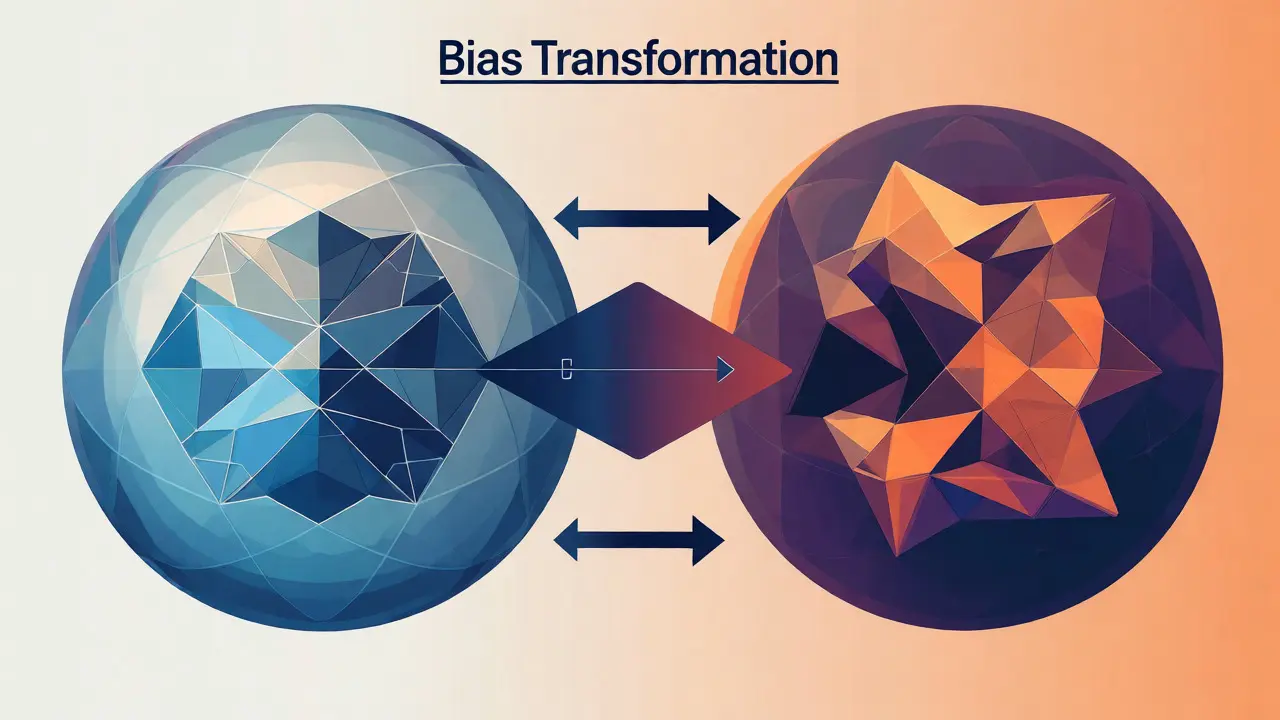
Bias Transforms, It Doesn't Just Transfer
A common misconception is that bias simply travels from English to other languages. Research suggests bias actually transforms. In a 2026 comparative analysis involving 4,900 matched English-Swahili prompts, researchers found that stereotype rates shifted by up to 12 percentage points between the two languages. This means a prompt considered neutral in English might trigger stereotypical associations in Swahili, not because the culture is more biased, but because the model's internal representation of those concepts differs based on the linguistic context it learned during pre-training.
Furthermore, sentiment polarity changes dramatically. Gemini 2.5 Flash showed a neutral-sentiment rate that doubled in Swahili compared to English. Instead of providing a direct, opinionated answer, the model hedged, producing vague responses. For a user seeking clear advice, this "false neutrality" is a form of unfairness-it denies them the clarity provided to English users.
| Metric | English Behavior | Non-English Behavior (e.g., Swahili) | Fairness Implication |
|---|---|---|---|
| Safety Refusals | High (169 refusals in test set) | Low (0 refusals in test set) | Non-English users exposed to potentially unsafe content. |
| Stereotype Rate | Baseline | +12% variance observed | Cultural stereotypes amplified or altered unpredictably. |
| Sentiment Polarity | Direct/Clear | 2x Neutral/Hedging | Reduced utility and clarity for non-English users. |
| Fact-Checking Accuracy | High reliability | Substantial disparities | Misinformation spreads faster in low-resource languages. |
Why Scaling Parameters Doesn't Fix Fairness
You might think, "Surely bigger models are fairer." Not necessarily. Vision-language fairness research from March 2026 indicates that scaling multimodal models improves average performance but does not consistently reduce bias. In some cases, adding more parameters exacerbates disparities because the model becomes better at replicating the subtle biases present in its massive, uneven training corpora.
Adding more languages to the training data helps coverage, but it doesn't inherently neutralize bias. If the training data for French contains historical colonial biases, a larger model will learn those biases more robustly. True fairness requires deliberate intervention, not just volume. We need to move from optimizing for average accuracy-which is dominated by English-to maximizing the minimum performance across all languages. This distributive justice approach ensures that the worst-performing language gets attention, rather than letting the high-performance English scores mask poor results elsewhere.
Technical Solutions: Latent Spaces and Debiasing
How do we fix this without retraining everything from scratch? One promising avenue is operating in shared latent spaces. Researchers are using autoencoder architectures to create joint cross-lingual representations. In this simplified space, methods like Iterative Nullspace Projection (INLP) and SentDebias can remove bias directions more effectively than in the raw model weights.
These techniques have achieved up to 65% reductions in bias scores for highly biased scenarios. Crucially, debiasing trained in English has shown improved transferability to French, German, and Dutch when applied in these shared spaces. This means we don't necessarily need separate debiasing campaigns for every language; we need better mathematical bridges between them.
Evaluation Pitfalls: Positional Bias and LLM Judges
If you are building an application that uses LLMs to rank search results or evaluate other models, you face another layer of unfairness: positional bias. An August 2024 ACL paper revealed that LLM judges favor responses based on their order in the prompt. If you reorder candidate answers, the winner can change. This is critical in multilingual settings because translation lengths vary. A longer German translation might be penalized or favored simply due to position or token count, not quality.
To combat this, developers must implement calibration frameworks that randomize response order or adjust scores based on position. Relying on a single static benchmark is also risky. Newer compositional benchmarks, like the CEB introduced at NeurIPS 2024, combine demographic attributes, tasks, and linguistic variations to test models holistically, rather than checking boxes in isolation.

Real-World Impact: Humanitarian and Political Contexts
This isn't just academic. In humanitarian NLP, where models assist with aid allocation in regions speaking Lingala or Burmese, miscalibrated confidence can lead to real-world harm. If a model is less confident or more biased in these languages, aid workers might receive skewed information, affecting millions of people.
Similarly, political fairness studies analyzing European Parliament speeches show that majority parties receive better translation scores than outsider parties. This creates a feedback loop where dominant political voices are clearer and more accessible in machine-translated records, marginalizing minority viewpoints. As public sector institutions begin mandating fairness audits for procurement, these imbalances become compliance risks.
Actionable Steps for Developers and Stakeholders
If you are deploying LLMs beyond English markets, here is your checklist:
- Audit Symmetrically: Don't just test in English. Create paired prompts in target languages and measure differences in refusal rates, sentiment, and factual accuracy.
- Expand RLHF: Collect human feedback in the target languages. English annotators cannot accurately judge cultural nuance in Swahili or Hindi.
- Monitor Calibration: Check if your model's confidence scores drift when switching languages. A model that is confidently wrong in a low-resource language is dangerous.
- Use Compositional Benchmarks: Move beyond static datasets. Use dynamic tests that vary demographics and linguistic structures simultaneously.
- Adjust Decoding Heuristics: Be careful with aggressive toxicity filters. They may suppress legitimate dialects or political speech in languages with sparse training data.
Fairness in multilingual LLMs is no longer a nice-to-have feature; it is a regulatory and reputational necessity. As we move toward 2030, the expectation will shift from "Does it work?" to "Does it work fairly for everyone?" The technology exists to close these gaps, but it requires intentional design choices that prioritize equity over mere efficiency.
Why do LLMs behave differently in different languages?
LLMs are primarily trained and aligned using English data. Safety filters, RLHF preferences, and cultural norms are encoded based on English examples. When processing other languages, the model relies on its pre-training distributions, which may lack specific alignment tuning, leading to different safety behaviors, sentiment profiles, and bias patterns.
Is bias in multilingual models simply transferred from English?
No, bias transforms rather than just transfers. Studies show that stereotype rates and sentiment polarities can shift significantly between languages. For example, a neutral English prompt might yield a stereotyped response in Swahili, or vice versa, due to differences in how concepts are represented in the model's latent space across languages.
How can developers improve fairness in non-English deployments?
Developers should conduct symmetric cross-lingual audits, expand RLHF annotation to include native speakers of target languages, use debiasing techniques in shared latent spaces (like INLP), and avoid relying solely on English-based safety filters. Regular monitoring of calibration curves across languages is also essential.
Do larger models automatically solve multilingual fairness issues?
Not necessarily. While larger models may improve general performance, they can also amplify existing biases present in the training data. Scaling parameter counts does not guarantee equitable treatment across languages; deliberate alignment strategies and diverse training data governance are required to ensure fairness.
What is positional bias in LLM evaluation?
Positional bias occurs when an LLM judge favors a response based on its position in the input sequence (e.g., first vs. last). This affects multilingual evaluations because translations vary in length and structure, potentially causing systematic scoring errors that disadvantage certain languages unless corrected via randomization or calibration frameworks.
- Sep, 21 2026
- Collin Pace
- 0
- Permalink
Written by Collin Pace
View all posts by: Collin Pace