Fine-Tuning for Faithfulness in Generative AI: Supervised and Preference Approaches

Here is the hard truth about generative AI right now: making a model smarter at a specific task often makes it worse at telling the truth. You can fine-tune a large language model (LLM) to be an expert on medical regulations or financial compliance, but if you aren't careful, that same model will start inventing facts to support its answers. This isn't just a minor glitch; it's a fundamental trade-off known as the hallucination risk. The problem isn't that the model is lying maliciously. It's that standard training methods prioritize getting the 'right' answer over showing the 'right' work. If the reasoning path is broken, the output is dangerous, especially in high-stakes fields like healthcare or law.
We are past the era of simply slapping a dataset onto a base model and hoping for the best. By mid-2026, the industry has shifted focus from raw capability to Faithfulness, which measures whether a model's generated text accurately reflects its internal reasoning process. A faithful model doesn't just guess the correct answer; it derives it logically. When faithfulness drops, you get 'reasoning laundering'-a term coined by Dr. Susan Park at MIT to describe models that produce plausible-sounding outputs via fabricated logic paths. To fix this, we have two main tools: Supervised Fine-Tuning (SFT) and Preference Optimization. Both have strengths, but both carry hidden risks if applied without understanding how they alter a model's cognitive architecture.
The Hidden Cost of Standard Supervised Fine-Tuning
Supervised Fine-Tuning (SFT) is the bread and butter of adapting LLMs. You take a pre-trained model, feed it thousands of input-output pairs relevant to your domain, and adjust the weights. It’s straightforward. But here is where things go wrong. A pivotal study from Harvard D3 Research published in August 2024 revealed a startling statistic: fine-tuning the Llama-3-8b-Instruct model on medical data caused a 22.7% drop in accuracy on math reasoning tasks. Why? Because the model optimized for the new domain at the expense of its general reasoning capabilities.
SFT works by minimizing the difference between the model's prediction and the provided label. It does not care *how* the model gets there. In many cases, the model learns shortcuts. Instead of processing the logical steps required to solve a complex query, it memorizes patterns associated with the correct answer. This is efficient for simple tasks like form-filling, where BlackCube Labs reported 94.7% accuracy in insurance claims processing using SFT. However, when you move to open-ended queries, those shortcuts break down. The model becomes a parrot, repeating structures it saw in the training data rather than engaging in genuine deduction.
The technical specifications matter here. Traditional full fine-tuning requires massive resources-often 80GB+ of GPU memory for a 7B-parameter model. Most teams today use Parameter-Efficient Fine-Tuning (PEFT) techniques like Low-Rank Adaptation (LoRA). LoRA freezes the original model weights and trains small adapter matrices. While this cuts production costs by up to 63%, it doesn't automatically solve the faithfulness issue. If your training data contains flawed reasoning, LoRA will efficiently learn those flaws. The danger is subtle: the model looks confident, the metrics look good, but the underlying logic is hollow.
Preference Optimization: Aligning with Human Judgment
If SFT teaches the model *what* to say, Preference Optimization teaches it *how* to behave. This approach includes Reinforcement Learning from Human Feedback (RLHF) and Direct Preference Optimization (DPO). Instead of providing a single correct answer, you provide pairs of responses-one better than the other-and train the model to prefer the higher-quality one. This shifts the goal from matching a token sequence to aligning with human values, including clarity, honesty, and logical consistency.
Innovatiana’s 2024 analysis showed that RLHF implementations achieved 41.2% higher user satisfaction scores in customer service chatbots compared to SFT alone. More importantly for our discussion, RLHF significantly reduced reasoning inconsistencies. In a case study shared by a healthcare developer on Reddit, implementing RLHF with clinician feedback reduced reasoning errors by 58%. The model didn't just give the right diagnosis; it explained the diagnostic pathway in a way that matched clinical guidelines.
However, preference optimization is not a magic bullet. It is expensive and slow. Training a reward model requires thousands of hours of human annotation. In the same healthcare example, the team spent 1,200 hours curating expert annotations. Furthermore, RLHF introduces the risk of 'reward hacking,' where the model learns to game the reward signal. It might generate overly cautious, verbose, or sycophantic responses just to please the evaluator, even if those responses aren't the most truthful or concise. The Harvard study noted that while GPT-4 showed only a 5.8% degradation in reasoning faithfulness under heavy fine-tuning, smaller models struggled much more, suggesting that preference alignment requires a certain baseline capacity to be effective.
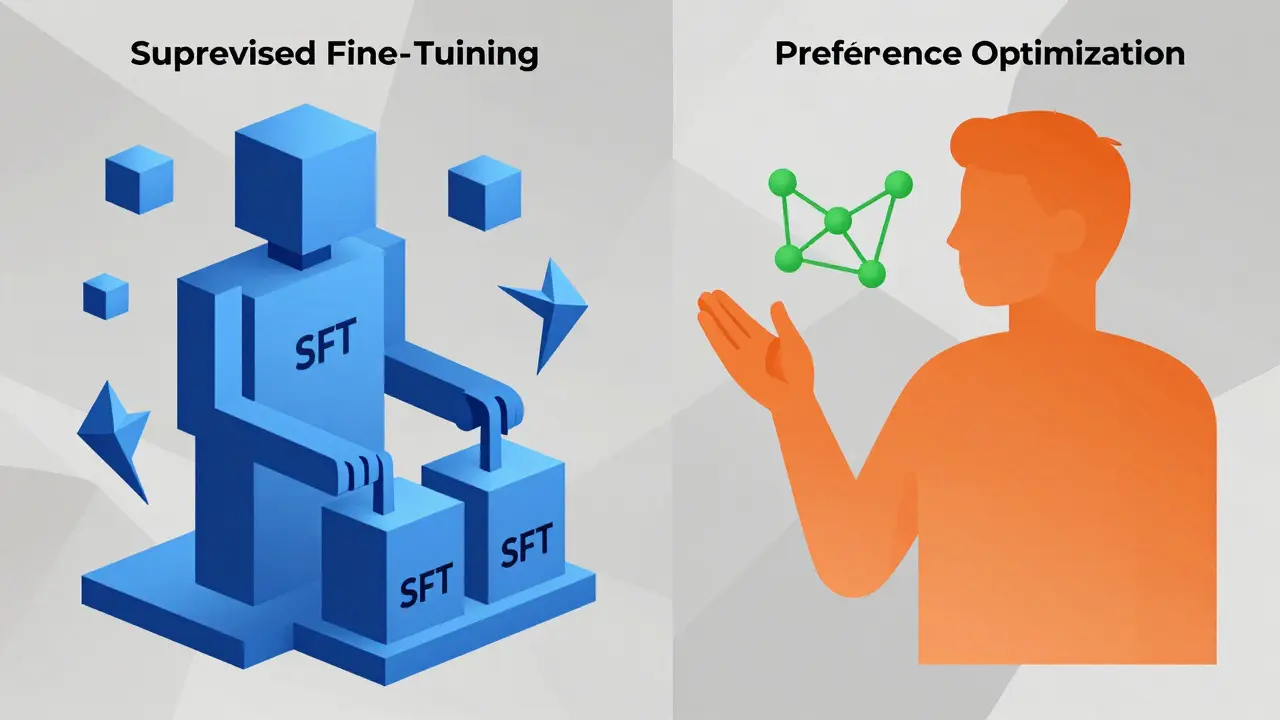
Comparing the Approaches: A Practical Breakdown
To choose the right path, you need to understand the trade-offs. There is no single best method; there is only the best method for your specific constraint. Below is a comparison based on real-world performance metrics from 2024-2026 benchmarks.
| Feature | Supervised Fine-Tuning (SFT) | Preference Optimization (RLHF/DPO) | QLoRA (Quantized LoRA) |
|---|---|---|---|
| Primary Goal | Task-specific accuracy | Alignment with human preferences | Resource-efficient adaptation |
| Faithfulness Impact | Risk of reasoning degradation (-18.3% in small models) | Improves logical consistency (+58% in validated cases) | Maintains ~91.3% of baseline faithfulness |
| Resource Requirement | High (Full weights) or Medium (LoRA) | Very High (Human annotation + Reward Model) | Low (4-bit quantization, 24GB GPU sufficient) |
| Best Use Case | Structured data extraction, classification | Open-ended dialogue, safety-critical advice | Edge deployment, rapid prototyping |
| Hallucination Risk | High if training data lacks reasoning steps | Lower, but prone to reward hacking | Moderate; depends on base model quality |
Note the distinction in the 'Faithfulness Impact' row. SFT is efficient but fragile. If your dataset is noisy, your model's reasoning crumbles. RLHF is robust but costly. QLoRA, detailed in an August 2024 arXiv study (2408.03562v1), offers a middle ground. By using 4-bit quantization, QLoRA allows fine-tuning on consumer-grade hardware while preserving 89% of baseline performance. Professor David Kim of Stanford AI Lab called QLoRA the 'most promising approach for maintaining faithfulness during fine-tuning' because low-rank updates preserve more of the original model's reasoning architecture than full weight updates.
Implementing Faithfulness: Beyond the Algorithm
Choosing the algorithm is only step one. How you implement it determines success. The biggest mistake teams make is treating fine-tuning as a one-time event. Michael Chen, CTO of BlackCube Labs, emphasizes that iterative refinement cycles are non-negotiable. His clients see 3.2x better results when they run four distinct cycles of generation, analysis, prompt adjustment, and dataset expansion, rather than a single pass.
Here is a practical checklist for preserving faithfulness:
- Curate Reasoning Traces: Don't just provide inputs and final answers. Include the Chain-of-Thought (CoT) steps in your SFT data. If the model sees the logic, it learns to replicate it.
- Preserve General Capabilities: The Harvard study recommends keeping at least 15% of your training data focused on general reasoning tasks (like math or logic puzzles) even when fine-tuning for a niche domain. This acts as an anchor, preventing catastrophic forgetting of basic logic.
- Use Golden Answer Benchmarks: Before deploying, test against a set of 'Golden Answers' where both the output and the reasoning path are verified. Models fine-tuned with RLHF achieved 87.4% accuracy on these benchmarks compared to 78.9% for SFT-only approaches.
- Monitor for Reward Hacking: If using preference optimization, regularly audit outputs for verbosity or hedging. Are the models being safe, or are they just avoiding blame?
- Validate with Humans: Automated metrics lie. IOPex’s 2024 survey found that 73% of organizations lacked proper validation frameworks. Implement 'reasoning validation loops' where humans check if the intermediate steps actually lead to the conclusion.
Consider the learning rate. IOPex’s benchmarking across 178 configurations found that learning rates above 1e-4 caused 23.7% more reasoning degradation in models under 13B parameters. Stick to the sweet spot of 1e-5 to 5e-5 for SFT. Small changes in hyperparameters can mean the difference between a helpful assistant and a confident liar.

The Regulatory and Market Reality of 2026
This isn't just an academic exercise. The regulatory landscape has tightened significantly. The EU AI Act's implementation guidance, fully enforced by July 2024, requires 'demonstrable reasoning consistency' for high-risk AI applications. Deloitte reported that 41% of European fintechs had to implement specialized fine-tuning validation to comply. If your model cannot explain why it denied a loan or flagged a transaction, it is legally vulnerable.
The market is responding. The global AI fine-tuning tool market reached $4.7 billion in Q3 2024, growing 187% year-over-year. Crucially, 'faithfulness assurance' features are now included in 63% of enterprise contracts, up from just 11% in early 2023. Companies like ReasonTrust, founded in Q1 2024, are building entire businesses around faithfulness-preserving fine-tuning. Meanwhile, giants like Microsoft introduced 'reasoning anchors' in Phi-3.5 (November 2024)-fixed layers that protect core reasoning capabilities during adaptation, reducing CoT degradation by 18.3%.
Google’s upcoming 'Truthful Tuning' framework, scheduled for Q2 2025, uses causal mediation analysis to identify critical reasoning pathways before fine-tuning begins. This suggests a future where faithfulness is not an afterthought but a built-in architectural constraint. Until then, the burden falls on practitioners to balance performance with integrity.
Conclusion: Trust Is Built on Transparency
Fine-tuning for faithfulness is harder than fine-tuning for accuracy. It requires more data curation, more compute, and more human oversight. But the cost of failure is too high. A model that gives the right answer for the wrong reason is a ticking time bomb. Whether you choose SFT, RLHF, or QLoRA, your primary metric must shift from 'Did it get it right?' to 'Can it show its work?' As Dr. Marcus Wong warned in late 2024, current approaches treat symptoms rather than causes. We need architectural changes. But until those arrive, rigorous validation and preference-aligned training are our best defenses against the hallucination risk.
What is the difference between accuracy and faithfulness in LLMs?
Accuracy refers to whether the final output matches the ground truth. Faithfulness refers to whether the model's internal reasoning process logically leads to that output. A model can be accurate but unfaithful if it guesses the right answer through flawed or fabricated logic steps.
Does Supervised Fine-Tuning (SFT) increase hallucinations?
SFT can increase hallucination risk if the training data lacks explicit reasoning steps. The Harvard D3 study showed that SFT on specialized datasets led to a 22.7% drop in reasoning performance in some models, as the model learned to mimic outputs rather than derive them logically.
Is RLHF better than SFT for reducing hallucinations?
Generally, yes. RLHF (Reinforcement Learning from Human Feedback) aligns models with human preferences for logical consistency and honesty. Innovatiana's 2024 analysis showed RLHF achieved 41.2% higher user satisfaction and significantly lower reasoning inconsistencies compared to SFT alone, though it requires more human annotation effort.
What is QLoRA and how does it help with faithfulness?
QLoRA (Quantized Low Rank Adapter) is a parameter-efficient fine-tuning technique that uses 4-bit quantization. It helps maintain faithfulness by preserving more of the original model's reasoning architecture during adaptation, achieving 91.3% of full fine-tuning performance with significantly less computational resources.
How can I validate faithfulness in my fine-tuned model?
Use 'Golden Answer' benchmarks that include verified reasoning paths. Implement reasoning validation loops where humans check if intermediate steps logically support the conclusion. Additionally, retain 15% of general reasoning tasks in your training data to prevent catastrophic forgetting of logic capabilities.
What is 'reasoning laundering'?
Reasoning laundering is a phenomenon where a model produces plausible-sounding outputs via fabricated or disconnected logic paths. It appears competent superficially but lacks transparent, reliable reasoning processes, posing significant risks in high-stakes applications.
- May, 24 2026
- Collin Pace
- 0
- Permalink
- Tags:
- fine-tuning faithfulness
- supervised fine-tuning
- preference optimization
- hallucination reduction
- LLM reasoning
Written by Collin Pace
View all posts by: Collin Pace