GDPR and CCPA Compliance in Vibe-Coded Systems: Data Mapping and Consent Flows
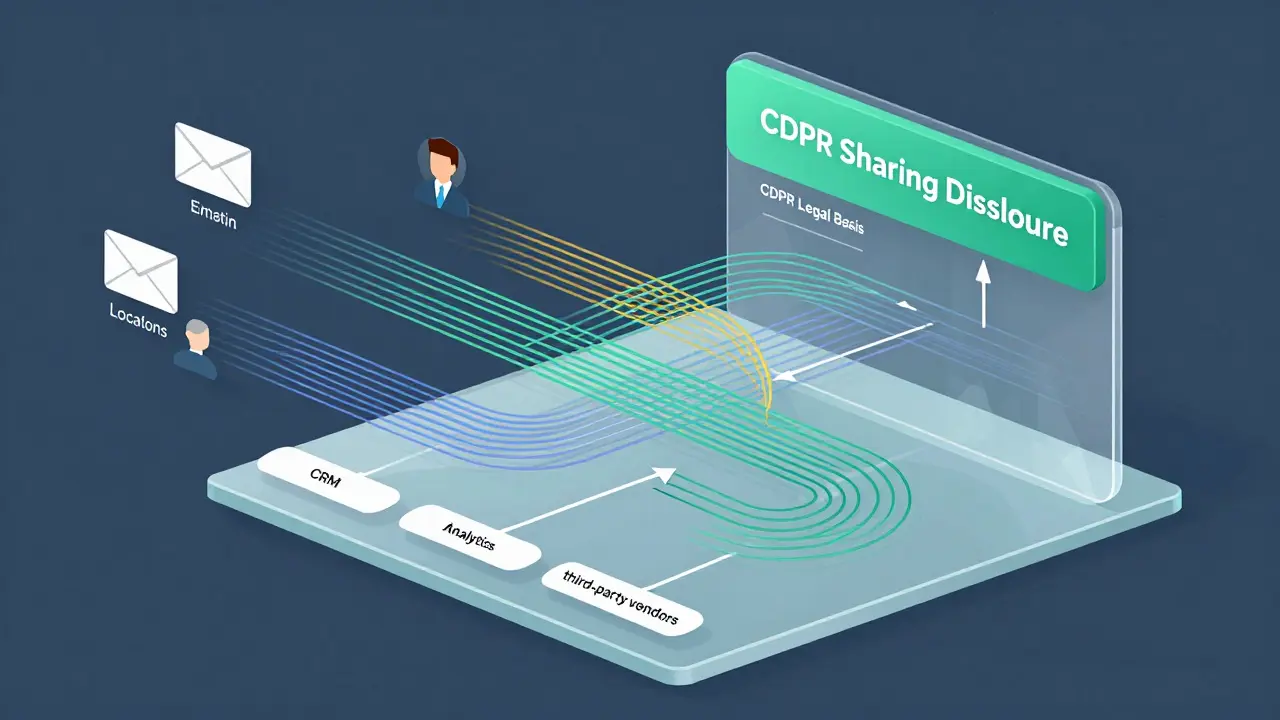
When you build a system that collects user data-whether it’s a mobile app, a website form, or a SaaS platform-you’re not just writing code. You’re creating legal obligations. Under GDPR and CCPA, every line of code that handles personal data must be traceable, justifiable, and controllable. This isn’t about checking boxes. It’s about building systems where data flows are visible, consent is clear, and compliance isn’t an afterthought-it’s baked into the architecture.
What Is Data Mapping, Really?
Data mapping isn’t a spreadsheet you fill out once and forget. It’s a living map of where personal data comes from, where it goes, who touches it, and why. Under GDPR, Article 30 requires organizations to maintain a Record of Processing Activities (RoPA). CCPA, as amended by CPRA, demands similar transparency around the collection, use, and sharing of personal information.Think of it like plumbing. If you don’t know where the pipes run, you can’t fix a leak. Same with data. Without mapping, you can’t answer questions like:
- Which third-party tools are receiving customer email addresses?
- How long are we keeping someone’s location data after they delete their account?
- Did we get proper consent before using biometric data to unlock a feature?
According to the IAPP’s 2025 Privacy Tech Vendor Report, 87% of companies with over $500 million in revenue now have formal data mapping processes. That’s not because they’re being nice-it’s because regulators are asking for it during audits. And if you can’t show the flow, you’re at risk.
GDPR vs. CCPA: What’s Different?
At first glance, GDPR and CCPA seem similar. Both want you to know where data lives. But their rules are built on different foundations.GDPR focuses on legal bases. You can’t just collect data because it’s convenient. You need one of six legal reasons: consent, contract, legal obligation, vital interests, public task, or legitimate interest. For each data flow, you must document which one applies. If you rely on consent, you need proof it was given-freely, specifically, and revocable.
CCPA doesn’t care about legal bases. It cares about purpose and sharing. Is the data being sold? Shared with advertisers? Used to build a profile? CCPA defines "selling" and "sharing" very broadly-even passing data to a vendor for targeted ads counts. And it includes inferences. If you guess someone’s income based on their browsing history, that’s personal information under CCPA.
Here’s a quick comparison:
| Requirement | GDPR | CCPA/CPRA |
|---|---|---|
| Legal basis for processing | Must document one of six legal bases | Not required |
| Personal data definition | Any data linked to an identifiable person | Includes inferences, device IDs, and behavioral profiles |
| Consent requirements | Explicit, granular, revocable | Opt-out for selling/sharing; opt-in for sensitive data |
| Special categories | Stricter rules for health, race, religion, etc. | Requires opt-in for sensitive personal information (SPI) |
| Third-party sharing | Must identify processors and contracts | Must disclose if data is sold or shared |
| Retention periods | Must define deletion triggers | Must align with business purpose |
Many companies think they can use one map for both. That’s risky. A GDPR-compliant map might miss CCPA’s focus on consumer rights and inferences. A CCPA map might skip documenting legal bases entirely. You need a unified approach that covers both.
Building Consent Flows That Work
Consent isn’t a pop-up. It’s a system.Under GDPR, consent must be:
- Specific-not "we may use your data for marketing"-but "we will use your email to send you monthly product updates"
- Freely given-no dark patterns. You can’t make users accept all cookies to access a basic feature
- Easy to withdraw-one click, no hoops
Under CCPA, you don’t need consent for most data collection. But you must honor opt-outs for selling or sharing. And starting January 2026, you need explicit opt-in for sensitive personal information-like health data, precise location, or biometrics.
Here’s how to build consent flows that survive audits:
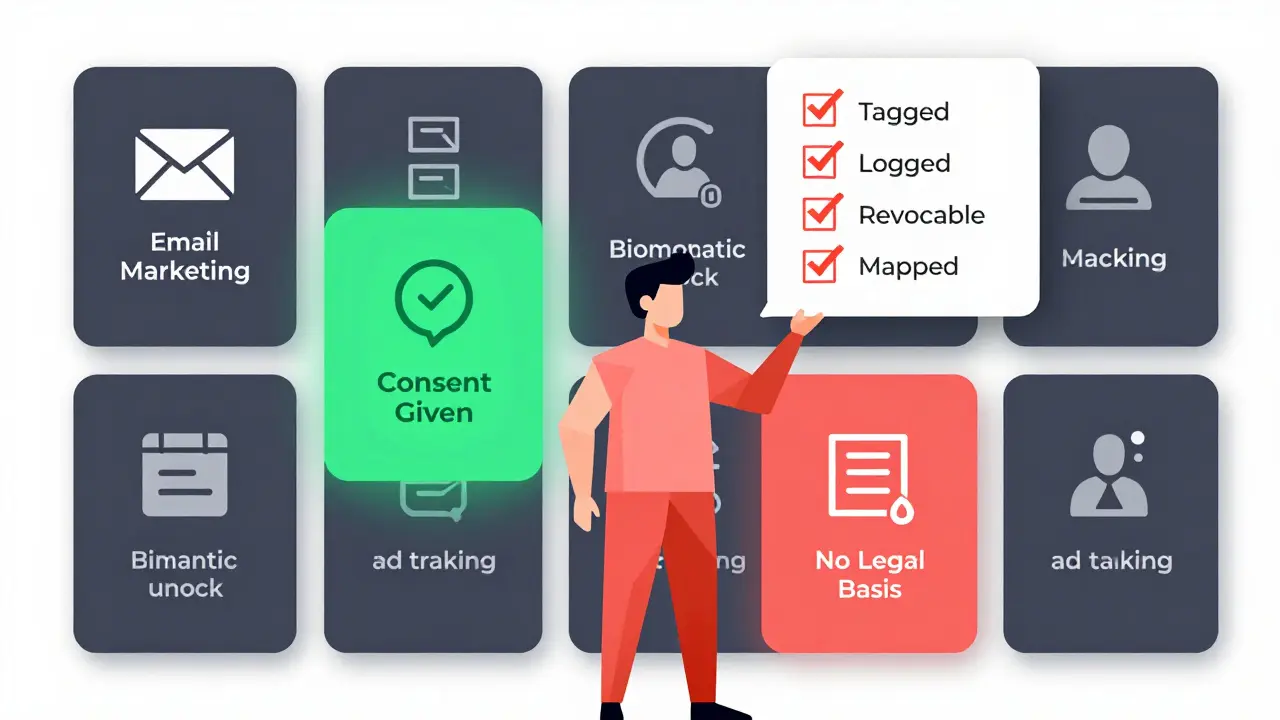
- Tag every data point with its legal basis and purpose. If a user gives consent for email marketing, tag that data as "consent - marketing". If it’s collected for fraud detection, tag it as "legitimate interest - security".
- Link consent to data sources. Don’t just record consent at the form level. Know which database, API, or third-party tool received that data.
- Automate revocation. When someone withdraws consent, trigger automated deletion or anonymization across all systems. Manual cleanup doesn’t scale.
- Log everything. Timestamps, user IDs, IP addresses, consent version-all stored securely. You’ll need this if someone challenges your consent.
Companies that tag data by legal basis see 68% fewer compliance gaps during audits, according to Jane Finlay of Ethyca. Why? Because when regulators ask, "How do you know you had consent?"-you can point to a tag, not a hope.
Where Data Flows Get Messy
The biggest problem isn’t the law. It’s your tech stack.Most companies have:
- Legacy CRM systems from 2015
- Marketing tools that auto-collect IP addresses
- Analytics scripts that send data to six different vendors
- Mobile apps with SDKs that collect device IDs without disclosure
One privacy officer from a mid-sized e-commerce company told Reddit’s r/privacy they spent 147 hours over three months just finding where data went. They found 19 undocumented data flows to third parties. One was a forgotten Google Form collecting names and phone numbers for a 2021 promo campaign. Still active. Still collecting.
Cloud environments make it worse. Data moves between AWS, Azure, and Google Cloud. Tools like Segment, Mixpanel, and Salesforce sync data silently. Without mapping, you’re flying blind.
According to TrustArc’s 2024 benchmark study, organizations using detailed processing activity mapping saw 43% faster DSAR (Data Subject Access Request) responses. Why? Because they knew where the data was. No hunting. No guessing.
How to Start Mapping (Without Overwhelming Your Team)
You don’t need a $200K tool to start. But you do need a process.Follow this five-phase approach:
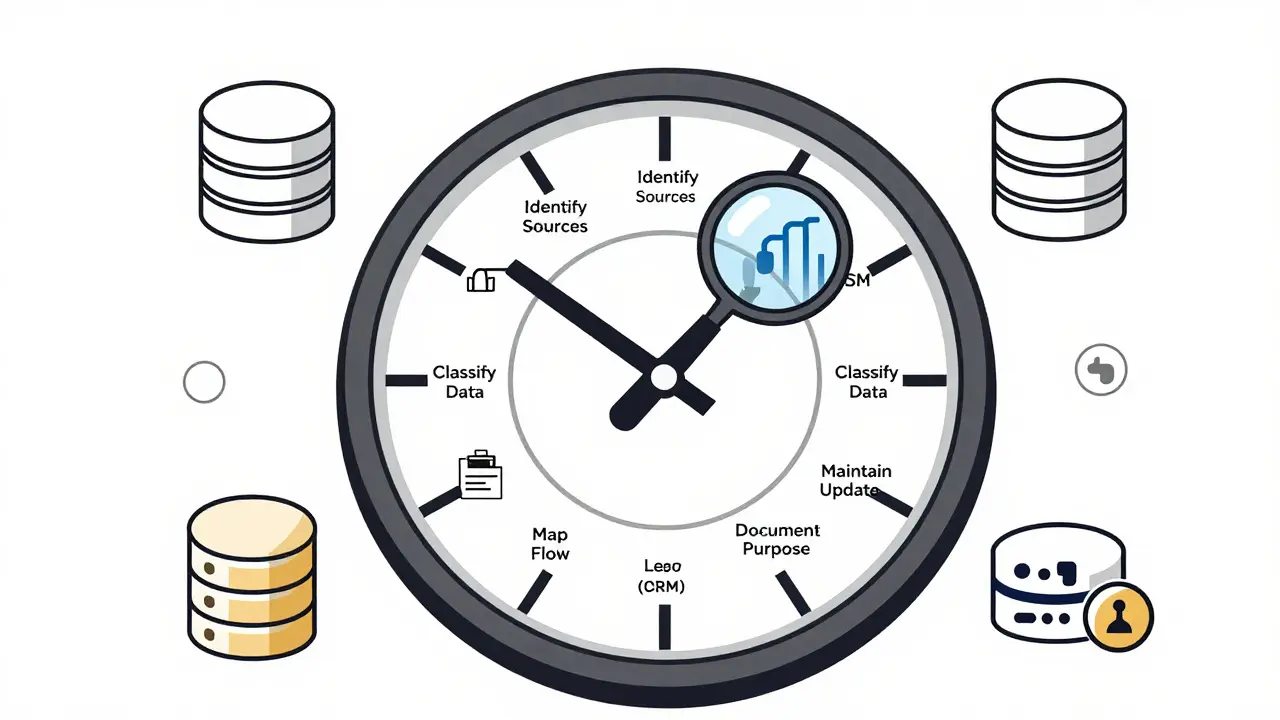
- Identify all data sources-Talk to every department. Marketing, sales, IT, customer support. Ask: "What data do you collect? Where do you store it? Who else gets it?" Don’t trust documentation. Ask people what they actually do.
- Classify data types-Is it name, email, IP, biometrics, purchase history? Under GDPR, some data (like health info) is "special category" and needs extra protection. Under CCPA, inferences count. Don’t skip this step.
- Map the flow-Draw diagrams. Use arrows. Show how data moves from web form → CRM → email tool → analytics dashboard → ad platform. Tools like Lucidchart or Miro help. Even a whiteboard photo works as a starting point.
- Document purposes and legal bases-For each flow, write: "Why are we collecting this?" and "Which legal basis applies?" If it’s consent, link to the consent mechanism. If it’s legitimate interest, explain why.
- Build maintenance into your workflow-Data mapping isn’t a project. It’s a habit. Every time you add a new tool, update the map. Every time you retire a system, remove it. Assign ownership. Marketing owns marketing data. IT owns infrastructure.
Cookie Script’s 2025 benchmarks show this process takes 80-200 hours for companies with 500+ employees. That’s not cheap. But the cost of a violation? Fines up to 4% of global revenue under GDPR. Or $7,500 per intentional CCPA violation.
Tools, Automation, and the Human Trap
The market for data mapping tools hit $1.24 billion in 2025, according to Gartner. Tools like OneTrust, TrustArc, and Usercentrics help automate discovery, tag data, and generate reports.But here’s the catch: 32% of companies using fully automated tools still failed audits in 2025, according to Dr. Rebecca Herold. Why? Because automation finds data-it doesn’t understand context.
Example: Your tool finds a field labeled "user_notes" in your database. It says, "This contains personal data." But is it? Maybe it’s just "Customer said they liked the color blue." That’s not personal under GDPR. But if it says, "Customer has chronic migraines and avoids sunlight," that’s sensitive. Only a human can decide that.
Best practice? Use tools to find the data. Use people to interpret it.
AI-powered mapping is coming. Forrester predicts 45% of large enterprises will use AI for real-time mapping by 2027. That’s promising. But until then, manual oversight isn’t optional-it’s the law.
What Happens If You Don’t Map?
Regulators aren’t asking for permission. They’re watching.In 2024, Meta was fined €1.2 billion under GDPR for failing to properly document data flows between Facebook and Instagram. In 2025, a California-based retailer was fined $3.2 million for not honoring opt-out requests because they couldn’t trace where customer data went after it left their CRM.
Companies with complete data maps have 57% fewer regulatory findings and resolve DSARs 63% faster, according to IAPP’s 2025 Compliance Survey. That’s not luck. It’s preparation.
If you’re still thinking, "We’ll handle it when we get audited," you’re already behind. Audits don’t give you time. They give you a deadline-and a fine.
Final Thought: Compliance Is Engineering
GDPR and CCPA aren’t legal documents you print and hang on the wall. They’re system requirements. Like uptime, security, or scalability.Every time you add a new feature, ask:
- What data does this touch?
- Do we have a legal basis?
- Can we delete it if asked?
- Can we prove we got consent?
Build that into your sprint planning. Train your devs on data ethics. Make your QA checklist include privacy checks. That’s how you build systems that last.
Is data mapping required by law, or is it just a best practice?
It’s required by law. GDPR Article 30 mandates a Record of Processing Activities for all organizations processing personal data. CCPA Section 1798.100 requires businesses to disclose what personal information they collect, sell, or share. Without data mapping, you can’t fulfill these obligations. It’s not optional-it’s foundational.
Can I use one data map for both GDPR and CCPA?
Yes, but only if it’s designed to cover both. GDPR requires legal bases and special category tracking. CCPA requires disclosure of selling/sharing and inferences. A single map can work if it includes both sets of requirements. Many organizations start with GDPR and expand to CCPA, but skipping CCPA’s unique rules-like sensitive personal information opt-in-leaves you exposed.
Do I need a tool to do data mapping?
No, but it helps. You can start with spreadsheets and diagrams. But if you’re collecting data across 10+ systems, using tools like OneTrust or TrustArc saves time and reduces errors. The key isn’t the tool-it’s the process. Tools automate discovery, but humans must interpret context, classify data, and assign legal bases.
What’s the biggest mistake companies make with data mapping?
Treating it as a one-time project. Data flows change. New apps get added. Vendors switch. Maps that aren’t updated become useless. The most successful companies treat mapping like code versioning-every change triggers a map update. Assign ownership. Make it part of your release cycle.
How do I handle consent for users in the EU and California at the same time?
Design your consent system for the strictest standard. If you collect data from both regions, use GDPR’s rules as your baseline: granular consent, easy withdrawal, and clear purpose. Then, add CCPA-specific toggles for selling/sharing and sensitive data opt-in. This way, you’re compliant everywhere without building separate flows. Tag each data point with the applicable jurisdiction and legal basis.
- Feb, 17 2026
- Collin Pace
- 7
- Permalink
- Tags:
- GDPR data mapping
- CCPA consent flows
- privacy compliance
- data processing records
- consent management
Written by Collin Pace
View all posts by: Collin Pace