Generative AI in 2026: Agentic Systems, Lower Costs, and Better Grounding

Remember when generative AI was just a fancy chatbot that wrote decent emails? That era is over. By mid-2026, the landscape has shifted dramatically. We are no longer talking about passive tools that wait for your prompt; we are dealing with agentic systems that plan, execute, and optimize workflows on their own. The conversation has moved from "Can it write code?" to "Can it run my supply chain without me looking over its shoulder?" This shift isn't just hype-it’s backed by hard numbers. Enterprise spend on these autonomous agents is projected to surge from less than $1 billion in 2024 to $51.5 billion by 2028. If you’re still treating AI as a static content generator, you’re already behind.
The Rise of Autonomous Agents
The biggest change in the last two years is the move from passive assistants to autonomous decision-making systems. Early models like GPT-3 were impressive but required constant human guidance. Today’s Agentic AI systems feature multi-step reasoning capabilities. They don’t just answer questions; they break down complex problems into actionable steps, execute them, and adapt in real-time if something goes wrong.
Think about customer service. In 2023, an AI might have suggested a reply to a support ticket. In 2026, an agentic system can diagnose the issue, check inventory, process a refund, and update the CRM-all without human intervention. According to recent industry reports, 70% of customer experience leaders plan to integrate these agents across all touchpoints by 2026. This isn’t just about efficiency; it’s about redefining operational limits. These systems learn from interactions, meaning they get smarter with every task they complete.
However, this autonomy comes with a catch. Agentic systems require significantly more computational resources during initial deployment compared to traditional supervised learning models. While they deliver a 3.7x ROI according to AmplifAI (each dollar invested returns $3.70), the upfront cost and complexity are higher. You can’t just plug them in and walk away. You need robust evaluation frameworks and monitoring systems to ensure they stay on track.
Cost Efficiency Through Synthetic Data
One of the most surprising developments in 2025 and early 2026 is the drop in costs associated with training high-quality models. How? Synthetic data. The market for synthetic data is growing at over 40% CAGR. Companies are no longer relying solely on scraping the internet or buying expensive proprietary datasets. Instead, they use generative AI to produce realistic, privacy-compliant training data.
This is huge for regulated industries like healthcare and finance. Previously, using patient records or financial transactions for AI training was a legal nightmare. Now, organizations can generate synthetic versions of this data that retain statistical properties without violating privacy laws. This not only speeds up model development but also reduces the risk of bias and data leakage.
Furthermore, model optimization techniques have matured. Techniques like quantization and distillation allow smaller, faster models to perform nearly as well as massive frontier models for specific tasks. This means businesses don’t always need the most expensive GPU clusters for every problem. They can deploy lightweight agents for routine tasks while reserving heavy compute for complex reasoning challenges.
| Feature | Traditional Supervised AI | Agentic Generative AI |
|---|---|---|
| Autonomy | Low (requires explicit programming) | High (plans and executes multi-step workflows) |
| ROI | Variable | 3.7x return on investment (AmplifAI, 2025) |
| Data Needs | Labeled historical data | Synthetic data + real-time context |
| Complexity | Lower deployment barrier | Higher infrastructure and monitoring needs |
| Best Use Case | Predictive analytics, classification | Workflow automation, creative design, R&D |

Better Grounding with RAG and Real-Time Data
Hallucinations-the tendency of AI to make things up-were a major pain point in 2023. By 2026, the situation has improved drastically thanks to better grounding. The primary driver here is Retrieval-Augmented Generation (RAG). Instead of relying solely on its pre-trained knowledge, the AI retrieves relevant information from trusted sources in real-time before generating a response.
Gartner predicts that by 2026, 60% of AI applications will incorporate real-time data retrieval. This has reduced hallucination rates from approximately 25% in early models to under 8% in current implementations. For enterprise users, this means you can trust the AI to provide accurate answers based on your internal documents, latest sales figures, or regulatory updates.
But grounding goes beyond just text. Modern systems are integrating multimodal capabilities-text, images, video, audio, and code. An agent can now look at a diagram, read a technical manual, and listen to a user’s voice command simultaneously to solve a problem. This holistic approach makes the AI much more context-aware and reliable.
The World Model Revolution
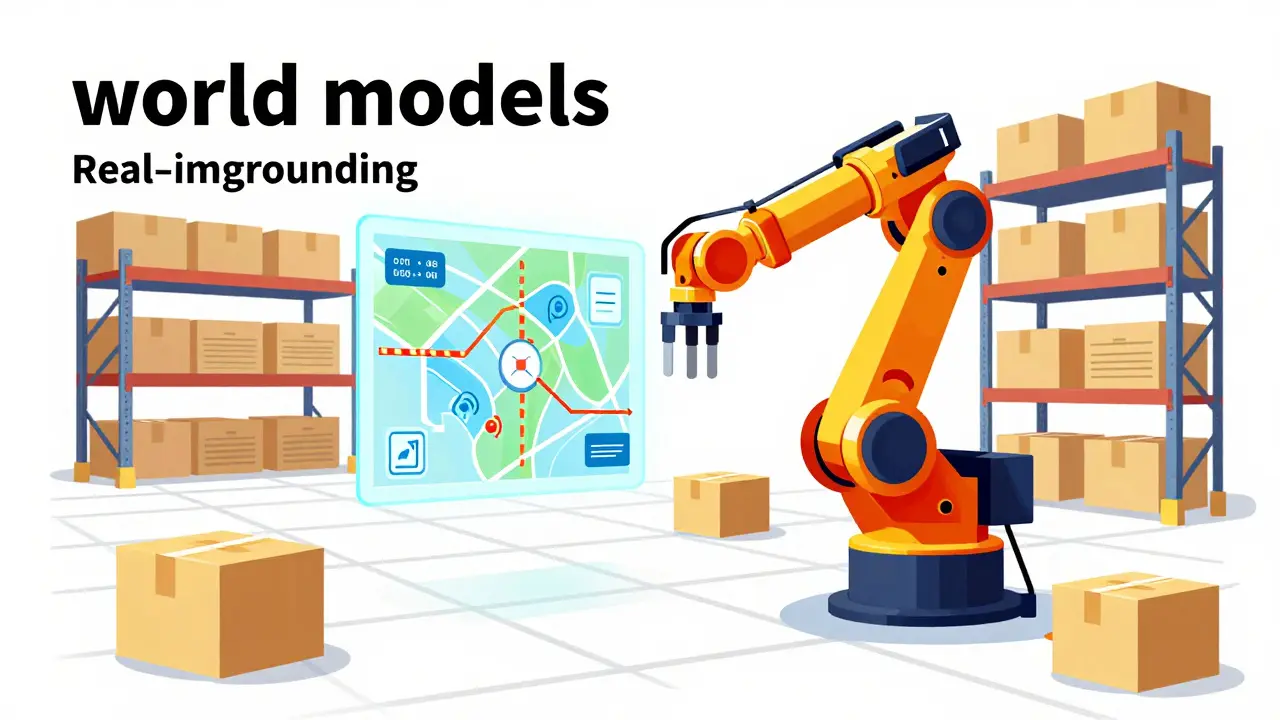
While large language models (LLMs) dominate headlines, experts like Yann LeCun, Chief AI Scientist at Meta, argue that the next big leap won’t come from bigger LLMs alone. He points to world models-systems that learn like infants through sensory input rather than just text patterns. A four-year-old has seen as much visual data as the largest LLM. World models enable robots and AI systems to understand physical cause-and-effect relationships.
This is already happening in logistics. Amazon has incorporated generative AI into its warehouses to optimize how robots travel and move material. These systems don’t just follow pre-programmed paths; they adapt to new layouts and obstacles in real-time. As world models become more prevalent, we’ll see AI systems that can "learn to complete a new task on its own with no training," fundamentally changing how we approach robotics and automation.
The Widening Gap: Winners and Laggards
The adoption curve is steep, but it’s not uniform. There’s a growing divide between "future-built companies" and laggards. Future-built companies allocate 15% of their resources to AI development and expect twice the revenue increase and 40% greater cost reductions by 2028. Laggards, stuck in "wait and see" mode, are falling behind fast.
The challenge isn’t just technology; it’s organizational readiness. Deploying agentic AI typically takes 6-12 months for enterprise readiness. It requires skills in prompt engineering, data pipeline management, and evaluation frameworks-areas where talent shortages persist. Companies that invest in their IT infrastructure and upskill their workforce now will reap the benefits. Those that delay will find themselves playing catch-up in a rapidly evolving market.
Regulatory considerations are also becoming critical. With the EU AI Act and other global regulations coming into force, companies must ensure their AI systems are transparent, accountable, and fair. Synthetic data helps here too, by allowing companies to build robust models without violating privacy laws. But governance remains a key hurdle. You need clear policies on who is responsible when an agent makes a mistake.
What Comes Next?
Looking ahead to 2028 and beyond, the trajectory is clear. Agentic AI will account for 29% of total AI value, up from 17% in 2025. Costs will continue to drop as synthetic data and optimization techniques mature. Grounding will become seamless, with AI systems accessing real-time data from any source.
But the real revolution lies in R&D. Generative AI is already accelerating product development and reducing time-to-market. Imagine designing a new drug, simulating its effects, and optimizing its structure-all in days instead of years. This is the promise of AI-driven innovation. The companies that embrace this future will not just survive; they will thrive.
So, what’s your move? Are you building for the future, or waiting for it to arrive? The clock is ticking, and the gap is widening. Don’t be left behind.
What are agentic AI systems?
Agentic AI systems are autonomous, context-aware systems that can plan, execute, and optimize workflows with minimal human intervention. Unlike traditional AI, which requires explicit programming for each step, agentic systems can reason through multi-step tasks and adapt in real-time.
How do agentic systems reduce costs?
Agentic systems reduce costs through automation of complex workflows, leading to higher productivity and lower labor costs. Additionally, the use of synthetic data allows companies to train models without expensive proprietary datasets, and model optimization techniques enable efficient deployment on smaller hardware.
What is Retrieval-Augmented Generation (RAG)?
RAG is a technique that improves AI accuracy by retrieving relevant information from trusted sources in real-time before generating a response. This reduces hallucinations and ensures the AI’s answers are grounded in current, verified data.
Why is synthetic data important for AI?
Synthetic data is crucial for training AI models in regulated industries like healthcare and finance. It allows companies to create realistic, privacy-compliant datasets that retain statistical properties without risking sensitive personal information.
What are world models in AI?
World models are AI systems that learn through sensory input, similar to how humans learn. They understand physical cause-and-effect relationships, enabling robots and AI to adapt to new environments and tasks without extensive prior training.
How long does it take to implement agentic AI?
Implementing agentic AI typically takes 6-12 months for enterprise readiness. This includes setting up infrastructure, integrating real-time data streams, and developing evaluation frameworks to monitor performance.
What is the ROI of generative AI?
According to AmplifAI, each dollar invested in generative AI delivers $3.70 back, representing a 3.7x ROI. This is driven by increased productivity, reduced time-to-market, and operational efficiencies.
Will AI replace human jobs?
AI is transforming jobs rather than replacing them entirely. While some routine tasks are automated, new roles in AI oversight, prompt engineering, and data management are emerging. The focus is on augmenting human capabilities, not eliminating them.
- May, 12 2026
- Collin Pace
- 0
- Permalink
- Tags:
- generative AI trends
- agentic systems
- AI cost reduction
- retrieval-augmented generation
- synthetic data
Written by Collin Pace
View all posts by: Collin Pace