Generative AI in Agriculture: Crop Reports, Equipment Manuals, and Market Outlooks
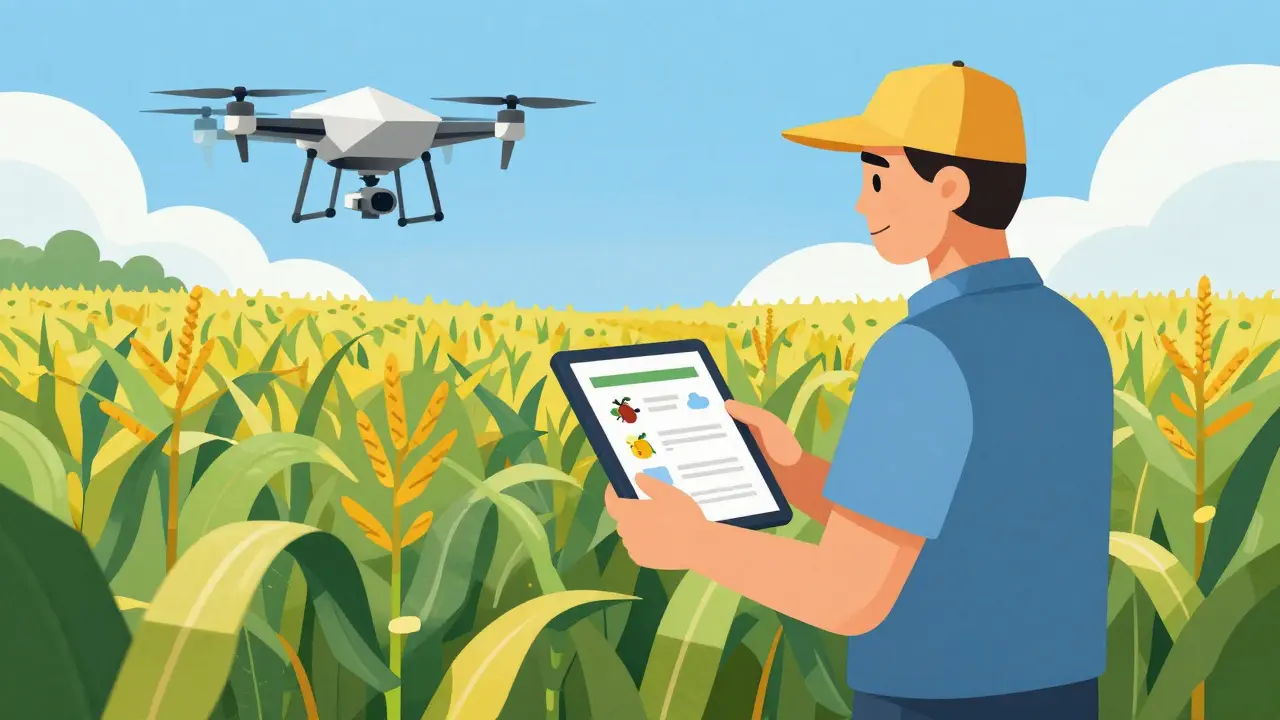
Farming has always been a game of risk management. You plant seeds hoping for rain, harvest hoping for sun, and sell hoping for stable prices. In 2026, that equation is changing. Generative AI is no longer just a buzzword in tech circles; it’s sitting in the cab of tractors, generating crop reports, rewriting equipment manuals, and predicting market outlooks with scary accuracy. The shift from experimental algorithms to field-ready tools means farmers aren’t just getting data anymore-they’re getting advice they can actually use.
This isn’t about replacing the farmer. It’s about giving them a co-pilot that never sleeps, reads every research paper ever published on soil health, and understands exactly how your specific tractor model works. Let’s look at how this technology is reshaping three critical areas of modern farming.
Crop Reports That Tell a Story, Not Just Numbers
Traditionally, a crop report was a spreadsheet. You had columns for yield per acre, moisture content, and nitrogen levels. Useful? Yes. Actionable? Often not. A number like “15% lower yield” doesn’t tell you why. Did pests attack? Was the irrigation timing off? Did a cold snap hit during pollination?
Generative AI changes this by synthesizing massive datasets into narrative insights. Instead of staring at raw data, a farmer might receive a summary saying: “Yield in Sector B dropped 15% due to localized aphid infestation detected via drone imagery on May 12th. Recommended action: Apply targeted biological control agent within 48 hours.”
This capability is driven by Large Language Models (LLMs) integrated with agricultural extension services. Projects like the GAIA project led by the International Food Policy Research Institute (IFPRI) are pioneering this. They use a framework called Retrieval-Augmented Generation (RAG). Think of RAG as giving the AI a library card. Instead of hallucinating answers based on general training data, the AI retrieves verified, context-specific information from trusted sources-like CGIAR research or local university extensions-and generates advice grounded in fact.
- Contextual Relevance: The AI knows your region, your soil type, and your crop variety.
- Real-Time Integration: It combines historical data with live weather feeds and satellite imagery.
- Actionable Advice: It moves beyond observation (“It rained”) to prescription (“Delay planting until Tuesday to avoid waterlogging”).
For smallholder farmers in developing regions, platforms like Farmer.Chat (developed by Digital Green) demonstrate that this isn’t just for industrial mega-farms. By aggregating open-access knowledge and proprietary materials, these tools provide timely, accurate advisories that traditional extension services struggle to deliver at scale.
Demystifying Equipment Manuals with Physical AI
We’ve all been there. Your combine harvester throws an error code, or you need to adjust the hydraulic pressure on a planter, but the manual is a 300-page PDF written by engineers, not farmers. You scroll, you guess, you call the dealer who is busy helping someone else.
In 2026, generative AI is turning static manuals into interactive assistants. This falls under the umbrella of Physical AI-intelligence systems that operate directly on machinery rather than just in the cloud. Imagine asking your tractor’s onboard system: “How do I reset the seed meter calibration after changing from corn to soybeans?”
The AI doesn’t just send you a link. It reads the specific technical documentation for your machine model, cross-references it with your current settings, and provides step-by-step instructions. If you have a multimodal system (one that can see and hear), you could even point a camera at a leaking hose, and the AI identifies the part, explains how to fix it, and checks if you have the replacement part in inventory.
| Feature | Traditional Manual | AI-Enhanced Assistant |
|---|---|---|
| Search Method | Index/Table of Contents | Natural Language Query |
| Context Awareness | None (Generic) | High (Machine ID + Current Status) |
| Update Frequency | Annual/Print Cycle | Real-Time Cloud Sync |
| Error Diagnosis | Code Lookup Table | Predictive Troubleshooting |
Companies like Agtonomy are pushing for this to become standard infrastructure. The goal is to reduce downtime. When a machine stops, money burns. An AI assistant that can diagnose and guide repairs instantly keeps the harvest moving. This also helps with the labor shortage issue. Newer operators don’t need decades of experience to understand complex machinery; the AI bridges the knowledge gap.

Market Outlooks: Predicting Prices Before They Move
Growing the crop is only half the battle. Selling it at a profit is the other. Historically, market outlooks were retrospective. Analysts looked at last year’s supply and demand to guess next year’s price. By the time that report reached you, the market had already moved.
Generative AI accelerates this cycle. It ingests global news, weather patterns, geopolitical events, shipping logistics, and consumer trends simultaneously. It can simulate thousands of market scenarios in seconds. For example, if a drought hits Brazil’s soybean belt, the AI doesn’t just note the event. It calculates the likely impact on global supply, predicts the price spike timeline, and suggests optimal selling windows for your local grain elevator.
This level of insight requires interoperability. Data must flow freely between different platforms. In 2026, we are seeing a tipping point where open APIs allow these AI models to pull data from siloed systems. The USDA’s fiscal year 2025-2026 strategy explicitly supports this, using predictive analytics to allocate resources and mitigate impacts from droughts or pest outbreaks. This institutional backing validates the technology for private sector adoption.
However, trust remains a hurdle. Farmers are skeptical of “black box” algorithms. Why did the AI suggest selling now? The best generative AI tools explain their reasoning. They cite the data sources: “Based on a 10% drop in Chinese import orders and favorable local storage conditions, holding inventory for two weeks may increase returns by 5%.” Transparency builds confidence.

The Human-in-the-Loop Reality
Despite the hype, AI isn’t taking over the farm. The most successful models in 2026 rely on human-in-the-loop automation. Machines handle repetitive tasks-scouting fields, monitoring sensors, drafting reports. Humans make the critical decisions.
Consider the role of the agricultural retailer. They are transitioning from input suppliers to trusted technology partners. A farmer goes to a retailer not just for fertilizer, but for a decision support system. The retailer uses AI to analyze the farmer’s soil maps and crop history, then recommends a precise variable-rate application plan. The farmer reviews the plan, adjusts it based on local intuition, and approves it. The AI handles the complexity; the farmer retains control.
This collaboration addresses the ethical concerns raised by initiatives like the GAIA project’s GenAI ethics toolkit. Bias, reliability, and appropriateness are serious issues. If an AI recommends a pesticide that harms local pollinators, who is liable? Robust data governance frameworks ensure that AI recommendations align with sustainability goals and regulatory standards.
Adoption Challenges and What’s Next
Not every farm is ready for this. Adoption is uneven. Larger operations with higher margins can afford the subscription costs and connectivity requirements. Small farms prioritize simplicity and proven value. If a tool adds complexity without clear ROI, it gets deleted.
Connectivity remains a barrier. Rural broadband is improving, but not everywhere. Offline-capable technology is essential. Some AI models are being shrunk down to run on edge devices-tablets or phones in the field-without needing constant internet access. This democratizes access to advanced insights.
Looking ahead, the convergence of physical AI, generative language models, and predictive analytics will create fully integrated farm operating systems. You won’t switch between apps for weather, equipment, and markets. One conversational interface will handle it all. The key for farmers in 2026 is to start small. Test one application-maybe automated crop reporting or smart manual assistance-and measure the return. If it saves time or increases yield, scale up. If not, pivot. The technology is here. The question is whether you’ll let it work for you.
What is the GAIA project in agriculture?
The GAIA (Generative AI for Agriculture) project is a multi-institutional initiative led by the International Food Policy Research Institute (IFPRI). It aims to enhance the efficacy and reliability of AI-generated agricultural advisories, particularly for small-scale producers. It uses frameworks like Retrieval-Augmented Generation (RAG) to ensure AI advice is grounded in verified scientific research rather than generic data.
How does generative AI improve equipment manuals?
Generative AI transforms static PDF manuals into interactive assistants. Farmers can ask natural language questions about their specific machinery, such as troubleshooting steps or maintenance schedules. The AI retrieves relevant information from technical documents and provides concise, contextual answers, reducing downtime and easing the learning curve for new operators.
Is generative AI suitable for small farms?
Yes, but adoption depends on simplicity and proven ROI. Platforms like Farmer.Chat demonstrate that AI can serve smallholders by providing accessible, localized advisory services via mobile phones. The key is ensuring the technology integrates easily into existing workflows without requiring expensive hardware or high-speed internet connections.
What is Physical AI in agriculture?
Physical AI refers to intelligence systems embedded directly in farm machinery and equipment, rather than existing solely in cloud servers. This includes autonomous tractors, robotic harvesters, and onboard diagnostic assistants. It enables real-time decision-making and automation of repetitive tasks, improving efficiency and reducing labor burdens.
How reliable are AI-generated market outlooks?
Reliability depends on the quality of underlying data and transparency. Advanced generative AI models analyze vast amounts of real-time data, including weather, geopolitics, and supply chains, to predict price trends. However, farmers should look for tools that explain their reasoning and cite sources, allowing them to validate recommendations against their own local knowledge and risk tolerance.
- May, 23 2026
- Collin Pace
- 10
- Permalink
Written by Collin Pace
View all posts by: Collin Pace