Generative AI in Business Operations: High-Impact Use Cases & Implementation
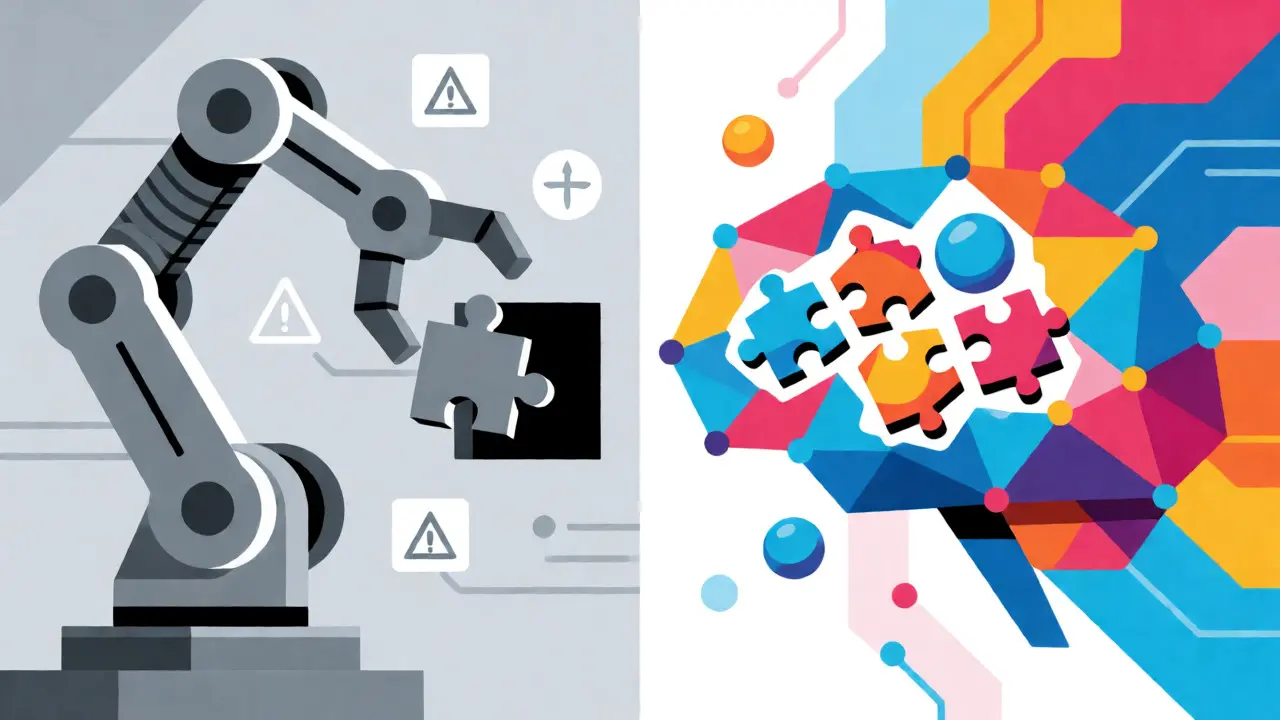
You probably heard the hype. Generative AI is supposed to change everything. But if you are a COO or an Ops Manager, "change everything" isn't a KPI. You need specific workflows that get faster, cheaper, or smarter. The gap between a cool demo and a deployed tool that saves your team ten hours a week is where most companies get stuck.
Here is the reality: Generative AI is not just a chatbot wrapper. It is a new layer of cognitive automation that handles unstructured data-emails, contracts, code, support tickets-in ways traditional software never could. According to McKinsey, about 75% of this value lives in four areas: customer ops, marketing/sales, software engineering, and R&D. If you aren't looking at those, you are missing the boat.
Quick Summary / Key Takeaways
- Focus on Unstructured Data: Generative AI shines where traditional rules fail-summarizing complex documents, drafting personalized emails, and coding assistance.
- Start Small, Scale Fast: Begin with low-risk, high-volume tasks like meeting summaries or internal search before touching mission-critical decision-making.
- Governance is Non-Negotiable: Without strict data privacy controls and human-in-the-loop checks, hallucinations and compliance risks can derail projects quickly.
- Integration Beats Innovation: The best tools fit into existing workflows (like CRM or Slack) rather than forcing employees to learn new interfaces.
- Measure ROI Early: Track time saved per task, not just adoption rates. If it doesn't save time or reduce error rates, kill the pilot.
Why Traditional Automation Isn't Enough
For years, we relied on Robotic Process Automation (RPA). It’s great for copying numbers from one spreadsheet to another. But it breaks the moment something unexpected happens. If a customer writes a complaint in broken English with sarcasm, RPA throws an error. Large Language Models (LLMs) handle this ambiguity naturally. They don’t follow rigid rules; they understand context.
This shift matters because 80% of business data is unstructured. Emails, call recordings, PDFs, and code comments are messy. Traditional tech ignores them or requires expensive manual processing. Generative AI reads, understands, and acts on this mess. For example, IBM reports that advanced assistants can reduce human intervention in customer service while maintaining high accuracy, simply by understanding intent rather than matching keywords.
High-Impact Use Cases That Actually Work
Don't try to automate everything. Pick the tasks that drain your team's energy but add little strategic value. Here are the patterns showing real results in 2026.
Customer Operations & Support
This is the biggest opportunity. Think beyond basic FAQ bots. Modern agents integrate with your CRM and knowledge base to resolve issues end-to-end. Commerzbank, a major German bank, used Google’s Gemini 1.5 Pro to automate client call documentation. Advisors stopped typing notes after calls and started building relationships instead.
The key here is context awareness. A good AI agent knows the customer’s purchase history, recent support tickets, and current sentiment. It drafts a response that feels human but follows your compliance rules. Humans still approve the final send, but the heavy lifting is done.
Software Engineering & IT
Coding assistants are no longer novelties. Tools integrated into IDEs help developers write boilerplate, debug errors, and document legacy code. Croud, a global media agency, saw 4-5x productivity gains on repeatable coding and data analysis tasks using custom AI models.
But it’s not just about writing code faster. It’s about reducing technical debt. AI can scan old repositories and suggest refactoring opportunities that humans might miss. This keeps your tech stack healthy without hiring more senior engineers.
Supply Chain & Logistics
Predictive analytics has been around forever, but generative AI adds simulation power. Instead of just forecasting demand based on last year’s sales, you can ask the system to simulate scenarios: "What if a port strike delays shipments by two weeks?" BMW Group uses digital twins powered by Vertex AI to run thousands of simulations, optimizing distribution efficiency in real-time.
This allows planners to test strategies virtually before committing resources. It turns supply chain management from reactive firefighting into proactive strategy.

Implementation Patterns: How to Roll Out Without Chaos
Most failed AI projects die because they skip the groundwork. They buy a tool and hope employees adapt. Here is a proven rollout pattern.
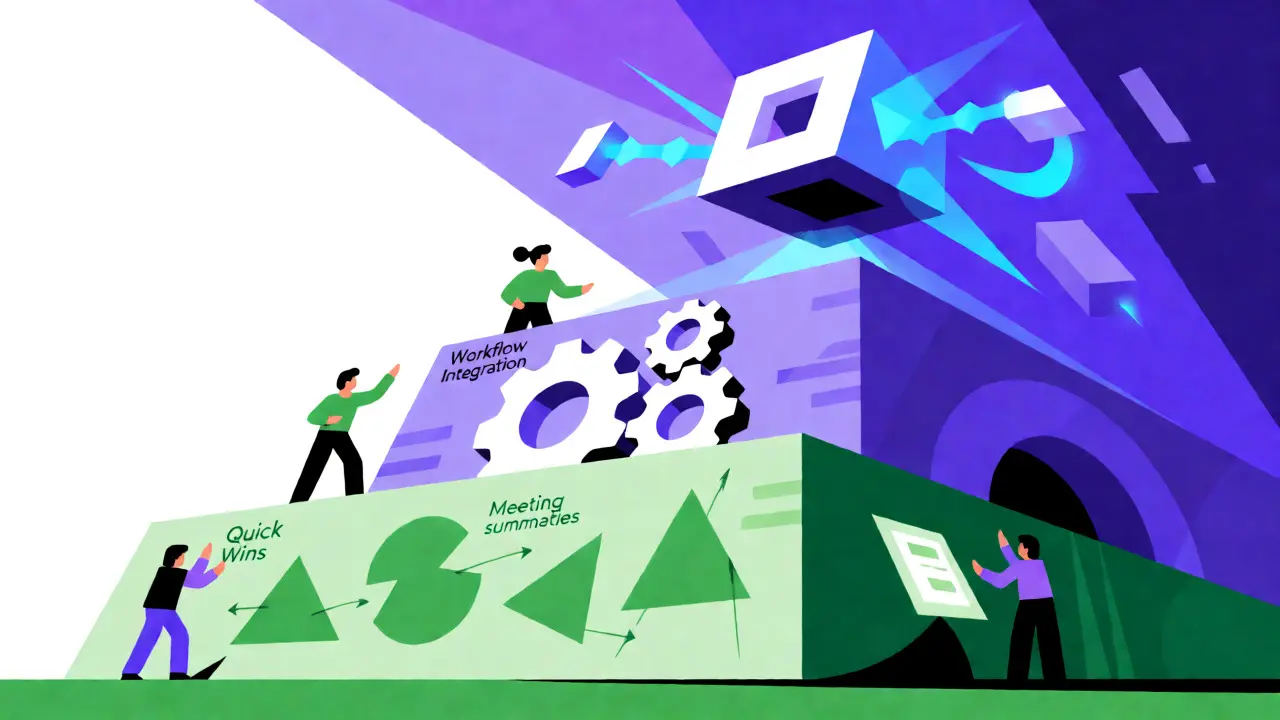
| Phase | Focus Area | Risk Level | Expected Outcome |
|---|---|---|---|
| 1. Quick Wins | Internal Knowledge Search, Meeting Summaries | Low | Immediate time savings, high employee buy-in |
| 2. Workflow Integration | Coding Assistants, Email Drafting, Report Generation | Medium | Measurable productivity gains (20-40%) |
| 3. Strategic Automation | Customer Service Agents, Supply Chain Simulations | High | Cost reduction, enhanced customer experience |
Start with Phase 1. Let employees use AI to find answers in company docs or summarize long meetings. These tasks are low-risk. If the AI hallucinates a date in a summary, no one gets fired. This builds trust. Once people see the value, move to Phase 2, where AI drafts content that humans review. Only move to Phase 3 when you have robust governance in place.
The Hidden Costs: Governance and Change Management
Technology is easy. People are hard. MIT Sloan experts warn that organizations must break down workflows into discrete tasks. Don't say "automate marketing." Say "automate the first draft of social media posts." Specificity prevents scope creep.
Then there is data privacy. In regulated industries like healthcare or finance, you cannot feed sensitive customer data into public LLMs without strict controls. HIPAA compliance isn't optional. You need private instances or enterprise-grade security wrappers. Deloitte notes that without proper governance, AI can perpetuate biases found in training data, especially in HR applications like resume screening.
Change management is the other hurdle. Employees fear replacement. Frame AI as a copilot, not a autopilot. Show them how it removes the boring parts of their job. At Pinnacol Assurance, 96% of employees reported time savings from using AI for client interview questions and claims analysis. When workers see their days getting easier, resistance drops.
Comparing Tech Stacks: Cloud vs. Specialized Vendors
You have choices. Major cloud providers offer flexible platforms, while specialized vendors offer out-of-the-box solutions. Which one fits your needs?
| Feature | Cloud Platforms (AWS Bedrock, Azure OpenAI, Google Vertex) | Specialized SaaS (e.g., Salesforce Einstein, HubSpot AI) |
|---|---|---|
| Flexibility | High. Build custom apps and agents. | Low. Limited to vendor’s ecosystem. |
| Setup Time | Weeks to Months. Requires dev resources. | Days. Plug-and-play integration. |
| Data Privacy | Configurable. Can keep data within your cloud account. | Vendor-managed. Check their SOC2/HIPAA certs. |
| Best For | Custom workflows, large enterprises with dev teams. | SMBs, quick wins in CRM/Marketing. |
If you have a strong engineering team, go with a cloud platform. You can build exactly what you need. If you want results next month, stick to specialized SaaS tools that already live in your workflow.
Future Outlook: From Copilots to Agents
We are moving past simple text generation. The next wave is agentic AI. These systems don't just answer questions; they execute multi-step workflows autonomously. Imagine telling an AI, "Plan a Q3 marketing campaign," and it researches trends, drafts copy, sets up the ad budget in your ad platform, and schedules the launch.
McKinsey predicts generative AI could automate 20-30% of current work hours by 2030. The winners won't be the companies with the smartest models. They will be the ones who integrate these models seamlessly into daily operations. Start small, measure ruthlessly, and keep humans in the loop until the technology proves itself.
What is the biggest risk of implementing generative AI in business?
The biggest risk is "hallucination" combined with poor governance. If an AI generates incorrect information and a human blindly trusts it, errors propagate through your business. Additionally, data privacy breaches occur if sensitive customer data is sent to public models without proper encryption or enterprise agreements.
How do I measure ROI for generative AI projects?
Track time saved per task and error reduction rates. For example, if a support agent spends 10 minutes less per ticket due to AI assistance, multiply that by the volume of tickets. Also, monitor employee satisfaction scores, as reduced burnout often correlates with higher retention and productivity.
Do we need a data science team to start with generative AI?
Not necessarily. Many modern platforms offer low-code or no-code interfaces for integrating LLMs into existing workflows. However, having at least one technical lead who understands API integrations and prompt engineering is crucial for troubleshooting and scaling beyond basic use cases.
Which industries benefit most from generative AI right now?
Financial services, healthcare, retail, and software development lead adoption. These sectors deal with high volumes of unstructured data (contracts, patient records, product descriptions, code) where generative AI provides immediate efficiency gains. Energy and utilities are also seeing rapid growth in predictive maintenance and supply chain optimization.
Is generative AI replacing jobs?
It is augmenting roles rather than replacing them entirely. Tasks involving routine content creation, data summarization, and basic customer inquiry resolution are automated. This shifts human effort toward higher-value activities like strategy, complex problem-solving, and relationship management. Job descriptions are evolving, not disappearing.
- Aug, 30 2026
- Collin Pace
- 10
- Permalink
Written by Collin Pace
View all posts by: Collin Pace