Governance Models for Generative AI: Councils, Policies, and Accountability

You bought the GPU clusters. You hired the prompt engineers. Your marketing team is already generating ten times more copy than last year. But when a hallucinated legal clause slipped into a client contract or your chatbot started quoting outdated pricing, who got fired? If you can't answer that in under three seconds, your Generative AI strategy lacks a spine.
Governance isn't about slowing things down; it's about making sure you don't crash while going fast. In 2025, we saw a massive shift. Organizations stopped treating AI as a science experiment and started treating it like critical infrastructure. The data backs this up: companies with mature governance models see a 23% higher ROI on their AI investments, according to PwC’s recent surveys. Yet, many are still stuck in "governance theater"-creating committees that meet monthly but never actually stop a bad model from shipping.
The Three Pillars of Modern AI Oversight
If you look at how successful companies handle risk, they generally rely on one of three structures, often mixing them for different use cases. There is no single "right" way, but there are definitely wrong ways.
| Model Type | Primary Focus | Speed Impact | Best For | Key Risk |
|---|---|---|---|---|
| Council-Based | Cross-functional review (Legal, Data, Business) | Slow (adds 14-21 days) | High-risk regulated industries (Healthcare, Finance) | Bottlenecks and bureaucracy |
| Policy-Driven | Standardized rules and compliance checks | Moderate | Scaling standardized workflows | Rigidity and lack of context |
| Accountability-Focused | Clear ownership per model/use case | Fast (accelerates deployment by 33%) | Agile tech teams and rapid innovation | Inconsistent standards if owners vary |
Councils: The Traditional Gatekeepers
Most large enterprises started here. An AI Ethics Council typically includes representatives from legal, compliance, data science, and business units. The idea sounds noble: diverse perspectives catch blind spots. And they do. A senior data scientist at a major bank noted that after implementing a council-based model, regulatory incidents dropped by 63% within six months.
But here is the trade-off: speed. About 62% of organizations reported that committee reviews added two to three weeks to their deployment timelines. If your competitive advantage depends on iterating weekly, a monthly council meeting is a death sentence. These models work best for high-stakes applications where a mistake costs millions, not for internal productivity tools.
Policies: The Rulebook Approach
Policy-driven frameworks establish clear guidelines for data quality, privacy, and model development. This approach relies heavily on standards like the NIST AI Risk Management Framework (RMF). In fact, 68% of surveyed leaders cite NIST as their primary reference. It provides a common language for risk, helping teams speak the same dialect whether they are in engineering or legal.
The problem with policies is rigidity. Generative AI evolves faster than policy drafting cycles. A rule written for text generation might be useless for autonomous agents that execute code. Organizations that lean too hard on static policies often find themselves rewriting documents every quarter, creating confusion rather than clarity. Effective policy frameworks need an amendment process that moves at the speed of software, not law.
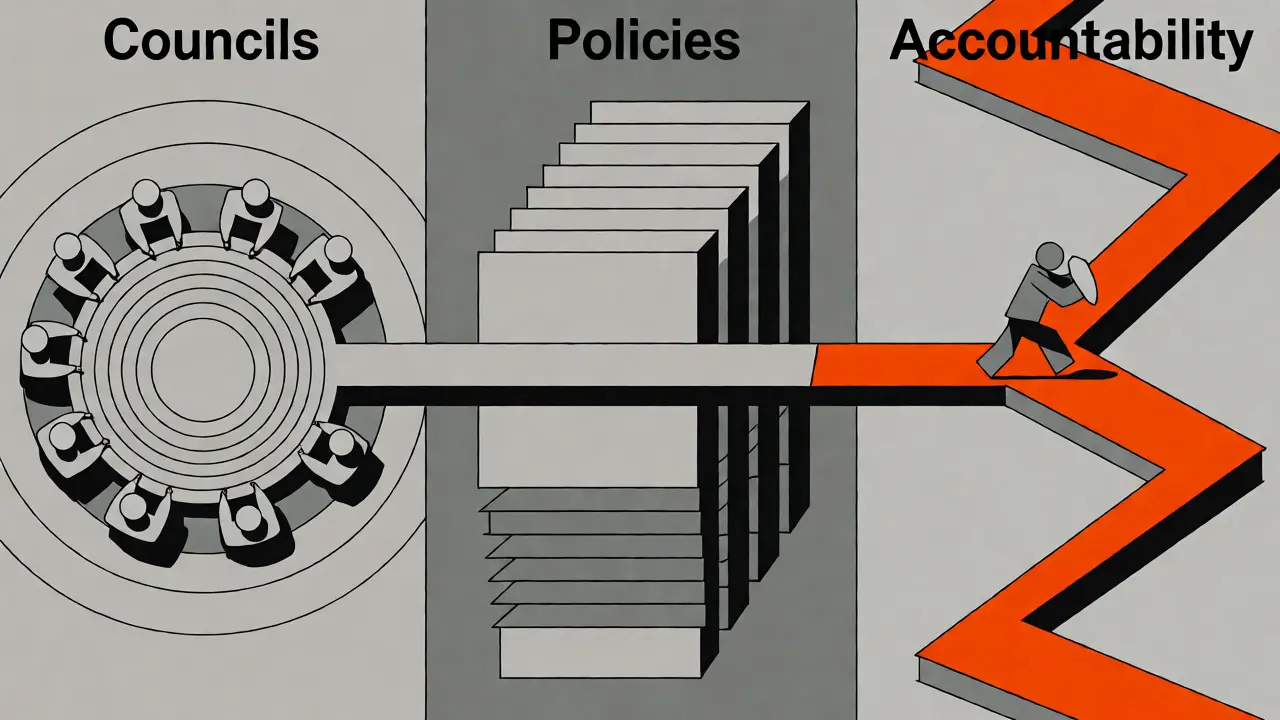
Accountability: Who Owns the Outcome?
This is the emerging winner among advanced organizations. Instead of asking "Is this compliant?", accountability-focused models ask "Who owns this?" When responsibility is embedded directly into the design and deployment process, decision-making gets faster. ModelOp data shows these organizations deploy 33% faster because they don't wait for a central committee to sign off on every minor update.
However, this requires cultural change. Engineers need to understand bias mitigation. Product managers need to grasp security vulnerabilities. Dr. Sarah Chen from Stanford HAI emphasizes that governance must evolve in real-time, shifting from static controls to continuous oversight. Without clear lines of ownership, you get shadow AI-where employees use unvetted tools because the official process is too painful.
The Shadow AI Problem
You think you have governance until you realize 78% of your employees are bringing their own AI tools to work. Microsoft’s research highlights this "Bring Your Own AI" trend. When the official path is blocked by red tape, people find side doors. One healthcare startup found that applying generic governance frameworks led to 42% of their medical imaging models being rejected for non-critical issues, wasting thousands of engineering hours.
To fix this, successful companies use secure sandbox environments. These allow employees to experiment with new tools without exposing core data. Compliance jumped from 31% to 89% in organizations that implemented sandboxes, proving that flexibility beats prohibition.

Implementing Governance: A Practical Checklist
Don't try to boil the ocean. Start small and scale based on risk. Here is a pragmatic approach derived from Nextgov’s phased framework:
- Audit Current Usage: Find out what tools are already in use. You likely have more AI in production than you think.
- Define Risk Tiers: Not all AI is equal. A chatbot answering FAQs has lower risk than an algorithm approving loans. Apply strict governance only to high-tier risks.
- Assign Owners: Every model needs a human name attached to it. If no one owns it, no one maintains it.
- Automate Monitoring: Manual reviews don't scale. Implement automated testing for bias and performance drift. Gartner predicts that by 2027, 73% of advanced orgs will use automated observability.
- Train Your Teams: Expect a learning curve. Technical teams need 6-8 weeks to adapt to new governance workflows. Budget for training-it pays off in reduced rework.
The Future: Agentic AI and Dynamic Guardrails
We are moving beyond simple content generation. Agentic AI systems now plan and execute tasks autonomously. This breaks traditional governance models. You can't review every action an agent takes in real-time. Oliver Patel, an AI governance specialist, predicts that by late 2025, nearly half of large enterprises will use "dynamic guardrails" that adjust permissions based on real-time risk assessments.
Imagine an AI agent booking travel. Low-risk actions (checking flight prices) happen instantly. High-risk actions (booking a $5,000 ticket) trigger a human approval step. This adaptive approach keeps safety without killing velocity.
Key Takeaways
- Governance drives ROI: Mature frameworks correlate with 23% higher returns on AI investments.
- Councils slow you down: Use them for high-risk, regulated domains, not for rapid iteration.
- Ownership beats oversight: Assigning clear accountability accelerates deployment by up to 33%.
- Embrace shadow AI: Provide safe sandboxes instead of banning tools outright.
- Automate or drown: Manual governance doesn't scale with agentic AI; implement automated monitoring early.
What is the difference between AI governance and AI ethics?
AI ethics refers to the moral principles guiding AI development, such as fairness and transparency. AI governance is the operational framework that enforces those principles through policies, processes, and accountability structures. Ethics defines the "what," while governance defines the "how" and "who."
Do small businesses need formal AI governance councils?
Not necessarily. Small businesses often benefit more from lightweight, accountability-focused models. Assigning specific roles to existing staff is usually more effective than forming a formal committee. The goal is to prevent risks, not to create bureaucracy.
How does the NIST AI Risk Management Framework help?
The NIST AI RMF provides a standardized set of functions-Govern, Map, Measure, and Manage-to help organizations identify and mitigate AI risks. It serves as a common language for technical and non-technical stakeholders, reducing miscommunication and streamlining compliance efforts.
What is "shadow AI" and why is it dangerous?
Shadow AI occurs when employees use unauthorized AI tools without IT or leadership oversight. It is dangerous because sensitive data may be exposed to third-party vendors without proper contracts, and outputs may lack accuracy or compliance checks, leading to potential legal or reputational damage.
How long does it take to implement an AI governance framework?
For medium-sized organizations, initial readiness reviews take 10-15 business days. Full implementation, including training and tool integration, typically takes 6-8 weeks for technical teams and 3-4 weeks for business stakeholders. Continuous refinement is ongoing.
- Nov, 27 2026
- Collin Pace
- 0
- Permalink
- Tags:
- Generative AI governance
- AI accountability frameworks
- AI ethics council
- NIST AI RMF
- responsible AI policies
Written by Collin Pace
View all posts by: Collin Pace