Guardrails for Medical and Legal LLMs: Controls, Tools, and Compliance

Imagine a scenario where an artificial intelligence system tells a doctor to prescribe a lethal dose of medication to a child. Or picture a law firm accidentally emailing privileged client secrets to the opposing counsel because their AI assistant didn't recognize the sensitivity of the data. These aren't just sci-fi nightmares; they are real risks facing industries that rely on Large Language Models (LLMs) for critical decision-making. In high-stakes fields like healthcare and law, accuracy isn't just a nice-to-have feature-it's a matter of life, death, and massive financial liability. This is why guardrails for factual domains have become the most urgent topic in enterprise AI right now.
Guardrails are specialized safety mechanisms designed to prevent harmful, inaccurate, or non-compliant outputs from these models. They act as a filter between the raw power of generative AI and the professional standards required in regulated industries. Without them, you're flying blind. With them, you have a structured way to enforce compliance, protect patient privacy, and maintain attorney-client privilege. But getting them right is harder than it looks.
The Urgent Need for Domain-Specific Safety
Why can't we just use general-purpose AI safety tools? The answer lies in the nature of the errors. In casual conversation, if an AI hallucinates a fact about a movie plot, nobody gets hurt. In medicine, however, the stakes are infinitely higher. Empirical studies conducted in 2023 showed that open-ended clinical tasks could trigger hallucination rates exceeding 60%. That means more than half the time, the model might invent a diagnosis or treatment plan that doesn't exist.
To put this risk into perspective, consider the scale of data exposure. According to the Health and Human Services 2023 Annual Report, healthcare data breaches compromised over 130 million US records in a single year. When you add AI into the mix, the potential for accidental disclosure skyrockets. A simple prompt asking for "patient summary" could inadvertently include Protected Health Information (PHI) if the model isn't strictly constrained.
In the legal sector, the danger is slightly different but equally severe. Providing unqualified legal advice without proper oversight constitutes the unauthorized practice of law in 47 US jurisdictions. Professor Richard Susskind OBE, IT Adviser to the Lord Chief Justice of England and Wales, warned in his November 2024 Legal Ethics Review that AI providing such advice without guardrails exposes both developers and users to significant liability. The goal here isn't just accuracy; it's maintaining the boundary between helpful assistance and illegal practice.
How Guardrails Actually Work
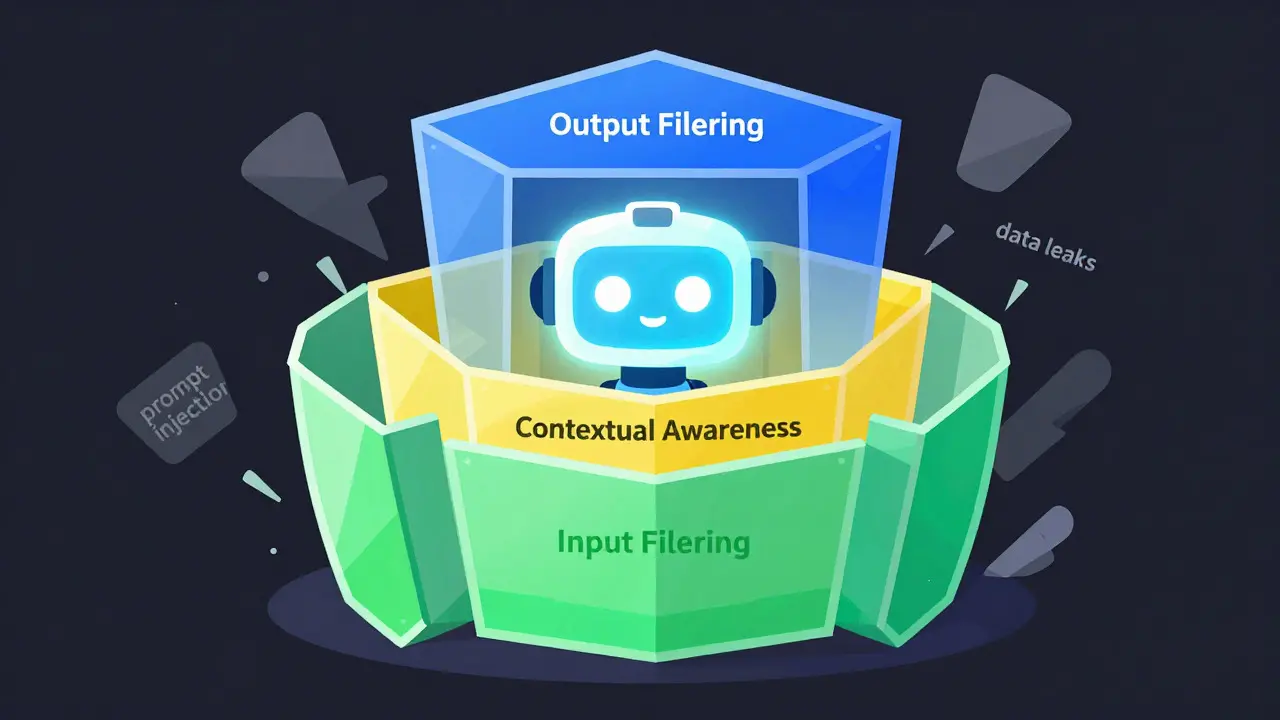
You might think guardrails are just simple keyword filters, blocking words like "diagnosis" or "confidential." If only it were that easy. Modern guardrail systems operate through multiple sophisticated layers to ensure comprehensive protection.
- Input Filtering: Before the prompt even reaches the main language model, the guardrail analyzes it. It checks for harmful intents, prompt injection attacks, or requests that violate domain-specific constraints. For example, it might block a query asking for specific dosage calculations for a pediatric patient unless the user is verified as a licensed physician.
- Contextual Awareness: This layer understands the nuance of the conversation. It knows the difference between a student discussing a hypothetical case study and a lawyer drafting a binding contract. NVIDIA's NeMo Guardrails, for instance, uses semantic similarity checks to understand intent rather than just matching patterns.
- Output Filtering: After the model generates a response, the guardrail scans it again. It looks for prohibited categories, such as unauthorized legal advice or confidential information disclosure. If a violation is detected, the output is blocked, modified, or flagged for human review.
These systems often rely on YAML-based configuration files with regex pattern matching and external API integrations. For deployment, you typically need Python 3.8+ and at least 8GB of RAM, though enterprise setups require significantly more resources to handle the latency overhead. Studies from the University of Washington in 2024 indicate that these safety layers add 120-350 milliseconds to standard responses-a small price to pay for preventing a malpractice lawsuit.
Leading Tools in the Market
The market for AI guardrails has exploded, growing at a 47% year-over-year rate according to Gartner's 2024 AI Governance Survey. Three platforms currently dominate the landscape, each with distinct strengths and weaknesses depending on your industry.
| Platform | Primary Focus | Key Strength | Weakness | Market Adoption |
|---|---|---|---|---|
| NVIDIA NeMo Guardrails | Healthcare | HIPAA Compliance (98.2% PHI detection) | Clinical nuance preservation (76.4%) | 63% among healthcare providers |
| Meta Llama Guard | Open Source / General | Multilingual support (137 languages) | Misses subtle legal violations (32.7% error rate) | 41% in legal tech startups |
| TruLens | Enterprise / Financial | Audit trail generation (3.2 verification points) | Requires heavy customization for medical use | 58% among Fortune 500 companies |
NVIDIA NeMo Guardrails leads the healthcare segment with a 51% market share. Its version 2.1.0, released in October 2024, excels at blocking 127 distinct query types related to patient data access. However, it struggles with clinical nuance, sometimes blocking legitimate discussions about rare diseases because they resemble diagnostic attempts.
Meta Llama Guard, open-sourced in July 2023, is popular among legal tech startups due to its accessibility and multilingual capabilities. But Stanford's 2024 LegalTech Audit revealed a critical flaw: it missed nearly a third of unauthorized practice of law scenarios. It's great for broad filtering but lacks the deep contextual understanding needed for complex legal reasoning.
TruLens stands out in the enterprise space, particularly for finance and law. Its strength lies in transparency. When it blocks content, it provides granular explanations, averaging 3.2 verification points per decision. This auditability is crucial for regulatory compliance, though it requires significant technical expertise to configure for medical applications.
Implementation Challenges and Real-World Friction
Buying a guardrail tool is the easy part. Implementing it effectively is where most organizations stumble. The friction comes from balancing safety with usability. You want to stop bad outputs, but you don't want to annoy your doctors and lawyers so much that they abandon the technology entirely.
At Mayo Clinic's pilot implementation, documented in the Journal of Medical Internet Research in 2025, clinicians reported 78% satisfaction with the system blocking inappropriate medical advice. But 63% complained about "overblocking." They found themselves having to manually override the system an average of 2.4 times per shift just to discuss differential diagnoses for rare conditions. This "alert fatigue" can lead to dangerous complacency.
Legal professionals face similar issues. A Law360 survey of 217 attorneys in March 2025 found that while 68% were satisfied with the prevention of accidental disclosures, 82% expressed concern about false negatives. Seventeen percent reported near-misses where sensitive client data nearly leaked through AI-assisted document review. The fear isn't just that the AI will talk too much; it's that it will stay silent when it should have flagged a risk.
Another major hurdle is the learning curve. Organizations report needing 120-160 hours of specialized training for AI safety officers to effectively manage medical guardrails. You can't just hire a generic IT admin; you need certified HIPAA security officers and clinical subject matter experts working together to configure domain-specific rules. This integration process typically takes 3-6 months for full deployment.

Regulatory Pressure and Future Trends
The push for better guardrails isn't just coming from internal risk management teams; it's being driven by regulators. The healthcare LLM guardrail market reached $187.4 million in 2024 and is projected to grow to $642.8 million by 2027, fueled by strict new requirements.
Key regulatory drivers include:
- HIPAA Updates (2024): New guidance explicitly requires "AI-specific safeguards" for protected health information, moving beyond traditional cybersecurity measures.
- FDA Draft Guidance (September 2024): Addresses AI/ML-enabled medical devices, implying that software acting as a medical device must have robust validation controls.
- EU AI Act: Classifies medical diagnostic tools as "high-risk," mandating rigorous testing and human oversight.
- ABA Formal Opinion 498: Requires lawyers to take "reasonable measures" to prevent AI from providing unauthorized legal advice.
Looking ahead, innovation is focusing on reducing false positives. NVIDIA's February 2025 release of NeMo Guardrails 2.2 introduced "clinical context awareness," which reduced false positives by 37% by better distinguishing between legitimate medical discussions and actual diagnostic attempts. Meanwhile, the European Commission plans a 2026 certification framework requiring minimum 98% accuracy in life-critical scenarios.
However, threats evolve too. HiddenLayer's November 2024 research demonstrated universal bypass techniques that successfully circumvented safety policies in GPT-4, Claude 3, and Gemini 1.5 with a 78.6% success rate. This arms race between attackers and defenders means guardrails cannot be set-and-forget solutions. They require continuous monitoring and updates, with healthcare organizations making an average of 14.3 monthly updates to their rule sets.
Practical Steps for Deployment
If you're considering implementing guardrails for your organization, start with a clear assessment of your risk tolerance. Are you prioritizing patient safety above all else, or do you need precise regulatory compliance for legal defensibility? These priorities often conflict.
First, conduct a thorough audit of your current AI usage. Identify where LLMs interact with sensitive data. Next, choose a platform that aligns with your primary domain-NeMo for healthcare, TruLens for enterprise legal/finance, or Llama Guard for cost-conscious startups. Then, invest in training. Don't underestimate the need for dedicated AI safety officers who understand both the technology and the domain regulations.
Finally, implement a "human-in-the-loop" verification system for high-risk outputs. As the Association of American Medical Colleges warns, current technologies remain insufficient for unsupervised clinical decision support. Keep humans involved for at least the next 3-5 years to ensure that when the AI fails, someone is there to catch it.
What is the difference between general AI safety and domain-specific guardrails?
General AI safety focuses on broad issues like toxicity, bias, and obvious falsehoods. Domain-specific guardrails, like those for medical or legal LLMs, address nuanced, high-stakes requirements such as HIPAA compliance, attorney-client privilege, and accurate representation boundaries. They use specialized pattern matching and contextual awareness to prevent errors that could lead to patient harm or legal liability.
Which guardrail tool is best for healthcare organizations?
NVIDIA NeMo Guardrails is currently the leader in healthcare, holding 63% market share among providers. It excels in HIPAA compliance with a 98.2% detection rate for protected health information queries. However, it may struggle with clinical nuance, potentially blocking legitimate medical discussions, so it requires careful tuning by clinical subject matter experts.
How much latency do guardrails add to LLM responses?
According to a 2024 study by the University of Washington, guardrail systems typically add 120-350 milliseconds of latency to standard LLM responses. This slight delay is generally considered acceptable given the significant reduction in risk and liability associated with inaccurate or non-compliant outputs.
Are current guardrails sufficient for unsupervised clinical decision support?
No. The Association of American Medical Colleges' February 2025 position paper states that current guardrail technologies remain insufficient for unsupervised clinical decision support. They recommend continued human oversight for at least the next 3-5 years to mitigate risks from hallucinations and adversarial attacks.
What are the main challenges in implementing legal AI guardrails?
The main challenges include high false positive rates (blocking legitimate work), false negatives (missing subtle violations like unauthorized practice of law), and the complexity of jurisdiction-specific requirements. Legal guardrails also require significant customization to integrate with existing tools like Relativity and LexisNexis, and they demand extensive training for staff to manage effectively.
How does Meta's Llama Guard compare to proprietary solutions?
Meta's Llama Guard is an open-source solution that offers superior multilingual support (137 languages) and lower entry costs, making it popular with legal tech startups. However, it lags behind proprietary tools like NeMo and TruLens in detecting subtle domain-specific violations, missing 32.7% of unauthorized practice of law scenarios in Stanford's 2024 audit.
What regulatory changes are driving the adoption of AI guardrails?
Key drivers include HIPAA's 2024 updated guidance requiring AI-specific safeguards, the FDA's draft guidance on AI/ML-enabled medical devices, the EU AI Act's high-risk classification for medical tools, and the American Bar Association's Formal Opinion 498 requiring reasonable measures to prevent unauthorized legal advice. These regulations make robust guardrails a compliance necessity rather than just a best practice.
- Aug, 10 2026
- Collin Pace
- 0
- Permalink
Written by Collin Pace
View all posts by: Collin Pace