How Reasoning-Enhanced LLMs Are Accelerating Scientific Discovery in 2026
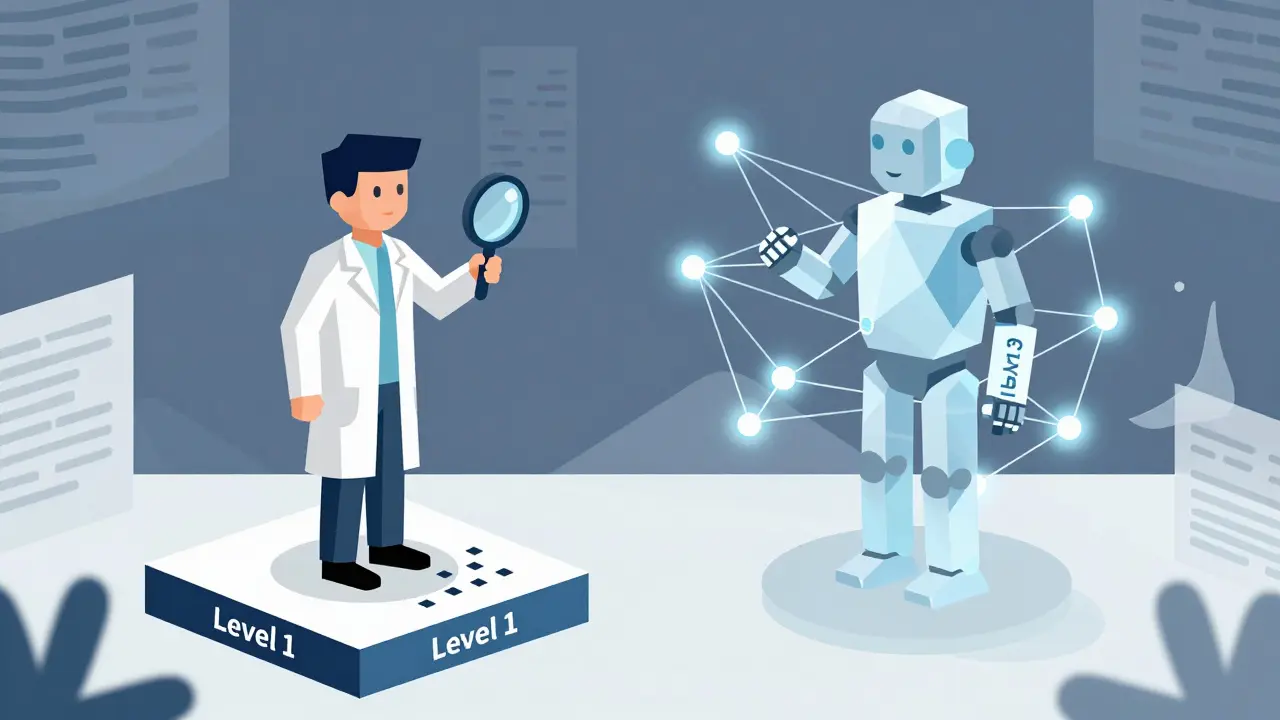
For decades, the bottleneck in scientific breakthroughs wasn’t a lack of data-it was a lack of time. Researchers spent years sifting through literature, running simulations, and manually connecting dots that might never align. Today, that dynamic is shifting. We are moving past the era where Large Language Models were just fancy search engines for academic papers. Instead, we are entering an age where these models actively reason, hypothesize, and even design experiments.
This isn't science fiction; it's happening right now in labs across chemistry, physics, and biology. The key differentiator? Reasoning-enhanced LLMs AI systems equipped with chain-of-thought capabilities and iterative self-correction mechanisms to solve complex scientific problems. These models don't just retrieve facts; they think through them. If you're curious about how this technology is reshaping discovery, let’s look at what’s actually working on the ground in 2026.
The Three Levels of AI in Science
To understand where we stand, we need to map out the current capabilities of AI in research. Experts generally categorize these systems into three distinct tiers based on their level of autonomy.
- Level 1: LLM as Tool. This is the baseline. You ask the model to summarize a paper or format a dataset. It performs specific, well-defined tasks under your direct supervision. It’s helpful, but it doesn’t make decisions.
- Level 2: LLM as Analyst. Here, the model takes more initiative. It can process complex information, conduct preliminary analyses, and offer insights with less hand-holding. Think of it as a highly skilled graduate student who can draft a literature review but still needs you to check the logic.
- Level 3: LLM as Scientist. This is the cutting edge. These systems autonomously formulate hypotheses, plan experiments, analyze results, and propose next steps. They act as collaborative partners rather than passive assistants.
We are currently seeing a rapid transition from Level 2 to Level 3. The gap between simply knowing scientific facts and being able to discover new ones is closing, thanks to advanced reasoning architectures.
Chemistry Gets Smarter: The MPPReasoner Breakthrough
One of the most concrete examples of this shift comes from molecular property prediction. Traditionally, predicting how a molecule behaves required specialized models that acted like black boxes-they gave you an answer but no explanation. This made it hard for chemists to trust or build upon those predictions.
Enter MPPReasoner A multimodal large language model built on Qwen2.5-VL-7B-Instruct designed for chemical reasoning and molecular property prediction. This system changes the game by integrating visual molecular structures with text-based SMILES strings. But the real magic lies in its training method.
MPPReasoner uses a two-stage approach. First, it undergoes supervised fine-tuning using 16,000 high-quality reasoning trajectories generated by experts. Then, it applies Reinforcement Learning from Principle-Guided Rewards (RLPGR) A training technique that uses verifiable, rule-based rewards to evaluate chemical principle application and logical consistency. Instead of just guessing the right answer, the model is rewarded for following correct chemical principles.
The results are measurable. In tests across eight datasets, MPPReasoner outperformed previous best-in-class baselines by 7.91% on standard tasks and 4.53% on out-of-distribution tasks-meaning it handled novel, unseen molecules better than ever before. This proves that teaching AI *how* to reason about chemistry yields better results than just feeding it more data.
| Feature | Traditional ML Models | Reasoning-Enhanced LLMs (e.g., MPPReasoner) |
|---|---|---|
| Interpretability | Low (Black Box) | High (Chain-of-Thought Explanations) |
| Generalization | Poor on unseen data | Strong (+4.53% improvement on OOD tasks) |
| Input Type | Numerical vectors only | Multimodal (Images + Text + Structure) |
| Error Correction | None | Self-Correction via RLPGR |

Beyond Chemistry: Physics and Biology Gains
While chemistry has seen clear wins, other fields are catching up fast. The Scientific Discovery Evaluation (SDE) A benchmark framework assessing LLMs on realistic, iterative scientific research tasks across biology, chemistry, materials, and physics framework recently tested top models like DeepSeek R1 and GPT-5 on real-world scenarios.
In biology, the impact was stark. When evaluating Leinsky’s rule-a fundamental concept in genetics-the same model jumped from 65% accuracy to a perfect 100% simply by enabling its reasoning capabilities. Without reasoning, the model guessed. With reasoning, it understood the biological mechanism.
In physics, symbolic regression-the process of discovering mathematical equations from data-is notoriously difficult. Reasoning-enabled models didn’t just find answers faster; they proposed structural improvements. For instance, one model realized a dynamic system required a sign function rather than a simple polynomial, a nuance that purely statistical models often miss. This shows that AI is beginning to grasp the underlying logic of physical laws, not just memorizing patterns.
Hybrid Frameworks: RAG Meets Case-Based Reasoning
One major criticism of early AI in science was hallucination. Scientists couldn’t risk citing a fake paper or a wrong chemical formula. To solve this, developers are building hybrid frameworks that combine Retrieval-Augmented Generation (RAG) A technique that retrieves external documents to ground LLM responses in factual data with Case-Based Reasoning (CBR) An AI methodology that solves new problems by adapting solutions from similar past cases.
These systems position the LLM as a reasoning engine rather than a static knowledge base. By leveraging graph databases and vector embeddings, the AI can pull verified historical cases, analyze them using logical deduction, and then generate new hypotheses grounded in reality. This creates a transparent workflow where every step of the AI’s “thinking” can be traced back to a source. For high-stakes domains like healthcare or drug discovery, this transparency is non-negotiable.

The Reality Check: We Aren’t There Yet
It’s easy to get swept up in the hype, but let’s keep our feet on the ground. While performance is improving, current LLMs are still far from achieving general scientific superintelligence. The SDE benchmarks revealed significant gaps between how well models perform on general science exams versus actual discovery tasks.
Models still struggle with true serendipity-the accidental discoveries that often drive major breakthroughs. They excel at guided exploration but lack the intuitive leaps that human scientists sometimes make. Furthermore, shared failure modes across top-tier models suggest that architectural innovations are still needed. We aren’t replacing scientists; we’re giving them powerful co-pilots.
What This Means for Researchers
If you work in R&D, academia, or tech-driven industries, the takeaway is clear: adapt or fall behind. The future of scientific discovery is collaborative. The most successful researchers won’t be those who ignore AI, nor those who blindly trust it. They will be the ones who know how to guide these reasoning-enhanced models, verify their outputs, and integrate them into iterative workflows.
We are witnessing the birth of a new paradigm where AI handles the heavy lifting of data synthesis and hypothesis generation, freeing humans to focus on creative strategy and ethical oversight. The tools are here. The question is whether we have the skills to use them effectively.
What is a reasoning-enhanced Large Language Model?
A reasoning-enhanced LLM is an AI system that goes beyond pattern matching to perform logical deduction, chain-of-thought analysis, and self-correction. Unlike standard models that predict the next word, these models simulate a step-by-step problem-solving process, making them suitable for complex tasks like scientific hypothesis generation.
How does MPPReasoner improve molecular property prediction?
MPPReasoner improves prediction by combining visual molecular data with text and using Reinforcement Learning from Principle-Guided Rewards (RLPGR). This trains the model to follow chemical rules logically, resulting in higher accuracy (up to 7.91% improvement) and better interpretability compared to traditional black-box models.
Can AI replace human scientists?
Not yet. Current AI systems operate at Level 2 or early Level 3 of autonomy, meaning they assist in analysis and hypothesis generation but require human oversight for validation and strategic direction. They are best viewed as collaborative partners that accelerate the research process rather than replacements.
What is the role of RAG and CBR in scientific AI?
Retrieval-Augmented Generation (RAG) ensures the AI cites accurate, up-to-date sources, while Case-Based Reasoning (CBR) allows it to learn from past experimental outcomes. Together, they reduce hallucinations and increase the transparency and reliability of AI-generated scientific insights.
Which fields are benefiting most from reasoning-enhanced LLMs?
Chemistry, physics, and biology are seeing the most immediate benefits. In chemistry, models like MPPReasoner aid drug discovery. In physics, they help derive complex equations via symbolic regression. In biology, they improve genetic analysis accuracy significantly when reasoning features are enabled.
- May, 30 2026
- Collin Pace
- 0
- Permalink
- Tags:
- reasoning-enhanced LLMs
- scientific discovery
- MPPReasoner
- AI research tools
- hypothesis generation
Written by Collin Pace
View all posts by: Collin Pace