How to Create Custom Benchmarks for Enterprise LLM Use Cases
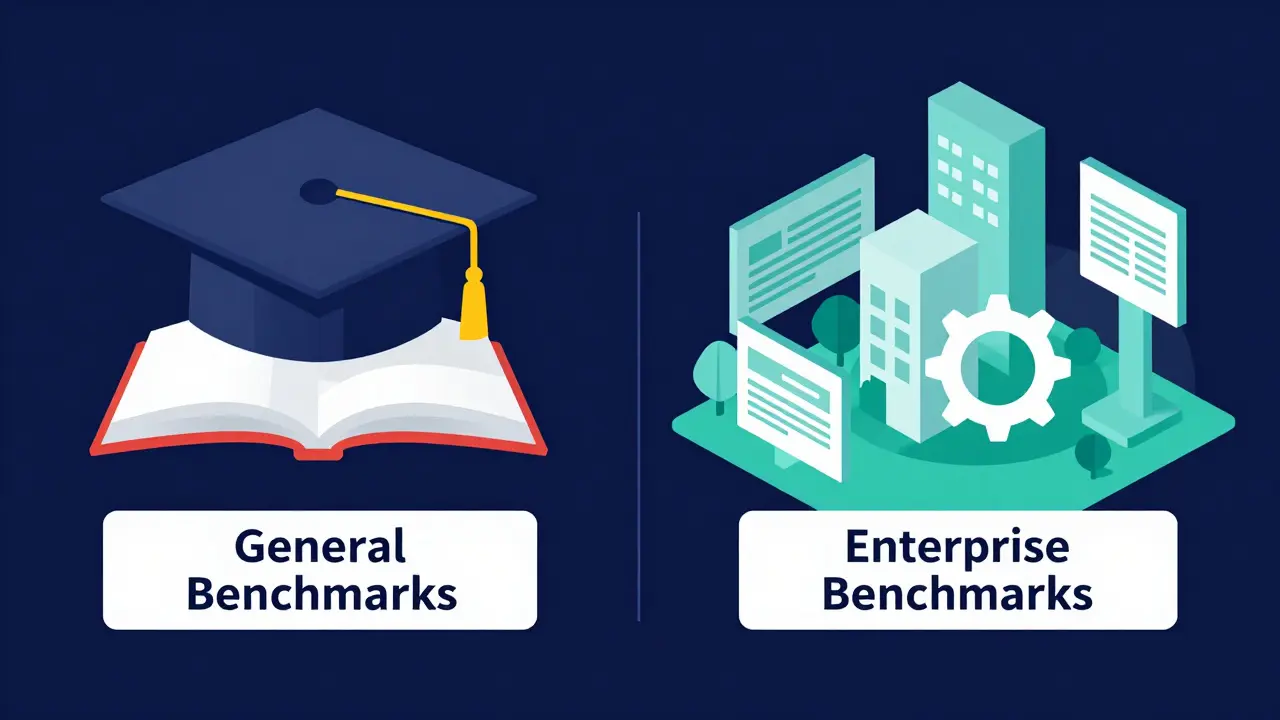
Most companies start their AI journey by testing a model with a few prompts and thinking, "This looks great." But there is a massive gap between a model that can write a poem and one that can accurately navigate your company's complex travel policy or resolve a technical support ticket. General benchmarks like the ARC-e dataset are designed for academic knowledge-they ask about fever causes or historical dates. In a business setting, you don't need to know why people get fevers; you need to know if the model can find a conference room or request software without hallucinating.
If you rely on generic scores, you're flying blind. To actually deploy AI at scale, you need enterprise LLM benchmarks that mirror your specific business reality. This means moving away from abstract tests and building a rigorous, internal evaluation framework that measures a model's ability to handle your unique data, your brand voice, and your regulatory constraints.
The Gap Between General and Enterprise Benchmarks
General-purpose benchmarks measure a model's breadth of knowledge, but enterprise use cases require depth and precision. When you deploy a Large Language Model (LLM) in a corporate environment, the cost of a mistake is much higher than in a consumer app. A wrong answer in a chatbot might be a minor annoyance, but a wrong answer in a legal contract review is a liability.
There are three main reasons why standard tests fail in the boardroom:
- Lack of Specificity: Academic benchmarks don't know your internal jargon, your product SKUs, or your organizational structure.
- Multi-Dimensional Needs: You aren't just testing for "correctness." You need to evaluate reasoning, extraction, classification, and adherence to brand guidelines simultaneously.
- Dynamic Contexts: Your business changes. Regulations shift, and product features are updated weekly. A static dataset from 2023 can't tell you if a model is performing well today.
Building Your Custom Evaluation Framework
To get a true reading of performance, you need to create "instruction-input-output trios." This is a standardized format where you define the task (instruction), provide the specific data (input), and define exactly what a perfect answer looks like (output).
Start by identifying five core enterprise themes: generation, reasoning, relevance, extraction, and classification. For example, if you're building a customer support bot, an "extraction" task would be identifying the order number from a messy email, while a "reasoning" task would be determining if a customer is eligible for a refund based on a 10-page policy document. Aim for a dataset of 200 to 1,000 custom examples. While a few dozen might seem enough, you need high-volume testing to catch the "corner cases"-those weird, rare user inputs that usually crash a system in production.
| Task Type | Example Scenario | Key Metric | Success Criteria |
|---|---|---|---|
| Extraction | Pulling dates from a contract | F1 Score | Precision and Recall of entities |
| Summarization | Condensing a 50-email thread | ROUGE / BLEU | Information density and accuracy |
| Classification | Routing tickets to departments | Accuracy % | Correct category assignment |
| Reasoning | Applying policy to a user request | LLM-as-a-Judge | Logical step-through to answer |
Why "Automated" Metrics Often Lie
Many teams fall into the trap of using BLEU or ROUGE scores. These metrics basically check how many words in the AI's answer match the human's answer. But in business, a model can be 100% accurate and get a terrible BLEU score simply because it used a synonym. Or, worse, it can get a high score by mimicking the structure of a manual while actually giving a wrong, dangerous answer.
The solution is the LLM-as-a-Judge approach. This involves using a more powerful model (like GPT-4o) to grade the outputs of a smaller, specialized model. You provide the judge with a detailed rubric-for example: "Rate this response from 1-5 based on helpfulness, brand voice adherence, and factual accuracy based on the provided context." This captures the nuance of tone and professionalism that a mathematical formula misses.
Optimizing for Cost and Performance
One of the biggest surprises in custom benchmarking is that you don't always need the biggest model. Research into proprietary models, such as MoveLM, shows that a smaller model fine-tuned on specific enterprise data can often match the performance of a massive general model like GPT-4 in specialized tasks.
When you have a custom benchmark, you can identify exactly where a model is failing. Instead of paying for a massive API for every simple query, you can use Parameter-Efficient Fine-Tuning (PEFT) to create small, task-specific adapters. This allows you to run a leaner, faster model that knows your business inside and out, significantly cutting your computational overhead without sacrificing quality.
Integrating RAG and Governance
Custom benchmarks aren't just about the model; they're about the whole system. Most enterprises use Retrieval-Augmented Generation (RAG) to ground the AI in real-time data. Your benchmarks must test the retrieval part too. Is the system pulling the right document? If the retrieval is wrong, the best model in the world will still give a wrong answer.
Governance is the final piece. Your evaluation set should include "red teaming" benchmarks-adversarial prompts designed to make the AI leak private data or ignore company policy. If the model can be tricked into giving a discount it shouldn't, your benchmark has identified a critical risk before it hit the customer.
The Iterative Benchmarking Cycle
Benchmarking isn't a one-time event; it's a loop. You should implement continuous evaluation where the model is re-tested every time the provider updates the base model or your internal documentation changes. Capture real user feedback and turn "failed" interactions into new test cases. This ensures your benchmark evolves as your users' behavior changes.
How many examples do I need for a reliable enterprise benchmark?
For a basic pilot, 200 examples can give you a direction. However, for a production-ready system, you should aim for 1,000 or more. This volume is necessary to cover diverse user scenarios and the "edge cases" that often lead to system failures in real-world use.
Can I use public datasets to save time?
You can use vertical-specific sets like HealthBench for healthcare or LegalBench for legal work, but they should only be a supplement. Public datasets test general professional knowledge, not your specific company policies or internal workflows. Custom data is non-negotiable for enterprise success.
What is the best way to score subjective qualities like "Brand Voice"?
The most effective method is combining LLM-as-a-Judge with periodic human review. Create a strict rubric that defines your brand voice (e.g., "Professional but not stiff," "Empathetic and concise"). Use a high-reasoning model to grade the outputs against this rubric, and have domain experts audit 5-10% of those grades to ensure the judge is aligned with human expectations.
How does fine-tuning affect benchmarking?
Fine-tuning allows a model to learn the specific nuances of your industry and data. Custom benchmarks are critical here because they tell you exactly when you've reached the point of diminishing returns. Without a benchmark, you're just guessing if the fine-tuning actually improved the model or if it's just mimicking the training data.
What happens if the LLM provider updates their model?
Model drift is a real risk. A provider update can either improve your results or suddenly break a prompt that was working perfectly. This is why you need an automated benchmarking pipeline that re-runs your test sets whenever a model version changes, allowing you to catch regressions before they affect users.
- Apr, 21 2026
- Collin Pace
- 0
- Permalink
Written by Collin Pace
View all posts by: Collin Pace