How to Evaluate LLMs: Human Ratings, Benchmarks, and Real-World Tests
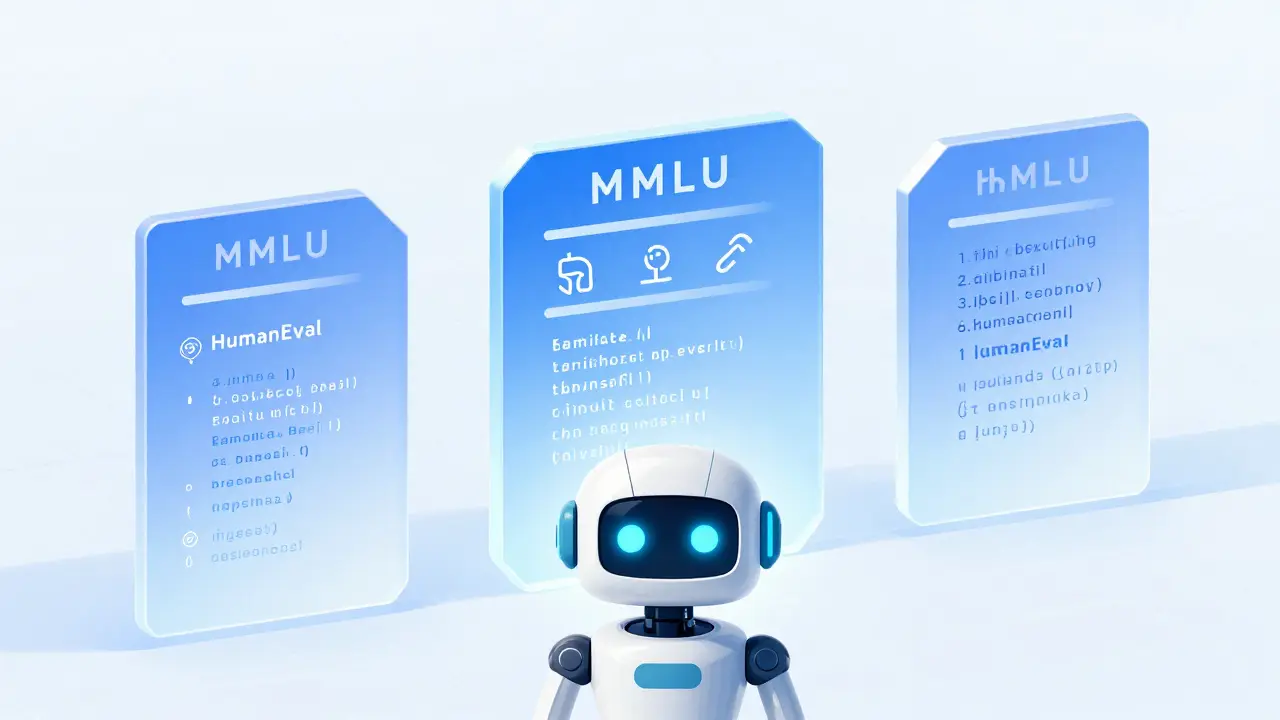
Buying a new large language model feels like buying a car without a test drive. You see the specs on the paper-parameter count, training data size, speed-but you have no idea how it actually handles your specific workload. Does it hallucinate when asked about medical history? Does it write clean code or just plausible-looking gibberish? In 2026, relying on a single score is a recipe for disaster. To truly understand an Large Language Model, which is an artificial intelligence system trained on vast amounts of text to generate human-like responses, you need a three-pronged approach: automated benchmarks, human ratings, and real-world task simulations.
This guide breaks down why each method matters, where they fail, and how to combine them to get a clear picture of model performance. We will look at the heavy hitters like MMLU and Chatbot Arena, explore the rise of LLM-as-a-judge, and show you how to build a hybrid evaluation strategy that protects your business from costly errors.
The Foundation: Automated Benchmarks and Standardized Tests
Automated benchmarks are the starting point for any serious evaluation. They provide objective, reproducible scores that allow you to compare models side-by-side quickly. Think of these as the SAT scores for AI models-they tell you if the model has learned general knowledge, but they don't guarantee it can handle the nuance of a real conversation.
As of 2026, there are over 283 representative benchmarks available, categorized into general capabilities, domain-specific tasks, and safety checks. Here are the most critical ones you should know:
- MMLU (Massive Multitask Language Understanding): This tests general knowledge across subjects like law, medicine, and STEM. It’s great for checking if a model has "read the books," but it doesn't test reasoning depth.
- HellaSwag: Focuses on common sense reasoning. It asks the model to complete sentences based on physical intuition. If a model fails here, it likely struggles with basic logical consistency.
- MATH: A rigorous test of mathematical problem-solving. Unlike simple arithmetic, this requires multi-step reasoning. High scores here indicate strong logical processing capabilities.
- HumanEval: Specifically designed for code generation. It measures functional correctness by running the generated code against hidden test cases. If you’re using an LLM for software development, this is non-negotiable.
- TruthfulQA: Measures the model's ability to avoid hallucinations. It presents questions where the false answer is often more tempting than the true one. A high score here suggests the model is less likely to make up facts.
The benefit of these benchmarks is scale. You can run thousands of tests in minutes. The downside? They are static. Models are often fine-tuned specifically to pass these tests, leading to "overfitting" on benchmarks. A model might ace MMLU but fail miserably when asked to summarize a complex legal contract because the prompt structure differs slightly from the training data.
The Gold Standard: Human Ratings and Subjective Feedback
Automated metrics miss the forest for the trees. They check for factual accuracy but ignore tone, empathy, cultural context, and subtle ethical implications. This is where human evaluation comes in. Despite being expensive and time-consuming, human judgment remains the most reliable way to assess quality for high-stakes applications.
Research shows that while LLMs can achieve 72% to 95% agreement with human experts on structured tasks, human evaluators excel at identifying issues like bias, toxicity, and practical usefulness. For example, a model might generate a grammatically perfect response that is culturally offensive or legally risky. An automated metric would give it a perfect score; a human reviewer would flag it immediately.
However, human evaluation is not without its flaws. It is subjective, biased, and suffers from inter-rater reliability issues. Two humans might disagree on what constitutes "helpful." To mitigate this, organizations use structured frameworks with clear guidelines. Evaluators are trained on specific criteria such as coherence, grammar, originality, accuracy, completeness, and relevance. Using multiple judges and calculating Cohen’s κ coefficients helps ensure that the consensus is robust rather than accidental.
| Method | Strengths | Weaknesses | Best Used For |
|---|---|---|---|
| Automated Benchmarks | Fast, scalable, objective | Static, prone to overfitting, misses nuance | Initial screening, technical capability checks |
| Human-in-the-Loop | Captures nuance, ethics, and context | Expensive, slow, subjective variability | High-stakes domains (healthcare, legal), final QA |
| LLM-as-a-Judge | Scalable, consistent, cost-effective | Bias toward specific models, lack of true understanding | Rapid iteration, approximating human preference |
Chatbot Arena: The Crowd-Sourced Truth
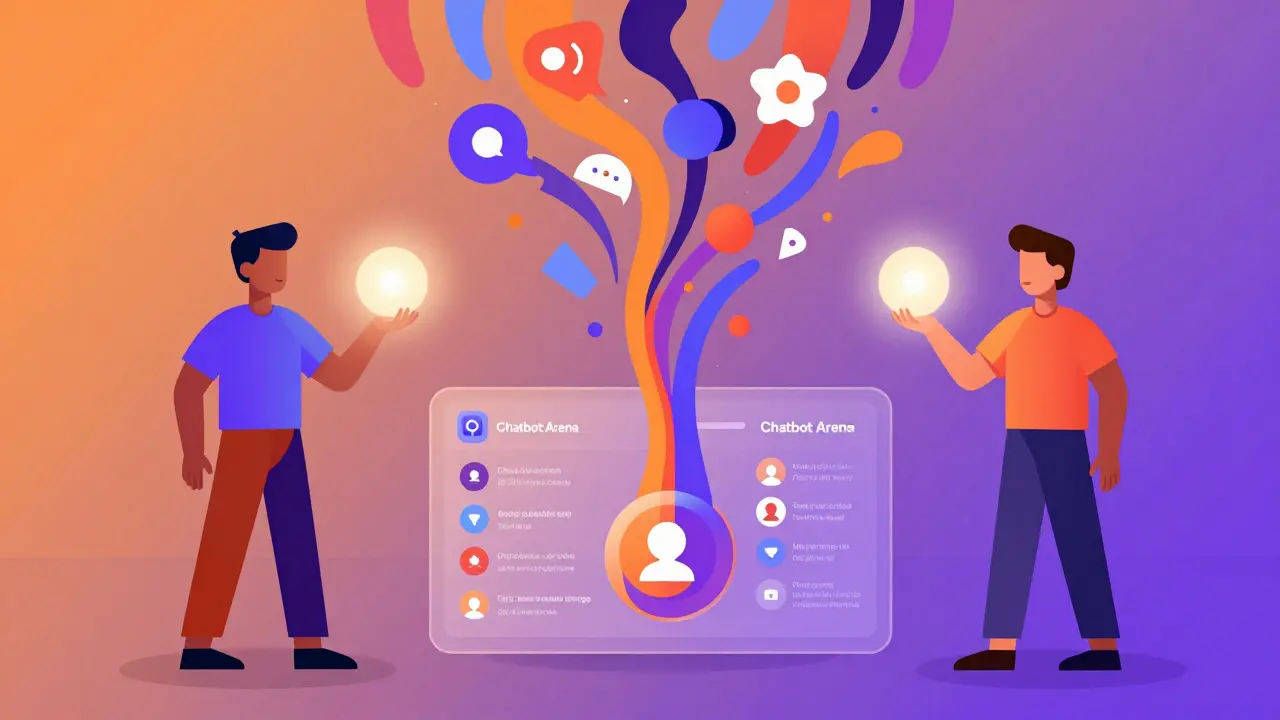
If you want to know how users actually feel about a model, look at the Chatbot Arena (also known as LMSYS Vicuna Benchmark). This platform uses crowdsourced interactions to rank models via Elo scores, similar to chess rankings. Users chat with two anonymous models simultaneously and vote on which response is better.
The strength of Chatbot Arena lies in its scale and diversity. It captures preferences across millions of conversations spanning numerous topics. Because the models are anonymous, user bias toward brand names is eliminated. The resulting Elo rankings reflect genuine user satisfaction rather than academic performance.
However, there is a catch. The queries in Chatbot Arena are heavily weighted toward casual conversation. Users rarely ask complex coding questions or detailed medical diagnoses. Therefore, a top-ranking model on Chatbot Arena might be excellent at chitchat but poor at specialized professional tasks. For those needs, specialized arenas like Code Arena or HealthBench are more relevant, involving domain experts who assess technical correctness.
The Rising Star: LLM-as-a-Judge
A newer trend gaining significant traction is using one large language model to evaluate another. Known as "LLM-as-a-judge," this method offers a middle ground between expensive human review and rigid automated metrics. Tools like MT-bench and Alpaca Eval 2.0 use advanced models (like GPT-4) to rate responses against reference answers or rubrics.
This approach is highly scalable and flexible. You can create custom evaluation sets, such as Arena Hard, which curates difficult prompts from Chatbot Arena to stress-test models. It provides win rates and detailed feedback on aspects like conciseness and helpfulness.
But be cautious. LLM judges have their own biases. They may favor models that share their training data or writing style. They also struggle with truly novel concepts that fall outside their training distribution. While useful for rapid iteration, LLM-as-a-judge should never be the sole determinant of deployment readiness. It is an approximation of human preference, not a replacement for it.
Building a Hybrid Evaluation Strategy
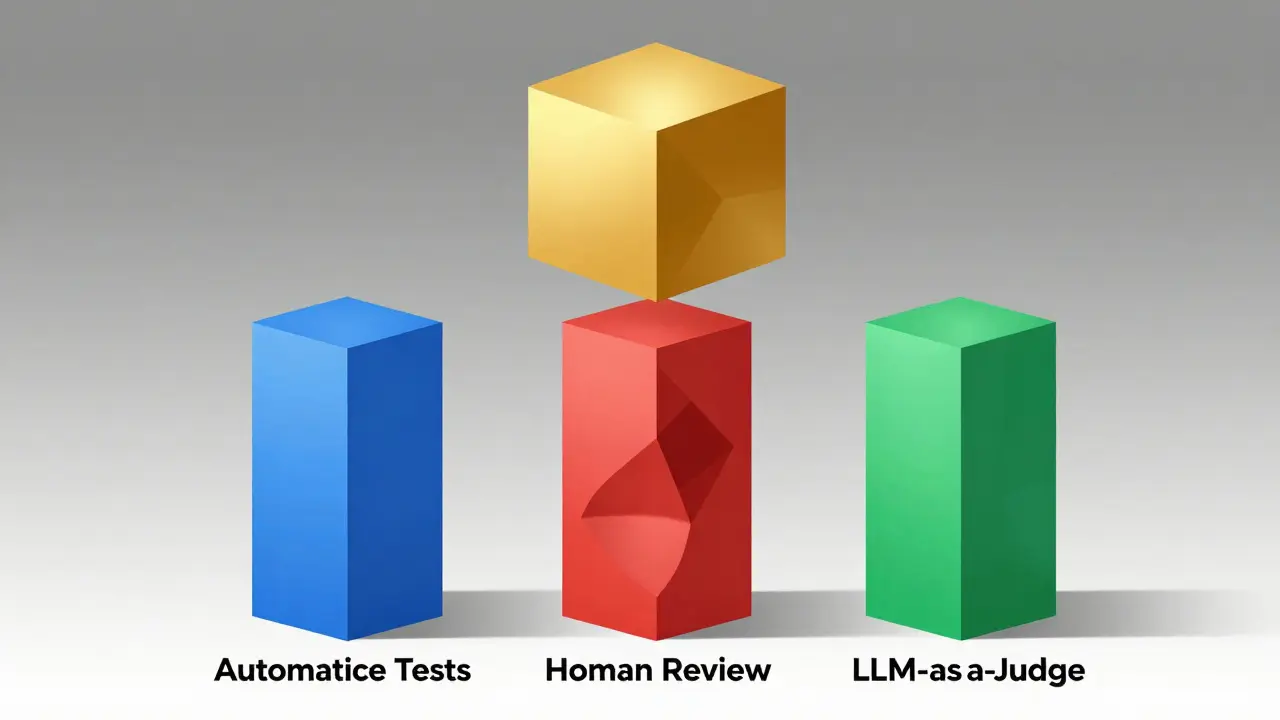
The most reliable approach integrates all three methods into a multidimensional strategy. No single metric tells the whole story. Here is how to structure your evaluation pipeline:
- Screen with Benchmarks: Start with automated tests like MMLU, HumanEval, and TruthfulQA. Filter out models that fail basic competence thresholds. This saves time and money by eliminating underperformers early.
- Simulate Real-World Tasks: Create custom datasets that mirror your actual use cases. If you’re building a customer support bot, include transcripts of past tickets. Test the model’s ability to adhere to prompt templates, retrieve accurate information (RAG capabilities), and maintain context over multi-turn conversations.
- Apply LLM-as-a-Judge: Use a strong judge model to score the outputs from step two against your specific rubric. Look for trends in failure modes-does the model consistently miss sarcasm? Does it truncate long responses?
- Final Human Review: Select a sample of edge cases and high-risk scenarios for human evaluation. Focus on ethical implications, cultural sensitivity, and overall helpfulness. Ensure inter-rater reliability by having multiple reviewers assess the same samples.
This hybrid approach ensures that your model meets predefined criteria for correctness, helpfulness, and conciseness while mitigating the risks associated with each individual method. It balances quantitative performance with qualitative risk assessment.
Safety, Bias, and Ethical Considerations
Evaluation isn’t just about performance; it’s about safety. As LLMs become more capable, the potential for harm increases. Safety benchmarks like HHH (Helpfulness, Honesty, and Harmlessness) assess how effectively models follow core ethical principles. These tests measure behavior across various conversational settings to ensure responses remain useful, truthful, and non-harmful.
Custom tests for bias, fairness, and toxicity are vital. You must evaluate your model against diverse demographic groups to ensure it does not perpetuate stereotypes. Regulatory requirements in industries like healthcare, finance, and legal services mandate human oversight. Your evaluation framework must document these checks to prove compliance and protect your organization’s reputation.
Remember, a model that is 99% accurate but produces toxic output 1% of the time is unacceptable in many contexts. Your evaluation strategy must prioritize safety alongside utility.
Conclusion: Moving Beyond Single Metrics
In 2026, dependence on single metrics like perplexity or even MMLU scores is inadequate. The landscape of LLM evaluation has matured into a nuanced discipline requiring a blend of automated rigor, human insight, and real-world validation. By combining standardized benchmarks, crowd-sourced ratings from platforms like Chatbot Arena, and structured human reviews, you can build a comprehensive understanding of model performance. This multidimensional approach not only improves accuracy but also ensures safety, alignment, and trustworthiness in your AI deployments.
What is the most important benchmark for evaluating LLMs in 2026?
There is no single "most important" benchmark. MMLU is best for general knowledge, HumanEval for coding, and Chatbot Arena Elo ratings for user preference. The best approach combines multiple benchmarks tailored to your specific use case.
Why is human evaluation still necessary if we have advanced AI benchmarks?
Human evaluation captures nuance, cultural context, ethical implications, and subjective qualities like empathy that automated metrics miss. It is essential for high-stakes applications where mistakes can cause serious harm.
What is "LLM-as-a-judge" and is it reliable?
LLM-as-a-judge uses one large language model to evaluate the outputs of another. It is scalable and cost-effective but can suffer from bias toward specific models. It should be used as part of a hybrid strategy, not as a standalone solution.
How does Chatbot Arena differ from traditional benchmarks?
Chatbot Arena uses crowdsourced, anonymous pairwise comparisons to generate Elo rankings based on real user preferences. Traditional benchmarks are static datasets with fixed answers. Arena reflects dynamic user satisfaction, while benchmarks measure specific technical capabilities.
What are the key challenges in human evaluation of LLMs?
Key challenges include subjectivity, bias, high cost, and low inter-rater reliability. Different humans may disagree on what constitutes a "good" response. Structured guidelines and multiple judges help mitigate these issues.
- May, 10 2026
- Collin Pace
- 8
- Permalink
Written by Collin Pace
View all posts by: Collin Pace