How to Measure Generative AI ROI: Metrics for Productivity and Growth
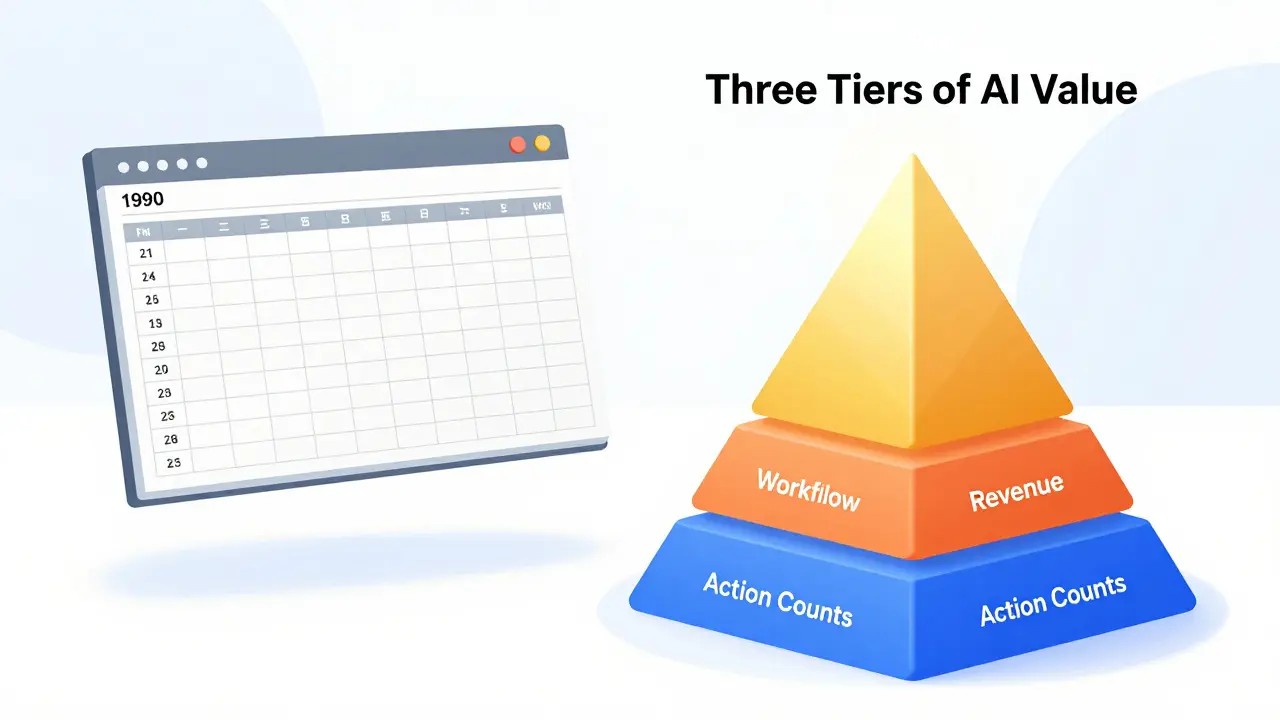
The Three Tiers of AI Value
To get a real picture of what's happening, you need to stop looking for one single number and start looking at a hierarchy of value. Most companies get stuck at the first level, but the real money is made at the third.Tier 1: Action Counts (The Basics)
This is your baseline. You're tracking things like API calls, how many people logged into ChatGPT Enterprise or GitHub Copilot, and daily active users. These tell you if people are using the tool, but they don't tell you if the tool is doing anything useful. It's like tracking how many times employees open a Word document-it shows activity, not productivity.
Tier 2: Workflow Efficiency (The Gains)
This is where you measure how the work actually changes. Look for time savings on specific tasks, error reduction rates, and the speed of delivery. For example, a product development team might see a 65% reduction in report generation time. The value here is operational: you're doing more with the same amount of people, or doing it faster.
Tier 3: Revenue Impact (The Win)
This is the holy grail. Here, you connect AI usage to actual business outcomes. Think about revenue per employee, Net Promoter Scores (NPS), or incremental profit margins. When you move from "we save 10 hours a week" to "we've increased our conversion rates by 22% because our content is better," you've found your true ROI.
| Metric Type | Example Metric | What it Tells You | Value Level |
|---|---|---|---|
| Hard ROI | Labor cost reduction | Direct cash savings | Financial |
| Hard ROI | Conversion rate increase | Direct revenue growth | Financial |
| Soft ROI | Error reduction rate | Higher quality output | Strategic |
| Soft ROI | Employee eNPS | Better talent retention | Cultural |
Why Traditional ROI Fails AI
Traditional ROI is built for factories, not for cognitive work. In a factory, if a machine makes 10% more widgets, the value is immediate and linear. In knowledge work, Generative AI often improves the quality of a decision before it improves the speed of the process. Imagine a senior data scientist who uses AI to cut a report's creation time by 65%. That's a great Tier 2 metric. But the real value is that the report now contains 30% more strategic insights that the CEO actually uses to pivot the business. You can't put a simple "hours saved" price tag on a better strategic decision, but that's where the massive enterprise value growth happens. Organizations that focus on this transformational measurement are projected to see 3.2x higher value growth by 2027 compared to those stuck in old-school accounting.
Connecting AI to Business Outcomes
If you want to stop guessing and start measuring, you need to move toward a holistic strategy. You can't just throw a tool at a team and hope for the best. The most successful companies-those seeing a median ROI of 55%-do three things differently:- They establish a baseline: You can't measure improvement if you don't know where you started. High-ROI organizations document at least 12 different KPIs before they even deploy the AI.
- They use controlled experiments: Don't just assume the AI helped. Compare a group of AI-enabled employees against a control group using traditional workflows. This is how a global law firm proved a 27% increase in billable hour utilization.
- They align with strategic goals: Using AI informally is a recipe for mediocre results. Companies with a formal strategy aligned to business goals achieve 2.3x higher ROI than those winging it.

Common Pitfalls and How to Avoid Them
One of the biggest mistakes is the "ROI Gap"-the time lag between turning the software on and seeing the money hit the bank. Quality improvements and employee satisfaction usually happen first. If you only measure revenue in the first 90 days, you'll likely kill a project that is actually working. Another hurdle is the data silo. Many companies use Claude Enterprise for coding and ChatGPT for marketing, but they don't have a single place to see how these tools impact the overall pipeline. To fix this, you need a unified analytics approach that tracks the user journey from the first prompt to the final business outcome.The Future of AI Measurement
We are moving toward a world of automatic attribution. By 2026, most enterprises will stop manually calculating ROI and instead use AI-powered analytics to automatically link a specific prompt or AI-driven workflow to a rise in revenue. We're also seeing a shift toward measuring "AI Agents" rather than just tools. When you measure the impact of an agent that can handle an entire customer service ticket from start to finish, the ROI becomes much easier to quantify because it replaces a complete business process, not just a few keystrokes.How long does it take to see a real ROI from Generative AI?
It depends on the tier. You'll see usage (Tier 1) in 2-4 weeks and productivity gains (Tier 2) within 8-12 weeks. However, meaningful revenue impact (Tier 3) typically takes 4-6 months to manifest and measure accurately.
What is the difference between Hard and Soft ROI in AI?
Hard ROI refers to direct, quantifiable financial gains like reduced labor costs or increased sales conversions. Soft ROI refers to qualitative improvements, such as better work quality, higher employee satisfaction (eNPS), and faster innovation cycles.
Why do so many AI projects report zero ROI?
Most projects are measured using traditional financial formulas that only look at immediate cost savings. Because AI often improves quality or strategic capability first, these "cognitive-era" gains aren't captured by industrial-era accounting, making the project look like a failure on paper.
Which metrics should I prioritize for a new AI rollout?
Start with adoption rates (Tier 1) to ensure the tool is being used, then quickly move to time-per-task and error rates (Tier 2). Finally, map these to a business outcome like customer satisfaction or revenue growth (Tier 3).
Do I need a specialist to measure AI ROI?
While basic metrics can be tracked by a manager, complex ROI measurement requires skills in cohort analysis and controlled experiment design. Many firms now employ measurement specialists to ensure the data is statistically valid and aligned with business goals.
- Apr, 4 2026
- Collin Pace
- 9
- Permalink
- Tags:
- Generative AI ROI
- AI productivity metrics
- AI business value
- measuring AI success
- GenAI transformation
Written by Collin Pace
View all posts by: Collin Pace