How to Negotiate Enterprise Contracts with Large Language Model Providers
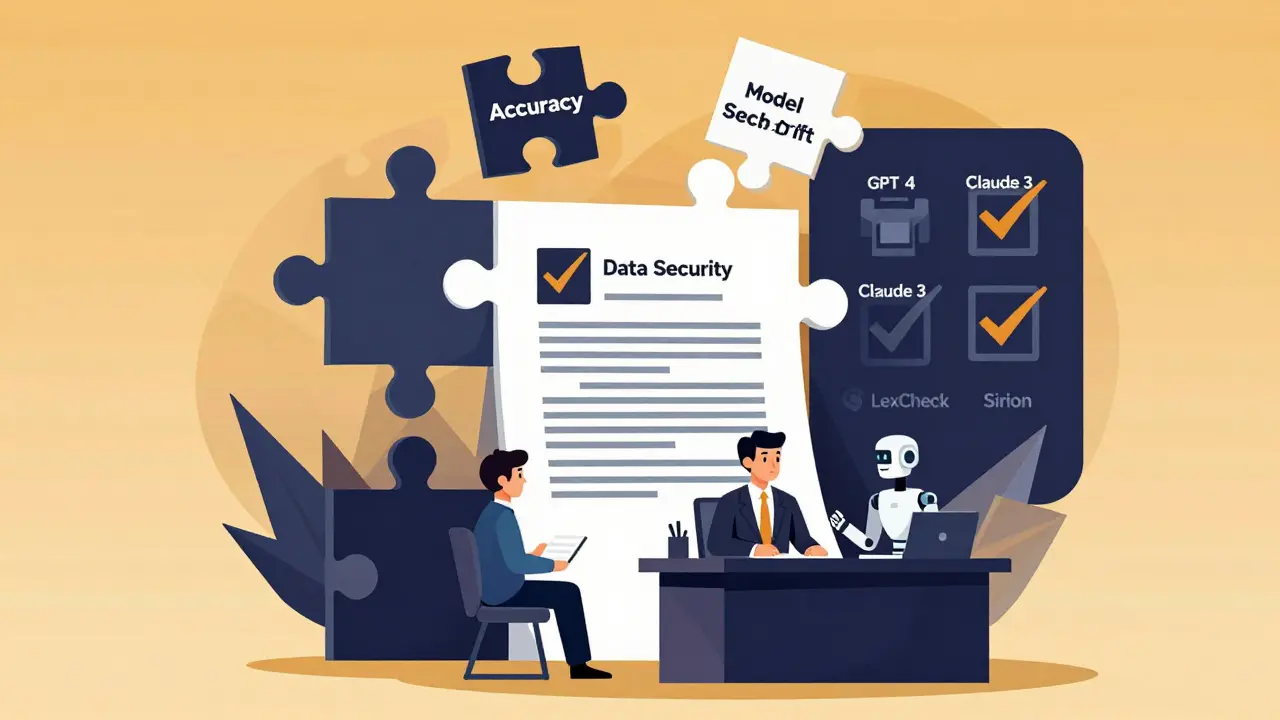
When your company signs a contract with a large language model (LLM) provider, you’re not just buying software-you’re locking in a legal, technical, and operational partnership that could make or break your contract management team’s efficiency. Many enterprises think they’re getting a simple API connection, but the reality is far more complex. LLMs used in contract review, drafting, and risk detection come with hidden costs, performance risks, and compliance traps that can cost millions if not handled correctly.
Understand What You’re Really Buying
Not all LLMs are created equal. OpenAI’s GPT-4, Anthropic’s Claude 3, and Google’s Gemini are general-purpose models trained on billions of internet texts. They’re great for chatbots and content generation. But when it comes to contracts? They struggle. Legal documents use precise language, nested clauses, jurisdiction-specific terms, and hidden obligations that general models weren’t built to understand. Specialized legal AI vendors like LexCheck, Sirion, and Aavenir train their models on tens of millions of actual contracts. This isn’t just a tweak-it’s a different foundation. These models achieve 86-92% accuracy in extracting obligations and identifying risks, compared to 72-78% for general models. That 15-20% gap isn’t academic. It means your legal team could miss a liability clause, approve an unfavorable termination term, or fail to spot a compliance violation. Before you sign anything, ask: Is this model trained on legal contracts? If the answer is vague or references "general knowledge," walk away.Pricing Isn’t Just Per Token-It’s Per Mistake
General LLM providers like OpenAI and Anthropic charge by the token: $0.0001 to $0.002 per token. At first glance, that sounds cheap. But here’s the catch: enterprise contracts often involve 500-2,000 documents per month, each averaging 8,000-15,000 tokens. That’s 4-30 million tokens monthly. Even at the low end, that’s $400-$6,000 per month in usage alone. Add in minimum annual commitments of $150,000-$500,000, and you’re looking at a six-figure bill before you even get started. Specialized legal AI vendors charge differently: $45-$120 per user per month, with a minimum of 50 users. That’s $27,000-$72,000 annually. It sounds more expensive per seat, but you’re paying for accuracy, integration, and support-not raw compute. You’re also avoiding the cost of errors. One missed clause in a $10M contract can cost 10x the annual license fee. Negotiate based on outcomes, not inputs. Don’t agree to a per-token model unless you have a cap. Demand a guaranteed reduction in contract review time. Ironclad’s data shows enterprises using accurate LLMs cut review time by 63%. Tie payment to that result.Accuracy Isn’t Optional-It’s Contractual
Most LLM contracts say nothing about performance. That’s a disaster waiting to happen. LexCheck’s 2024 benchmark study found that enterprise LLMs must hit these minimums to be useful:- 89.2% accuracy in extracting legal clauses
- 84.7% accuracy in identifying financial or compliance risks
- 78.3% accuracy in generating negotiated language
Data Security Isn’t Just Compliance-It’s Liability
Your contracts contain sensitive information: pricing, termination rights, indemnity clauses, personal data of employees and customers. If your LLM provider trains on that data, you’re giving away your competitive edge. Insist on these three things:- ISO 27001 and SOC 2 Type II compliance-non-negotiable.
- GDPR Article 28 processor agreement-required if you handle EU data.
- Data residency guarantees-your contract data must stay in your region (e.g., U.S. data stays in U.S. data centers).

Integration Isn’t a Feature-It’s a Requirement
An LLM that doesn’t talk to your contract management system (CLM) like Icertis, DocuSign, or SAP Ariba is useless. Your contract must specify:- API capacity: minimum 500 requests per second
- Uptime: 99.95% SLA for mission-critical review workflows
- Native integration: 92% of legal AI vendors offer this; only 38% of general LLM providers do
Playbooks and Prompts Are Your Secret Weapon
The best LLM in the world won’t help if it doesn’t know your company’s rules. That’s where playbooks come in. A playbook is a set of predefined prompts and rules that tell the AI: "If you see a non-compete clause longer than 18 months in a U.S. employment contract, flag it as high risk." Specialized vendors come with hundreds of pre-built playbooks for industries like finance, healthcare, and manufacturing. General LLM providers? They give you a blank prompt box. Negotiate for access to their playbook library. Demand the right to customize them. And insist on documentation-79% of satisfied users cite "domain-specific prompt libraries" as their top success factor.Change Management Is the Silent Killer
You can have the best tech in the world, but if your legal team doesn’t trust it, you’ll never use it. Many enterprises fail because they treat LLM adoption like installing new software. It’s not. It’s a cultural shift. Your contract should require the provider to support:- Training for legal operations staff
- Change management resources
- 24-hour SLA for legal-specific issues
Exit Strategy: Plan for When It Fails
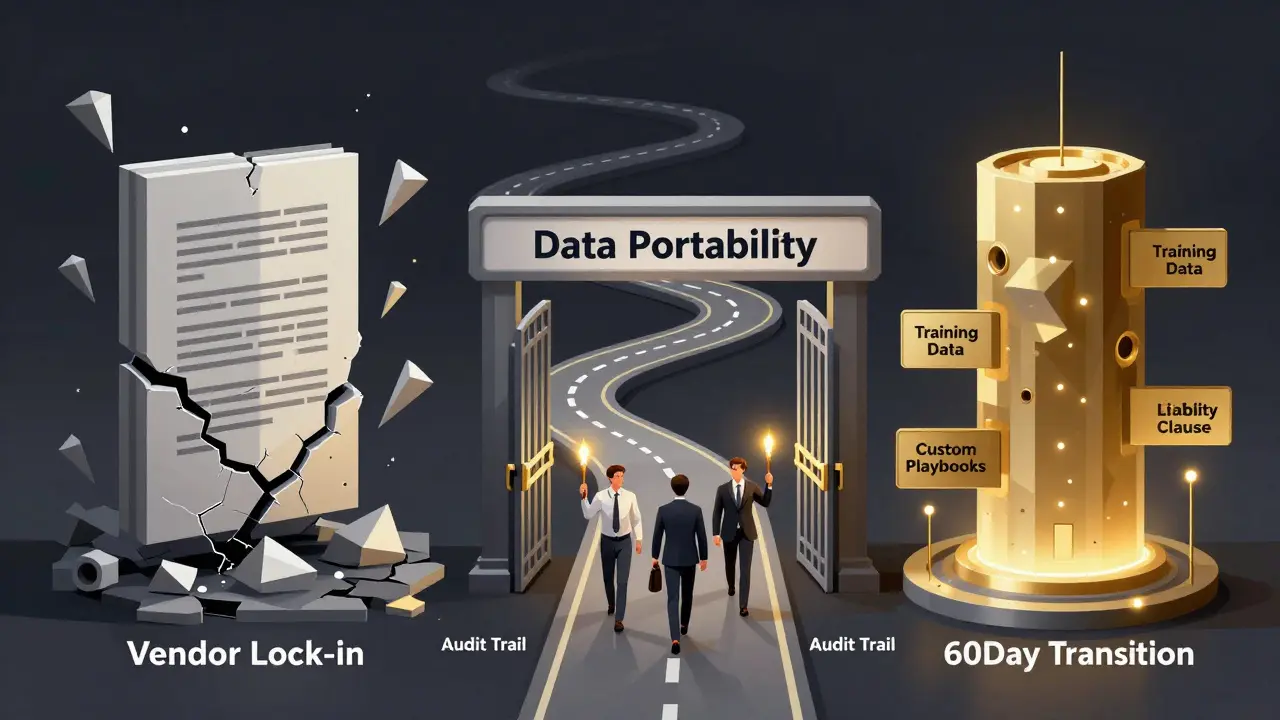
Here’s the hard truth: 63% of early adopters switch LLM providers within 18 months. Why? Performance gaps, hidden costs, or vendor pivots. Your contract must include an exit strategy:- Access to your training data in a usable format
- Portability of your custom playbooks
- Transition support for at least 60 days after termination
Regulations Are Coming-Make Sure You’re Covered
The EU AI Act (effective February 2025), California’s AI Truth in Advertising Act, and proposed U.S. legislation now require transparency in AI systems. Your LLM provider must be able to prove:- Where their training data came from
- How decisions were made
- Whether the model was fine-tuned on your data
Who Should Lead This Negotiation?
Legal teams own the contracts. Procurement owns the vendor relationships. IT owns the integration. But no one owns the LLM contract. Create a cross-functional team: legal, procurement, IT, compliance, and a legal operations specialist with prompt engineering skills. That role doesn’t exist in most companies yet-but it pays $145,000 a year because it’s critical. Don’t skip it.What to Do Next
1. Audit your current contract review process. How many documents do you handle monthly? What’s the average time per review? 2. Shortlist two types of providers: one general LLM (like OpenAI) and one specialized legal AI (like LexCheck or Sirion). 3. Run a 30-day pilot. Measure accuracy, speed, and cost. 4. Bring your legal team into the test. If they don’t trust the output, don’t sign. 5. Draft your contract with all the clauses above. Don’t accept a standard SaaS agreement. Enterprise LLM contracts aren’t about technology. They’re about risk, control, and accountability. Get them right, and your legal team will save hundreds of hours. Get them wrong, and you’ll be fixing mistakes for years.What’s the biggest mistake companies make when signing LLM contracts?
The biggest mistake is treating LLM contracts like standard SaaS agreements. Most companies focus on price and uptime but ignore accuracy guarantees, data ownership, model drift, and transparency. Without these, they end up with a tool that’s slow, unreliable, and legally risky. The result? Legal teams ignore it, and the company wastes six figures on software that doesn’t work.
Can I use ChatGPT for contract review without a special contract?
Technically yes, but you shouldn’t. OpenAI’s terms allow them to use your inputs to train future models. If you upload a contract with confidential pricing, non-compete clauses, or customer data, you’re giving that information to OpenAI. Enterprise contracts require explicit prohibitions against this. General-purpose LLMs aren’t designed for legal use-specialized legal AI vendors are.
How do I know if an LLM is accurate enough for my contracts?
Ask for a third-party audit report from the vendor. Look for benchmarks on clause extraction (89%+), risk identification (84%+), and language generation (78%+). Run your own test: feed 50 of your actual contracts into the system and compare the AI’s output to your legal team’s review. If the AI misses more than 1 in 10 critical clauses, it’s not ready.
Are specialized legal AI vendors worth the higher cost?
Yes-if your company handles more than 100 contracts a month. General LLMs cost less per token but require more manual review because they’re less accurate. Specialized vendors cost more per user but reduce review time by 60-70%. The savings in legal hours and risk avoidance quickly outweigh the license cost. Most Fortune 500 companies using LLMs for contracts now use specialized vendors for this reason.
What happens if the LLM makes a mistake that causes a lawsuit?
Unless your contract includes specific liability clauses, you’re on your own. Most providers disclaim all liability for AI errors. You need to negotiate indemnification for financial losses caused by the model’s failure to detect a clause or risk. Also require the vendor to carry professional liability insurance covering AI errors. Without this, you’re assuming all legal and financial risk.
How long does it take to implement an LLM for contract management?
Realistically, 12-16 weeks. Many vendors promise 4-8 weeks, but that’s unrealistic. You need time to train the model on your contract library, build playbooks, integrate with your CLM system, and train your team. Icertis found 54% of enterprises underestimate this timeline, leading to rushed deployments and failed adoption. Plan for 3 months minimum.
Will AI replace lawyers in contract negotiation?
No. AI is a tool, not a replacement. It can draft language, flag risks, and suggest alternatives-but it can’t understand business context, negotiate relationships, or interpret unspoken intentions. The best outcomes come when AI handles the repetitive work, and lawyers focus on strategy, trust, and high-stakes decisions. The future isn’t AI vs. lawyers. It’s AI + lawyers.
- Jan, 25 2026
- Collin Pace
- 6
- Permalink
- Tags:
- LLM contracts
- enterprise AI negotiation
- large language model pricing
- contract management AI
- LLM service agreements
Written by Collin Pace
View all posts by: Collin Pace