How to Scale Generative AI: KPI Baselines and Post-Launch Review Guide

You spent months building a Generative AI technology that creates new content, code, or data based on patterns learned from training sets pilot. The demos were slick. The stakeholders were impressed. Now comes the hard part: taking it from a shiny prototype to a system that actually handles real-world chaos at scale. Here is the brutal truth most leaders ignore-78% of AI projects fail when they try to jump straight to enterprise-wide implementation without proper validation. That statistic, pulled from Scott Madden’s 2024 analysis of 247 implementations, isn’t just bad luck. It’s a symptom of skipping the bridge between experiment and operation.
The gap between a successful pilot and a scaled product is not technology; it’s discipline. Specifically, it’s about setting rigorous KPI baselines before you start and conducting honest post-launch reviews after you finish. If you treat your pilot like a science project instead of a business investment, you will burn cash. This guide breaks down exactly how to set those metrics, what to measure, and how to decide if your AI is ready for prime time.
Why Pilots Fail When They Scale
A pilot is a controlled environment. You have clean data, enthusiastic early adopters, and maybe even a dedicated team watching over the model like a hawk. Production is different. In production, users are tired, data is messy, and the stakes are financial. According to research by SayOne Technologies, a pilot is defined as a "controlled trial period" typically lasting 3 to 6 months. But scaling requires shifting from hosted API endpoints, like basic OpenAI services, to secure, scalable enterprise solutions with robust governance.
The biggest mistake teams make is assuming technical success equals business success. A model might have 95% accuracy in a test lab but drop to 78% in production due to unaccounted data drift. We saw this firsthand in feedback from manufacturing data scientists who reported massive performance drops once the model encountered real-world variability. Without a structured framework to catch these issues early, you end up with a system that looks good on paper but fails in practice. Fission Labs analyzed 47 pilot projects and found that scaling often requires 30-50% more infrastructure resources than initially planned. If you didn’t budget for that, your project stalls.
Setting the Right KPI Baselines
Before you write a single line of code for your pilot, you need to define what "success" looks like. Vague goals like "improve efficiency" don’t cut it. You need quantitative baselines. Dr. Sarah Johnson, Chief AI Officer at Launch Consulting, noted that establishing measurable, quantitative baselines during pilot design is the single biggest predictor of scaling success.
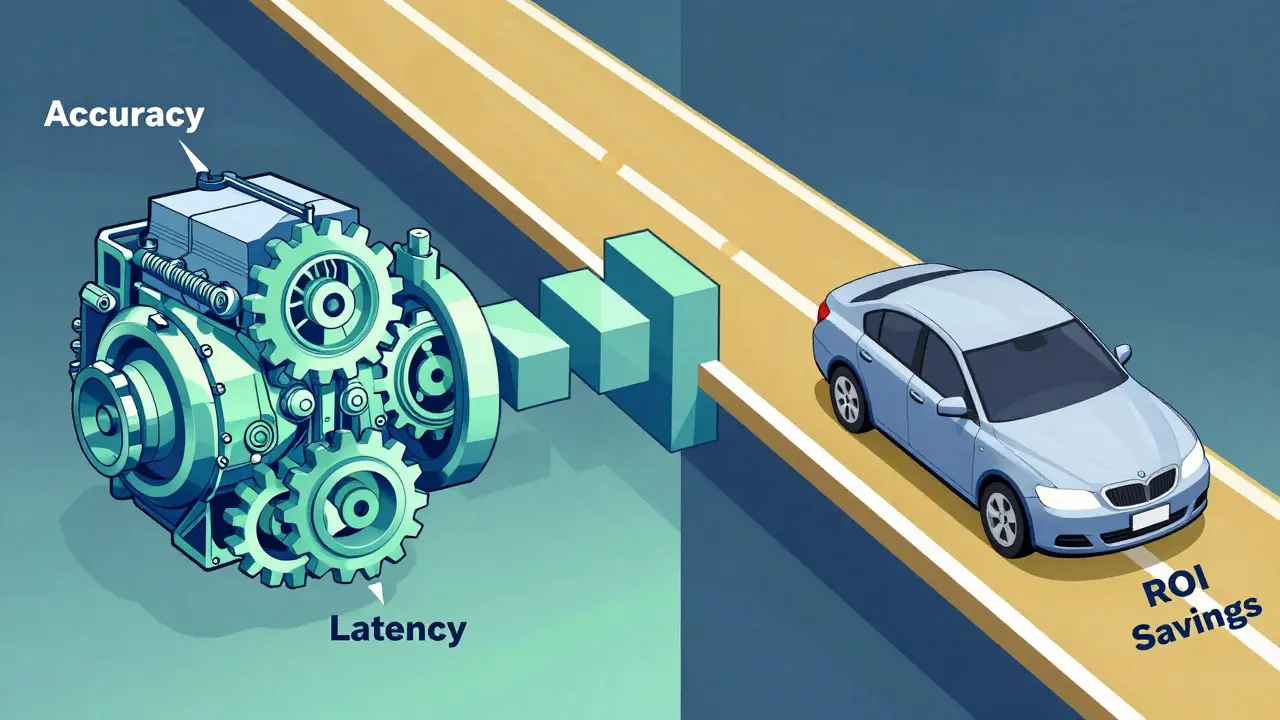
Your KPIs should fall into two buckets: technical and business. Technical metrics ensure the engine runs smoothly; business metrics ensure the car is going somewhere valuable.
| Category | Key Metric | Target Benchmark (Example) |
|---|---|---|
| Technical | Model Accuracy / Precision | >92% for production readiness (Squirro 2023) |
| Technical | Latency | <2 seconds for customer-facing apps |
| Business | Time-to-Market Reduction | Minimum 15% reduction |
| Business | Cost Savings | $50,000+ quarterly savings |
| User Experience | User Satisfaction Rate | >85% positive feedback |
Notice the specificity here. IBM’s manufacturing case studies show that prioritizing use cases based on strategic alignment (30% weight), financial impact (25%), and implementation speed (20%) leads to better outcomes. Don’t just pick random numbers. Look at your current baseline. If your customer support team currently takes 10 minutes to resolve a ticket, a 20% improvement means getting that down to 8 minutes. Can your AI do that? If yes, build it. If no, rethink the use case.
The Phased Approach to Scaling
Scaling isn’t a switch you flip; it’s a ladder you climb. The most effective frameworks use phased implementation cycles. Start with an ideation phase (2-4 weeks) to identify use cases, followed by a prioritization phase. Then, move into implementation, which typically takes 2-3 months for design, development, and validation.
During implementation, run sprint cycles of 2-3 weeks for iterative refinement. This allows you to catch errors early. For example, one Reddit user shared a strategy of phased scaling with specific KPI gates: Phase 1 involved 100 users with a 90% satisfaction threshold. Phase 2 expanded to 1,000 users with an 85% threshold. Only then did they go enterprise-wide. This prevented them from scaling a solution that worked for power users but failed for general staff.
This approach also helps manage resource requirements. Fission Labs reports that teams typically need 40-60 hours of cross-functional workshop time just for the ideation phase. Establishing KPI baselines alone can take 20-30 hours of stakeholder alignment per use case. Budget your time accordingly. If you rush this, you’ll pay for it later in rework.
Post-Launch Reviews: The Make-or-Break Step
Most organizations skip this step or treat it as a formality. That’s a huge error. Miles Group Principal Consultant David Reynolds warned that 73% of scaling failures stem from inadequate post-pilot review processes. These reviews aren’t just about checking boxes; they’re about capturing critical learnings regarding data quality, integration challenges, and user resistance.
A proper post-launch review must include:
- Data Drift Detection: Monitor model performance over 30 days. Acceptable degradation should be less than 5%. If your model’s accuracy drops significantly after launch, your training data may no longer reflect reality.
- Resource Assessment: Did you hit your infrastructure limits? As mentioned, scaling often requires 30-50% more compute power than piloting. Document these gaps.
- Risk Analysis: Review security compliance against frameworks like NIST AI RMF 1.0. Did any edge cases cause hallucinations or security breaches?
- User Feedback Loop: Analyze qualitative feedback. Are users adopting the tool? Early-stage implementations face a 65% average user resistance rate. Understanding why helps you adjust change management strategies.
Scott Madden’s research shows that organizations conducting formal post-launch reviews with cross-functional teams achieve 2.8x higher ROI on scaled implementations compared to those with ad-hoc reviews. Take this seriously. Dedicate 15-20% of your pilot resources specifically for these review activities.

Common Pitfalls to Avoid
Even with a solid plan, things can go wrong. Here are three common traps:
- Ignoring Data Quality: Squirro notes that data quality assessment should take 20-30% of your pilot time. Garbage in, garbage out applies doubly to generative AI. If your source documents are outdated or biased, your AI will be too.
- Over-relying on Vendor Metrics: O3 World found that organizations relying solely on vendor-provided metrics experienced 68% higher cost overruns during scaling. Always validate claims with your own internal testing.
- Siloed Implementations: IBM documented that companies using isolated pilots achieved only 8-15% productivity gains, whereas those implementing shared foundations (agentic AI approaches) saw 22-35% gains. Build platforms, not just point solutions.
Also, watch out for the "demo effect." Just because the model worked perfectly during the presentation doesn’t mean it will work under load. One healthcare CIO shared a story on Gartner Peer Insights where scaling too quickly without reviewing edge cases resulted in $250k in remediation costs. Painful, but avoidable with patience.
Future-Proofing Your AI Strategy
The landscape is moving fast. By 2026, Gartner predicts that 60% of enterprises will use AI-augmented tools for scaling decisions, up from just 15% in 2023. Tools like Squirro’s 'ScaleAssist' are already automating 40% of post-pilot review processes. Keeping an eye on these developments can give you an edge.
Regulatory considerations are also tightening. With GDPR, CCPA, and emerging AI regulations, 73% of enterprises cite compliance as a critical factor in post-launch reviews. Ensure your KPIs include compliance checks. Ignoring legal risks now could shut down your entire initiative later.
Finally, remember that scaling is iterative. Even after launch, continue to monitor performance. Use the insights from your post-launch reviews to refine your next pilot. The goal isn’t just to deploy AI once; it’s to build an organization that continuously improves through intelligent automation.
What is the typical duration of a Generative AI pilot?
According to SayOne Technologies, a standard Generative AI pilot lasts between 3 to 6 months. This timeframe allows for adequate testing, validation, and initial user feedback collection before making a decision on scaling.
How do I determine if my AI pilot is ready to scale?
Your pilot is ready to scale if it meets specific KPI thresholds consistently. Look for minimum 15% time-to-market reduction, 20% resource optimization, or $50,000+ quarterly cost savings. Additionally, ensure technical metrics like model accuracy (>92%) and latency (<2 seconds) are stable over a 30-day period.
Why do most AI scaling attempts fail?
The primary reasons for failure include lack of predefined KPI baselines, ignoring data drift, and inadequate post-launch reviews. Scott Madden’s research indicates that 78% of projects fail when jumping directly to enterprise implementation without proper validation phases.
What is data drift and why does it matter?
Data drift occurs when the statistical properties of input data change over time, causing model performance to degrade. It matters because a model accurate in a controlled pilot may fail in production if the real-world data differs significantly from training data. Monitoring for less than 5% degradation over 30 days is recommended.
How much extra infrastructure is needed for scaling?
Fission Labs’ analysis suggests that scaling often requires 30-50% more infrastructure resources than the pilot phase. This includes additional compute power, storage, and potentially enhanced security measures to handle increased load and complexity.
- Jun, 29 2026
- Collin Pace
- 5
- Permalink
- Tags:
- generative AI scaling
- KPI baselines
- post-launch review
- AI pilot program
- enterprise AI governance
Written by Collin Pace
View all posts by: Collin Pace