How to Stop LLMs From Drifting and Repeating in Long-Form Text
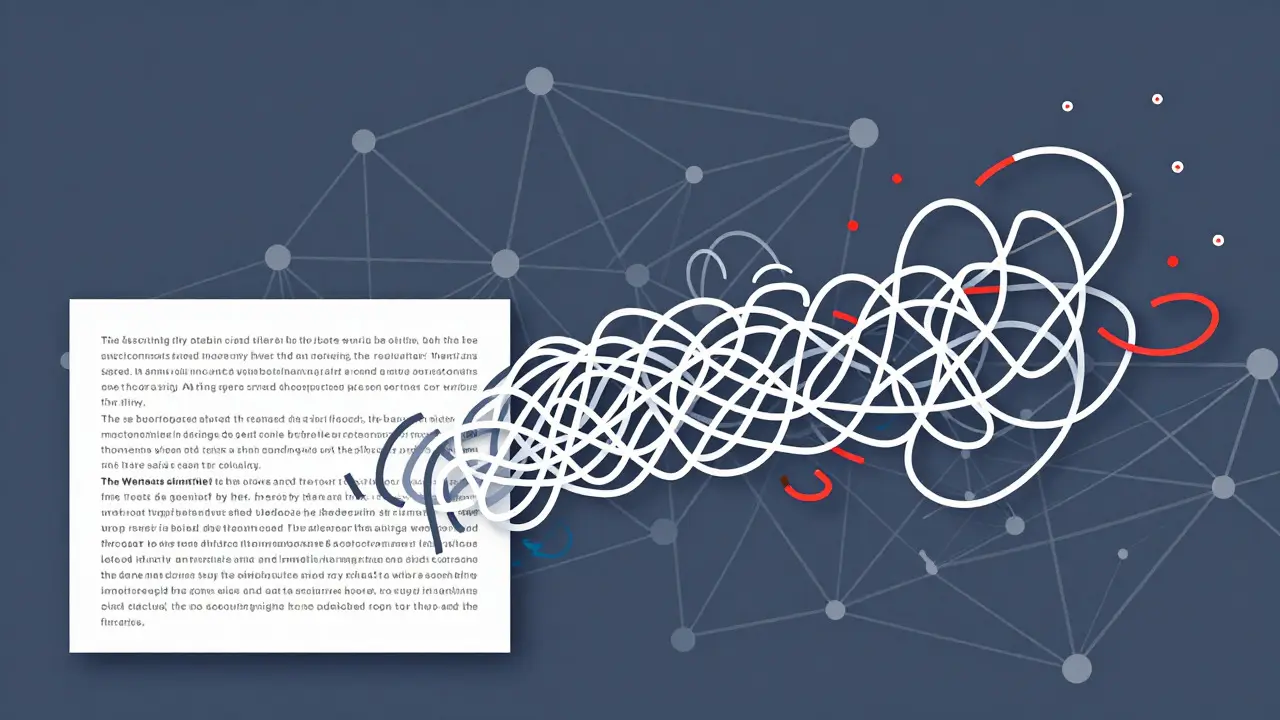
You ask an AI to write a 2,000-word technical guide. The first 500 words are brilliant-clear, structured, and on point. But by word 1,200, the text starts looping. It repeats the same examples. It forgets the main argument. Suddenly, you’re reading about cloud storage architecture when the topic was database indexing. This isn’t just annoying; it’s useless.
This is the core problem with long-form generation using Large Language Models (LLMs). As outputs stretch beyond typical conversational lengths, models suffer from two fatal flaws: topic drift and repetition loops. According to data from RTS Labs, unguided models drift off-topic in 68% of generations past 1,500 tokens. Repetition rates spike by 32% for every additional 500 tokens generated. If you want publishable content, you can’t just hit “generate” and hope for the best. You need a strategy.
Why Do LLMs Lose Their Way?
To fix the problem, you have to understand why it happens. Large Language Models don’t “think” like humans. They predict the next word based on what came before. This is called autoregressive generation. In short responses, this works fine. The context window-the memory of the conversation-is small enough that the model keeps track of everything.
But as the text grows, the model hits architectural limits. Standard Transformer architectures rely on positional encoding to know where each word sits in the sequence. When the output exceeds these thresholds (often between 2,048 and 8,192 tokens depending on the model), the model’s grasp on the beginning of the text weakens. Research published on arXiv in February 2024 showed that even top-tier models like GPT-4 lose 47% of their accuracy in maintaining topic consistency once they pass 2,000 tokens.
Repetition happens through self-reinforcement. The model generates a phrase, sees it in its own immediate history, and decides, “This looks like a good pattern,” so it repeats it. It gets stuck in a loop because its probability distribution favors familiar patterns over new ideas when uncertainty rises. Without intervention, the AI becomes an echo chamber of its own making.
The Prompt Engineering Fix: Structure Over Freedom
The easiest way to fight drift is to constrain the model with better prompts. Free-writing prompts invite chaos. Structured prompts provide guardrails.
One of the most effective techniques is Chain-of-Thought (CoT) prompting. Instead of asking for the final essay, you ask the model to outline its reasoning step-by-step first. RTS Labs found that CoT reduces drift by 31%. However, it comes at a cost: computational overhead increases by 22% because the model has to generate more intermediate tokens.
Here is a practical approach to structuring your prompts for long-form tasks:
- Define the Scope Early: Explicitly state the word count or section structure in the prompt. “Write a 1,500-word article divided into three sections: Introduction, Technical Deep Dive, and Conclusion.”
- Use Sectional Generation: Don’t ask for the whole piece at once. Ask for Section 1. Then feed Section 1 back into the prompt along with the original instructions to generate Section 2. This keeps the context window fresh and focused.
- Include Negative Constraints: Tell the model what NOT to do. “Avoid repeating the term ‘digital transformation’ more than twice. Do not restate the introduction in the conclusion.”
This method requires more manual oversight, but it prevents the model from wandering off into irrelevant tangents halfway through the draft.
Retrieval-Augmented Generation (RAG): Anchoring Facts
If your long-form content relies on specific facts, data, or proprietary knowledge, pure generation will fail. The model will hallucinate details to fill gaps, leading to severe drift from reality. This is where Retrieval-Augmented Generation (RAG) becomes essential.
RAG works by fetching relevant documents from a database before generating text. It anchors the model’s output to real-world information. For knowledge-intensive content, RAG improves factual consistency by 45%, according to industry benchmarks. However, it adds latency. Each retrieval call adds 300-500 milliseconds to the generation time.
Implementing RAG effectively involves:
- Chunking Data Correctly: Break your source documents into small, semantic chunks (around 500-1,000 tokens each). Too large, and the retrieval noise increases. Too small, and you lose context.
- Vector Embeddings: Use high-quality embedding models to convert text into numerical vectors. These allow the system to find semantically similar content, not just keyword matches.
- Dynamic Context Injection: Insert the retrieved chunks directly into the prompt’s context window. Ensure the prompt instructs the model to prioritize this retrieved information over its pre-trained knowledge.
While RAG doesn’t directly stop stylistic repetition, it stops factual drift. The model stays tethered to the source material, which naturally keeps the narrative on track.

Fine-Tuning and Parameter Adjustment: The Heavy Lifters
If prompt engineering and RAG aren’t enough, you may need to adjust the model itself. Fine-tuning involves training the model on a specific dataset of high-quality long-form texts. This teaches the model the style, structure, and coherence patterns you want.
Parameter-Efficient Fine-Tuning (PEFT) methods like LoRA (Low-Rank Adaptation) are popular because they are cheaper than full fine-tuning. RTS Labs reported a 23% improvement in coherence for long-form outputs when applying LoRA to 7B-parameter models. Full fine-tuning can reduce drift by 58% and repetition by 52%, but it costs significantly more-around $12,000 in cloud computing costs for a single 7B-model run on AWS p4d instances.
Before spending money on fine-tuning, try adjusting inference parameters. Temperature controls randomness. A temperature of 1.0 is creative but chaotic. Lowering it to 0.3-0.7 reduces repetition by 18% while maintaining enough creativity to avoid robotic prose. Developers on HackerNews noted that dropping temperature from 1.0 to 0.5 cut repetitive phrases by 35% in novel writing tasks.
Comparing Mitigation Strategies
| Technique | Drift Reduction | Repetition Reduction | Cost/Complexity | Best Use Case |
|---|---|---|---|---|
| Prompt Engineering (CoT) | 31% | Moderate | Low | General essays, brainstorming |
| Temperature Scaling | Minimal | 18-35% | Very Low | Creative writing, coding |
| RAG Systems | High (Factual) | Moderate | Medium (Infrastructure) | Technical docs, research reports |
| LoRA Fine-Tuning | 23% (Coherence) | Significant | Medium (Compute) | Brand-specific tone, specialized domains |
| Full Fine-Tuning | 58% | 52% | High ($12k+) | Enterprise-grade consistency |
Hybrid Approaches: The Future of Coherence
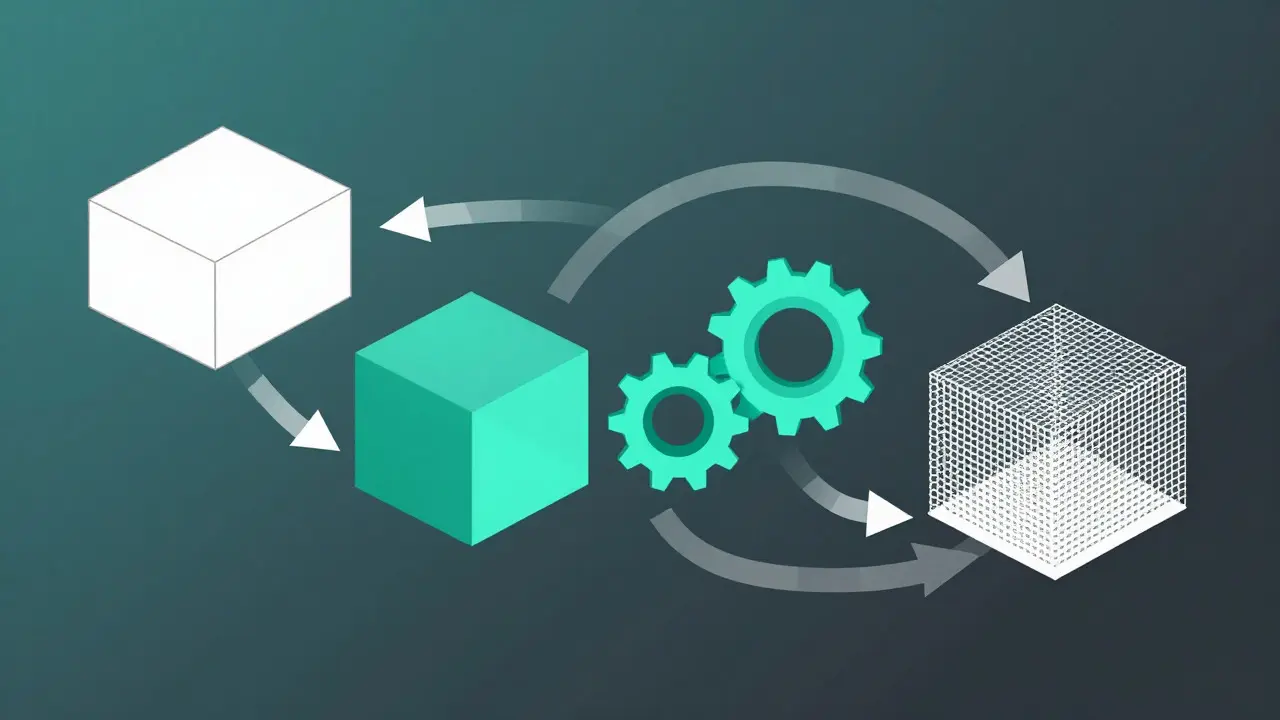
No single technique solves all problems. The most robust systems combine methods. Scale AI’s analysis shows that combining RAG with temperature-scaled generation and selective fine-tuning achieves 73% coherence maintenance at 3,000 tokens. Compare that to base models, which maintain only 29% coherence at the same length.
A hybrid workflow might look like this:
- Outline Phase: Use a high-temperature model to brainstorm a detailed outline. Human approves the structure.
- Section Generation: Generate each section individually using a lower-temperature model.
- RAG Integration: Inject verified facts via RAG during generation to prevent hallucination.
- Post-Processing: Run the final text through a separate evaluation model (self-consistency check) to identify and flag repetitive or drifting paragraphs.
Self-consistency methods, where the model generates multiple versions and selects the most consistent one, reduce hallucination by 37% but increase generation time by 2.3x. It’s a trade-off between speed and quality.
Expert Perspectives and Limitations
Despite these advances, fundamental limits remain. Dr. Emily Bender of the University of Washington notes that current architectures struggle with long-range dependencies without significant modification. She argues that true long-form coherence is still out of reach for standard Transformers. Conversely, Yann LeCun at Meta believes that memory-augmented transformers and hierarchical attention mechanisms will solve 80% of these issues within 24 months.
For now, users must accept that perfect coherence is rare. Even Microsoft’s Phi-3-mini, which maintains 79% coherence at 4,000 tokens on consumer hardware, isn’t flawless. The goal isn’t perfection; it’s manageability. By understanding the mechanics of drift and repetition, you can build workflows that produce usable, high-quality long-form content without wasting hours editing AI nonsense.
What causes topic drift in LLM long-form generation?
Topic drift occurs because LLMs use autoregressive generation, predicting the next token based on previous context. As the text length exceeds the model's effective context window (often 2,000+ tokens), the influence of earlier instructions weakens. Positional encoding limitations cause the model to lose track of the initial prompt, leading it to wander off-topic. Additionally, the model may latch onto recent keywords rather than the overarching theme.
How does temperature affect repetition in AI text?
Temperature controls the randomness of the model's predictions. A high temperature (e.g., 1.0) encourages diverse, creative outputs but increases the risk of erratic behavior and repetition loops as the model seeks familiar patterns to stabilize its output. Lowering the temperature to 0.3-0.7 constrains the probability distribution, forcing the model to stick closer to likely sequences, which empirically reduces repetition by 18-35%.
Is RAG necessary for avoiding drift?
RAG is not strictly necessary for preventing stylistic drift, but it is critical for preventing factual drift. By retrieving external documents and injecting them into the context, RAG anchors the model to specific information. This prevents the model from hallucinating details or deviating from the source material, improving factual consistency by 45% in knowledge-intensive tasks.
What is the most cost-effective way to improve long-form coherence?
The most cost-effective approach is combining prompt engineering with temperature scaling. Using Chain-of-Thought prompting reduces drift by 31% with minimal compute cost. Adjusting temperature to 0.5 further reduces repetition. Fine-tuning offers better results but requires thousands of dollars in cloud computing costs, making it less accessible for individual developers or small teams.
Can LLMs generate coherent text over 10,000 tokens?
Currently, no standard LLM can reliably generate coherent text over 10,000 tokens without significant architectural modifications or hybrid approaches. While models like GPT-4 and Claude 3 Opus show improved performance, accuracy degrades sharply beyond 2,000-3,000 tokens. For extremely long outputs, sectional generation (breaking the task into smaller chunks) remains the only reliable method.
- Jul, 26 2026
- Collin Pace
- 7
- Permalink
Written by Collin Pace
View all posts by: Collin Pace