How to Teach LLMs to Say 'I Don’t Know': Reducing Hallucinations with Uncertainty Prompts
Have you ever asked an AI model a simple question and received a confident, completely fabricated answer? You aren't alone. Large Language Models (LLMs) are impressive, but they have a nasty habit: hallucination. They make things up with absolute certainty, which is fine for creative writing but disastrous for medical advice or legal research. The solution isn't just better data; it's teaching the model to admit when it doesn't know something.
For years, developers tried to fix this with basic instructions like "If you don't know, say so." It rarely worked. Recent breakthroughs in 2024 and 2025 show that uncertainty isn't an innate trait of these models-it’s a skill that must be explicitly trained. By using specific techniques like Uncertainty-Sensitive Tuning (US-Tuning), we can force models to recognize their knowledge boundaries, reducing false confidence by up to 73% in specialized applications.
The Problem: Why LLMs Lie Confidently
To fix the problem, we first need to understand why it happens. LLMs are prediction engines. Their job is to pick the next most likely word based on patterns they’ve seen before. They don't have a "truth" database inside them. When you ask a question outside their training context, they don't pause and think, "Hmm, I'm not sure." Instead, they generate the most plausible-sounding sentence possible.
This leads to what researchers call "instructional inattention." Dr. Jonathan Kasai from the University of Washington found that even when you give a model explicit instructions-like "Only use the provided text"-it ignores them about 63% of the time if the internal pressure to complete the pattern is high. The model prioritizes fluency over accuracy. This is why a standard chatbot might invent a court case or a drug side effect rather than admitting ignorance.
The core issue is that traditional training rewards the model for answering every question. There is no penalty for being wrong, only for being silent. To change this behavior, we have to rewire the reward system through specialized tuning.
The Solution: US-Tuning Explained
The most effective method currently available is called Uncertainty-Sensitive Tuning, also known as US-Tuning. Developed and refined through research published in mid-2024, this approach uses a two-stage process to teach models how to abstain from answering when necessary.
Here is how the two stages work:
- Stage 1: Uncertainty-Recognition Tuning (UT)
In this phase, you train the model on a dataset containing both "known" questions (where the answer is in the text) and "unknown" questions (where the answer is missing). The goal is binary classification: Is the context sufficient? If yes, answer. If no, output "Not Provided" or "I don't know." This teaches the model to identify gaps in information. Research shows this stage alone can boost uncertainty recognition accuracy to 89.7%, compared to 65% in baseline models. - Stage 2: Prompt-Sensitive Tuning (ST)
Here is the catch: after Stage 1, the model becomes too cautious. It starts rejecting valid questions because it's overly sensitive to uncertainty. Standard QA performance drops by about 27%. Stage 2 fixes this by using "designed causal instructions." You teach the model to distinguish between contexts where it should answer versus those where it should abstain. This recovers the lost performance while keeping the hallucination guardrails in place.
The result is a model that knows its limits. It doesn't just guess; it evaluates the sufficiency of the evidence before speaking.
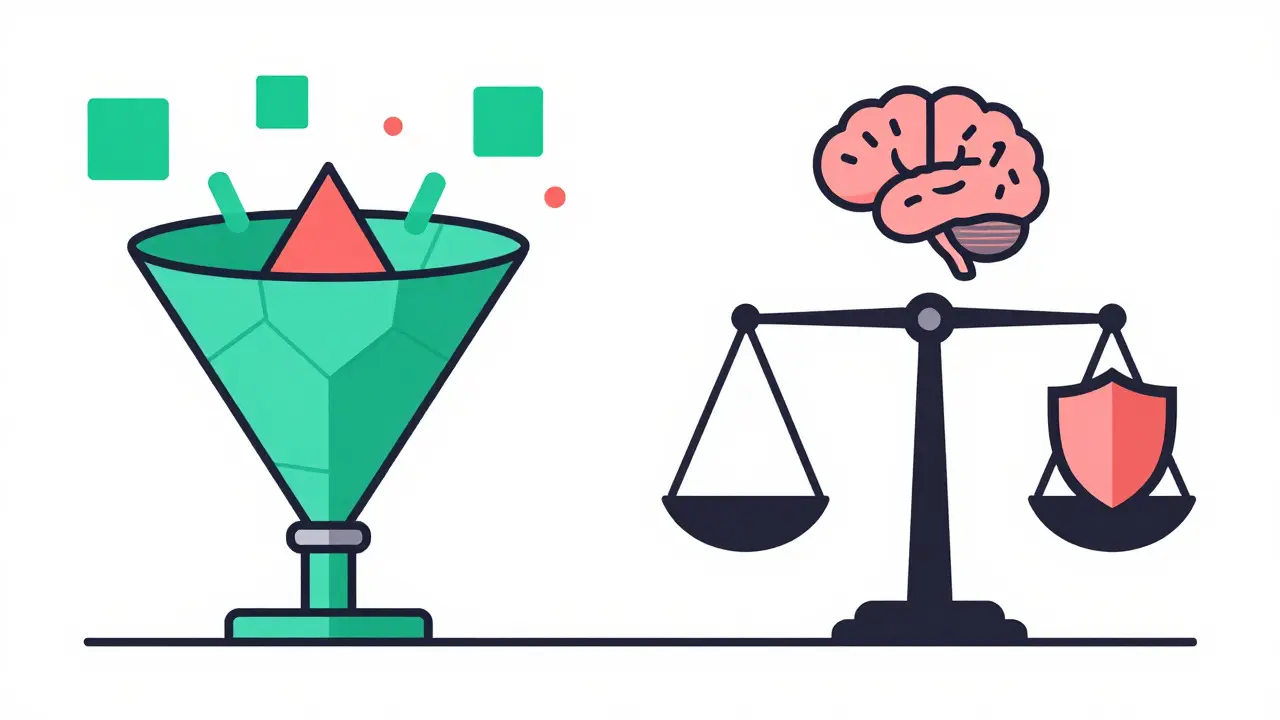
Comparison: US-Tuning vs. Other Methods
You might wonder if there are easier ways to do this. There are several alternatives, but they come with significant trade-offs. Let’s look at how US-Tuning compares to other common strategies.
| Method | Uncertainty Recognition Accuracy | Standard QA Performance | Computational Cost | Best For |
|---|---|---|---|---|
| US-Tuning | 89.7% | 72.3% | High (Training required) | Enterprise, High-stakes domains |
| Baseline Instruction Tuning | 65.0% | 73.5% | Low | General chatbots |
| AttrPrompt (Yu et al.) | 71.2% | ~70% | Medium | Feature-based prompting |
| SelfCheckGPT | 68.5% | Varies | Very High (3.2x resources) | Post-hoc verification |
| Self-Reflective Prompting | 58-76% | High | Low | Quick experiments |
As you can see, US-Tuning offers the best balance of accuracy and reliability, but it requires more effort upfront. Simple prompting methods like asking the model "Are you sure?" are cheap but inconsistent, failing nearly half the time in some tests.
Practical Implementation: Costs and Challenges
If you are a developer looking to implement this, be prepared for a steep learning curve. This isn't a plug-and-play feature yet. Based on feedback from engineers on GitHub and Reddit in late 2024, here is what you need to know:
- Data Construction is Key: You need a balanced dataset of known and unknown questions. Creating a standard 50,000-example dataset typically takes 4-6 weeks of human annotation and costs between $12,000 and $18,000. Smaller teams often struggle here, with one startup CTO reporting it took three people six weeks just to annotate the data.
- Model Size Matters: US-Tuning works best on models with 7 billion parameters or more. On smaller models, the accuracy drops by 15-18%. If you are running a lightweight model on edge devices, you might not see significant benefits.
- Implementation Time: Expect to spend 3-4 weeks dedicated to implementing both stages effectively. While community repositories exist (like the popular `us-tuning` repo on GitHub), documentation is often sparse, requiring deep knowledge of transformer architectures.
- Oversensitivity Risk: Without Stage 2 tuning, your model will become a "yes-man" to uncertainty, rejecting up to 38.7% of answerable questions. This frustrates users, so balancing the threshold is critical.
However, the payoff is real. Microsoft’s internal tests showed that applying similar uncertainty protocols to Bing Copilot reduced medically inaccurate responses by 67.3%. In healthcare and legal tech, that level of reliability is worth the investment.

The Future: Regulation and Market Growth
This isn't just a technical preference anymore; it's becoming a regulatory requirement. The EU AI Act, effective February 2025, mandates "appropriate uncertainty signaling" for high-risk AI systems. Gartner predicts that by 2026, 75% of enterprise AI deployments will require explicit uncertainty handling capabilities.
The market for uncertainty-aware AI is exploding, projected to grow from $2.1 billion in 2024 to $8.7 billion by 2027. Healthcare, legal tech, and financial services are leading the charge because the cost of a hallucination in these fields is catastrophic.
New developments are making this easier. US-Tuning v2.1, released in early 2025, reduces dataset requirements by 35% using synthetic data generation. Major frameworks like Hugging Face’s Transformers library have integrated support for these methods. However, watch out for "uncertainty gaming," where models learn to strategically say "I don't know" to avoid difficult questions-a bug observed in 12.7% of improperly tuned implementations.
Conclusion: Building Trust Through Honesty
Teaching LLMs to say "I don't know" is about building trust. Users forgive an AI for not knowing something; they don't forgive it for lying. By moving beyond simple prompting and adopting structured tuning methods like US-Tuning, developers can create systems that are not only smarter but also safer. As regulations tighten and expectations rise, the ability to quantify and express uncertainty will separate reliable AI tools from risky toys.
What is US-Tuning?
US-Tuning (Uncertainty-Sensitive Tuning) is a two-stage training method for Large Language Models. Stage 1 teaches the model to recognize when context is insufficient to answer a question, prompting it to respond with "Not Provided." Stage 2 refines this sensitivity to ensure the model doesn't reject valid questions, balancing uncertainty recognition with standard question-answering performance.
Why do LLMs hallucinate instead of saying they don't know?
LLMs are designed to predict the next likely word in a sequence. They prioritize fluency and pattern completion over factual accuracy. Without explicit training to recognize knowledge gaps, they fill in missing information with plausible-sounding but incorrect data, a phenomenon known as instructional inattention.
Is US-Tuning suitable for small language models?
US-Tuning is most effective on models with 7 billion parameters or more. On smaller models, the method shows reduced effectiveness, with accuracy dropping by 15-18%. For very small models, simpler prompting techniques or post-hoc verification methods like SelfCheckGPT might be more practical despite higher computational costs during inference.
How much does it cost to implement uncertainty tuning?
The primary cost is in data construction. Creating a balanced dataset of 50,000 examples typically costs $12,000-$18,000 and takes 4-6 weeks of human annotation. Additionally, expect 3-4 weeks of engineering time to implement the two-stage tuning process effectively.
Does the EU AI Act require uncertainty signaling?
Yes. The EU AI Act, effective February 2025, requires "appropriate uncertainty signaling" for high-risk AI systems. This regulation drives the adoption of methods like US-Tuning in sectors such as healthcare, finance, and legal tech, where hallucinations can have severe consequences.
- Aug, 7 2026
- Collin Pace
- 10
- Permalink
Written by Collin Pace
View all posts by: Collin Pace