Human Feedback in the Loop: Scoring and Refining AI Code Iterations

We've all been there: you ask your AI assistant to write a function, it gives you something that looks right, and then three days later, it crashes the production server. It’s frustrating because the technology is powerful, but without guardrails, it feels like driving a race car blindfolded. That’s where Human Feedback in the Loop comes in.
Human Feedback in the Loop isn't just about nodding when the AI gets it right. It is a systematic process where developers actively score and evaluate AI output to teach the system what "good code" actually means for their specific project. As we move deeper into 2026, relying on raw autocomplete features is becoming risky. Companies that implement structured feedback mechanisms report seeing massive drops in bugs and security holes. If you want your code to be safe, maintainable, and ready for enterprise environments, understanding this scoring loop is non-negotiable.
Understanding the Core Mechanics of HFIL
So, what exactly is happening under the hood? We are talking about a methodology rooted in Reinforcement Learning from Human Feedback (RLHF). Originally pioneered by researchers around 2017, this was meant to stop AI from hallucinating wildly. In the coding world, it evolved into something much more practical. Instead of just letting an algorithm guess, we insert a human checkpoint.
Think of it like a code review session that happens instantly. When an AI tool like GitHub Copilot suggests a snippet, the developer doesn't just accept or ignore it. They assign a score. Maybe they say, “This is secure but slow,” or “It works but violates our naming conventions.” Modern systems capture these preferences. According to a 2025 IEEE study, this structured approach leads to a 37.2% reduction in critical bugs compared to teams using AI ad-hoc. That number alone makes the case for formalizing this process.
The architecture usually boils down to three parts:
- The Interface: Where you see the suggestion and give feedback (inside your IDE).
- The Scoring Model: A reward model trained on thousands of labeled examples to understand your preference.
- The Refinement Engine: Takes that score and adjusts the model parameters for the next prompt.
For instance, systems analyzed in June 2025 by CMU show that effective reward models are trained on anywhere between 50,000 and 200,000 human-labeled code examples. This ensures the AI understands nuance, not just syntax.
Comparing Leading Tools and Pricing Models
If you are shopping for a setup in early 2026, the market has matured significantly. You aren't just choosing between tools anymore; you are choosing how deep the feedback loop goes. Some platforms offer basic binary approval (yes/no), while others offer multi-dimensional scoring. The difference in quality is stark.
| Platform | Pricing (Monthly) | Feedback Type | Key Differentiator |
|---|---|---|---|
| GitHub Copilot Business | $39/user | Multi-dimensional | Integrated feedback loop (v3.2+) |
| Amazon CodeWhisperer Pro | $19/user | Binary (Approve/Reject) | Simpler setup, lower cost |
| Google Vertex AI | $45/user | 12-Metric Scoring | Deep customization of weights |
GitHub Copilot Business stands out here because its feedback integration allows the model to learn from team habits over time. The 2025 Gartner testing found that Copilot with integrated feedback loops produced code that scored 32.7% higher on SonarQube metrics than basic versions. However, if you are on a budget and don't have complex compliance needs, Amazon CodeWhisperer offers a cheaper alternative, though Forrester noted that binary feedback systems show 41.2% less long-term quality improvement. Google Vertex AI takes it further, letting you weigh metrics like security at 22.3% and performance at 18.7%, which is ideal for regulated industries.
Designing Your Scoring Rubric
You can buy the best tool, but if your team scores poorly, the results won't matter. The feedback loop is only as good as the input. Many teams fail because they treat feedback as a checkbox rather than a data point. To get the full benefit, you need a rubric. Don't just look at whether the code runs.
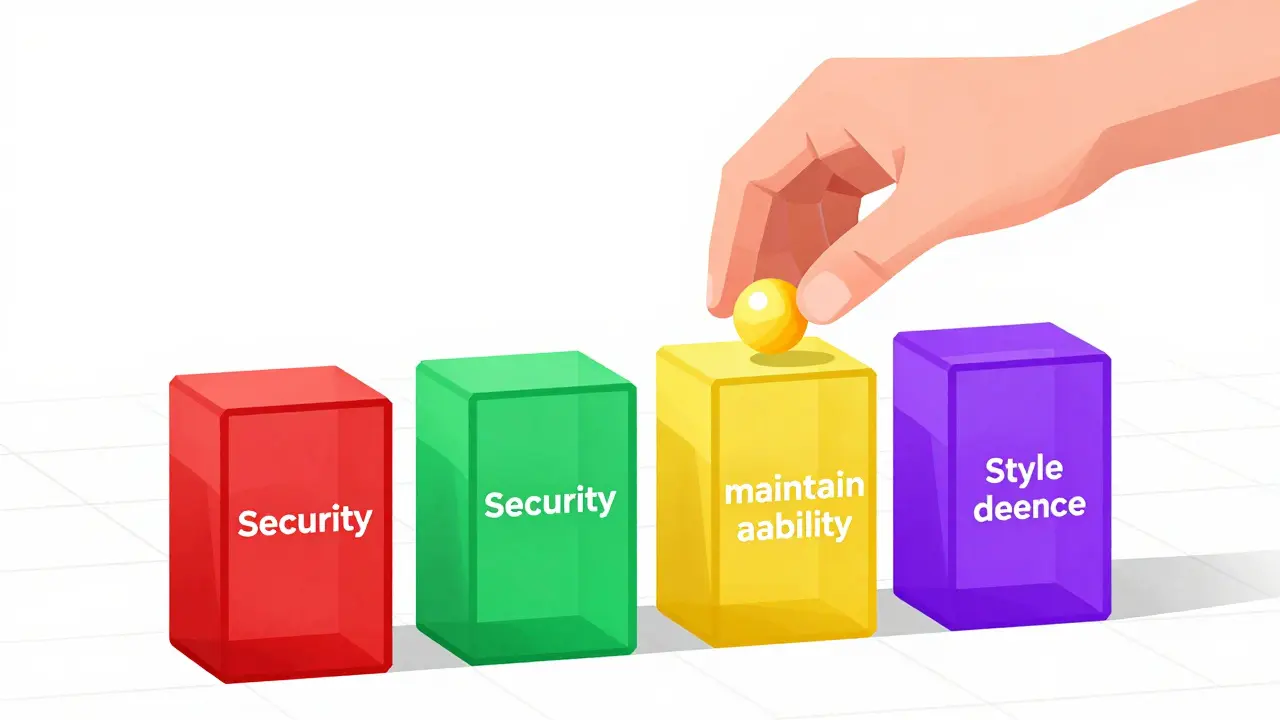
Effective rubrics usually cover four pillars:
- Security: Does this expose any vulnerabilities?
- Performance: Is the complexity optimized for scale?
- Maintainability: Will the next engineer know how to edit this?
- Adherence: Does it match our specific style guides?
In 2025, Anthropic released their Claude Code Enterprise Edition, which implements exactly this. It evaluates 12 distinct quality metrics. Their default weighting suggests that security should carry the heaviest load, but your project might differ. Perhaps you are building a startup prototype where speed matters more than security, initially. In that case, adjust the weights. The key is consistency. Inconsistent scoring creates noise, and the AI will eventually stop learning effectively.
A study by InfoQ in 2025 showed that average configuration time for these rubrics is about 11.3 hours per team. That sounds high, but it pays off. Banks using these strict workflows saw compliance violations drop from 14.3% to 2.1%. If you skip this step, you might end up with a system that optimizes for the wrong things-like generating short code that is impossible to read.

Managing Feedback Fatigue and Training
Here is the hard truth nobody tells you: scoring code every single day is tiring. Developers report high levels of "feedback fatigue" after about four months. If you require your engineers to rate every suggestion, productivity can dip by 15-20% during the first month of adoption. Why? Because they have to stop and think instead of just type.
To mitigate this, focus on calibration sessions. Successful teams hold weekly meetings to discuss difficult edge cases. A common complaint on Hacker News discussions late last year was that junior developers were accepting bad patterns because they didn't understand why they were bad. This creates a "garbage in, garbage out" scenario for the model.
Training is essential. The JetBrains survey from 2025 highlighted that senior engineers need about 18 hours of practice to provide consistently high-quality feedback, while juniors need nearly 30 hours. Do not throw them into the deep end. Start by having them score past code snippets before integrating live suggestions. Google's leaked internal roadmap from January 2025 even mentions establishing daily cadences for critical systems and weekly ones for others. You need to find the balance where feedback drives improvement without burning out the team.
The Future of Automated Scoring
As we look toward the rest of 2026 and beyond, the manual effort of scoring is going to decrease. GitHub recently announced "Copilot Feedback Studio," which uses AI to help you score AI suggestions. Essentially, the AI will analyze your comment and suggest a standardized score for you, cutting down the mental overhead. This could reduce feedback time by another 35%.
Furthermore, the Linux Foundation launched the Open Feedback Framework (OFF) 1.0 earlier this year. This is an industry standard that aims to solve the fragmentation issue. With 47 major tech companies participating, it establishes baseline scoring metrics so that AI systems don't optimize for just one company's weird preferences. Forrester predicts that by 2027, 85% of enterprise tools will incorporate this level of automated oversight.
However, there is a risk called "feedback homogenization." If everyone optimizes for the same popular patterns, we lose innovation. We start getting code that is technically perfect but boring or inefficient because it fits a generic mold. Keeping some diversity in your feedback is crucial for long-term creativity.
Implementing a Human Feedback in the Loop system isn't just a technical upgrade; it's a cultural shift. It forces better standards and faster onboarding for new developers who learn from the scored examples. As long as you manage the workload and train your team properly, the payoff is safer, cleaner, and significantly smarter software.
How does Human Feedback in the Loop differ from standard code reviews?
Standard code reviews happen after code is written and committed. Human Feedback in the Loop integrates scoring directly into the generation phase. You are teaching the AI in real-time as it suggests code, preventing bad patterns from ever making it into your repository rather than fixing them later.
Is HFIL necessary for small startups?
If you are prioritizing rapid prototyping over absolute stability, strict HFIL might slow you down. TechCrunch analysis shows a 27.8% increase in time-to-prototype when strict workflows are enforced. Small teams often benefit from simpler binary approval systems until scale demands more rigorous quality controls.
Can this improve security compliance?
Yes. Bank of America engineering managers reported reducing compliance violations in AI-generated code from 14.3% to 2.1% over six months using HFIL. The constant reinforcement of security constraints helps the model prioritize safety over speed.
What causes feedback fatigue?
Fatigue occurs when developers feel forced to interact with the tool constantly without seeing immediate benefits. It is addressed by limiting the scope of required feedback and ensuring that the AI actually learns from the input, so the interaction time decreases over time.
Does this work with legacy codebases?
Absolutely. Customizing the scoring rubric to reflect legacy architecture styles allows the AI to mimic existing patterns, helping maintain consistency across older projects while slowly refactoring modern improvements.
- Mar, 29 2026
- Collin Pace
- 10
- Permalink
- Tags:
- human feedback in the loop
- AI code generation
- software development AI
- code quality scoring
- machine learning feedback
Written by Collin Pace
View all posts by: Collin Pace