Human-in-the-Loop Workflows for Fine-Tuned LLMs: A Practical Guide

Getting an Large Language Model (an AI system trained to understand and generate human language) to 85% accuracy is often just the beginning. The final stretch from 85% to 99% precision rarely comes from throwing more compute at the problem. It comes from people. Specifically, it comes from integrating human judgment into your model's workflow.
This approach, known as Human-in-the-Loop (HITL) (a structured process where humans intervene to validate, correct, or approve AI outputs), is no longer a theoretical concept for academic papers. For teams deploying Fine-Tuned Large Language Models (LLMs that have been further trained on specific datasets to specialize in particular tasks), HITL is the difference between a helpful tool and a liability waiting to happen.
The Core Problem: Why Automation Hits a Wall
You’ve fine-tuned your model. You’ve fed it thousands of examples of your company’s legal documents, customer support tickets, or codebases. It looks great in testing. But when you push it to production, something feels off. The model hallucinates a citation here. It misses a nuance in a contract clause there. It writes code that runs but fails edge cases.
According to industry observations from studios like NineTwoThree, achieving precision beyond approximately 80-85% frequently necessitates direct human intervention. That last 15-20% of accuracy is where the "black box" nature of neural networks clashes with real-world consequences. In high-stakes environments-finance, healthcare, legal-a single error isn’t just a glitch; it’s a lawsuit, a regulatory fine, or a safety risk.
HITL solves this by treating human expertise not as a replacement for automation, but as a complementary layer. Humans don’t do the heavy lifting of processing millions of tokens. Instead, they act as validators, correctors, and adjudicators at critical decision points.
Designing Your HITL Architecture: Three Key Patterns
Not all human involvement is created equal. To build a scalable workflow, you need to choose the right pattern for your specific use case. Here are the three most effective operational patterns:
- The Approval Gate: The model generates a candidate output. A subject matter expert reviews it and signs off. This creates a hard validation checkpoint. Use this for final deliverables like client-facing reports or public statements.
- The Correction Gate: Experts edit the model’s output directly. Crucially, these edits become labeled training data. This creates a feedback loop where human corrections improve future model performance. This is ideal for iterative tasks like drafting emails or coding assistance.
- The Adjudication Workflow: When multiple reviewers disagree, a senior reviewer steps in to resolve the conflict. This establishes consistency across large-scale operations and prevents bias from creeping into your dataset.
Consider the case of OneShot, a platform profiled in recent beta deployments. They implemented a two-phase model. First, their API routes failed LLM outputs to trained humans. These humans tweak prompts, select alternative models, or add context until the output is correct. Second, they store all those tweaks as structured data. This accumulated dataset then fuels the fine-tuning phase, creating thousands of documented improvements that reduce manual testing in future deployments.
HITL vs. HOTL: Choosing the Right Level of Oversight
A common mistake is assuming HITL means reviewing every single output. That’s expensive and slow. Enter Human-on-the-Loop (HOTL) (a hybrid system that reserves human intervention for low-confidence or high-risk cases).
| Feature | Human-in-the-Loop (HITL) | Human-on-the-Loop (HOTL) |
|---|---|---|
| Review Scope | Universal (all outputs) | Selective (high-risk/low-confidence only) |
| Cost Efficiency | Lower (higher labor cost) | Higher (optimized resource use) |
| Scalability | Limited by human bandwidth | Highly scalable |
| Best For | Legal docs, financial advice, clinical decisions | Email drafting, summaries, general chatbots |
| Error Catching | Catches all errors | Catches critical/high-risk errors |
HOTL systems use automated risk triggers. If the model’s confidence score drops below a threshold, or if certain sensitive keywords appear, the case is routed to a human. Otherwise, the AI handles it autonomously. This hybrid approach manages high-confidence tasks with AI while reserving human intervention strategically.
The Tiered Validation Hierarchy
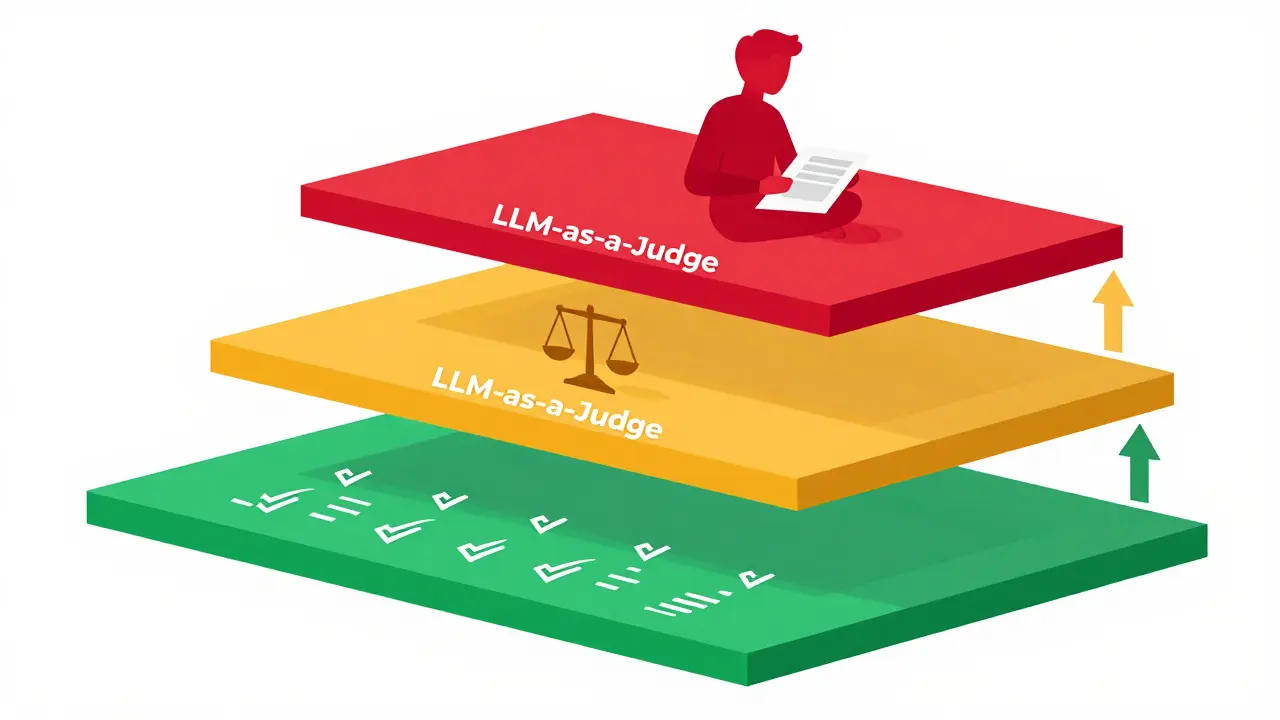
To balance speed and accuracy, Kili Technology recommends a tiered validation hierarchy. Don’t send everything to a human immediately. Filter it first.
- Tier 1: Automated Checks: Fast filters like formatting rules, policy keyword screening, unit tests for code, and citation presence verification. These catch obvious errors instantly.
- Tier 2: LLM-as-a-Judge: Use another model to score outputs based on rubrics, critique quality, tag risks, or perform pairwise comparisons for A/B testing. This is scalable but less reliable than human judgment.
- Tier 3: HITL Review: Subject matter experts approve, correct, and assign severity classifications for high-risk cases that passed the lower tiers.
- Tier 4: HOTL Monitoring: Audits, drift monitoring, and incident response protocols for the remaining bulk of outputs.
This hierarchy addresses the core scalability challenge. By filtering out the easy wins automatically, you ensure your human reviewers focus their energy where it matters most.
When to Implement HITL: The Decision Framework
How do you know if your project needs HITL? Apply this practical test: Would your organization accept a junior employee’s work without review? If the answer is no, you should not accept the model’s output without review.
Implement HITL by default when:
- The downside of an error involves legal exposure, financial loss, safety risk, or security vulnerabilities.
- The task requires accountable professional judgment (e.g., diagnosing a medical condition).
- Outputs must be defensible in audits.
For enterprise copilot applications like email drafting, HOTL combined with sampling audits is usually sufficient. For AI coding assistants, combine automated tests with mandatory human code review and HOTL monitoring for regression detection.
Technical Implementation: Integrating with MLOps
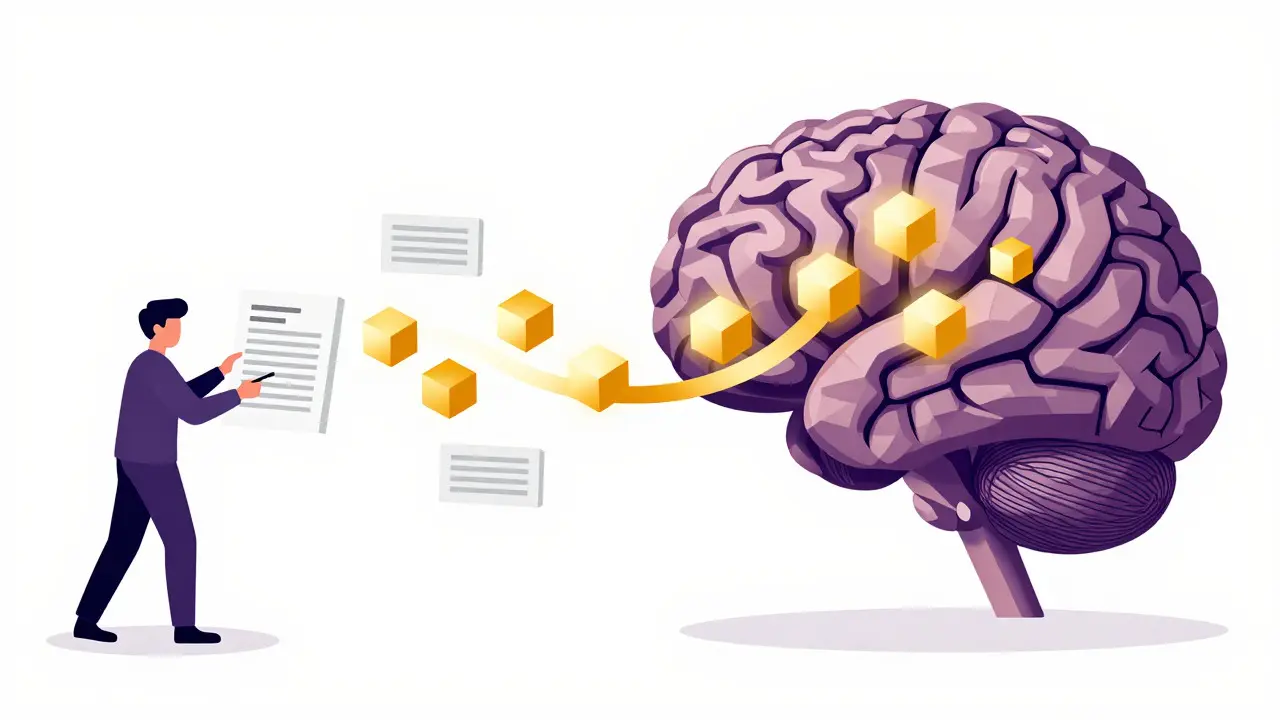
HITL isn’t just a process; it’s a technical infrastructure requirement. You need to integrate these workflows into your MLOps (Machine Learning Operations practices for managing AI lifecycle) framework.
Key requirements include:
- Automated Data Annotation Pipelines: Corrections made by humans must automatically flow back into your training dataset.
- Comprehensive Audit Logs: Track reviewer identity, timestamp, guideline version, specific changes made, and reasoning. This traceability is crucial for compliance.
- Drift Detection: Monitor for sudden spikes in error rates or human overrides, which may indicate model degradation.
- Rollback Capabilities: If error rates rise unexpectedly, have a protocol to revert to a previous model version.
Transparency is non-negotiable. Outputs must be understandable to humans at each interaction point. If a reviewer can’t explain why they rejected an output, the system lacks the necessary transparency to build trust.
Overcoming Scalability Challenges
The biggest complaint about HITL is cost and speed. Human review is slower than API calls. However, frameworks exist to incrementally reduce manual review while maintaining safety nets.
If AI accuracy stabilizes at 95% or higher in domain-specific tasks, and human interventions fall below defined thresholds, you can gradually shift from HITL to HOTL. Clear conflict-resolution protocols must flag inconsistencies, escalate to subject-matter experts, log all decisions, and retrain models using curated examples where human judgment overrode AI predictions.
Remember, HITL is not a permanent crutch. It’s a bridge to better models. The goal is to capture human expertise in training data so that future versions of the model require less oversight.
What is the difference between HITL and Active Learning?
Active Learning is a training method where the model identifies uncertain data points and requests human labels specifically to improve accuracy efficiently during the training phase. HITL is a broader operational framework where humans intervene in live workflows to review, validate, or override outputs, enhancing transparency and compliance during deployment. Active Learning prioritizes label efficiency; HITL prioritizes output reliability.
How do I measure the success of a HITL workflow?
Success metrics include reduction in post-deployment errors, increase in model accuracy over time due to feedback loops, and decrease in average time-to-review as reviewers become familiar with common issues. Additionally, track the ratio of human overrides to total outputs; a declining ratio indicates the model is learning effectively.
Is HITL required for all AI applications?
No. For low-stakes applications like casual chatbots or internal brainstorming tools, full HITL may be overkill. Use HOTL or simple sampling audits instead. Reserve HITL for domains where errors carry material consequences, such as healthcare, finance, and legal services.
How does HITL help with model drift?
Model drift occurs when the model's performance degrades over time due to changes in input data distribution. HITL workflows provide continuous feedback. As humans correct drifted outputs, these corrections are added to the training data, allowing the model to adapt to new patterns and maintain accuracy.
What tools are needed to implement HITL?
You need a platform that supports routing failed outputs to humans, storing corrections as structured data, and integrating with your MLOps pipeline for retraining. Tools like OneShot, Kili Technology, or custom-built APIs with robust logging capabilities are essential for managing the workflow efficiently.
- Jul, 30 2026
- Collin Pace
- 0
- Permalink
Written by Collin Pace
View all posts by: Collin Pace