Knowledge Distillation for LLMs: Training Smaller Students from Big Teachers

You have a massive, brilliant Large Language Model (LLM). It’s smart, it’s accurate, and it costs a fortune to run. Now you need that same intelligence on a smartphone, in a browser tab, or on a server that doesn’t cost $50 an hour. How do you shrink the brain without losing the mind? You don’t just cut it down; you teach a smaller student to think like the big teacher. This is Knowledge Distillation (KD) for LLMs.
It’s not magic, but it feels close. Instead of training a small model from scratch on raw data, you use a huge, pre-trained model-like GPT-4 or LLaMA-3-70B-as a mentor. The student model learns by mimicking the teacher’s probability distributions, capturing subtle nuances that simple labels miss. In this guide, we’ll break down how KD works for modern LLMs, why it’s the go-to strategy for model compression in 2026, and how you can actually implement it without burning through your GPU budget.
What Is Knowledge Distillation for LLMs?
Knowledge Distillation is a machine learning technique where a compact "student" model is trained to replicate the behavior of a larger, more complex "teacher" model. Unlike traditional training, which relies on hard ground-truth labels (e.g., "this token is correct"), KD uses "soft labels." These soft labels are the full probability distribution over the entire vocabulary that the teacher produces at each step.
Think of it this way: If you ask a teacher what comes next in a sentence, they might say "apple" with 80% confidence, "orange" with 15%, and "banana" with 5%. A standard label only tells the student "apple." But the soft label teaches the student *why* orange is plausible and banana is less so. This extra information, often called "dark knowledge," helps the student generalize better, even with far fewer parameters.
The concept isn’t new-Geoffrey Hinton popularized it back in 2015-but its application to LLMs has exploded since 2022. Why now? Because models crossed the 100-billion-parameter threshold, making inference costs prohibitive for many real-world applications. Companies needed a way to deploy frontier-level capabilities on commodity hardware. KD became the pivotal methodology for transferring capabilities from proprietary giants to open-source students like Mistral or LLaMA.
Why Use Distillation Over Pruning or Quantization?
You might wonder, "Can’t I just prune the layers or quantize the weights?" Yes, you can, and you probably should combine them. But they solve different problems.
- Pruning removes redundant connections or layers. It reduces parameter count but can degrade performance if done too aggressively.
- Quantization lowers numerical precision (e.g., from 16-bit to 4-bit). It saves memory bandwidth but doesn’t reduce the number of operations per token.
- Distillation trains a fundamentally smaller architecture. It reduces both parameter count and computational complexity, leading to lower latency and energy consumption.
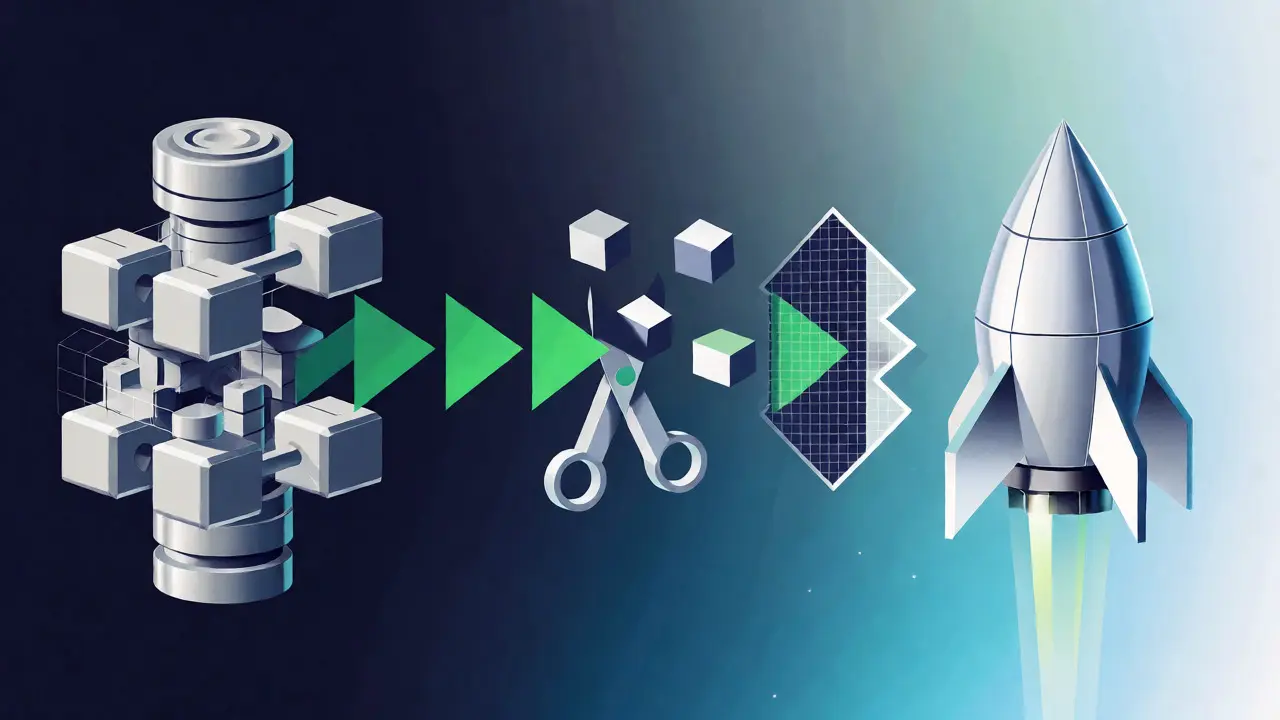
In practice, these methods are complementary. A common pipeline looks like this: Start with a large open-source model (e.g., LLaMA-2-13B). Fine-tune it for your specific task. Then, use it as a teacher to distill into a smaller student (e.g., a 3B or 7B model). Finally, quantize the student for deployment. This layered approach maximizes efficiency while retaining accuracy.
| Technique | Mechanism | Primary Benefit | Risk/Limitation |
|---|---|---|---|
| Pruning | Removes weights/layers | Reduces model size & FLOPs | Performance drop if structure is critical |
| Quantization | Lowers bit precision | Reduces memory footprint & bandwidth | Potential accuracy loss in sensitive tasks |
| Distillation | Trains small model to mimic large one | Retains capability in smaller arch | High training compute cost; teacher dependency |
The Core Mechanics: Logits, Temperature, and Loss
At the heart of KD is the loss function. The student tries to minimize the difference between its output distribution and the teacher’s. This is typically measured using Kullback-Leibler (KL) divergence.
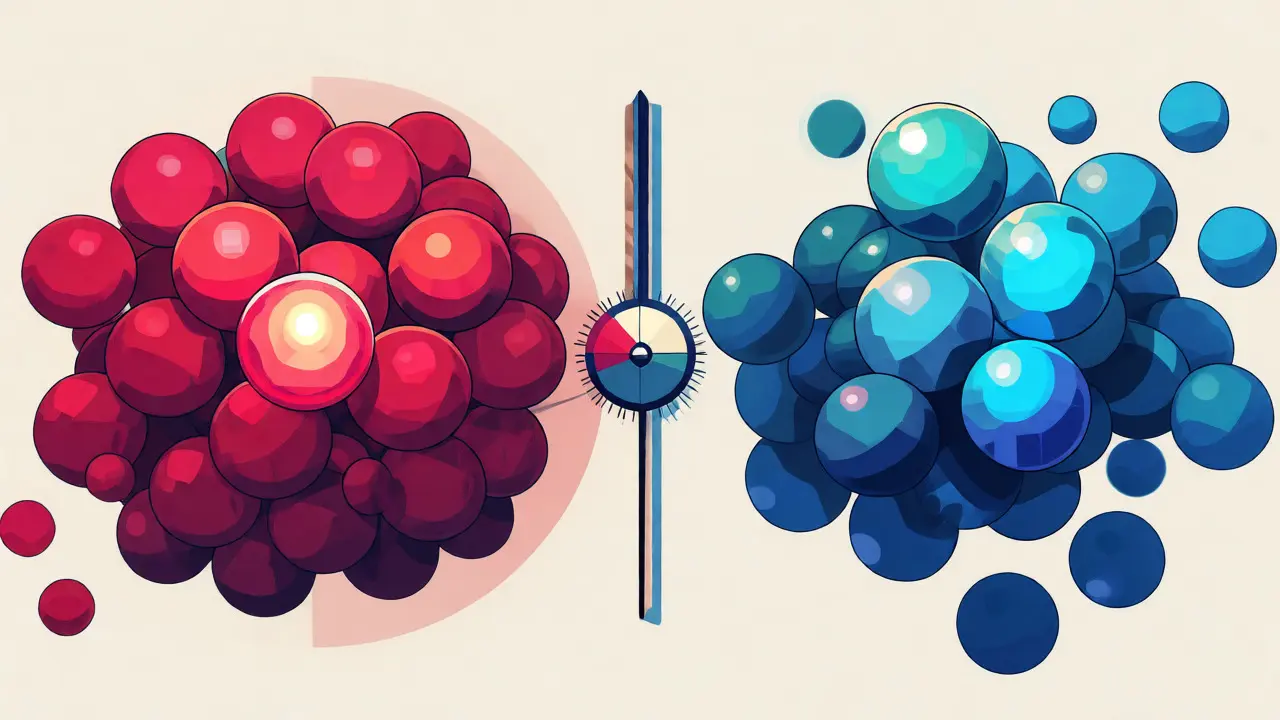
To make this work effectively, we introduce a temperature parameter ($T$). When $T=1$, the probabilities are sharp. If the teacher is confident, the distribution looks almost like a hard label. By raising $T$ (e.g., to 2, 3, or 4), we "soften" the logits. This flattens the distribution, making the differences between non-top tokens more visible to the student. It’s like turning up the volume on the background details so the student can hear them.
The total loss is usually a weighted sum:
- Distillation Loss: KL divergence between softened teacher and student logits.
- Task Loss: Standard cross-entropy against ground-truth labels (if available).
Balancing these two is tricky. Too much weight on the teacher, and you inherit their biases and errors. Too little, and you lose the rich soft-label information. Most practitioners start with a 50/50 split and tune based on validation performance.
Types of Knowledge You Can Transfer
Not all distillation is about matching logits. Researchers have expanded the definition to include several types of "knowledge":
- Logit-Level: The classic approach. Matching token-by-token probability distributions. High fidelity, high compute cost.
- Sequence-Level (Data Distillation): The teacher generates synthetic data (answers, code, summaries). The student is then trained on this data using standard supervised learning. This is cheaper but misses the uncertainty structure.
- Preference-Level: Using a reward model or human feedback to teach the student preferences (e.g., "this answer is safer than that one"). Crucial for alignment.
- Representation-Level: Matching internal hidden states or attention patterns. Useful when architectures differ significantly.
A notable trend in 2025-2026 is Flipped Knowledge Distillation, where specialized small models teach general-purpose LLMs. For instance, a tiny medical model might teach a general LLM specific terminology nuances, improving domain expertise without bloating the main model.
Implementation Challenges and Solutions
Proper distillation is expensive. For every training example, you need a forward pass through the teacher *and* the student. That doubles your compute compared to standard fine-tuning. If you’re processing trillions of tokens, that adds up fast.
Here’s how engineers mitigate this:
- Sampled Soft Labels: Instead of storing the full 128k-vocab distribution, sample the top 256 tokens from the teacher’s output. Zero out the rest. This drastically reduces memory traffic and storage needs, as seen in Google’s Gemma distillation pipelines.
- Code Distillation: Train teacher and student simultaneously. The teacher’s outputs on the current minibatch serve as immediate soft labels for the student. This avoids storing massive datasets of soft labels.
- Offline Pre-computation: Run the teacher once, save the logits (or sampled versions), and train the student offline. Good for static datasets.
NVIDIA’s NeMo framework provides concrete examples, such as compressing Meta-Llama-3.1-8B into a 4B student via depth pruning followed by logit distillation. They use scripts like `megatron_gpt_distillation.py` to handle the heavy lifting, demonstrating that you don’t need to write custom CUDA kernels to get started.
When Should You Use KD?
Don’t reach for KD if you just need a slight speedup. Try quantization first. Use KD when:
- Latency is Critical: You need sub-200ms responses on edge devices.
- Cost Constraints Exist: Running a 70B model is too expensive for your cloud bill.
- Privacy Matters: You want to keep data on-premises but leverage cloud-based teacher insights during training.
- Capability Gap Exists: Your small model struggles with reasoning or nuance that the teacher handles well.
For example, a customer support chatbot might use GPT-4 as a teacher to generate thousands of high-quality dialogue turns. A 7B student is then distilled on this data, achieving 90% of the quality at 10% of the inference cost.
Common Pitfalls to Avoid
Even with good intentions, KD projects fail. Here are the most common mistakes:
- Teacher Bias Propagation: If your teacher hallucinates or has toxic tendencies, the student will learn them. Always align the teacher first.
- Vocabulary Mismatch: If teacher and student use different tokenizers, logit matching becomes impossible. Stick to compatible architectures or use sequence-level distillation.
- Overfitting to Teacher Noise: At very low temperatures, the student might chase noise in the teacher’s logits. Monitor validation loss closely.
- Ignoring Data Quality: Garbage in, garbage out. If your training corpus is poor, the teacher’s guidance won’t save the student.
Is knowledge distillation better than fine-tuning a small model directly?
Generally, yes, if you have access to a strong teacher. Direct fine-tuning relies on hard labels, which contain less information. Distillation transfers the teacher's nuanced understanding of relationships between tokens, often resulting in better generalization and robustness, especially when labeled data is scarce.
Do I need the same tokenizer for teacher and student?
For logit-level distillation, yes. The vocabularies must align perfectly to compare probability distributions. If they differ, you must use sequence-level distillation (training on generated text) or map tokens between vocabularies, which adds complexity and potential error.
How much does temperature affect distillation?
Temperature controls the softness of the teacher's probabilities. Higher temperatures reveal more information about non-top tokens but can dilute the signal. Typical values range from 2 to 4. Experimentation is key; too low and you lose dark knowledge, too high and the student struggles to converge.
Can a distilled student ever outperform the teacher?
Rarely on broad benchmarks, but possible on specific tasks. If the teacher is biased or noisy, and the student is trained on cleaner, curated data alongside teacher signals, the student might achieve higher accuracy in narrow domains. However, generally, the student caps out near the teacher's performance level.
What hardware do I need for LLM distillation?
Training requires significant resources because you're running two models. A single 24GB GPU can handle small students (e.g., 1B-3B params) with mixed precision. For larger teachers (7B+), you'll likely need multi-GPU setups or efficient frameworks like NVIDIA NeMo or DeepSpeed to manage memory usage.
- Sep, 18 2026
- Collin Pace
- 0
- Permalink
- Tags:
- knowledge distillation
- LLM compression
- teacher-student models
- model efficiency
- AI optimization
Written by Collin Pace
View all posts by: Collin Pace