Llama vs Mistral vs Qwen vs DeepSeek: Choosing the Best Open-Source LLM in 2026
Choosing an open-source large language model (LLM) used to be simple. You downloaded Llama, a popular open-source AI model family by Meta, and you were good. That era ended in late 2025. The landscape has fractured into distinct camps, each with different strengths, licensing traps, and geopolitical baggage. If you are building an enterprise application today, picking the wrong model isn't just a technical mistake-it's a compliance risk or a budget disaster.
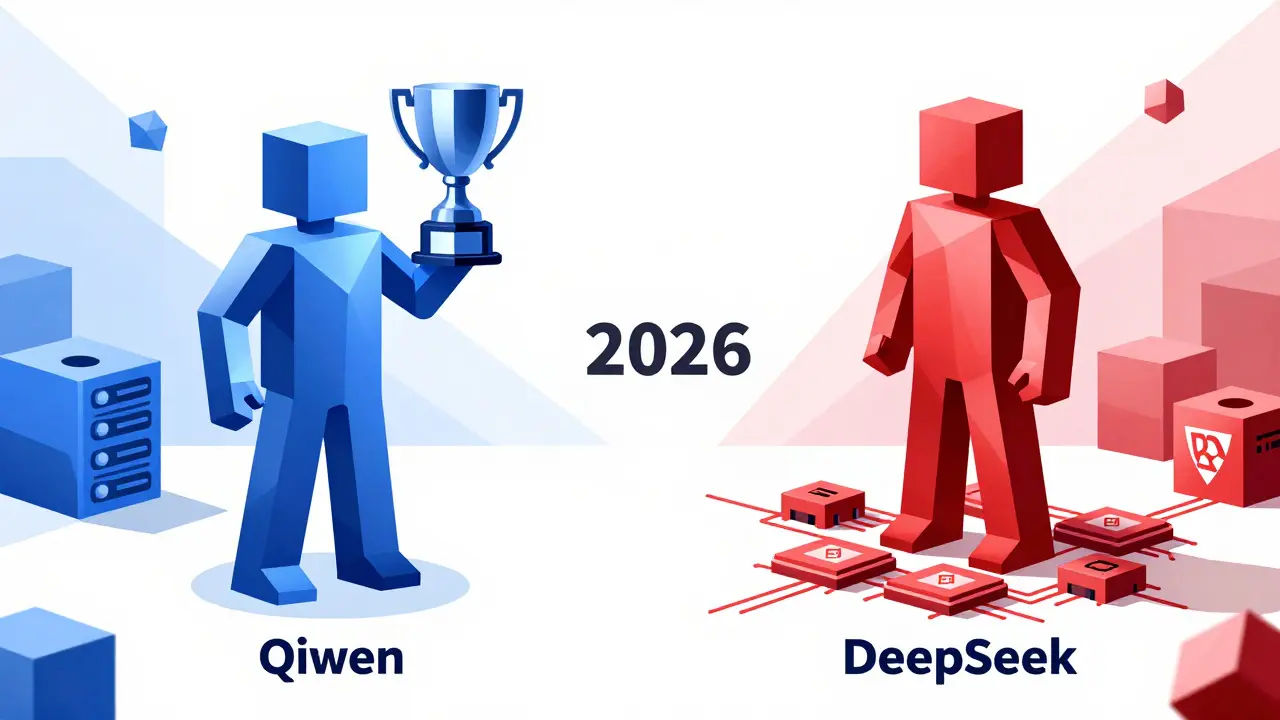
In January 2026, Alibaba’s Qwen, a high-performance open-source LLM family known for multilingual capabilities overtook Llama as the most downloaded model family on HuggingFace. This wasn’t a fluke. It signaled a shift toward models that offer better cost-efficiency and broader language support. But downloads don’t always equal deployment suitability. While Qwen leads in volume, DeepSeek, a reasoning-focused open-source LLM series under MIT license dominates high-stakes logic tasks, and Mistral, a European-based open-source LLM provider emphasizing GDPR compliance remains the safe harbor for regulated industries.
Key Takeaways
- Cost Savings: Self-hosted open-source models cut inference costs by 80-90% compared to proprietary APIs like GPT-4o.
- Best for Logic: DeepSeek R1 is the top choice for complex reasoning and debugging due to its transparent chain-of-thought architecture.
- Best for Compliance: Mistral Large is the only major option fully baked for GDPR and EU AI Act requirements.
- Best for Multilingual: Qwen 3 supports 119 languages with native-level competency, not just translation.
- Geopolitical Risk: US government contractors are largely prohibited from using Chinese-origin models (Qwen, DeepSeek).
The Four Contenders: A Technical Breakdown
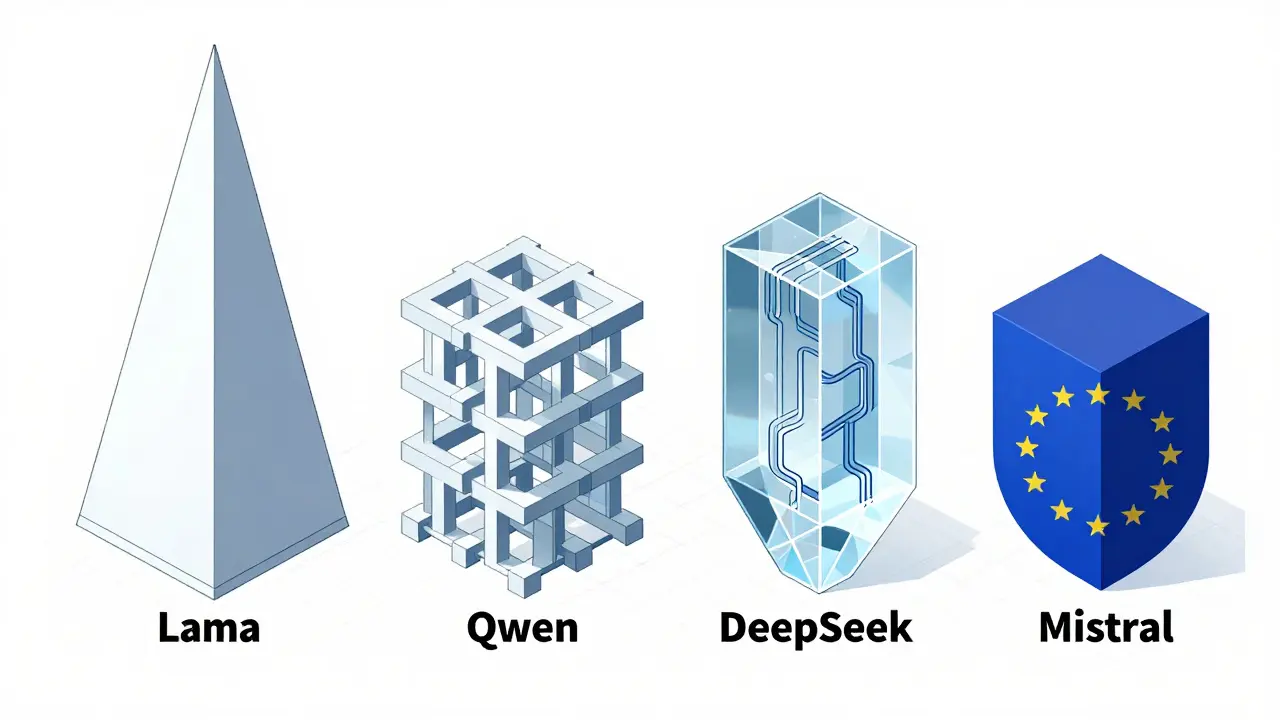
To make a smart choice, you need to look past the marketing hype and understand the architectural differences. These four models solve different problems.
Meta Llama 4: The Context King
Meta’s latest iteration, Llama 4, is no longer just one model but a family of variants including Scout, Maverick, and Behemoth. The standout feature here is context window size. Llama 4 Scout offers a massive 10 million token context window. For comparison, most competitors cap out at 128K to 200K tokens. If your use case involves analyzing entire codebases, legal archives, or long-form video transcripts, Llama 4 Scout is currently unmatched. However, this comes with significant hardware demands. The MoE (Mixture of Experts) structures range from 109 billion to 2 trillion parameters, meaning you need serious GPU clusters to run the larger variants efficiently.
Alibaba Qwen 3: The Efficiency Powerhouse
Qwen 3 took the market by storm because it punches well above its weight class. Its flagship model uses a Mixture of Experts (MoE) architecture with 235 billion total parameters, but it only activates about 100 billion during inference. This means you get three times the knowledge capacity of dense models at similar computational costs. In benchmarks, Qwen 3 scored 92.3% on AIME25 (mathematical reasoning) and 88.5% on HumanEval (coding). It also supports 119 languages natively. The catch? The tooling ecosystem is predominantly in Chinese, which adds friction for Western development teams.
DeepSeek R1: The Reasoning Specialist
Released in January 2025 under the permissive MIT license, DeepSeek R1 was built for logic. Unlike other models that might hallucinate steps in a math problem, DeepSeek employs a "reasoning-first" architecture. It provides transparent chain-of-thought capabilities, showing exactly how it arrived at an answer. This makes it ideal for debugging complex logic errors or academic research where verification is critical. It scored approximately 80% on AIME25, trailing Qwen slightly in raw speed but leading in verifiability. In fact, 73% of academic papers requiring verifiable reasoning chains used DeepSeek R1 in early 2026.
Mistral Large: The European Sovereign Choice
If data residency is your primary concern, Mistral Large is your answer. Based in France, Mistral has designed its models with full GDPR compliance and EU AI Act readiness baked into the data processing architecture. Jean-Luc Moreau, European AI Policy Director at Bracai, noted in February 2026 that this compliance isn’t just marketing-it’s structural. Mistral Large uses a dense transformer architecture optimized for enterprise stability rather than bleeding-edge benchmark scores. It delivers about 90% of top-tier performance at a fraction of the complexity for legal teams.
| Model Family | License | Key Strength | Deployment Time (Est.) | Best For |
|---|---|---|---|---|
| Llama 4 | Custom (Meta) | 10M Token Context Window | 40-60 hours | Long-document analysis, Codebases |
| Qwen 3 | Apache 2.0 | Multilingual (119 langs), Cost-Efficient MoE | 60-80 hours | Global customer support, Math/Coding |
| DeepSeek R1 | MIT | Transparent Reasoning Chains | 40 hours | Logic-heavy apps, Debugging, Research |
| Mistral Large | Commercial/GDPR | EU Compliance, Data Residency | 50-70 hours | EU Enterprises, Regulated Industries |
Licensing and Geopolitical Risks
You can have the best model in the world, but if the license prevents you from selling your product, it’s worthless. Licensing varies wildly among these four.
DeepSeek R1 offers the most freedom with its MIT license. This is a standard, permissive open-source license that allows commercial use without restrictions. Dr. Elena Rodriguez, Chief AI Analyst at Nodewave, called this a "paradigm shift in open-source AI accessibility." If you want to build a SaaS product on top of the model and sell it, DeepSeek is the safest bet legally.
Qwen 3 uses Apache 2.0, which is also permissive and includes patent grants. This is generally safe for commercial use, but you must include the license text in your distribution. The bigger issue isn’t the license itself, but the origin. As of December 2025, updated Federal AI Procurement Guidelines prohibit US government contractors from using Chinese-origin models. This affects both Qwen and DeepSeek. If you are bidding for US federal contracts, these two are off the table.
Mistral Large operates under more restrictive commercial licensing options. You often need to negotiate terms for heavy enterprise usage. However, this restriction buys you peace of mind regarding data sovereignty. For EU enterprises, the ability to guarantee that training data and inference logs stay within the EU is worth the higher initial setup costs.
Llama 4 continues to use Meta’s custom license. It’s open for research and limited commercial use (usually capped by user count), but Meta retains the right to revoke licenses. This creates a layer of uncertainty for startups planning to scale rapidly.
Implementation Reality: Costs and Learning Curves
Downloading the weights is easy. Getting them to run in production is hard. Interconnects AI’s February 2026 report highlights that self-hosted models can reduce inference costs by 80-90% compared to API calls. But that savings assumes you can deploy them efficiently.
Time to Deploy:
- DeepSeek R1: ~40 hours for experienced teams. Documentation is comprehensive and in English.
- Qwen 3: 60-80 hours for independent teams. The complex MoE architecture requires specialized tuning. Alibaba’s paid enterprise support can cut this to 35-45 hours.
- Mistral Large: 50-70 hours. Requires specialized knowledge of EU compliance frameworks, but saves ~200 hours of legal review later.
Hardware Requirements: Qwen 3’s MoE design is hardware-friendly because it doesn’t load all parameters into memory simultaneously. This allows it to run on fewer GPUs than a dense model of similar capability. DeepSeek R1 is also relatively efficient for its reasoning power. Llama 4’s larger variants, however, require massive VRAM setups, making them expensive to host unless you use quantization techniques aggressively.
Community Support: If you hit a bug at 2 AM, who helps you? Qwen has the largest GitHub community with over 42,000 contributors. However, much of the discussion is in Chinese. DeepSeek has the most active English-language forum with 18,500 monthly participants, making it easier for Western developers to find solutions. Mistral’s community is smaller but highly professional, focused on enterprise integration patterns.
Which Model Should You Choose?
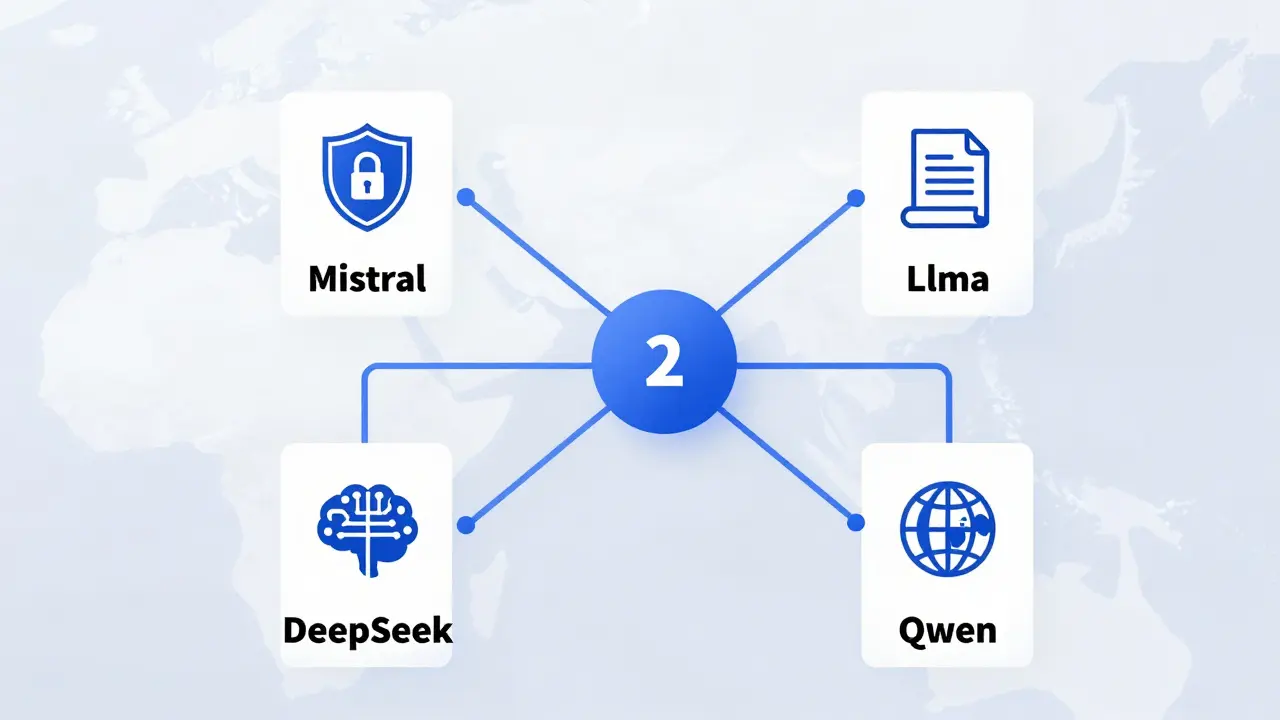
There is no single "best" model. Your choice depends on your specific constraints. Here is a decision tree based on real-world scenarios:
- Are you subject to strict EU data regulations?
If yes, choose Mistral Large. The GDPR compliance is non-negotiable for many sectors, and Mistral’s architecture is built for this. Don’t risk fines trying to retrofit Qwen or DeepSeek. - Do you need to process extremely long documents or codebases?
If yes, choose Llama 4 Scout. The 10 million token context window is unique. No other open-source model offers this depth without chunking strategies that lose coherence. - Is your app logic-heavy (math, coding, complex reasoning)?
If yes, choose DeepSeek R1. The transparent chain-of-thought helps you debug why the model made a specific decision. The MIT license also keeps legal overhead low. - Do you need global language support or maximum cost efficiency?
If yes, choose Qwen 3. With 119 languages and MoE efficiency, it handles multilingual customer support better than any competitor. Just budget extra time for the learning curve and potential language barriers in documentation.
Future Outlook: What Comes Next?
The market is moving fast. By 2027, analysts predict that MoE architectures will dominate the high-performance segment (78% market share), while dense models will remain preferred for edge devices (63% share). Qwen announced Qwen 3.1 in January 2026 with enhanced code generation, and DeepSeek released R1.2 with support for 37 additional languages. Mistral is developing "Mistral Sovereign" for air-gapped government deployments, scheduled for Q3 2026.
The biggest threat to all these models is regulatory fragmentation. 67% of enterprise AI leaders cite the potential split of the open-source ecosystem along geopolitical lines as their primary concern for 2026-2027. Keep an eye on policy changes in the US and EU, as they could suddenly render your chosen model unusable for certain markets.
Is DeepSeek R1 safe for commercial use?
Yes, DeepSeek R1 is released under the MIT license, which is one of the most permissive open-source licenses available. It allows for unrestricted commercial use, modification, and distribution. However, note that US government contractors may face restrictions due to its Chinese origin.
Why did Qwen overtake Llama in downloads?
Qwen 3’s rise is driven by its superior cost-efficiency via Mixture of Experts (MoE) architecture and its extensive multilingual support (119 languages). Developers are increasingly prioritizing models that offer high performance at lower inference costs, especially for global applications.
Can I use Mistral Large outside of Europe?
Yes, you can use Mistral Large anywhere. However, its primary value proposition is GDPR and EU AI Act compliance. If you are not operating in the EU or handling EU citizen data, you may find other models like DeepSeek or Qwen offer better performance-to-cost ratios.
What is the biggest risk of using Chinese-origin LLMs?
The main risks are geopolitical and regulatory. In the US, federal contractors are prohibited from using Chinese-origin models. Additionally, there are concerns about data privacy and potential backdoors, although open-source transparency mitigates some of these fears. Companies must weigh these risks against the technical benefits.
How much can I save by self-hosting these models?
According to Interconnects AI’s 2026 report, self-hosted open-source models can reduce inference costs by 80-90% compared to proprietary API alternatives. This assumes you have existing GPU infrastructure; if you need to buy new hardware, the ROI timeline extends, but long-term savings remain significant.
- May, 5 2026
- Collin Pace
- 0
- Permalink
Written by Collin Pace
View all posts by: Collin Pace