LLM Operating Model: Teams, Roles & Responsibilities for AI Adoption

You built a killer prototype. The chatbot answers customer queries with startling accuracy. Your leadership is excited. Then you try to scale it to production, and everything breaks. Latency spikes, hallucinations creep in, legal panics about data privacy, and nobody knows who owns the prompt library. This isn't a tech problem; it's an organizational one.
Most enterprises fail at LLM adoption not because their models are weak, but because their operating models are non-existent. You can't treat Large Language Models like traditional software or even standard machine learning pipelines. They require a new kind of team structure, specific roles that didn't exist five years ago, and clear lines of responsibility between engineering, data science, and business units.
If you're trying to move from pilot to production, you need a blueprint. Here is how to build an operating model that actually works, avoiding the silos that kill 78% of enterprise AI initiatives before they deliver real ROI.
Why Traditional MLOps Doesn't Cut It
Before we assign roles, let's address why your existing ML team might struggle. Traditional MLOps focuses on model training, versioning, and deployment. It assumes deterministic outputs and structured data. LLMs break these assumptions. They are probabilistic, consume unstructured text, and require constant human-in-the-loop evaluation.
Gartner’s analysis highlights three critical gaps when forcing LLMs into legacy MLOps frameworks:
- Prompt Engineering Complexity: There is no code to deploy in the traditional sense. The "model" is often a combination of base weights and dynamic prompts. Who owns the prompt?
- Evaluation Ambiguity: Accuracy metrics don't work here. You need semantic evaluation, which requires domain experts, not just data scientists.
- Security Vulnerabilities: Prompt injection attacks are unique to LLMs. Standard API security protocols miss these entirely.
Organizations that tried to adapt existing MLOps pipelines saw 47% longer deployment cycles and 3.2x more production incidents. You need a specialized approach: LLMOps (a set of practices and workflows specifically designed for the lifecycle management of large language models).
The Core Pillars of an Effective LLM Operating Model
An effective operating model isn't just an org chart. It's a system of interactions. Based on successful implementations at companies like Capital One and major financial institutions, four pillars support scalable LLM adoption.
1. Cross-Functional Product Teams
Siloed departments kill LLM projects. Data science builds a model, hands it off to engineering, who hands it to product, who realizes it doesn't solve the user's problem. The fix is integrated squads. Each squad should include a Product Manager, an LLM Engineer, a Domain Expert (from the business side), and a Security Specialist. This structure ensures that technical feasibility, business value, and risk mitigation are considered simultaneously, not sequentially.
2. Centralized Governance, Decentralized Execution
You need a central body to set standards-what models can be used, what data can be fed into them, and what compliance rules apply. But you shouldn't centralize execution. Let individual product teams choose their tools and implement solutions within those guardrails. A centralized "Center of Excellence" (CoE) provides the platform and guidelines, while distributed teams drive innovation.
3. Continuous Evaluation Loops
Unlike traditional software, LLMs degrade silently. A model that worked yesterday might hallucinate today due to subtle changes in input distribution. Your operating model must mandate continuous evaluation. This isn't a one-time QA check; it's an ongoing process involving automated metrics and human review panels.
4. Clear Accountability Matrix
Who fixes a bad response? If the answer is "everyone," then no one does. You need a RACI matrix (Responsible, Accountable, Consulted, Informed) tailored for LLM lifecycles. For example, the Prompt Engineer is responsible for optimizing responses, but the Legal Team is accountable for content compliance.
Key Roles and Responsibilities
Let's get specific. Here are the essential roles needed to run an LLM operating model, along with what they actually do day-to-day.
| Role | Primary Responsibility | Key Skills | Reporting Line |
|---|---|---|---|
| LLM Product Manager | Defines use cases, prioritizes features, bridges business and tech. | AI literacy, stakeholder management, ROI analysis. | Product / Business Unit |
| Prompt Engineer | Designs, tests, and optimizes prompts; manages prompt libraries. | NLP understanding, creative writing, systematic testing. | Engineering / Data Science |
| LLM Ops Engineer | Manages infrastructure, vector databases, API integrations, and monitoring. | Kubernetes, Python, LangChain/LlamaIndex, Cloud infra. | Platform Engineering |
| AI Ethicist / Compliance Officer | Ensures regulatory adherence (GDPR, EU AI Act), bias auditing. | Legal knowledge, risk assessment, policy writing. | Legal / Risk Management |
| Domain Expert | Provides ground truth data, validates output quality, defines success metrics. | Deep subject matter expertise, communication skills. | Business Unit (e.g., Sales, Support) |
The Rise of the Prompt Engineer
This role is often misunderstood. It's not just about typing clever sentences. A skilled Prompt Engineer treats prompting as software development. They version control prompts, write unit tests for them, and analyze token usage to reduce costs. In many organizations, this role starts within the data science team but eventually moves closer to product engineering as prompts become part of the core application logic.
Why You Need a Dedicated LLM Ops Engineer
Your DevOps team can handle Kubernetes, but they likely don't know how to debug a vector database retrieval issue or optimize token latency. An LLM Ops Engineer specializes in the stack that supports LLMs: embedding models, vector stores (like Pinecone or Weaviate), and orchestration frameworks (like LangChain). They ensure the system scales without blowing up your cloud bill.

Building Your Center of Excellence (CoE)
A Center of Excellence acts as the brain of your LLM operations. It doesn't build every app, but it sets the standards. By 2026, Gartner predicts 75% of enterprises will have established dedicated LLM CoEs. What should yours do?
- Vendor Management: Evaluate and contract with model providers (OpenAI, Anthropic, Mistral) and platform vendors. Negotiate enterprise terms and security guarantees.
- Toolchain Standardization: Decide on the approved stack. Are you using Weights & Biases for tracking? LangSmith for tracing? Standardizing prevents fragmentation.
- Knowledge Sharing: Run internal guilds where engineers share successful prompting patterns and failure stories. This accelerates learning across teams.
- Risk Oversight: Maintain the register of AI risks. When a new regulation drops, the CoE assesses impact across all active LLM projects.
Implementation Roadmap: From Pilot to Scale
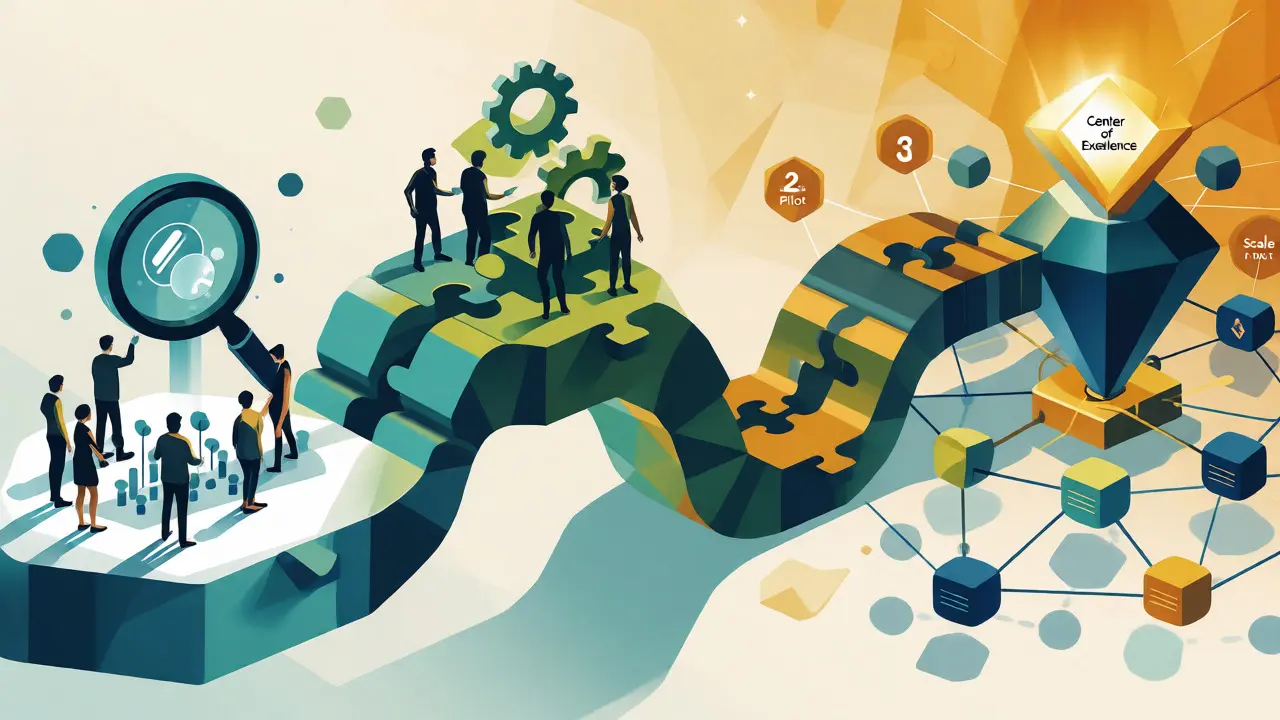
Don't try to boil the ocean. Follow a phased approach to build your operating model.
Phase 1: Discovery and Readiness (Months 1-3)
Start with a high-value, low-risk use case. Define clear success metrics with the business unit. Assess your data readiness. Do you have clean, accessible data for RAG (Retrieval-Augmented Generation)? Identify the initial cross-functional team. Keep it small-five people max.
Phase 2: Pilot and Process Definition (Months 4-6)
Build the MVP. During this phase, document everything. How did you evaluate the model? What security checks did you run? Create your first version of the LLM Playbook. Establish the feedback loop between domain experts and prompt engineers. This is where you discover if your roles are working or if there's friction.
Phase 3: Scaling and Governance (Months 7-9)
Expand to additional use cases. Formalize the Center of Excellence. Implement automated monitoring for drift and cost. Roll out training programs for broader staff. At this stage, you should see a reduction in time-to-deploy and an increase in confidence among stakeholders.
Common Pitfalls to Avoid
Even with a good plan, things go wrong. Here are the most common failures I've seen in the field.
1. The "Black Box" Problem
Teams treat LLMs as magic boxes. They don't understand why the model gave a certain answer. Without interpretability tools, trust erodes quickly. Invest in observability platforms that show you exactly which documents were retrieved and how the model processed them.
2. Ignoring Cost Governance
LLM costs can spiral if not monitored. Token usage varies wildly based on prompt length and context window size. Assign cost ownership to each product team. Show them their spend in real-time. If they don't feel the pain of the bill, they won't optimize their prompts.
3. Underestimating Change Management
Adopting LLMs changes workflows. Customer support agents aren't just answering tickets; they're reviewing AI drafts. Sales reps aren't just writing emails; they're editing AI suggestions. Provide training on how to interact with AI, not just how to use the tool. Address fears of job replacement head-on.
Future-Proofing Your Operating Model
The landscape is shifting fast. Multimodal models (text + image + audio) are entering production, requiring new evaluation skills. Agentic workflows (where LLMs take actions, not just generate text) demand tighter integration with backend systems. Your operating model needs to be flexible enough to absorb these changes without collapsing.
Keep an eye on convergence. As tools mature, some specialized roles may merge. Prompt engineering might become a skill embedded in every developer's toolkit rather than a standalone role. Stay agile. Review your operating model quarterly against industry benchmarks and internal performance data.
Do we really need a separate Prompt Engineer role?
It depends on complexity. For simple chatbots, developers can handle prompting. For complex applications with nuanced tone requirements, strict compliance needs, or intricate chain-of-thought reasoning, a dedicated Prompt Engineer adds significant value by treating prompts as code artifacts that need versioning, testing, and optimization.
How does LLM Ops differ from traditional MLOps?
Traditional MLOps focuses on model retraining and structured data pipelines. LLM Ops emphasizes prompt management, retrieval augmentation (RAG), vector database maintenance, and semantic evaluation. It also places much heavier emphasis on security against prompt injection and managing variable inference costs.
Who owns the data used in RAG systems?
Ownership typically lies with the source business unit (e.g., Marketing owns blog posts, Support owns ticket history). However, the Data Engineering team is responsible for the pipeline that cleans, chunks, and embeds that data. Clear SLAs between data owners and data engineers are crucial to prevent stale or dirty data from degrading model performance.
What is the biggest risk in scaling LLMs without a proper operating model?
Uncontrolled sprawl. Without governance, different teams build duplicate solutions, use incompatible tools, and ignore security standards. This leads to fragmented data, inconsistent user experiences, and skyrocketing infrastructure costs that are difficult to attribute or optimize.
How do we measure the success of our LLM operating model?
Track both operational and business metrics. Operational: Time-to-deploy, incident rate, cost per query, prompt reuse rate. Business: User satisfaction scores, resolution rates, revenue impact, or time saved. A healthy operating model shows improving trends in both categories over time.
- Sep, 24 2026
- Collin Pace
- 0
- Permalink
- Tags:
- LLM operating model
- LLMOps teams
- AI governance roles
- prompt engineer responsibilities
- LLM adoption strategy
Written by Collin Pace
View all posts by: Collin Pace