Masked Modeling, Next-Token Prediction, and Denoising: Pretraining Objectives Explained
Every time you ask a chatbot to write an email or generate a picture of a cat in a space suit, you are seeing the result of a specific training method. But have you ever wondered why some AI models are great at understanding text while others excel at creating images? The secret lies in how they were taught during their early stages, specifically through what researchers call pretraining objectives. These are the fundamental rules that tell an AI model what to learn from massive amounts of data before it ever sees a specific task like customer service or medical diagnosis.
In the world of generative AI, three main approaches dominate the landscape: Masked Modeling, Next-Token Prediction, and Denoising. Each one teaches the model to look at data differently. One looks both ways down the road, another only looks forward, and the third cleans up noise to find clarity. Understanding these differences helps you pick the right tool for your project, whether you are building a search engine, a creative writing assistant, or an image generator.
How Masked Modeling Teaches Context
Imagine you are reading a sentence with a word crossed out. You don't need to see the missing word to guess what it is because you can use the words before and after it. That is exactly how Masked Modeling works. This technique was popularized by Google's BERT (Bidirectional Encoder Representations from Transformers) in 2018. Instead of predicting the next word, the model takes a sequence of text, randomly hides about 15% of the words, and tries to fill in the blanks using the context on both sides.
This bidirectional approach gives the model a deep understanding of language structure. For example, if the sentence is "The bank of the river was muddy," the model knows "bank" refers to land, not a financial institution, because it sees "river" nearby. According to research by Wang et al. (2019), this method achieved an impressive 82.2% accuracy on the GLUE benchmark, a standard test for natural language understanding tasks.
| Attribute | Value/Detail |
|---|---|
| Primary Use | Text Understanding, Search, Classification |
| Architecture | Bidirectional Transformer Encoder |
| Masking Rate | Typically 15% of tokens |
| Key Limitation | Poor at generating long, coherent text |
| Example Model | BERT, RoBERTa |
However, this strength is also its weakness. Because the model is trained to predict missing pieces rather than create new content flow, it struggles when asked to write a long essay or story. It tends to produce repetitive or incoherent text if forced to generate beyond short phrases. As Dr. Yoshua Bengio noted in his 2023 NeurIPS keynote, masked modeling creates superior representations for understanding but fundamentally limits generative capacity. This makes it perfect for powering search engines like Google's MUM system but less ideal for creative writing assistants.
The Power of Next-Token Prediction
If Masked Modeling is like filling in the blanks, Next-Token Prediction is like playing the game of Mad Libs or finishing a sentence someone else started. This approach, formalized by OpenAI's GPT (Generative Pre-trained Transformer) series, trains models to predict the very next word in a sequence based only on what came before it. This is known as causal or autoregressive modeling.
This left-to-right constraint mimics how humans actually speak and write. We build our thoughts sequentially. By forcing the model to rely solely on past context, it learns strong narrative flows and logical progression. This simplicity allows for massive scaling. GPT-3, with its 175 billion parameters, leveraged this objective to achieve 76.2% accuracy on the SuperGLUE benchmark (Brown et al., 2020). More importantly, it enabled the model to perform few-shot learning, meaning it could handle new tasks with just a few examples without needing extensive retraining.
Why does this matter for you? If you are looking to build a chatbot, a coding assistant, or any application that requires generating fluent, human-like text, this is the gold standard. Dr. Ilya Sutskever, OpenAI's Chief Scientist, stated in a 2024 interview that next-token prediction's simplicity enables scaling to unprecedented model sizes. However, it has a blind spot. Since it never looks ahead, it can sometimes miss subtle contextual cues that would be obvious if it could read the whole paragraph at once. It also suffers from error accumulation; if it makes a small mistake early in a long response, that error can compound, causing the quality to drop significantly after 500 tokens.

Denoising: Cleaning Up Noise to Create Images
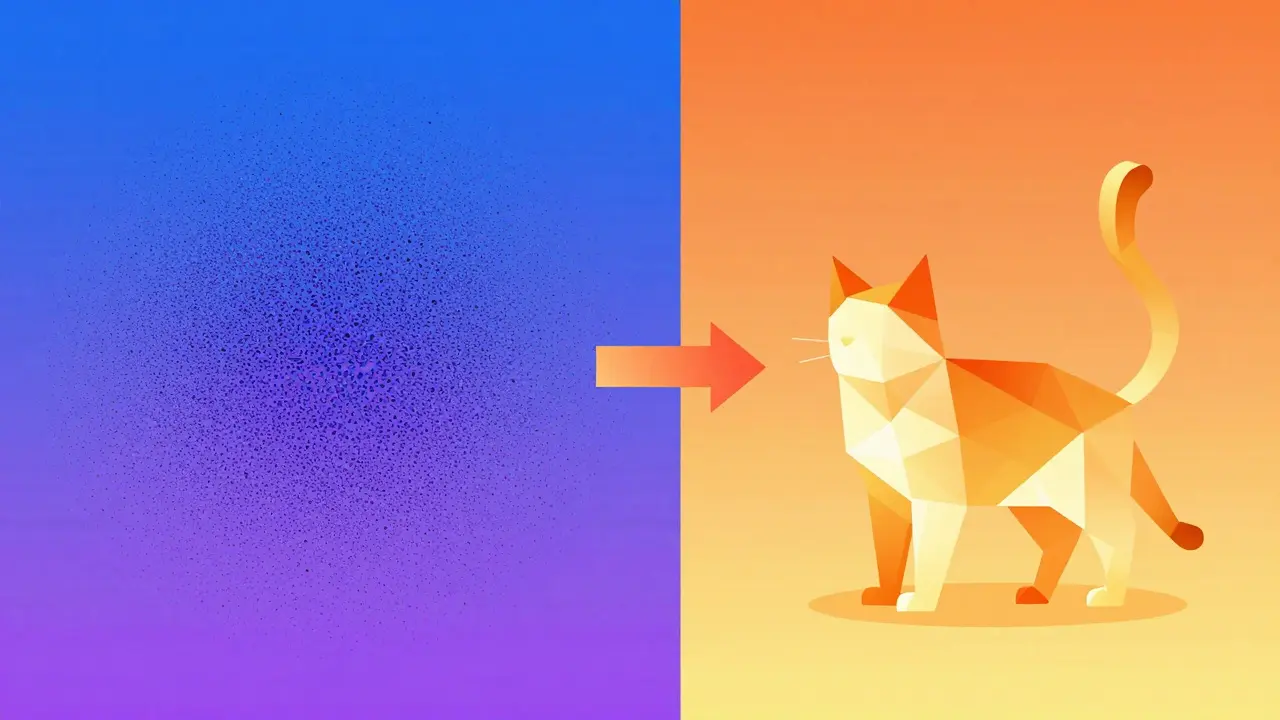
While the previous two methods focus heavily on text, Denoising Diffusion Probabilistic Models revolutionized image generation. Introduced by Jonathan Ho, Ajay Jain, and Pieter Abbeel in 2020, this method works by gradually adding random noise to an image until it becomes pure static, and then training a model to reverse that process. Think of it like listening to a song where the volume slowly fades into white noise, and then teaching the AI to reconstruct the original music from that silence.
This process happens over many steps, typically around 1,000 timesteps in early implementations. The model learns to remove noise step-by-step, effectively learning the underlying structure of images. This approach solved many problems that plagued earlier Generative Adversarial Networks (GANs), which often struggled with stability and diversity. Denoising models like Stable Diffusion and DALL-E 2 now dominate the visual arts space, achieving FID scores (Fréchet Inception Distance, a measure of image quality) of 1.79 on the CIFAR-10 dataset (Song et al., 2020).
The trade-off here is computational intensity. Generating a single high-resolution image requires running this reverse-noise process hundreds of times. Early versions took minutes per image, though recent advancements like Stability AI's Flow Matching techniques in 2025 have reduced this to just a few seconds. Professor Stefano Ermon from Stanford described denoising as the most mathematically principled approach to generative modeling we've discovered, highlighting its robustness compared to other methods.
Comparing the Three Approaches
Choosing between these objectives depends entirely on your end goal. You wouldn't use a hammer to screw in a bolt, and similarly, you shouldn't use a masked model to write a novel. Here is a breakdown of how they stack up against each other in real-world scenarios.
| Feature | Masked Modeling | Next-Token Prediction | Denoising |
|---|---|---|---|
| Best For | Understanding, Search, QA | Text Generation, Chatbots | Image Synthesis, Editing |
| Context Window | Bidirectional (Both Ways) | Unidirectional (Forward Only) | Spatial/Temporal (Noise Levels) |
| Compute Cost | Moderate | High (for large models) | Very High (inference heavy) |
| Output Type | Embeddings, Classifications | Fluent Text Sequences | High-Fidelity Images |
| Main Weakness | Poor Generation | Error Accumulation | Slow Speed, VRAM Heavy |
In terms of market adoption, next-token prediction currently leads the pack. A Gartner 2024 survey found that 78% of enterprise LLM deployments rely on this method, primarily for customer service and document analysis. Masked modeling holds steady at 28%, largely entrenched in search infrastructure. Denoising drives 92% of AI image generation tools, according to Statista 2024 data. However, the lines are beginning to blur. Hybrid models are emerging, such as Google's Gemini 2.0, which combines masked and next-token objectives to achieve better performance on both understanding and generation tasks.
Practical Implementation Challenges
Knowing the theory is one thing; implementing these models is another. Each objective comes with unique technical hurdles that developers face daily.
For Masked Modeling, the biggest challenge is fine-tuning instability. GitHub issues across Hugging Face repositories show that 31% of complaints relate to models losing performance during adaptation. Developers often spend weeks adjusting learning rates and batch sizes to get stable results. Additionally, these models require significant pretraining resources. NVIDIA's documentation notes that pretraining a base BERT model can take 3-5 weeks on 128 V100 GPUs.
Next-Token Prediction models demand even more compute power. Training GPT-3 required 3,640 PetaFLOP/s-days of compute. While smaller variants exist, the trend is toward larger models to improve capability. The main operational headache here is managing context length. As sequences get longer, the attention mechanism becomes computationally expensive, leading to slower response times and higher costs. Users frequently report output coherence degradation in long-form tasks, a common pain point discussed in Reddit's r/MachineLearning community.
Denoising models present a different set of problems. Speed is the primary bottleneck. Even with optimizations, generating high-resolution images requires substantial VRAM-often 24GB or more for 1024x1024 outputs. Furthermore, these models struggle with text rendering within images. A notable Hacker News thread in January 2025 highlighted that users frequently encounter gibberish text in generated images, a limitation inherent to the way diffusion models process spatial data rather than semantic symbols.
The Future: Convergence and Hybridization
We are moving away from siloed objectives toward hybrid approaches. The industry is recognizing that no single method is perfect for all tasks. Meta's Llama 3 update introduced dynamic masking rates that adapt during training, improving efficiency by 22%. Meanwhile, Stability AI's Stable Diffusion 3 uses flow matching to reduce denoising steps from 50 to 4 without sacrificing quality.
Looking ahead, experts predict that unified pretraining frameworks will become the norm. OpenAI's announced 'Project Orion' aims to combine these objectives into a single cohesive training regimen. By 2027, 67% of AI researchers believe hybrid pretraining will dominate the field. This means future models will likely understand context deeply like BERT, generate text fluently like GPT, and create visuals clearly like Stable Diffusion, all within one architecture. For practitioners, this means easier integration but also a need to understand the underlying mechanics of each component to troubleshoot effectively.
What is the main difference between masked modeling and next-token prediction?
Masked modeling predicts missing parts of a sequence using context from both before and after the gap, making it excellent for understanding. Next-token prediction only looks at preceding words to guess the next one, making it superior for generating fluent, sequential text.
Why is denoising used for image generation instead of text?
Denoising works by reversing a process of adding random noise to data. This mathematical approach is highly effective for capturing the complex, continuous distributions of pixel data in images. Text, being discrete and symbolic, is better suited for token-based prediction methods.
Can masked models generate text?
Technically yes, but poorly. They are not designed for sequential generation. When forced to generate long texts, they often produce repetitive, incoherent, or nonsensical output because they lack the directional flow constraints that next-token prediction provides.
Which pretraining objective is best for building a chatbot?
Next-token prediction is the standard choice for chatbots. Its ability to maintain conversational flow and generate coherent responses based on prior dialogue makes it ideal for interactive applications. Models like GPT-4 are built on this foundation.
Are hybrid models replacing traditional objectives?
Not immediately, but they are gaining ground. While specialized models still dominate specific niches (like BERT for search), new architectures like Gemini 2.0 combine masked and next-token objectives to offer broader capabilities. Industry trends suggest hybrids will become dominant by 2027.
- May, 21 2026
- Collin Pace
- 0
- Permalink
- Tags:
- pretraining objectives
- masked modeling
- next-token prediction
- denoising diffusion
- generative AI
Written by Collin Pace
View all posts by: Collin Pace