Measuring Data Quality for LLM Training: Model-Based and Heuristic Filters

Imagine spending months building a sophisticated Large Language Model, only to watch it fail because the fuel you fed it was contaminated. This isn't just a hypothetical nightmare; it's the daily reality for many AI engineers. We often obsess over model architecture or compute power, but we ignore the foundation: the training data. If your dataset is noisy, biased, or riddled with hallucinations, your model will be too. The industry has moved past the "garbage in, garbage out" slogan into rigorous engineering practices. Today, measuring data quality isn't optional-it’s the single biggest lever for improving accuracy, reducing bias, and cutting costs.
You might think that simply scraping more of the web solves everything. But raw web text is messy. It contains ads, code snippets, nonsensical comments, and deliberately misleading content. Research from the Association for Computing Machinery (ASE) 2024 study showed that unfiltered datasets with just 15% low-quality content can degrade model performance by up to 37%. That’s a massive hit to your investment. To fix this, we use two main tools: Heuristic Filters are simple rule-based checks, while Model-Based Filters use machine learning to judge quality. Let’s break down how they work, their trade-offs, and how to combine them effectively.
The First Line of Defense: Heuristic Filters
Before you spend money on expensive GPU cycles, you need to clean up the obvious junk. Heuristic Filters are fast, cheap, and surprisingly effective at removing the lowest-hanging fruit. These are not smart algorithms; they are rigid rules based on statistics and patterns. Think of them as the bouncer at a club checking IDs before anyone gets inside.
Here are the most common heuristic metrics you should implement immediately:
- Word Count Thresholds: Documents that are too short (under 50 words) usually lack context. Those that are excessively long (over 5,000 words) might be concatenated errors. A sweet spot often lies between 50 and 5,000 words per document.
- Alphabetic Character Ratio: High-quality text is mostly letters. If a document has less than 75-85% alphabetic characters, it likely contains too much code, symbols, or formatting noise. AWS guidelines suggest using 85% as a safe upper bound for general text.
- Average Word Length: Human language tends to cluster around specific word lengths. An average word length outside the 3.5 to 6.5 character range often signals non-human generated text or heavy coding artifacts.
- Duplicate Content Removal: You don’t want your model memorizing the same sentence twice. Use exact matching or fuzzy matching (with a similarity threshold of 95-98%) to deduplicate your corpus. This saves storage and prevents bias toward repeated phrases.
- Code-Switching Detection: If you’re training an English model, you need to filter out documents where more than 10-15% of the text is in another language. Mixed-language documents confuse the model’s tokenization and grammar understanding.
These filters are incredibly fast. You can process terabytes of data in hours using basic scripts. However, they have blind spots. A heuristic filter can’t tell if a grammatically perfect sentence is factually wrong. It also risks "overfiltering," where strict rules accidentally remove 8-12% of high-quality technical content that happens to use unusual formatting. Always review a sample of rejected data to tune your thresholds.
Leveling Up: Model-Based Filters
Once heuristics have cleaned the surface dirt, you need something smarter to assess semantic quality. This is where Model-Based Filters come in. These classifiers analyze the meaning, coherence, and usefulness of the text. They range from lightweight statistical models to full-scale Large Language Models acting as judges.
The hierarchy of model-based filters looks like this:
| Filter Type | Accuracy | Speed (Docs/sec) | Cost Profile | Best Use Case |
|---|---|---|---|---|
| n-gram Classifiers (e.g., fastText) | 78-82% | ~1,200 | Very Low | Initial large-scale filtering of billions of tokens |
| BERT-style Classifiers | 85-89% | 85-120 | Moderate | Balanced precision for medium-sized datasets |
| LLM-as-Judge | 92-95% | 15-25/min | Very High | Critical datasets, fine-tuning data, final verification |
n-gram Classifiers: Tools like fastText are the workhorses of initial filtering. They require minimal training data (100k-1M samples) and run blazingly fast-processing about 1,200 documents per second on a single NVIDIA A100 GPU. While they miss nuanced issues (achieving only 78-82% accuracy), they are perfect for slicing through massive raw corpora quickly.
BERT-style Classifiers: If you need better precision, BERT-based models offer a significant jump in accuracy (85-89%) but at a higher computational cost. They process roughly 350GB of text per hour compared to 1.6TB/hour for n-grams. They understand context better, catching subtle incoherence that keyword counters miss.
LLM-as-Judge: For the highest stakes, you can use a powerful LLM to evaluate other texts. Methods like G-Eval achieve 92-95% correlation with human judgments. Specialized reward models, such as NVIDIA’s Nemotron-4-340B, assess five key attributes: Helpfulness, Correctness, Coherence, Complexity, and Verbosity. However, this is slow and expensive. Processing 10TB of data this way could cost $18,500-$22,000 in cloud resources. Reserve this for small, critical datasets like instruction-tuning pairs.

The Gold Standard: Cascaded Filtering Pipelines
So, which method should you choose? The answer is: all of them, in order. The ASE 2024 study found that 73% of practitioners use a Cascaded Filtering Pipeline. This approach maximizes quality while minimizing cost by applying the cheapest filters first and saving the expensive ones for the survivors.
- Stage 1: Heuristic Cleaning. Run your raw data through rule-based filters. This typically removes 18-22% of the data instantly. You’ve just saved yourself from processing junk.
- Stage 2: Lightweight Model Filtering. Pass the remaining data through an n-gram classifier like fastText. This catches another 12-15% of low-quality content without breaking the bank.
- Stage 3: Advanced Assessment. For the final 60-70% of your data, apply BERT-style classifiers or, if budget allows, LLM-as-judge evaluations. This final step removes the last 5-8% of problematic content.
This strategy achieves 89-92% overall quality efficiency. Compare that to a heuristic-only approach (75-78% quality) or an LLM-only approach (prohibitively expensive). By layering these techniques, you ensure that every dollar spent on compute goes toward evaluating data that has already passed basic sanity checks.
Pitfalls and Real-World Challenges
Even with a solid pipeline, things can go wrong. Here are three traps to avoid:
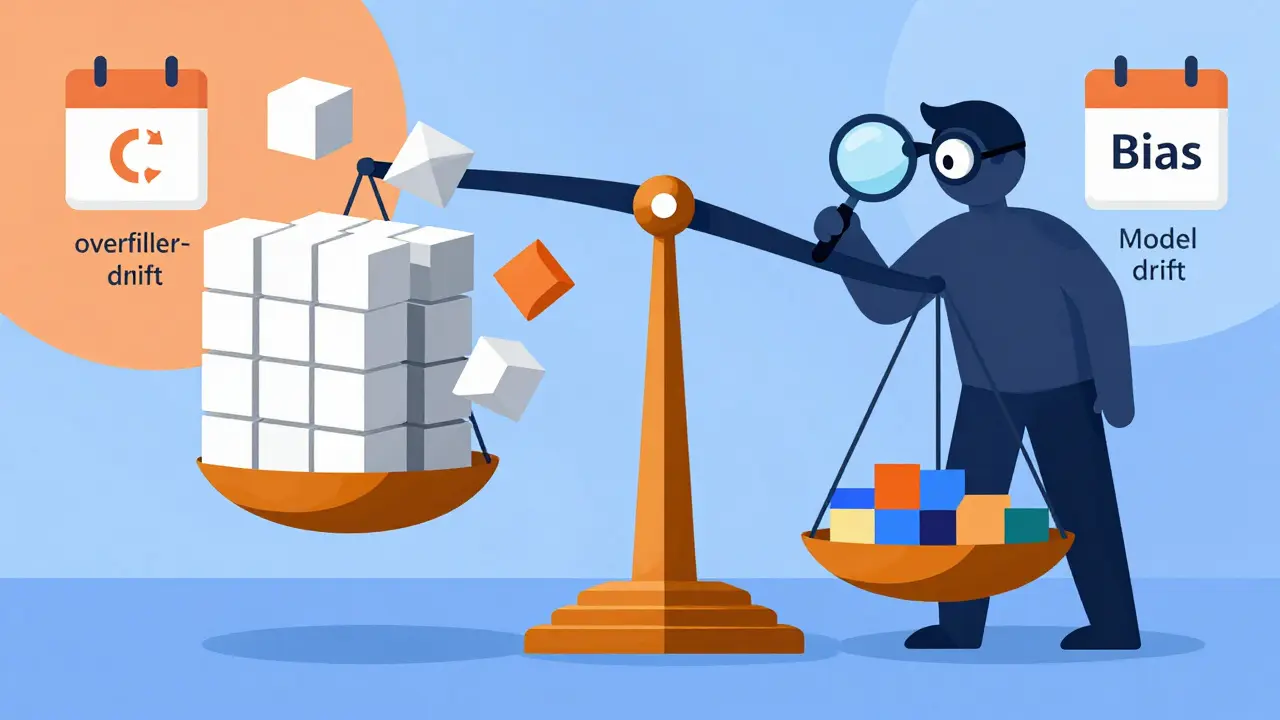
1. The Illusion of Objectivity: Dr. Emily M. Bender warns that quality classifiers trained on Western web text can systematically devalue content from non-Western perspectives by 22-27%. Your filters might be biased against certain dialects or cultural writing styles. Regularly audit your rejected data for demographic or linguistic bias.
2. Model Drift: The web changes. A classifier trained in 2023 might be useless by 2026. Static models lose effectiveness as new slang, formats, and misinformation tactics emerge. Retrain your classifiers every 45-60 days to keep them sharp.
3. Overfiltering Technical Content: Strict word-length or symbol-ratio rules can kill high-quality code documentation or scientific papers. If you’re training a specialized model (like for healthcare or finance), relax your heuristics and rely more on domain-specific model-based filters. Healthcare models, for instance, require 99.2% factual accuracy, often necessitating triple-layer filtering and human-in-the-loop verification.
Conclusion: Investing in Quality Pays Off
Data quality is no longer a side project; it’s central to LLM success. Investing 15-20% of your project resources in robust filtering pipelines can reduce downstream model refinement costs by 30-40%. With the LLM data preparation market projected to reach $4.8 billion by 2026, the tools and best practices are maturing rapidly. Start with simple heuristics, scale up with n-gram classifiers, and reserve your heavy artillery for the final polish. Your model-and your users-will thank you.
What is the difference between heuristic and model-based filters?
Heuristic filters use simple, rule-based statistics like word count, character ratio, and duplicate detection. They are fast and cheap but lack semantic understanding. Model-based filters use machine learning models (like fastText, BERT, or LLMs) to analyze the meaning, coherence, and quality of the text. They are slower and more expensive but provide much higher accuracy in identifying nuanced quality issues.
How much does data filtering improve LLM performance?
Research indicates that using filtered datasets can improve model accuracy benchmarks by 12-18%. Additionally, high-quality data reduces training compute requirements by 22-35% and decreases bias indicators by 15-25%. Conversely, leaving 15% low-quality content in your dataset can degrade performance by up to 37%.
Is LLM-as-judge worth the cost for pretraining data?
Generally, no. LLM-as-judge methods are extremely computationally expensive, costing thousands of dollars for large datasets and processing only 15-25 documents per minute. They are best reserved for small, critical datasets like instruction-tuning examples or final verification steps. For massive pretraining corpora, cascaded pipelines using cheaper n-gram and BERT classifiers are more practical.
What are common pitfalls in data quality measurement?
Common pitfalls include "heuristic overfiltering," where strict rules remove valid technical content; "model drift," where static classifiers become outdated as web content evolves; and bias, where filters trained on Western data undervalue non-Western perspectives. Regular auditing and retraining are essential to mitigate these risks.
How often should I retrain my data quality filters?
You should retrain your model-based filters every 45-60 days. Web content, language trends, and misinformation tactics evolve rapidly. A filter trained six months ago may miss new types of low-quality or harmful content, leading to decreased effectiveness in your current pipeline.
- Jun, 8 2026
- Collin Pace
- 2
- Permalink
Written by Collin Pace
View all posts by: Collin Pace