Measuring Maintainability: Cognitive Complexity and Coupling Metrics

Have you ever opened a function that looked simple at first glance, only to realize ten minutes later that you couldn't explain what it actually does? That feeling of mental friction is exactly what modern software engineering tries to quantify. For decades, we relied on outdated measures like McCabe’s cyclomatic complexity, which counted execution paths but ignored how hard those paths were for a human brain to follow. Today, the industry has shifted toward Cognitive Complexity, a metric designed by SonarSource around 2018 to measure the actual mental effort required to understand code. But understanding a single function is only half the battle. To truly gauge maintainability, you also need to know how that function connects to the rest of your system. This is where coupling metrics come in.
Measuring maintainability effectively requires looking at two distinct dimensions: internal readability (cognitive load) and external dependency (coupling). When you combine these views, you stop guessing which parts of your codebase are risky and start identifying them with precision. Here is how these metrics work, why they matter more than traditional measures, and how to use them together to protect your software from technical debt.
Understanding Cognitive Complexity
Traditional complexity metrics often "cry wolf." They flag code as complex simply because it has many branches, even if those branches are flat and easy to read. Cyclomatic Complexity, developed in the 1970s, focuses on testability-specifically, the minimum number of unit tests needed to cover all paths. It doesn’t care if those paths are nested five levels deep or laid out side-by-side.
Cognitive Complexity, on the other hand, is built on the principle that nesting breaks linear flow and increases mental strain. The algorithm starts each method with a base score of 0 and adds points based on three main rules:
- Control Flow Breaks: Each
if,else,while, orforloop adds 1 point. - Nesting Depth: Every additional level of indentation adds another 1 point. A nested
ifinside anotherifcosts more than two separateifstatements. - Logical Operators: Sequences of
&&or||operators add points because they force the reader to hold multiple conditions in memory simultaneously.
Notably, this metric treats switch statements differently. Instead of counting every case label, it assigns a fixed cost of 1 for the entire structure, recognizing that switch blocks are generally easier to scan than deeply nested conditionals. In early validation studies, 77% of developers agreed that this metric accurately reflected their perception of code difficulty, a significant jump in practitioner buy-in compared to older standards.
The Role of Coupling Metrics
Even if a function is easy to read, it can be a nightmare to change if it depends on too many other parts of the system. This is where coupling metrics step in. Coupling measures the degree of interdependence between software modules. High coupling means that a small change in one area ripples outward, breaking things elsewhere.
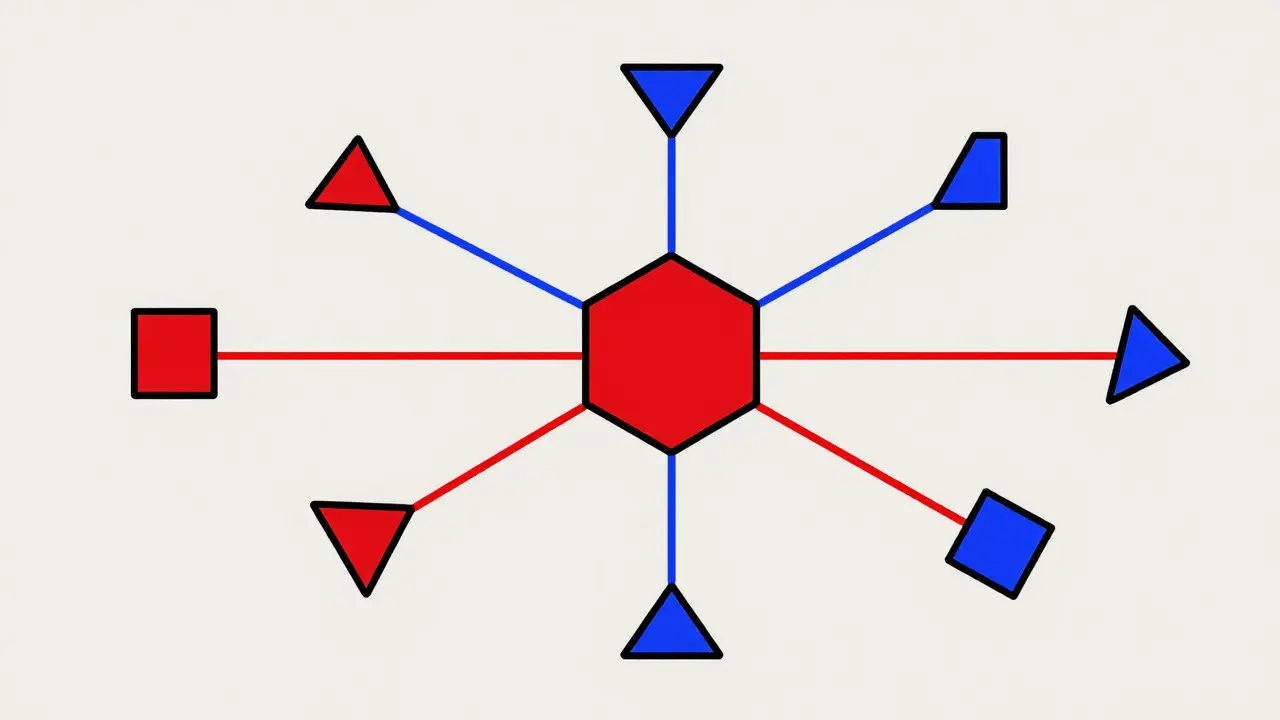
The most common ways to measure this are through Fan-In and Fan-Out:
- Fan-In: The number of other modules that call this component. High fan-in indicates a popular utility or service. If you change it, you risk breaking many callers.
- Fan-Out: The number of modules that this component calls. High fan-out suggests the module is doing too much or coordinating too many dependencies.
A classic rule of thumb, echoing cognitive psychology research on working memory limits, suggests an optimal fan-out of 7 ± 2. If a module directly invokes 15 subordinate modules, it exceeds this limit by roughly 66%, signaling that the design is likely too fragmented and hard to maintain.
Combining Metrics for Risk Assessment
To get a true picture of maintainability, you shouldn't look at these metrics in isolation. The real danger lies at the intersection of high cognitive complexity and high coupling. Imagine a function with a cognitive complexity score of 30 (well above the typical threshold) that also has a high fan-in. This is a maintenance hotspot: it’s hard to understand, and many other parts of your application depend on it. Changing this code carries a high risk of introducing bugs.
One way to quantify this combined risk is using the Information Flow Index. Defined as IF(A) = [FAN-IN(A) × FAN-OUT(A)]², this formula grows quadratically when both inbound and outbound dependencies are high. For example, a component with a fan-in of 4 and a fan-out of 5 yields an IF(A) of 400. Such a high number flags the component as a critical candidate for refactoring or architectural review.
| Metric | Primary Focus | Typical Threshold | Best Used For |
|---|---|---|---|
| Cyclomatic Complexity | Testability / Path Coverage | ≤ 10 | Determining unit test requirements |
| Cognitive Complexity | Understandability / Mental Load | ≤ 15 (most languages) ≤ 25 (C-family) |
Code reviews and readability enforcement |
| Fan-Out | Dependency Scope | ≤ 9 (Rule of 7±2) | Identifying over-coordinated modules |
| Information Flow Index | Change Impact Risk | Context-dependent | Prioritizing architectural refactoring |

Implementing Metrics in Your Workflow
You don’t need expensive enterprise tools to start measuring these values. SonarQube and SonarCloud offer free Community Editions that include Cognitive Complexity analysis for major languages like Java, Python, JavaScript, and C#. These tools provide line-by-line breakdowns, showing you exactly which statement pushes a method over the limit.
Here is a practical approach to integrating these metrics into your development process:
- Set Function-Level Rules: Avoid setting project-wide Quality Gates for complexity alone. Instead, enforce rules at the method level. For example, configure your linter to fail if a new method exceeds a cognitive complexity of 15.
- Integrate into CI/CD: Use plugins to check these metrics during pull requests. If a developer introduces a highly nested block of code, the build should flag it before merge.
- Review Call Graphs: Use static analysis tools to visualize fan-in and fan-out. Look for nodes with unusually high connections. These are your candidates for modularization.
- Tune Based on Feedback: Metrics are approximations. If your team finds that the default thresholds generate too many false positives, adjust them. The goal is to reduce noise so developers focus on genuine hotspots.
Remember that empirical studies, including a 2023 evaluation in the Journal of Systems and Software, suggest that while Cognitive Complexity correlates well with subjective understandability, it doesn’t drastically outperform traditional metrics in predictive power. It is best used as an additional lens, not a silver bullet. Combine it with human judgment and code review practices for the best results.
Refactoring Strategies for High Scores
When you identify a function with high cognitive complexity, the fix usually involves flattening the logic. Extract nested conditions into separate helper methods. Use guard clauses to return early, reducing the depth of subsequent blocks. For high coupling, consider applying design patterns like Dependency Injection or introducing interfaces to decouple components. The aim is to make each piece of code do one thing well, without needing to coordinate with dozens of other modules.
What is the difference between Cyclomatic and Cognitive Complexity?
Cyclomatic Complexity counts the number of independent paths through code, primarily serving as a guide for unit testing coverage. Cognitive Complexity measures the mental effort required to understand the code by penalizing nesting and logical breaks in flow. While cyclomatic complexity might treat a flat series of if-statements and a deeply nested block equally, cognitive complexity assigns a higher score to the nested block because it is harder for humans to read.
What are the recommended thresholds for Cognitive Complexity?
SonarSource recommends a default threshold of 15 for most programming languages. For C-family languages like C++ and C#, the threshold is set higher at 25, acknowledging that these languages often require more verbose control structures. These thresholds should be enforced at the function or method level rather than as an aggregate project metric.
How do Fan-In and Fan-Out affect maintainability?
Fan-In represents how many other modules depend on a specific component, while Fan-Out represents how many components a module depends on. High Fan-In makes a module risky to change because updates may break many callers. High Fan-Out indicates a module is overly coordinated or doing too much. Both extremes increase the cost and risk of maintenance.
Is Cognitive Complexity better than Cyclomatic Complexity?
For assessing code readability and developer experience, yes. Cognitive Complexity aligns more closely with human perception of difficulty. However, Cyclomatic Complexity remains valuable for determining test coverage requirements. The best approach is to use both: Cyclomatic for testing strategy and Cognitive for code review and refactoring priorities.
Can I calculate these metrics manually?
While possible for small functions, it is impractical for large systems. Tools like SonarQube, SonarCloud, and various IDE plugins automate the calculation of Cognitive Complexity and coupling metrics. They provide precise line-level data and integrate directly into your continuous integration pipeline, making manual calculation unnecessary and error-prone.
- Aug, 9 2026
- Collin Pace
- 0
- Permalink
Written by Collin Pace
View all posts by: Collin Pace