Multilingual LLMs: How Transfer Learning Bridges Language Gaps in 2026
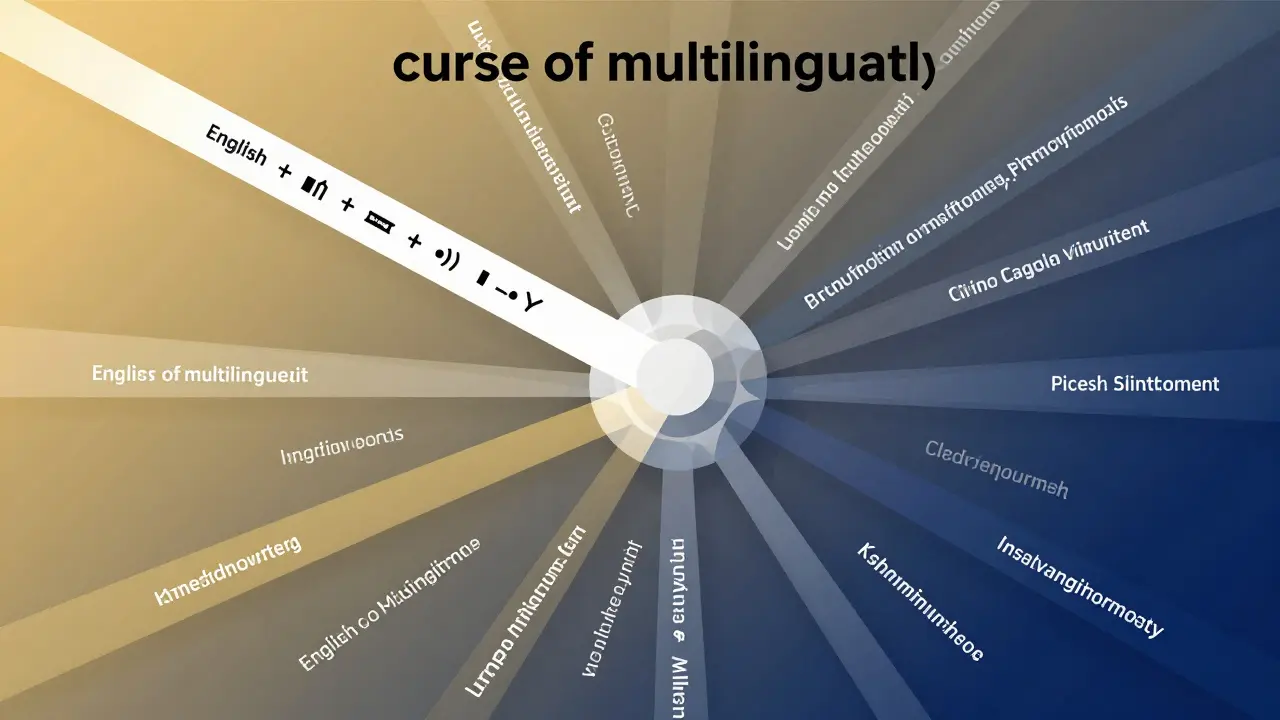
Imagine building a customer service chatbot that speaks fluent English and Spanish but completely chokes on Swahili or Tagalog. For years, this was the standard reality for AI developers. You could build great tools for the world’s most spoken languages, but if your users spoke anything outside that elite circle, the system failed hard. That gap is what Multilingual Large Language Models (MLLMs) are designed to fix. These aren't just translation tools; they are systems trained to understand context, nuance, and intent across dozens of languages simultaneously. The secret sauce? Transfer learning-the ability to take knowledge gained from data-rich languages like English and apply it to data-poor ones.
But here is the catch: it doesn’t work perfectly yet. There is a stubborn performance drop-off when moving from high-resource languages to low-resource ones. If you are looking to deploy global AI solutions in 2026, understanding how these models learn, where they break, and which techniques actually close the gap is critical. This isn't just about academic curiosity; it's about whether your product works for half the planet or just a fraction of it.
The Core Problem: The Curse of Multilinguality
You might assume that adding more languages to a model makes it smarter across the board. In practice, the opposite often happens. Researchers call this the "curse of multilinguality." When you expand a model's language coverage by 50%, its per-language performance typically drops by 3 to 7 percentage points. Why? Because the model has to share its neural pathways among more linguistic patterns, leading to what experts call "transfer-dilution effects" (Gurgurov et al., 2024).
Consider the numbers. On benchmarks like XNLI (Cross-lingual Natural Language Inference), top-tier MLLMs hit 85-88% accuracy in English. But for low-resource languages like Urdu or Swahili, that score plummets to 55-65%. That is a massive drop. It means the model understands the grammar of English well enough to pass a test, but it struggles to grasp the same logical inference in a language with fewer digital texts available for training.
This disparity stems from data imbalance. High-resource languages have billions of words in their training corpora. Low-resource languages might have less than one million examples. The model learns rich, nuanced representations for the former and shallow, brittle ones for the latter. Bridging this gap requires more than just throwing data at the problem; it requires sophisticated transfer learning strategies.
How Transfer Learning Works Across Languages
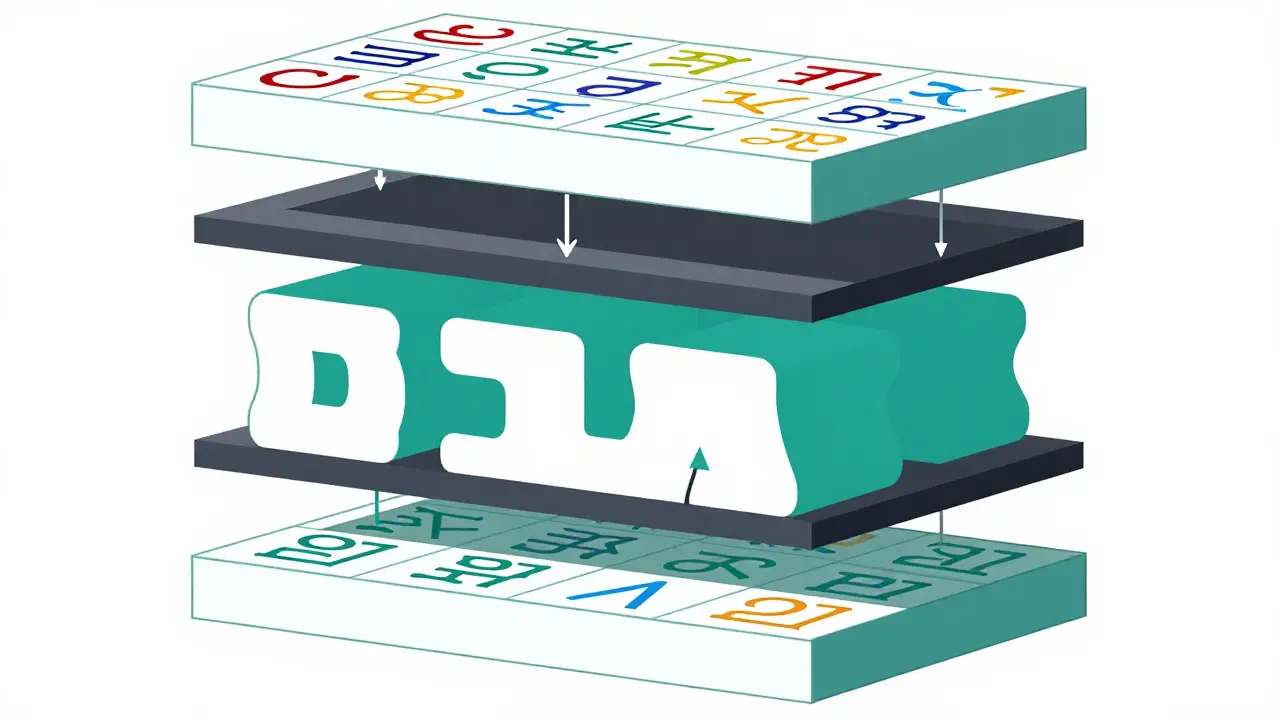
Transfer learning in multilingual contexts relies on the idea that many languages share underlying semantic structures. Even if the words are different, the concept of "cause and effect" or "subject-object relationship" remains similar. Modern transformer-based architectures exploit this by creating shared embedding spaces.
Research from Emergent Mind (2024) reveals an interesting architectural detail: neuron clusters responsible for specific language encoding tend to concentrate in the first and last layers of the transformer. The middle layers, however, become increasingly language-agnostic. They focus on semantic alignment rather than specific vocabulary. This is where the magic happens. The model learns to map the meaning of a sentence in French to the same conceptual space as a sentence in Japanese, even if the surface forms look nothing alike.
However, this alignment is imperfect. Languages with different writing systems pose a significant hurdle. Models show 15-20% lower performance on Arabic and Japanese compared to Latin-script languages. The visual structure of the text affects how the tokenizer breaks down information, creating representational gaps in the embedding space. If the tokenizer can't efficiently chunk the text, the model struggles to find those shared semantic anchors.
Top Techniques to Boost Low-Resource Performance
If you are working with low-resource languages, standard fine-tuning won't cut it. You need advanced techniques designed specifically to force knowledge transfer from strong languages to weak ones. Here are the three most effective approaches currently in use:
- Code-Switching Curriculum Learning (CSCL): This method trains the model on mixed-language inputs-switching between languages at the token or sentence level. By forcing the model to handle code-switched text (common in real-world multilingual communities), it learns robust cross-lingual mappings. Studies show CSCL improves Indonesian performance on XQuAD by 12.7 percentage points compared to standard methods. It essentially teaches the model that language boundaries are fluid, not rigid.
- Multi-level Knowledge Distillation (MMKD): Instead of just predicting the next word, MMKD aligns the model's outputs at multiple levels: token, word, sentence, and structure. A large, powerful teacher model guides a smaller student model, ensuring the student captures deep structural similarities across languages. This approach achieved 73.5% accuracy on XNLI for low-resource languages, beating standard BERT-base by over 5 points.
- Dynamic Data Sampling: This technique prioritizes underrepresented languages during training epochs. By feeding the model more examples from low-resource languages, it prevents them from being drowned out by English data. However, be careful: boosting low-resource performance by 8.3 points can sometimes degrade high-resource performance by 2.1 points. It’s a balancing act.
Model Comparison: Who Does It Best?
Not all multilingual models are created equal. Your choice depends heavily on your target languages and resource constraints. Here is how the major players stack up based on 2024-2026 performance data.
| Model | Performance Gap (High vs. Low Resource) | Key Strength | Weakness |
|---|---|---|---|
| Meta XLM-RoBERTa-large | 12 points | Consistent performance across 100+ languages | High computational cost |
| Google mT5 | 28 points | Strong encoder-decoder architecture | Poor transfer to agglutinative languages |
| Facebook NLLB | Varies | Specialized for translation tasks | Less effective for general reasoning |
Meta’s XLM-RoBERTa-large stands out for its consistency. With only a 12-point gap between high- and low-resource languages, it offers the most reliable baseline for global deployment. Google’s mT5, while powerful, suffers from a wider 28-point gap, making it riskier for applications requiring uniform quality across diverse markets. Facebook’s NLLB (No Language Left Behind) is excellent if your primary goal is translation, but it lacks the general reasoning capabilities needed for complex chatbots or analysis tools.
Practical Challenges for Developers
Deploying these models in the real world introduces headaches that benchmark scores don't capture. Tokenization is the biggest culprit. Default tokenizers like SentencePiece often merge too many subwords in agglutinative languages like Turkish or Finnish. This breaks compatibility with standard pipelines and forces you to train custom tokenizers with 20,000-30,000 additional tokens. It’s tedious, time-consuming work.
Then there is the issue of code-switching in user input. A developer on Reddit reported that fine-tuning mBERT for Swahili required three times more data augmentation than expected because users naturally mix Swahili and English in digital communication. The model, trained on pure language splits, struggled with this hybrid reality. You need to augment your training data with realistic, messy, code-switched examples to match actual user behavior.
Safety is another minefield. Dr. Elena Rodriguez of Stanford warns that current transfer learning methods can inadvertently reinforce toxic biases in low-resource languages. Since safety alignment is often done primarily in English, the model may not recognize harmful content in other languages, or worse, it may misclassify culturally neutral phrases as toxic due to spurious correlations. You must audit your model’s outputs in every target language, not just English.
Future Outlook: Closing the Gap
The trajectory for multilingual AI is positive, but slow. Gartner predicts that by 2027, the performance gap between high- and low-resource languages will narrow to 15 percentage points, down from today’s 30+. This improvement will come from modular architectures that use language-specific adapters rather than monolithic weights. Imagine a core model that handles universal semantics, with lightweight plugins added for specific linguistic features of Turkish, Bengali, or Yoruba.
We are also seeing advances in zero-shot transfer. Meta’s XLM-R 2.0, released in early 2024, improved zero-shot transfer to unseen scripts by 11.3 percentage points through enhanced script conversion capabilities. This means you might soon be able to deploy a model in a language it was never explicitly trained on, provided it shares a script family with known languages.
For now, the path forward requires patience and precision. Don't rely on off-the-shelf defaults. Customize your tokenizers, use code-switching curriculum learning, and rigorously test for bias. The technology is ready to democratize AI access globally, but only if you put in the work to bridge the remaining gaps.
What is the "curse of multilinguality"?
The curse of multilinguality refers to the phenomenon where increasing the number of languages a model supports leads to a decrease in performance for each individual language. As the model tries to learn more linguistic patterns simultaneously, it experiences "transfer-dilution," causing accuracy drops of 3-7 percentage points per language added.
Which multilingual model is best for low-resource languages?
Meta's XLM-RoBERTa-large is currently considered the best option for low-resource languages due to its consistent performance across 100+ languages. It maintains a relatively small 12-point performance gap between high- and low-resource languages, whereas models like Google's mT5 show larger disparities.
How does Code-Switching Curriculum Learning (CSCL) help?
CSCL improves model performance by training on mixed-language inputs that switch between languages at the token or sentence level. This mimics real-world multilingual communication and forces the model to build stronger cross-lingual semantic mappings, improving accuracy on low-resource languages by up to 12.7 percentage points on certain benchmarks.
Why do models struggle with non-Latin scripts?
Models often perform 15-20% worse on languages with non-Latin scripts like Arabic or Japanese due to tokenization challenges. Standard tokenizers may inefficiently split characters in these scripts, creating representational gaps in the embedding space that hinder the model's ability to align semantics with high-resource languages.
Is it safe to deploy multilingual models without extra testing?
No. Safety alignment is often biased toward English, meaning low-resource language outputs can be disproportionately toxic or misclassified. Experts warn that transfer learning can reinforce spurious correlations, so rigorous auditing in every target language is essential before deployment.
- Jul, 7 2026
- Collin Pace
- 0
- Permalink
Written by Collin Pace
View all posts by: Collin Pace