Parallel Transformer Decoding Strategies for Low-Latency LLM Responses
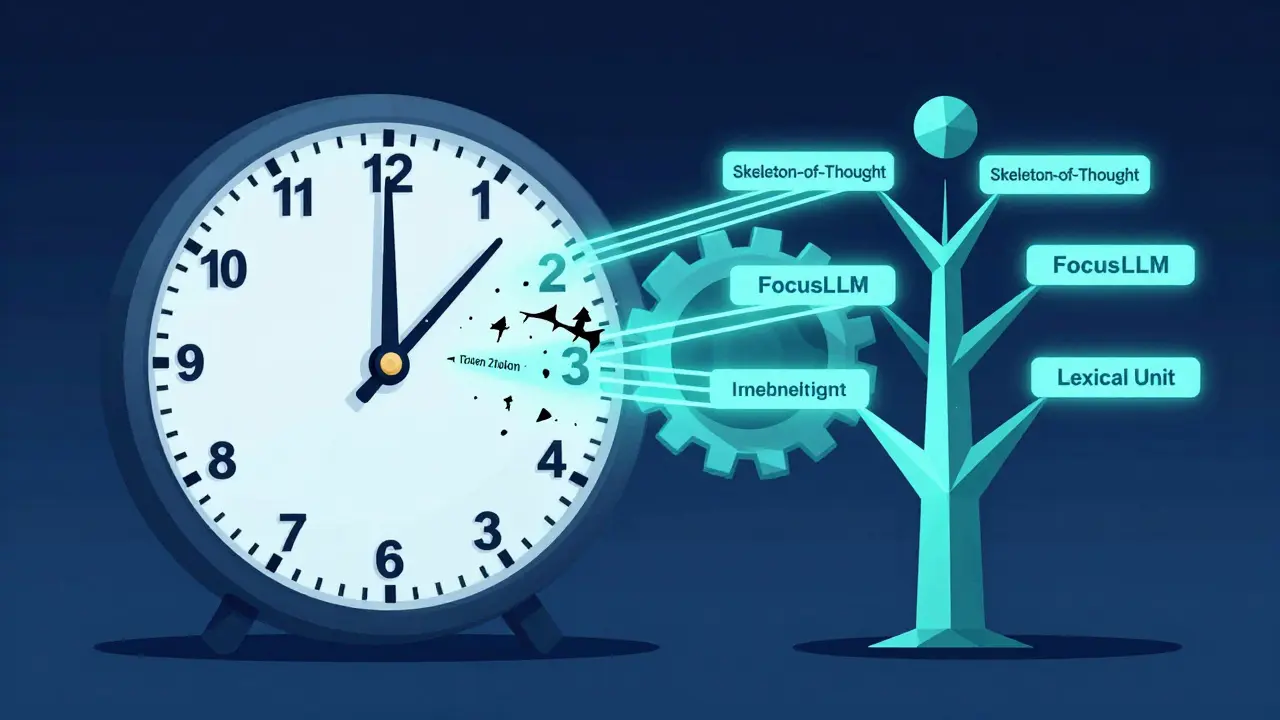
Imagine asking an AI assistant a complex question and waiting 20 seconds for a reply. That’s not just frustrating-it’s unusable in real-time applications like customer service, live translation, or code assistants. The problem isn’t the model’s intelligence. It’s how it generates text. Traditional large language models (LLMs) use sequential decoding: one token at a time, like typing a sentence letter by letter. If you want 500 words, you wait for 500 steps. That’s why a 500-token response from Claude 2.1 took nearly 22 seconds in 2023 tests. But a new wave of techniques is changing that. Parallel transformer decoding lets LLMs generate multiple tokens at once-cutting response times in half without sacrificing quality.
Why Sequential Decoding Is the Bottleneck
Every LLM you’ve used-GPT, Claude, Llama-relies on auto-regressive generation. After predicting the first word, it uses that word as input to predict the second. Then the third. And so on. This isn’t inefficient because the model is slow. It’s because the process is inherently linear. Each token depends on the last. There’s no way around it unless you change how decoding works. This linear dependency creates a hard latency ceiling. Double the output length? Double the time. For real-time apps, that’s a dealbreaker. A chatbot that takes 15 seconds to reply won’t retain users. A code assistant that lags between suggestions kills developer flow. The solution isn’t faster GPUs-it’s smarter decoding.Three Ways to Decode in Parallel
Three main approaches have emerged to break the sequential chain. Each has different trade-offs in speed, complexity, and quality.Skeleton-of-Thought (SoT): Prompt Engineering That Works
Skeleton-of-Thought doesn’t change the model. It changes the prompt. First, the LLM generates a structured outline-like bullet points or a numbered list-of the key ideas needed for the full answer. Then, it expands each point independently, in parallel. For example, if you ask for advice on resolving a workplace conflict, the skeleton might be:- Listen actively to both sides
- Identify the root cause
- Propose a compromise
FocusLLM: Breaking Long Contexts Into Chunks
FocusLLM tackles a different problem: long documents. When you feed a model a 128K-token legal contract or research paper, the attention mechanism has to compute relationships between every single token. That’s O(L²) complexity-meaning computation grows with the square of the sequence length. For 128K tokens, that’s over 16 billion pairwise comparisons. FocusLLM splits the input into smaller chunks-say, four 32K-token segments. It processes each chunk in parallel, then stitches the results together using lightweight trainable layers. The complexity drops to O((L/n)²), where n is the number of chunks. For four chunks, that’s a 16x reduction in computation. The magic? Original model weights stay frozen. You don’t need to retrain the whole LLM. Just add a small adapter layer to merge chunk outputs. This makes it ideal for enterprises that can’t retrain proprietary models. It’s especially powerful for RAG systems, legal analysis, and technical documentation. Google’s Gemini 1.5 used similar chunking in late 2024 to cut 8K+ context latency by 42%.Lexical Unit Parallel Decoding: Predicting Word Groups
This method predicts multiple consecutive tokens-like phrases or code snippets-in one step. Instead of generating “def”, then “calculate”, then “total”, it predicts “def calculate_total()” as a single unit. It does this by identifying high-probability token spans during inference. If the model is 90% confident that the next three tokens form a coherent unit, it generates them all at once. This approach delivers 30-33% faster generation on natural language tasks and up to 38% faster on code generation. Why code? Because code follows strict patterns: function signatures, loops, imports. These are predictable. GitHub developers reported 25-35% faster completions in early 2024 tests. But here’s the catch: you need to retrain the model to recognize these lexical units. The LREC 2024 paper shows models must be trained with [PAD] tokens appended to multi-token sequences. That’s not something you can do with a prompt. It requires data labeling, fine-tuning, and validation. Only a few models-like Llama 3-70B (released November 2024)-have native support.
Comparing the Strategies
| Strategy | Speed Gain | Model Changes | Best For | Quality Impact |
|---|---|---|---|---|
| Skeleton-of-Thought | 1.83x (45-50%) | None (prompt-only) | Customer service, general Q&A | Minimal if skeleton is strong |
| FocusLLM | 2-3x (context-dependent) | Minimal (adapter layers) | Long-context RAG, legal, research | None (preserves original output) |
| Lexical Unit | 30-38% | Full retraining required | Code generation, structured output | Low if confidence threshold is tuned |
Real-World Impact and Adoption
Enterprise adoption is accelerating. According to Gartner, 65% of enterprise LLM deployments will use parallel decoding by 2026-up from just 12% in mid-2024. The biggest users? Customer service chatbots (47%), real-time translation (28%), and code assistants (19%). One AWS solutions architect shared that switching to parallel decoding cut translation latency from 1200ms to 780ms-meeting their 800ms SLA for 95% of queries. On GitHub, developers using lexical unit decoding reported identical BLEU scores but 33% faster API responses. The trade-off? Tuning the confidence threshold α. Too low, and you get errors. Too high, and you lose speed. One engineer had to raise it from 0.85 to 0.92 to prevent bad completions. But adoption isn’t easy. Stack Overflow data shows 41% of questions about parallel decoding relate to thread synchronization. Running multiple decoding tasks at once introduces race conditions, memory leaks, and timing bugs. Documentation is uneven. Skeleton-of-Thought has 247 GitHub repos and 837 Stack Overflow questions-clear community support. FocusLLM’s code is scattered across academic repos. Lexical unit decoding? Almost no public tutorials.
What’s Next? The Road Ahead
The next wave of improvements is already in the works. FocusLLM’s upcoming update will dynamically adjust chunk size based on content relevance-processing dense sections in smaller chunks, sparse ones in larger ones. Llama 3-70B’s native support for lexical decoding is a sign that model vendors are building this in at the core. But there’s a limit. Some tasks-creative writing, complex reasoning, multi-step math-still need sequential thought. Parallel decoding can’t replace the human-like step-by-step reasoning that makes LLMs feel intelligent. The goal isn’t to eliminate sequential decoding. It’s to eliminate it where it doesn’t matter. In customer service, you don’t need 100% creative flair-you need speed and accuracy. In code generation, you want structure, not poetry. For those cases, parallel decoding isn’t just helpful. It’s essential.Frequently Asked Questions
Can I use parallel decoding with my existing LLM without retraining?
Yes, but only with Skeleton-of-Thought. It uses prompt engineering-no model changes needed. Just send two prompts: one to generate a skeleton, another to expand each point. It works with GPT, Claude, Llama, and others. FocusLLM requires adding small adapter layers, and lexical unit decoding requires full retraining.
Does parallel decoding reduce answer quality?
It can, but not if implemented well. Skeleton-of-Thought sometimes produces shallow answers if the skeleton is weak. Lexical unit decoding can generate errors if the confidence threshold is too low. FocusLLM preserves quality because it doesn’t alter the model’s weights. The key is tuning: test different thresholds, validate outputs, and monitor for hallucinations or omissions.
Which strategy is best for code generation?
Lexical unit parallel decoding is the strongest for code. Code follows predictable patterns-function names, loops, imports-which are easier to predict in chunks. Llama 3-70B achieves 38% faster code generation with this method. Skeleton-of-Thought can work if you prompt for code structure first, but lexical decoding gives the biggest gains without changing the prompt.
Is parallel decoding available on cloud platforms?
Yes, but selectively. AWS Lambda added support in October 2024 with a 15% pricing premium. Google’s Gemini 1.5 includes experimental parallel decoding for long contexts. Open-source frameworks like vLLM and TensorRT-LLM now support lexical unit decoding. If you’re using a managed service, check their documentation for “fast decoding,” “multi-token generation,” or “speculative decoding.”
Why isn’t everyone using parallel decoding yet?
Implementation complexity and lack of standardization. Skeleton-of-Thought is easy but inconsistent. FocusLLM requires custom training pipelines. Lexical decoding needs retraining and labeled data. Many teams lack the engineering resources. Also, for short responses under 100 tokens, the speed gain isn’t noticeable. Parallel decoding shines in long-form, high-volume, real-time use cases.
- Jan, 27 2026
- Collin Pace
- 7
- Permalink
Written by Collin Pace
View all posts by: Collin Pace