Privacy-Preserving Generative AI: Homomorphic Encryption and Secure Enclaves

Most of us have a love-hate relationship with Generative AI. We love the productivity boost, but we hate the feeling that our private data is being sucked into a black box where we lose all control. The core problem is that traditional encryption is like a locked safe: it's great for storing data, but the moment you want to actually do something with that data-like asking an LLM to analyze a medical report-you have to unlock the safe. That tiny window of decryption is where the leaks happen.
But what if we never had to unlock the safe? Imagine a world where an AI can process your data, find patterns, and generate a response without ever actually "seeing" the raw information. This isn't science fiction; it's the goal of Homomorphic Encryption is a cryptographic method that allows computations to be performed on encrypted data, producing an encrypted result that, when decrypted, matches the result of operations performed on the plaintext. By moving the computation into the encrypted space, we remove the vulnerability window entirely.
The Magic of Computing Without Decrypting
To understand why this is a big deal, look at how standard AI works. You send a prompt to a cloud server, the server decrypts your request, processes it using its model, and sends back an answer. Even if the connection is secure, the server operator (or a hacker who has breached the server) can see everything. Fully Homomorphic Encryption (or FHE) changes the game by allowing unlimited arithmetic operations on ciphertext.
Think of it like a glove box. A jeweler puts a diamond (your data) and some tools inside a sealed glass box with built-in gloves. A worker can put their hands in the gloves and polish the diamond, but they can never actually touch it or take it out of the box. The worker completes the job, but the diamond stays protected. In the AI world, this means you can send an encrypted query to a Large Language Model, and the model can generate a response while the data remains encrypted. Only you, the person with the secret key, can read the final output.
While this sounds computationally heavy, we're seeing a shift toward practical use. Recent work by the Pacific Northwest National Laboratory (PNNL) in early 2025 showed that using the CKKS encryption scheme allows these operations to run even on edge devices and IoT hardware. By managing "noise"-the mathematical clutter that usually builds up during FHE operations-they've made it possible to balance privacy with actual performance.
Secure Enclaves: The Hardware Guard
While FHE handles the math, Secure Enclaves (also known as Trusted Execution Environments or TEEs) handle the physical space. If FHE is a mathematical shield, a secure enclave is a digital vault. It is a hardware-isolated area of a CPU that protects data from the rest of the system. Even if the operating system is compromised by a rootkit, the enclave remains a black box that the attacker cannot peek into.
| Feature | Homomorphic Encryption (FHE) | Secure Enclaves (TEEs) |
|---|---|---|
| Security Basis | Mathematical (Hard Problems) | Hardware Isolation |
| Performance | Slower (High Overhead) | Fast (Near-native speed) |
| Trust Model | Trust the Math | Trust the Chip Manufacturer |
| Data State | Always Encrypted | Decrypted inside the Enclave |
In a real-world scenario, like a bank detecting fraud across international borders, a secure enclave can ingest encrypted data from three different countries, decrypt it only within the isolated hardware chip, run the fraud detection algorithm, and then wipe the memory before sending the encrypted result back. It's incredibly fast, but it requires you to trust the hardware vendor (like Intel or AMD) to have built the chip without backdoors.

Combining FHE with Federated Learning
One of the most exciting trends is the marriage of FHE and Federated Learning. Normally, federated learning lets AI train on local data (like on your phone) and only sends the "learned patterns" (model updates) to a central server. The raw data never leaves your device, which sounds great, but there's a catch: clever attackers can sometimes reverse-engineer those updates to figure out what the original data was.
By adding homomorphic encryption to the mix, the model updates themselves are encrypted before they are sent. The central server performs a "homomorphic aggregation," meaning it adds up all the updates from thousands of users while they are still encrypted. The server never sees the individual updates-only the combined total. This creates a double layer of armor: the data stays on the device, and the updates stay encrypted during transit and processing.
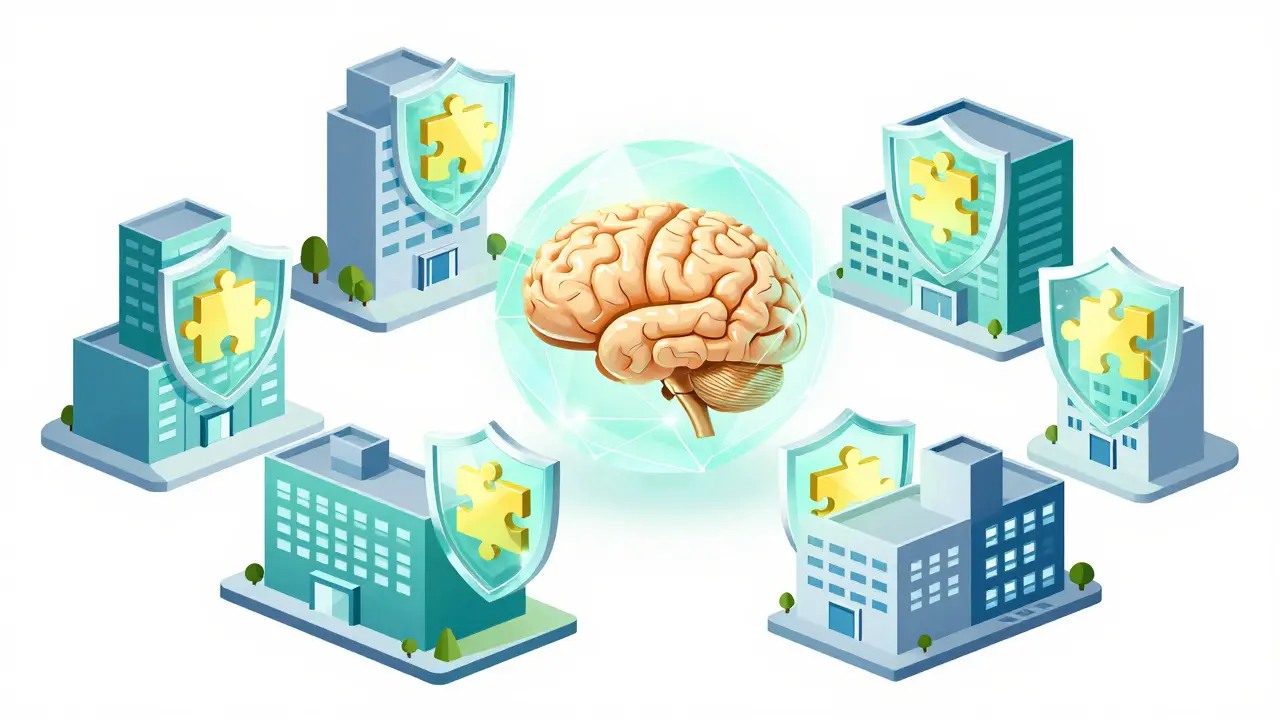
IBM is already pushing this in the healthcare sector. Imagine five hospitals that all want to train an AI to predict postoperative outcomes. They can't share patient records due to GDPR or HIPAA laws. By using this combined approach, they can collectively train a master model without any hospital ever seeing another hospital's patient data. The result is a model that is far more accurate than any single hospital could build alone because it has seen a much wider variety of cases.
Regulatory Compliance and the "Math-First" Approach
For years, companies have relied on "contractual guarantees" for privacy. They sign a piece of paper saying, "We promise not to look at your data." In the age of AI, that's not enough. Regulators, especially under the GDPR (General Data Protection Regulation), are moving toward demanding mathematical proof of protection.
Homomorphic encryption provides exactly that. It shifts the burden of trust from the human (the company) to the math (the algorithm). If the data is processed using FHE, it is mathematically impossible for the service provider to access the plaintext, regardless of what their internal policies say. This turns a legal headache into a technical certainty, making it much easier for companies to deploy AI in highly regulated industries like law, finance, and medicine.
The Roadblocks: Why Isn't This Everywhere Yet?
If this is so great, why are we still using standard cloud AI? The truth is that FHE is computationally expensive. Doing math on encrypted numbers is significantly slower than doing it on regular numbers. For a simple calculation, it might be a few times slower; for a complex generative AI model with billions of parameters, it can be thousands of times slower.
However, we are hitting a tipping point. New frameworks from New York University are bringing FHE to deep learning more efficiently. As we get better at optimizing these algorithms and as hardware accelerators (like specialized AI chips) evolve to handle encrypted math, the "performance tax" will drop. We are moving from the era of "it's theoretically possible" to "it's practically viable for specific use cases." Right now, the smart move for organizations is to run small-scale pilots-focusing on high-value, high-privacy data-while relying on federated learning for broader, less sensitive tasks.
Does homomorphic encryption make AI slower?
Yes, significantly. Because the AI is performing calculations on encrypted ciphertext rather than plain numbers, it requires much more computational power. However, new schemes like CKKS and hardware optimizations are rapidly reducing this overhead, making it viable for specific edge-device applications.
What is the difference between a Secure Enclave and FHE?
FHE is a mathematical approach where data is never decrypted during processing. A Secure Enclave is a hardware approach where data is decrypted, but only inside a physically isolated part of the CPU that the rest of the system cannot access.
Can FHE help with GDPR compliance?
Absolutely. FHE provides cryptographic assurance that data remains protected during processing, moving beyond simple contracts to a mathematical guarantee that sensitive personal information is not exposed, which aligns with the stringent requirements of the GDPR.
Is Federated Learning the same as Homomorphic Encryption?
No. Federated Learning keeps raw data on the local device and only shares model updates. Homomorphic Encryption encrypts those updates (or the data itself) so they can be processed without ever being decrypted. They are often used together to provide maximum privacy.
Who is currently using this technology?
IBM is incorporating these methods into its federated learning frameworks for banks and hospitals. Research institutions like PNNL and NYU are also developing frameworks to bring these protections to edge devices and deep learning applications.
Next Steps for Implementation
If you're a developer or a business leader looking to integrate these technologies, don't try to boil the ocean. Start with a Privacy Impact Assessment to identify which specific data points are the most sensitive. If you have high-latency tolerance but need absolute privacy (like medical research), look into FHE pilots. If you need real-time performance and can trust your hardware vendor, explore TEEs (Secure Enclaves). For those building collaborative models across different organizations, a hybrid approach combining Federated Learning with FHE for the aggregation phase is the gold standard for 2026.
- Apr, 19 2026
- Collin Pace
- 0
- Permalink
Written by Collin Pace
View all posts by: Collin Pace