Procurement and Contracts with Generative AI: Vendor Assessments and Clause Libraries
Generative AI is Changing How Companies Handle Contracts and Vendors
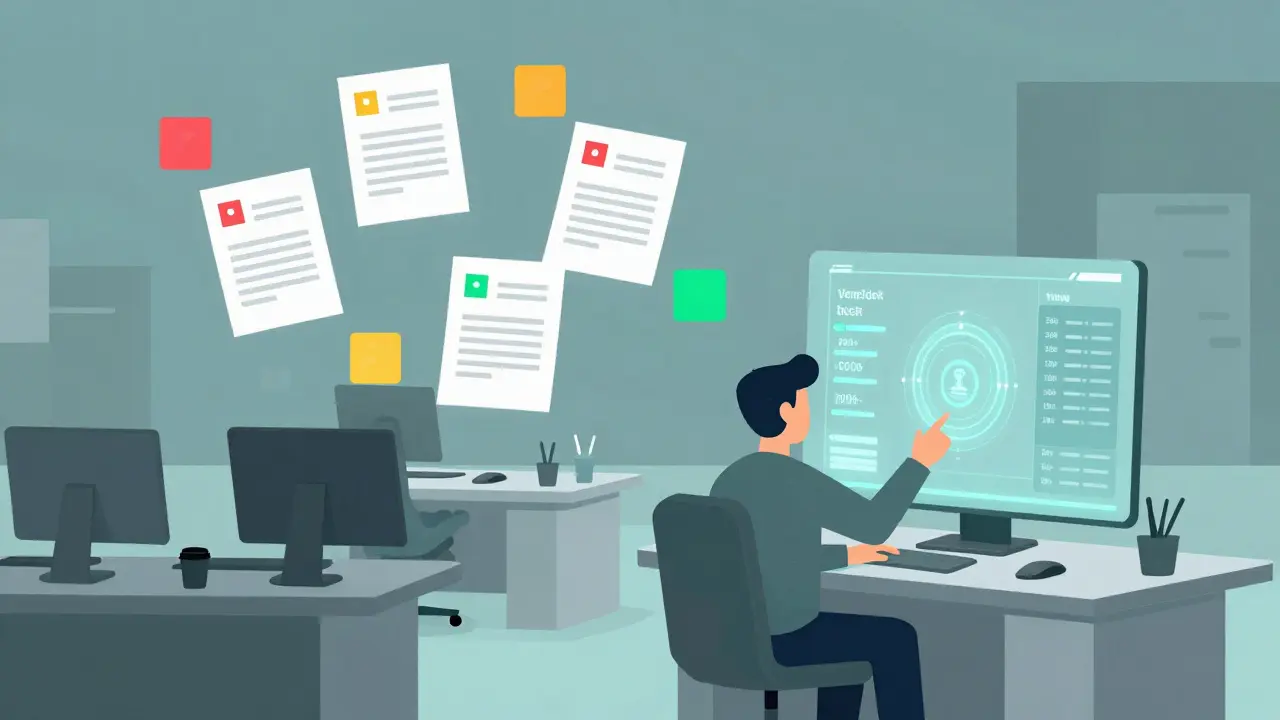
Five years ago, procurement teams spent weeks reviewing vendor contracts. Lawyers marked up PDFs by hand. Risk teams dug through spreadsheets for supplier financials. Today, a single AI tool can scan 50 contracts in 20 minutes, flag risky clauses, and suggest better language-all while cross-checking supplier performance data from 200+ sources. This isn’t science fiction. It’s happening now, and companies that ignore it are falling behind.
What Generative AI Actually Does in Procurement
Generative AI in procurement doesn’t just automate tasks-it understands them. Unlike old rule-based systems that looked for keywords like "indemnity" or "termination," modern AI tools like Gainfront’s EfficiencyAI and Hexaware’s Agentic AI read contracts the way a human would. They know that a clause about "liability caps" means something different in a software services agreement than in a manufacturing supply deal.
These systems are built on transformer models fine-tuned with millions of real contracts. They’ve learned that a 30-day notice period might be standard in IT services but dangerous in pharmaceutical logistics. They recognize that a vendor’s "on-time delivery rate" of 92% looks great until you cross-reference it with their recent bankruptcy filings and negative social media sentiment.
The result? Contracts that used to take three days to review now take four hours. Risk flags that were missed by human reviewers get caught. And instead of just saying "this clause is missing," the AI explains why it matters: "This force majeure clause doesn’t cover AI system failures, which could halt your entire digital supply chain. Consider adding ‘technology outages’ as a covered event."
How Vendor Assessments Work With AI
Before AI, vendor assessments were a checklist game: Did they submit their financials? Are they ISO certified? Did they pass the last audit? Now, AI pulls together data you didn’t even know you had.
It scans public records for lawsuits, monitors news feeds for factory closures, checks credit ratings, and tracks delivery delays from your own ERP system. It even reads supplier reviews on platforms like G2 and LinkedIn to gauge cultural fit. One manufacturing company in Wisconsin found their top-rated vendor had a 15% increase in employee turnover over the past year-something their traditional vendor scorecard never mentioned. The AI flagged it. They dug deeper. Turns out, the vendor was losing key engineers to a competitor. They renegotiated terms before a critical component shortage hit.
AI assesses over 200 data points in real time:
- Financial health: debt-to-equity ratios, cash flow trends, liquidity metrics
- Operational reliability: on-time delivery, defect rates, service response times
- Reputational risk: news mentions, social media sentiment, regulatory violations
- Compliance: certifications, labor practices, environmental disclosures
These aren’t static scores. They update hourly. If a vendor’s CEO gets indicted or a factory burns down, the AI knows within minutes. That’s the kind of early warning that used to cost companies millions.
Clause Libraries: From Chaos to Control
Most companies have hundreds-or thousands-of contracts scattered across email inboxes, shared drives, and legacy systems. Finding the right clause? Good luck.
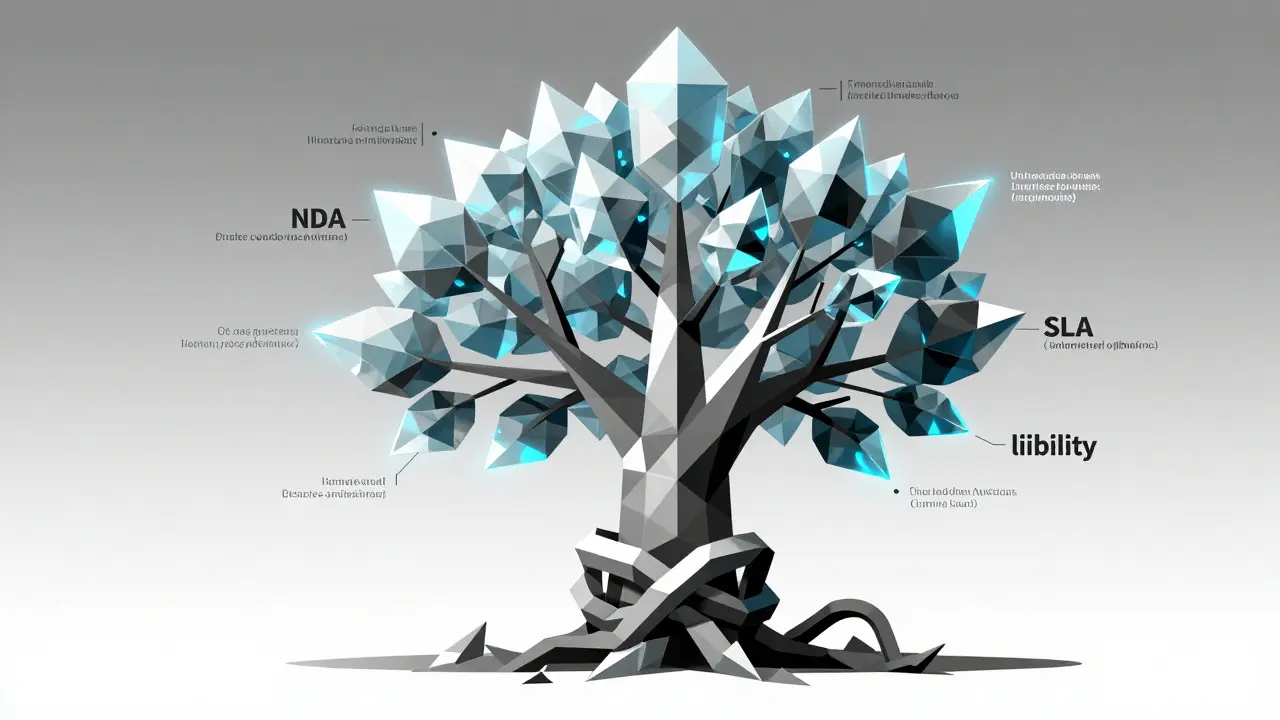
Generative AI fixes that by building a living clause library. It ingests every contract you’ve ever signed, tags each clause by type (payment terms, confidentiality, SLAs, liability), and scores them by risk level. Over time, it learns what works. It notices your legal team always rewrites the indemnity clause in cloud service agreements. It starts suggesting that version automatically.
One Fortune 500 company used AI to analyze 8,200 NDAs. They found 147 different versions of the same confidentiality clause. Some were too broad. Others were too weak. The AI grouped them, flagged inconsistencies, and recommended a single, standardized version. That cut negotiation time by 40% and reduced legal disputes by 37%.
It doesn’t just organize. It improves. If you’re negotiating a new contract and the vendor proposes a clause that’s never been used before, the AI compares it to similar clauses across your entire library and says: "This version lacks a data breach notification window. In 72% of past contracts with similar vendors, we required 48-hour notification. Recommend adding it."
AI vs. Old Tools: Why Rule-Based Systems Fall Short
Before generative AI, companies used tools like Icertis or DocuSign. These systems were great for e-signatures and basic workflow tracking. But they couldn’t understand context.
Rule-based tools would flag a missing "governing law" clause. Generative AI asks: "Why does it matter? The vendor is based in Singapore, but your team is in Ohio. If a dispute arises, which court handles it? And what if Singapore’s data laws conflict with your GDPR obligations?"
AI doesn’t just match templates. It interprets. It knows that a "liquidated damages" clause might be acceptable in a construction contract but could violate antitrust rules in a joint venture. It spots hidden contradictions. One client’s AI found that while their purchase order terms said payments were due in 30 days, their master agreement said 45. No one had noticed in 12 years.
Gartner predicts that by 2027, half of all procurement teams will use AI to negotiate contracts. The ones still using manual review will be the ones losing money to hidden risks.
Real Results: Numbers That Matter
Don’t take our word for it. Here’s what real companies are seeing:
- 70-85% faster contract review (Gainfront, 2024)
- 37% more compliance issues caught (Reddit user, r/procurement, 2025)
- 22% faster supplier onboarding (SpendEdge, 2025)
- 18% reduction in supplier-related risks (SpendEdge, 2025)
- 65% shorter negotiation cycles (Optisolbusiness, 2023)
- 50% improvement in compliance monitoring efficiency (Deloitte, 2024)
One healthcare provider in Minnesota slashed their contract cycle time from 28 days to 9. They didn’t hire more staff. They didn’t outsource. They just turned on their AI tool and gave their team 3 weeks to learn how to use it.
The Catch: AI Isn’t Perfect
Here’s the truth: AI makes mistakes. It hallucinates. It invents clauses that don’t exist. One procurement manager in Chicago told us their AI flagged 120 risks in a single contract. Forty percent were false alarms-clauses that were fine, just worded oddly.
It doesn’t understand nuance in high-stakes deals. Mergers, joint ventures, or aerospace supply agreements? AI can’t yet handle those without heavy human oversight. Professor Michael Bennett from Harvard warns that over-relying on AI can lead to standardized, bland contracts that miss critical negotiation opportunities. In one case, AI-drafted contracts saw a 12% increase in unfavorable terms because the system optimized for speed, not leverage.
And integration? Painful. If your company still uses an old ERP system from 2010, connecting it to a modern AI tool can take months. Sixty-eight percent of organizations report data silos as their biggest barrier.

How to Get Started Without Getting Burned
You don’t need to rip out your whole system. Start small.
- Build your clause library. Pick 200 of your most common contracts-NDAs, service agreements, purchase orders. Upload them. Let the AI tag and categorize. This takes 4-8 weeks.
- Train the AI on your rules. Feed it your legal team’s preferred wording. Show it which clauses are red flags. This isn’t a one-time setup. Update it every quarter.
- Start with low-risk contracts. Don’t let AI draft your $50M merger agreement. Start with vendor onboarding docs, IT service agreements, or non-disclosure forms.
- Build a human-in-the-loop team. Pair a procurement specialist with a legal reviewer. Make them co-owners of the AI’s output. Don’t let the AI run alone.
- Track performance. Measure how many risks it catches, how much time it saves, and how many false positives it generates. Adjust training data accordingly.
Companies that do this right see results in 90 days. Those that try to go all-in overnight? They end up with angry lawyers and confused buyers.
Who’s Leading the Pack?
The market is crowded, but a few names stand out:
- Gainfront: Best for speed. Their EfficiencyAI tool is the fastest in the market for contract review.
- Hexaware: Leading in autonomous workflows. Their Agentic AI can trigger renegotiations automatically when supplier risk spikes.
- Conduent: Top for real-time risk updates. Their system scans news and market data hourly.
- ClauseBase: Great for mid-market companies. Easy to use, cloud-based, under $50K/year.
- Ivalua: Strong integration with SAP and Coupa. Ideal if you’re already in those ecosystems.
Don’t buy based on features. Buy based on data. Ask vendors: "How many contracts in my industry have you trained on? Can I see your accuracy metrics for my exact contract types?" If they can’t answer, keep looking.
What’s Next? The Future of AI in Procurement
By 2027, AI won’t just advise you-it’ll act. Hexaware’s platform already auto-renews contracts that meet all your criteria. Conduent’s system can pause payments if a vendor’s risk score jumps. In 2026, expect AI to predict supplier failures before they happen-using everything from shipping delays to employee layoffs to stock price swings.
By 2028, AI will be the default interface for procurement. You’ll talk to it like a colleague: "Find me all contracts with vendors in Mexico that have payment terms longer than 60 days and no force majeure clause." And it’ll show you, ranked by risk.
But here’s the catch: California’s new law (effective Jan 2025) says AI-generated contract terms must be reviewed by a human subject matter expert. That’s not a restriction-it’s a safeguard. The best AI tools aren’t replacing people. They’re making them smarter.
Final Thought: AI Doesn’t Replace Procurement-It Elevates It
The goal isn’t to make procurement faster. It’s to make it better. To turn buyers from paper-pushers into strategic partners. To give legal teams back hours so they can focus on high-value negotiations instead of scanning 300-page agreements for typos.
Generative AI won’t make your job obsolete. But someone using it will. The question isn’t whether to adopt it. It’s how fast you can learn to work with it.
Can generative AI replace lawyers in contract review?
No. Generative AI can flag risks, suggest wording, and summarize clauses-but it can’t interpret legal intent, negotiate terms, or represent your company in disputes. Legal teams still own final approval. AI is a co-pilot, not a replacement. California’s 2025 law requires human validation for all AI-generated contract terms, reinforcing this role.
What types of contracts work best with generative AI?
Standard contracts like NDAs, service agreements, purchase orders, and IT vendor contracts are ideal. These have predictable language and high volume. AI struggles with complex, one-off deals like M&A agreements, joint ventures, or highly regulated contracts in aerospace or pharmaceuticals, where context and legal precedent matter more than pattern recognition.
How long does it take to implement generative AI for procurement?
Most organizations see results in 3-6 months. Building a clause library takes 4-8 weeks. Training the AI on your company’s specific language and risk rules takes another 2-6 weeks. Integrating with your ERP or e-procurement system (like SAP or Coupa) adds 4-8 weeks. Full adoption, including team training and governance setup, typically takes 6-12 weeks for early adopters.
Is generative AI secure for sensitive contracts?
Yes, if you choose enterprise-grade tools. Leading platforms like Deloitte’s AI and Hexaware follow ISO 27001 security standards with end-to-end encryption, role-based access, and full audit trails. Avoid consumer-grade AI tools like ChatGPT for contracts-they don’t offer data protection. Always confirm your vendor’s data handling policies before uploading sensitive documents.
How much does generative AI for procurement cost?
Pricing varies by scale. Mid-market companies pay $15,000-$50,000 annually for cloud-based tools like ClauseBase. Enterprise solutions (Gainfront, Hexaware) cost $100,000-$500,000 per year, with implementation fees equal to 50-100% of the license cost. Most vendors offer tiered pricing based on contract volume and number of users.
What skills do procurement teams need to use AI tools effectively?
Procurement staff need basic data literacy and familiarity with contract types. Legal teams need to understand AI limitations-especially hallucinations and bias. Power users benefit from prompt engineering skills: knowing how to ask the AI for specific insights, like "Compare all indemnity clauses in our cloud vendor contracts from the last 3 years." Training typically takes 2-3 weeks for procurement, 4-6 weeks for legal.
What happens if the AI suggests a bad clause?
That’s why human oversight is mandatory. Every AI suggestion should be reviewed by a qualified team member. If a bad clause slips through, the company-not the AI-is liable. Best practice: log all AI recommendations, track which ones are accepted or rejected, and use that feedback to retrain the model. This turns mistakes into learning opportunities.
Can generative AI help with global contracts in multiple languages?
Yes, but not yet perfectly. Leading platforms like Hexaware and Conduent now support multi-lingual clause analysis, translating and comparing terms across English, Spanish, German, and Mandarin contracts. However, legal nuances vary by jurisdiction. A "termination for convenience" clause in the U.S. isn’t the same as in Germany. AI can flag differences, but human legal experts must validate them. Full harmonization is expected by 2027.
- Jan, 31 2026
- Collin Pace
- 9
- Permalink
- Tags:
- generative AI procurement
- vendor assessment AI
- contract clause library
- AI contract management
- procurement AI tools
Written by Collin Pace
View all posts by: Collin Pace