Product Management with LLMs: How to Draft Roadmaps, PRDs, and Refine User Stories

Product managers today aren’t just writing requirements-they’re training AI to write them. By February 2026, LLM product management isn’t a buzzword anymore. It’s the new standard. Teams using large language models to draft roadmaps, generate PRDs, and refine user stories are cutting requirement cycles by 40%, reducing misalignment between design and engineering, and shipping faster. But here’s the catch: the AI doesn’t replace you. It amplifies your thinking-if you know how to guide it.
Why LLMs Are Changing Product Management
Five years ago, a product manager spent weeks gathering feedback, interviewing users, and wrestling with Jira tickets to build a roadmap. Today, that same person types a prompt into an AI tool and gets a draft roadmap in under ten minutes. Not perfect. Not final. But a starting point-rich with data, patterns, and connections a human might miss. The shift started around 2023, when LLMs moved beyond chatbots and began handling structured outputs. Now, tools like Orq.ai and integrated AI features in Confluence and Jira let product teams generate full PRDs with model specs, KPIs, risk assessments, and even user journey maps. Gartner’s 2025 report found 68% of Fortune 500 product teams now use LLMs for at least one part of their workflow. Why? Because the numbers don’t lie. AI-generated PRDs cover 92% of required sections compared to 76% in human-only drafts. That’s not magic-it’s pattern recognition at scale. But here’s what no one talks about: AI doesn’t understand context. It doesn’t know why your fintech app needs PCI compliance. It doesn’t feel the frustration of a user stuck in a checkout loop. That’s where you come in.Drafting Roadmaps with LLMs: Start with Data, Not Assumptions
A roadmap isn’t a list of features. It’s a story of outcomes. LLMs can generate timelines, but only if you feed them the right inputs. Start by giving the AI:- Market trends from your CRM or analytics platform (e.g., “Top 5 feature requests from Q4 2025”)
- Competitor moves (e.g., “Notion launched AI templates in November 2025”)
- Your business goals (e.g., “Increase retention by 20% in 6 months”)
- Technical constraints (e.g., “We can’t use AWS Lambda due to compliance rules”)
Building AI-Generated PRDs That Actually Work
A PRD (Product Requirements Document) used to be a 20-page Word doc no one read. Now, it’s a living, structured document with embedded model specs. The best LLM-generated PRDs follow Product School’s AI PRD Template (updated December 2025). It has four non-negotiable sections:- Business Objective - Measurable. Not “improve user experience.” It’s “Increase session duration by 18% within 90 days.”
- User Journey - Map touchpoints. Include data inputs and outputs. Example: “User taps ‘Save’ → system calls NLP model → returns summary → displays in sidebar.”
- Model Requirements - Accuracy thresholds (minimum 85% on golden test sets), latency (<3.5s), cost (<$0.002 per 1k tokens), and privacy posture (SOC 2 Type II).
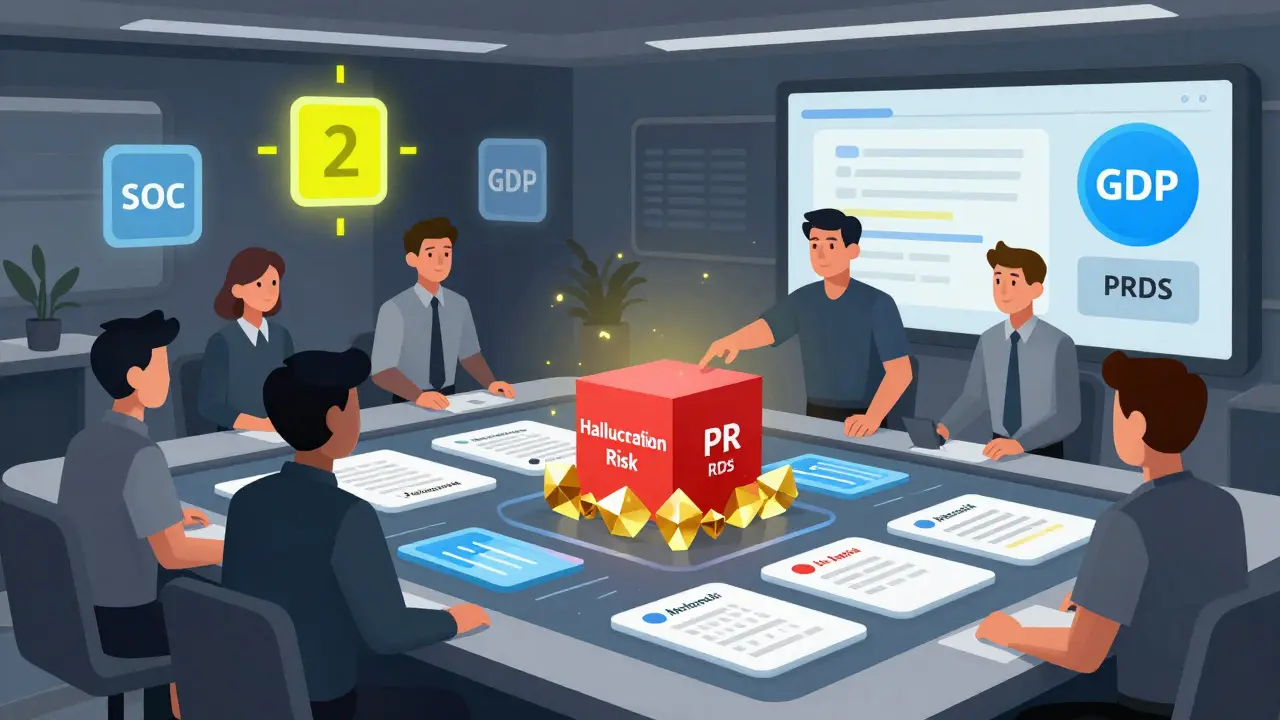
- Risk Mitigation - What happens if the model hallucinates? What’s the fallback? Who validates output?
Refining User Stories: From “I Want” to “I Can”
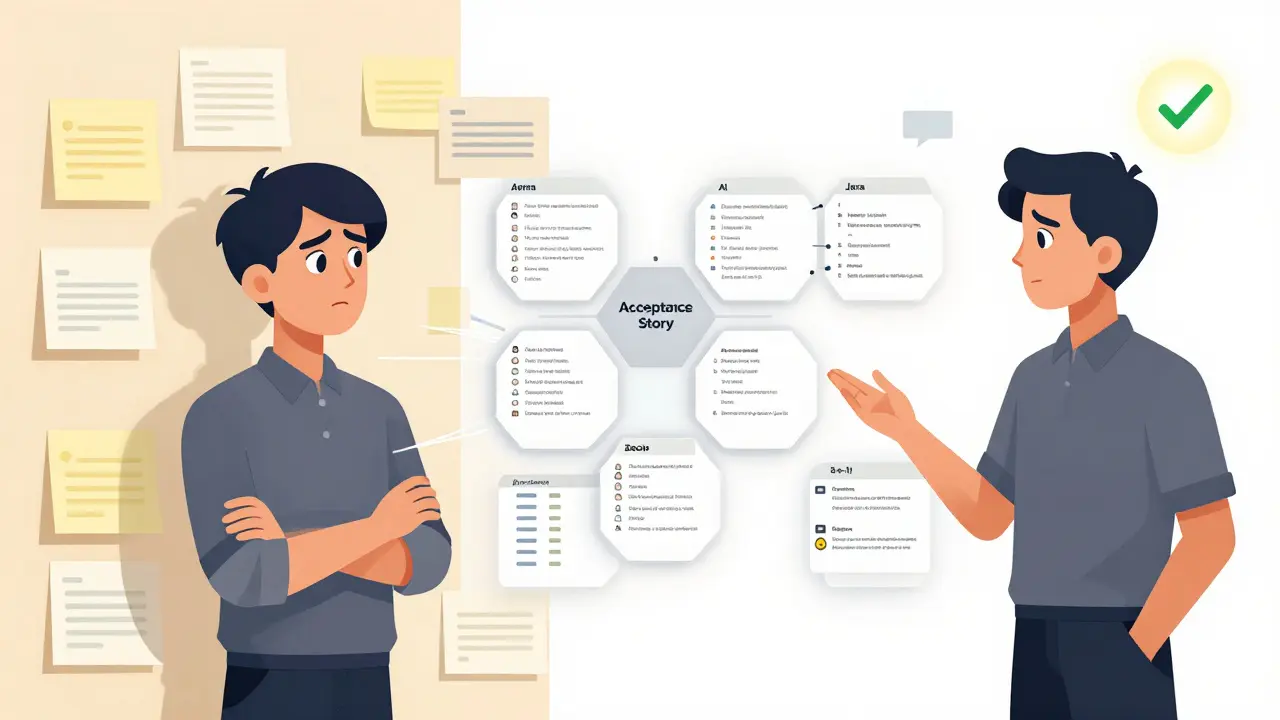
User stories are the heartbeat of agile. But vague ones like “I want a better search bar” lead to wasted sprints. LLMs excel at turning fuzzy requests into testable stories. Here’s how:- Take raw user feedback (e.g., from support tickets or surveys)
- Paste it into your LLM tool with this prompt: “Convert this into three user stories following the format: As a [role], I want [action] so that [outcome]. Include acceptance criteria.”
- Brand Guidelines (constant): “Follow our tone: professional, concise, user-first.”
- Product Details (variable): “This is a B2B SaaS tool for HR teams managing remote onboarding.”
- Instruction (constant): “Generate 5 user stories with acceptance criteria. Do not invent features.”
The Hidden Cost: Prompt Engineering and Governance
You can’t just plug in an LLM and expect magic. Setup takes work. Product School’s certification data shows PMs need 8-12 hours of training to prompt LLMs effectively. Most failures happen because people skip these steps:- Not defining context window limits-complex user journeys over 5,000 tokens cause fragmented outputs (AI21 Labs, Nov 2024)
- Not setting accuracy thresholds-teams that didn’t require 85%+ performance on test cases saw 28% higher revision rates
- Not validating against historical data-Amazon’s pilot reduced defects by 22% by comparing AI-generated stories to past successful features
Who Struggles the Most? (And How to Fix It)
Junior PMs (0-2 years experience) are 68% more likely to draft requirements that lack traceability to business goals, according to Product School’s November 2025 data. Why? They treat LLM output as truth, not a starting point. The fix? Build a shared eval suite. Create 10-15 “golden tasks”-real-world examples of good and bad user stories. Train your team to score AI outputs against them. Use red-team cases: “What if the model suggests a feature that violates GDPR?” Also, never skip the “what you won’t build” rule. Marty Cagan says successful AI teams define boundaries upfront: “We won’t use generative AI for medical advice. We won’t automate compliance checks without legal review.” That’s not limiting-it’s protecting.What’s Next? The 2026 Roadmap
By mid-2026, LLM product management will evolve in three ways:- Multimodal inputs - You’ll upload a Figma mockup, and the AI will generate user stories from visuals (piloted by mshojaei77).
- Automated validation - AI will compare new user stories against historical performance data to predict success rates (Amazon’s Q4 2025 pilot cut defects by 22%).
- Ethical audits - 41% of Fortune 500 companies now require AI-generated requirements to pass bias and fairness checks before approval.
Start Today: Your 3-Step Action Plan
1. Pick one workflow - Start with user story refinement. It’s low-risk, high-reward. 2. Build your template - Use Product School’s three-part input structure. Save it. Reuse it. 3. Set guardrails - Define accuracy thresholds, latency limits, and a human review step. Never auto-approve. LLMs aren’t replacing product managers. They’re making the best ones even better. The ones who learn to ask the right questions, validate the outputs, and keep the human judgment in the loop.Can LLMs replace product managers?
No. LLMs are tools, not decision-makers. They generate drafts, identify patterns, and surface risks-but they don’t understand business strategy, user emotion, or regulatory nuance. Top-performing teams use AI to handle 60-70% of the grunt work, freeing up PMs to focus on judgment, alignment, and stakeholder trust. The AI writes the first draft; you write the final version.
What LLMs work best for product management?
It depends on your needs. For structured outputs like PRDs and user stories, models fine-tuned on product data (like Orq.ai’s LLMOps suite) outperform general-purpose models. GPT-4o and Claude 3 Opus handle complex prompts well, but if you’re in healthcare or finance, prioritize models with SOC 2 Type II compliance and audit trails. Avoid open-source models unless you can validate their accuracy on domain-specific tasks. Accuracy above 82% on your own test set is the minimum threshold.
How do I prevent AI hallucinations in PRDs?
Three ways: First, use a “golden test set” of 20-30 real PRDs your team has approved. Score every AI output against it. Second, require the AI to cite sources: “Based on user feedback from Q4 2025, this feature is requested by 67% of enterprise clients.” Third, build a pre-prod gate: block any PRD that doesn’t pass engineering validation. Microsoft’s team reduced hallucinations by 89% after adding this step.
Is LLM product management only for big companies?
No. Start small. Even a solo PM can use free tier LLMs (like Claude or Perplexity) to refine user stories or draft a 3-month roadmap. The real barrier isn’t cost-it’s process. If you don’t have a system for validation, even a $10/month tool can cause more harm than good. Begin by using AI for one task: turning raw feedback into structured user stories. Measure the time saved. Then scale.
How much time does it take to set up LLM workflows?
Most teams spend 15-25 hours total: 8-12 hours training on prompt patterns, 5-7 hours building templates, and 3-5 hours integrating with Jira or Confluence. CodingCops’ study found teams that skipped setup and jumped straight to drafting took 3x longer to ship because of constant revisions. Invest in setup. It pays back in weeks.
What if my team resists using AI?
Don’t force it. Show it. Run a side-by-side test: have one person draft a PRD manually. Have another use AI with your template. Compare time spent, clarity, and number of revisions. In 9 out of 10 cases, the AI-assisted version wins on speed and completeness. Data beats persuasion. Once engineers see fewer clarification meetings, they’ll ask for the AI to be included.
- Feb, 3 2026
- Collin Pace
- 9
- Permalink
Written by Collin Pace
View all posts by: Collin Pace