Public Sector Generative AI Policies: Procurement, Transparency, and Accountability in 2026

Imagine a government agency deploying a chatbot that confidently gives incorrect legal advice to thousands of citizens, or a procurement officer buying an AI tool with no idea how it was trained. Sound familiar? It’s becoming the norm because public sector leaders are rushing to adopt Generative AI without the guardrails needed to keep it safe, fair, and transparent. As of late 2025 and heading into 2026, the landscape has shifted from "should we use AI?" to "how do we control it?" The answer lies in robust policies covering three critical pillars: procurement, transparency, and accountability.
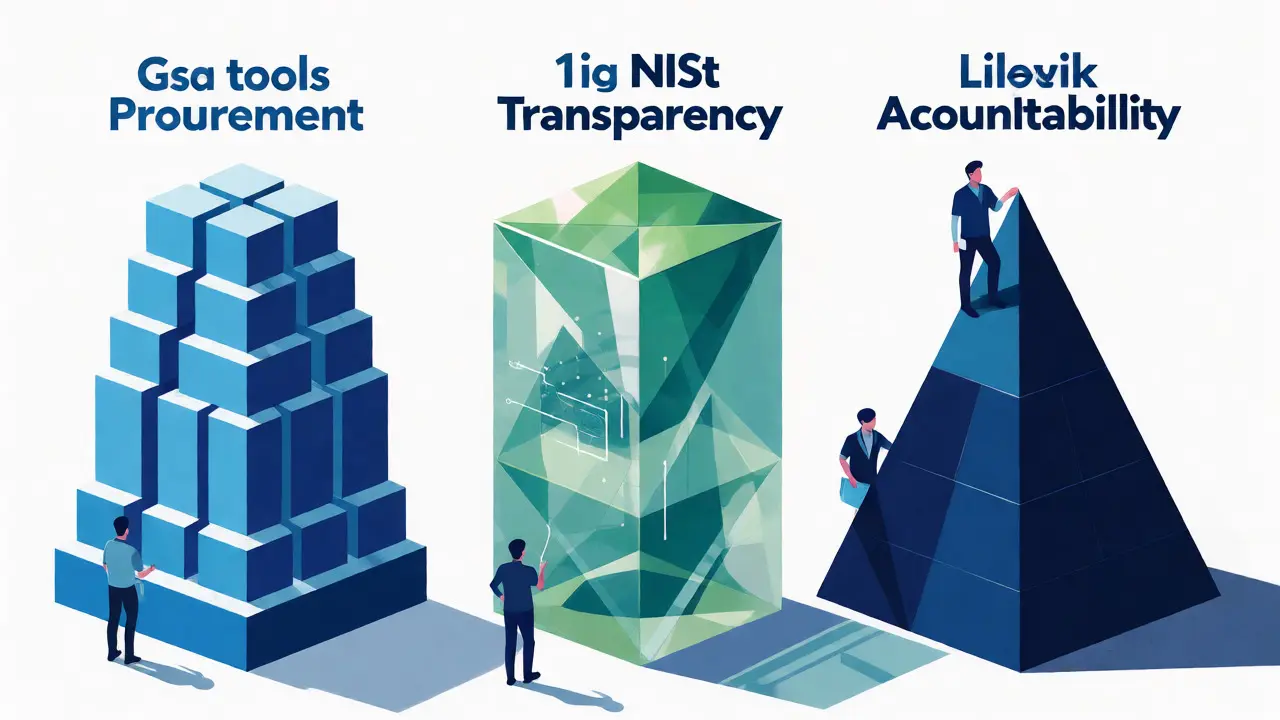
| Pillar | Core Requirement | Primary Framework/Tool |
|---|---|---|
| Procurement | Standardized acquisition processes for AI tools | GSA AI Procurement Toolbox, OMB M-25-22 |
| Transparency | Disclosure of training data and model logic | NIST AI Risk Management Framework |
| Accountability | Clear liability for errors and bias | Risk-based classification (High/Low) |
The Shift from Experimentation to Regulation
For years, government agencies treated AI like a science project. But by 2024, U.S. federal agencies introduced 59 AI-related regulations-more than double the count from 2023. This surge wasn't random; it was a reaction to the rapid integration of large language models into daily operations. President Trump's April 2025 Executive Orders, specifically 14277 and 14278, kicked off America's AI Action Plan. These orders didn't just encourage innovation; they demanded structure. They established three pillars: Accelerating Innovation, Building AI Infrastructure, and Leading International Diplomacy.
Why does this matter to you if you work in government tech? Because the "wild west" era is over. You can no longer buy an AI tool on a credit card and hope for the best. The new rules require that any agency employee whose work could benefit from frontier language models must have access to appropriate tools and training. It’s not just about having the software; it’s about having the capability to use it responsibly.
Procurement: Buying AI Without the Bureaucratic Headache
Let’s talk about money and contracts. Traditional IT procurement doesn't fit AI well. You’re not just buying a static piece of software; you’re buying a dynamic system that changes as it learns. To fix this, the General Services Administration (GSA) is developing an AI Procurement Toolbox in coordination with the Office of Management and Budget (OMB). The goal? Uniformity. If every agency uses different contract terms for AI, sharing capabilities becomes a nightmare.
The Advanced Technology Transfer and Capability Sharing Program is another key player here. It allows agencies to rapidly transfer AI capabilities between departments. Imagine one agency develops a great fraud detection algorithm; instead of reinventing the wheel, another agency can license or adopt it quickly. This reduces redundancy and saves taxpayer dollars. However, there’s a catch. Many agencies still rely on legacy systems. Presidio’s analysis notes that while interest is surging, about 60% of federal agencies feel unprepared to integrate AI into production systems because their underlying infrastructure isn’t ready. You can’t buy your way out of bad architecture.
Transparency: Showing Your Work
If an AI denies a citizen’s application for benefits, why did it do that? In the past, this was often a black box. Now, transparency mandates are forcing these boxes open. Executive Order 14319, signed in July 2025, titled "Preventing Woke AI in the Federal Government," mandates red-teaming of AI capabilities. Red-teaming essentially means trying to break the AI to find biases or failures before it goes live.
Agencies must comply with OMB Memorandum M-25-22, which drives efficient acquisition but also emphasizes unbiased principles. This builds public trust. When people know how an algorithm reached a decision, they’re more likely to accept it. Washington State’s Interim Report from December 2025 takes this further by recommending that developers disclose how training data is processed. This helps mitigate errors and biases during model development. It’s not enough to say "the AI decided." You need to show the data lineage.
Accountability: Who Is Responsible?
This is the hardest part. If an AI makes a mistake, who gets fired? The developer? The agency head? The vendor? Current policies are moving toward a risk-based approach. Washington State’s framework distinguishes between "low-risk" and "high-risk" AI systems. High-risk systems-those impacting health, safety, or fundamental rights-require stricter governance.
These high-risk systems must adopt recognized frameworks like the NIST AI Risk Management Framework or ISO/IEC 42001. These aren't just suggestions; they’re becoming requirements for public disclosure. If you deploy a high-risk AI, you must publicly disclose your risk management practices. This creates a paper trail. If things go wrong, investigators can look at your documentation to see if you followed the rules. Accountability isn't about blame; it's about traceability.
Federal vs. State: A Tale of Two Approaches
It’s crucial to understand that federal and state policies don't always align. The federal level, driven by the America's AI Action Plan, focuses heavily on infrastructure and scale. Think $30 billion investments from companies like AWS and global competitive pressure from China’s $47.5 billion semiconductor fund. The federal government wants speed and dominance in the AI race.
State-level policies, like those emerging in Washington State, focus on granular control and consumer protection. They are more willing to call for "additional safeguards, restrictions, or outright bans" on specific high-risk applications. For example, a state might ban facial recognition in schools even if the federal government encourages its broader use. If you’re a contractor selling to both levels, you need two different compliance strategies. One size does not fit all.

Implementation Challenges: The Readiness Gap
Here is the reality check. Having a policy on paper is easy. Executing it is hard. Dr. Lynne Parker, Director of the White House Office of Science and Technology Policy, emphasized the need for a National AI R&D Strategic Plan to guide research. But research is different from deployment. GovTech reports highlight that IT organizations struggle to unify efforts. They need an "enterprise layer of AI" to serve as a central brain.
Without this centralization, agencies end up with dozens of disconnected AI tools from different vendors. This leads to data silos and security risks. Furthermore, talent gaps remain significant. The America's AI Action Plan includes a talent-exchange program to allow rapid details of federal staff to other agencies needing specialized skills like data scientists. But swapping personnel is complex. Most agencies lack the internal expertise to audit the AI tools they buy. They rely on trusted partners, but finding partners who understand both government bureaucracy and cutting-edge AI is tough.
What Does Success Look Like in 2026?
Success isn't just about launching more bots. It’s about alignment. Vision, infrastructure, and application readiness must match. Agencies that succeed will be those that treat AI governance as a core business function, not an afterthought. They will use unified platforms to manage AI solutions. They will prioritize transparency so citizens trust the outcomes. And they will hold themselves accountable through rigorous testing and clear liability structures.
The global context adds urgency. With countries like France committing €109 billion and Saudi Arabia launching a $100 billion initiative, the U.S. public sector cannot afford to lag. But speed without safety is reckless. The balance lies in these three pillars. Get procurement right, and you save money. Get transparency right, and you gain trust. Get accountability right, and you avoid disaster.
What is the GSA AI Procurement Toolbox?
The GSA AI Procurement Toolbox is a set of standardized guidelines and templates developed by the General Services Administration in coordination with the Office of Management and Budget. Its purpose is to help federal agencies acquire artificial intelligence technologies more efficiently and uniformly, reducing bureaucratic friction and ensuring consistent contract terms across different government entities.
How does the NIST AI Risk Management Framework apply to government AI?
The NIST AI Risk Management Framework provides a structured approach for managing risks associated with AI systems. For government agencies, adopting this framework is often mandated for high-risk AI applications. It requires agencies to map, measure, and manage AI risks throughout the lifecycle of the technology, ensuring that potential biases, security vulnerabilities, and performance issues are identified and mitigated before deployment.
What is the difference between low-risk and high-risk AI in public policy?
Low-risk AI systems typically involve tasks with minimal impact on individual rights or safety, such as internal document summarization. High-risk AI systems significantly impact people's lives, health, safety, or fundamental rights, such as algorithms used in criminal justice sentencing or healthcare diagnostics. High-risk systems require stricter governance, including mandatory disclosures, red-teaming, and adherence to standards like ISO/IEC 42001.
Why is transparency important in government generative AI?
Transparency is crucial for maintaining public trust. When citizens interact with AI-driven services, they need to understand how decisions are made. Requirements include disclosing how training data is processed and revealing the logic behind automated decisions. This helps prevent hidden biases and ensures that government actions remain explainable and defensible under law.
How do executive orders influence public sector AI adoption?
Executive orders set the strategic direction and immediate priorities for federal agencies. Recent orders, such as those establishing America's AI Action Plan, mandate specific actions like providing employees with access to frontier models, implementing unbiased AI principles, and accelerating infrastructure development. They effectively turn political intent into operational requirements for government workers.
- Oct, 20 2026
- Collin Pace
- 0
- Permalink
- Tags:
- public sector AI policies
- generative AI procurement
- AI transparency regulations
- government AI accountability
- NIST AI framework
Written by Collin Pace
View all posts by: Collin Pace