Quantization-Aware Training: How to Keep LLM Accuracy High in 2026
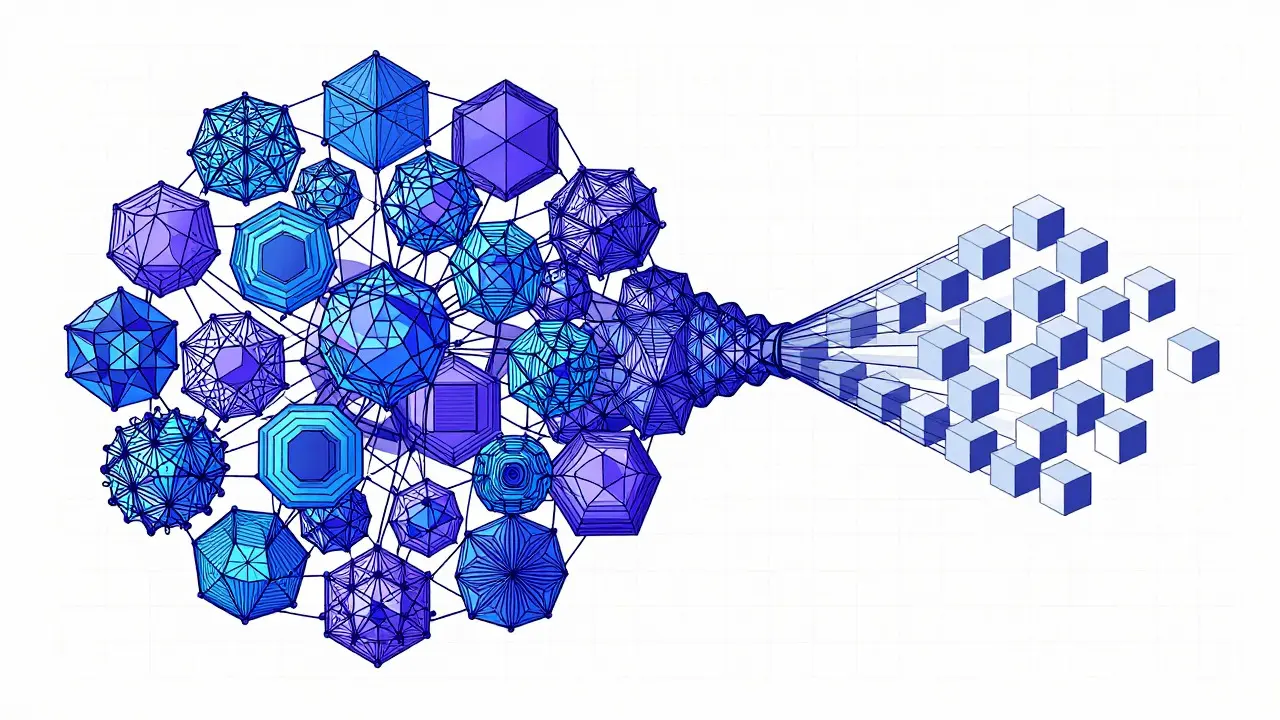
Running a 30-billion parameter model on a laptop used to be science fiction. Today, it’s just Tuesday. But here’s the catch: if you squeeze that model down to fit your hardware using standard methods, it often starts hallucinating or giving up entirely. That’s where Quantization-Aware Training (QAT) comes in. It’s not just a trick; it’s the difference between a usable tool and a broken toy.
Most developers reach for Post-Training Quantization (PTQ) first because it’s fast. You train the model at full precision, then shrink it later. For small models under 3 billion parameters, this works fine. But once you cross into the 7B+ range, PTQ starts eating your accuracy. QAT fixes this by simulating the 'crunch' of low precision *during* the training phase itself. The model learns to be robust against the noise introduced by reducing numbers from 16-bit floats to 4-bit integers before it ever hits production.
Why Standard Quantization Fails Big Models
To understand why QAT is necessary, you have to look at what happens when you compress a Large Language Model (LLM). In a standard neural network, weights are stored as 16-bit floating-point numbers. This gives you a massive range of values with high precision. When you quantize these to 8-bit or 4-bit integers, you lose resolution. It’s like trying to describe a sunset using only four colors instead of millions. Some details vanish.
In smaller networks, the brain (or rather, the math) can compensate. In LLMs, the architecture is deep and wide. Errors don’t just stay local; they propagate through layers. Research from Meta AI showed that standard PTQ on LLaMA-30B caused unacceptable performance drops in tasks requiring long-context reasoning. The model would forget instructions given three paragraphs earlier because the Key-Value (KV) cache-the memory the model uses to track conversation history-was corrupted by quantization errors.
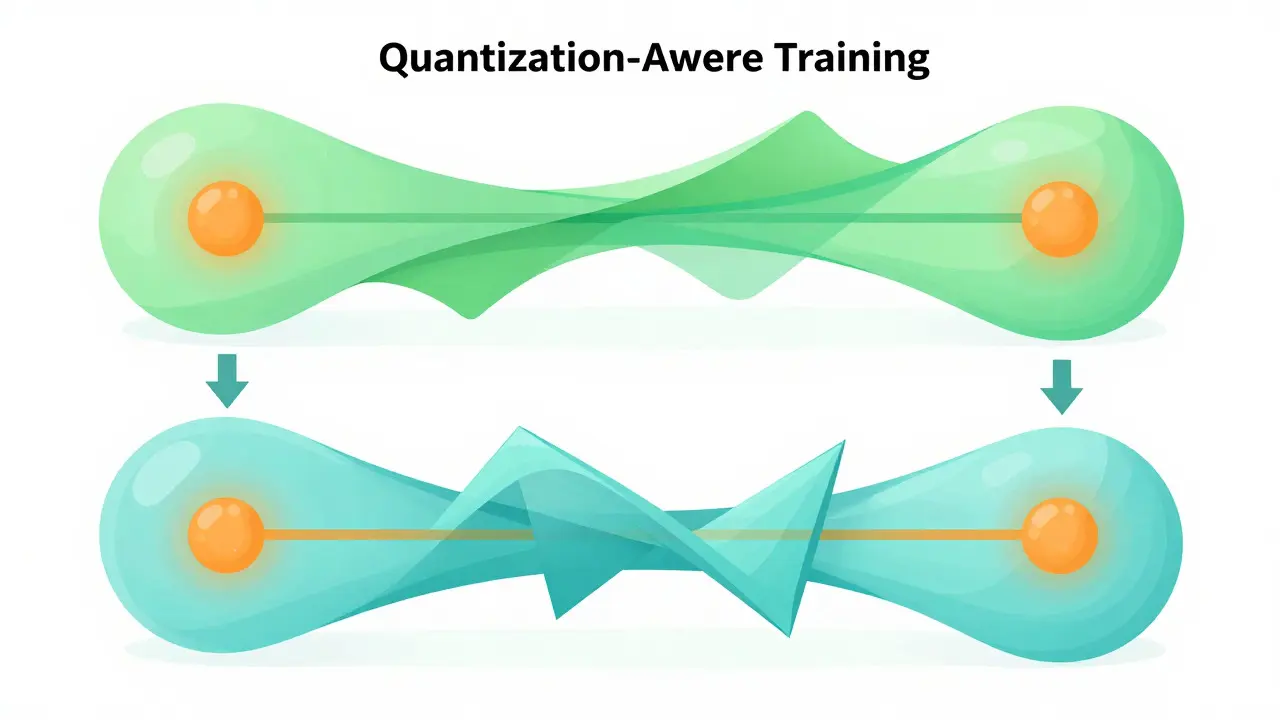
This is where QAT shines. By forcing the model to train with fake quantization nodes, the optimizer adjusts the weights specifically to minimize error in those low-precision states. The result? A model that behaves almost exactly like its full-precision sibling, but takes up a fraction of the space.
The Core Mechanics: Simulating the Squeeze
So, how does QAT actually work under the hood? It relies on a technique called straight-through estimation. During the forward pass, weights are quantized to their lower precision (e.g., int4). During the backward pass, gradients are calculated as if no quantization happened, allowing the standard optimizers like AdamW to update the weights smoothly.
However, modern LLM implementations go beyond basic weight quantization. The most critical innovation in recent years has been the quantization of the KV cache. If you’ve ever tried to run a long document through an LLM, you know memory spikes quickly. The KV cache accounts for 20-30% of total memory usage during inference. Traditional QAT ignored this. Newer frameworks, like those documented in ACL 2024 findings, now quantize the KV cache to 4-bit as well. This alone can improve throughput by 37% for 8K sequence lengths, making real-time chat applications feasible on consumer GPUs.
Another key component is data-free distillation. You don’t need the original training dataset to do QAT. Instead, you use the pre-trained model to generate its own synthetic data. The model acts as its own teacher, generating text that it then uses to fine-tune the quantized version. This eliminates the dependency on proprietary datasets, which is a huge win for open-source communities working with models like Llama or Mistral.
QAT vs. PTQ: The Numbers Don't Lie
Let’s talk concrete results. According to PyTorch’s 2024 documentation, QAT preserves up to 96% of the original model's accuracy on benchmark tasks like HellaSwag, whereas PTQ often struggles to hit 85% on complex reasoning tasks for models over 7B parameters. On WikiText perplexity, a measure of how surprised the model is by new text, QAT recovers 68% of the degradation seen in PTQ for Llama3-8B models quantized to 4-bit.
| Feature | Post-Training Quantization (PTQ) | Quantization-Aware Training (QAT) |
|---|---|---|
| Accuracy Retention (HellaSwag) | ~85% | Up to 96% |
| KV Cache Handling | Often unquantized or lossy | Quantized to 4-bit (stable) |
| Compute Cost | Low (minutes) | High (hours to days) |
| Memory Footprint (Inference) | Reduced | Reduced + Better Throughput |
| Best For | Small models (<3B), quick prototyping | Large models (7B+), production deployment |
The trade-off is clear. PTQ is cheap and fast. QAT is expensive but accurate. If you’re building a simple classifier or a tiny assistant, stick with PTQ. But if you’re deploying a coding assistant or a legal advisor that needs to remember context and reason logically, QAT is non-negotiable.
Implementation Roadmap: From Code to Chip
Implementing QAT isn’t plug-and-play. It requires a structured approach. Here is the standard workflow used by teams at major tech companies:
- Sensitivity Analysis: Not all layers are created equal. The first few and last few layers of a transformer are highly sensitive to quantization. Skipping quantization for the first 3 and last 2 layers can drop WordPerplexity from 6766 to 30 on WikiText. Use tools to identify which layers can safely be compressed.
- Data Generation: Run your base model to generate a diverse set of prompts and responses. This creates the 'distillation data' needed for training.
- Fine-Tuning with Simulation: Insert fake quantization operators into your PyTorch or TensorFlow graph. Train the model for a few epochs. Expect this to take 24-48 hours on a cluster of 8x A100 GPUs for a 7B model.
- Evaluation: Test against both generic benchmarks (MMLU, HellaSwag) and your specific domain data. Look for regressions in long-context tasks specifically.
Tools like PyTorch torchao is a library within PyTorch designed for optimizing AI models through quantization and other techniques have made this process more accessible. It handles the heavy lifting of int8 per-token dynamic activations combined with int4 grouped weights automatically. Similarly, TensorFlow Model Optimization is a suite of tools for reducing model size and improving inference speed in TensorFlow projects offers robust pipelines for mixed-precision QAT.

Common Pitfalls and How to Avoid Them
Even with the right tools, QAT can trip you up. Here are the most common issues reported by developers on GitHub and Reddit:
- Numerical Instability: Gradients can explode when switching between float and integer representations. Solution: Use gradient clipping at 1.0 and cosine learning rate decay instead of linear decay.
- Layer Selection Errors: Blindly quantizing every layer destroys quality. Always keep the embedding layer and the final output layer at higher precision (int8 or fp16).
- Overfitting to Distillation Data: If your generated data lacks diversity, the quantized model will memorize patterns rather than learn robustness. Ensure your prompt generation covers edge cases and rare topics.
A user on r/MachineLearning recently shared that applying QAT to Llama3-8B took 36 hours on 4x A100s, yielding a 0.9% drop in MMLU score compared to full precision. That’s a massive win for a 4x reduction in memory. But another user noted that skipping the first 3 layers was essential; otherwise, response quality dropped by 40%. These anecdotes highlight that hyperparameter tuning is still an art form.
The Future: Automated and Faster
We are moving toward a future where QAT is less manual. PyTorch 2.5 introduced automatic layer sensitivity detection, cutting down the time spent on manual tuning by 70%. Google’s TensorFlow updates now support mixed-precision QAT with automatic bit-width assignment per layer. Imagine a system that decides some layers should be 8-bit and others 4-bit based on their importance, all without human intervention.
Meta AI has announced plans to integrate QAT directly into the Llama training pipeline. If successful, this could reduce the fine-tuning phase from days to minutes. For now, though, QAT remains a specialized skill. It requires understanding not just deep learning, but also computer architecture and numerical analysis. As LLMs continue to grow, this skill set will become as standard as knowing how to compile code.
Is Quantization-Aware Training worth the compute cost?
Yes, for any model larger than 7 billion parameters intended for production use. The accuracy gain is significant enough to justify the extra training time, especially when considering the reduced infrastructure costs during inference. For smaller models or rapid prototyping, Post-Training Quantization may suffice.
Do I need my original training dataset for QAT?
No. Modern QAT techniques use data-free distillation, where the pre-trained model generates its own training data. This allows you to apply QAT to open-source models without needing access to the proprietary datasets used in their initial training.
What is the best bit-width for LLM quantization?
4-bit is the current sweet spot for balancing memory savings and accuracy. With proper QAT, you can achieve near-full-precision performance at 4-bit. 8-bit is safer for very sensitive tasks but offers less memory reduction. 2-bit is generally too lossy for complex reasoning tasks.
How does QAT handle the Key-Value cache?
Advanced QAT implementations explicitly quantize the KV cache to 4-bit. This is crucial for long-context tasks, as the KV cache consumes a large portion of memory during inference. Quantizing it improves throughput and reduces memory footprint significantly.
Which framework is best for implementing QAT?
PyTorch with the torchao library is currently the most popular choice due to its active development and strong community support. TensorFlow Model Optimization is also a solid option, particularly for teams already invested in the TensorFlow ecosystem. Both support state-of-the-art QAT techniques.
- Aug, 25 2026
- Collin Pace
- 0
- Permalink
- Tags:
- Quantization-Aware Training
- LLM compression
- model quantization
- 4-bit inference
- PyTorch torchao
Written by Collin Pace
View all posts by: Collin Pace