Reasoning-Capable Large Language Models: How Internal Thinking Changes AI

You ask a standard large language model a tricky math problem. It spits out an answer instantly. Sometimes it's right, often it's wrong. You get no clue why. Now, imagine an AI that pauses. It doesn't just guess; it thinks. It breaks the problem down, checks its work, catches errors, and then gives you the answer. This isn't science fiction anymore. In 2026, this "internal thinking" capability has moved from research labs to production systems. Reasoning-capable large language models are changing how we build AI applications. They trade raw speed for accuracy. If you're building agents or complex workflows, understanding this shift is critical.
The Shift From Prediction To Deliberation
Traditional LLMs are essentially sophisticated autocomplete engines. They predict the next token based on probability. Fast? Yes. Accurate on complex logic? Not always. Reasoning models change the game by introducing a hidden deliberation phase. Before generating the final response, these models generate intermediate "thinking tokens." These tokens represent steps in a logical chain. The model effectively talks to itself, verifying each step before moving on. This process mimics human problem-solving more closely than simple pattern matching. The result is a significant jump in performance on tasks requiring multi-step inference, like mathematics, coding, and strategic planning.
This architectural shift defines 2026 as the year of "reasoning-first" AI development. Companies realized that maximizing parameter count alone wasn't enough. They needed models that could self-correct. By using reinforcement learning to train these internal loops, developers created systems that can reassess their approach when they hit a dead end. It’s not just about knowing facts; it’s about knowing how to use them logically.
How Internal Thinking Actually Works
Under the hood, reasoning models rely on specific training methodologies and architectures. Most leading models now use Mixture-of-Experts (MoE) designs. Instead of activating all parameters for every query, MoE models activate only a small subset-often less than 5%-of their total capacity. This allows for massive model sizes without prohibitive computational costs during inference. For example, a model might have 671 billion total parameters but only 3 billion active ones per token.
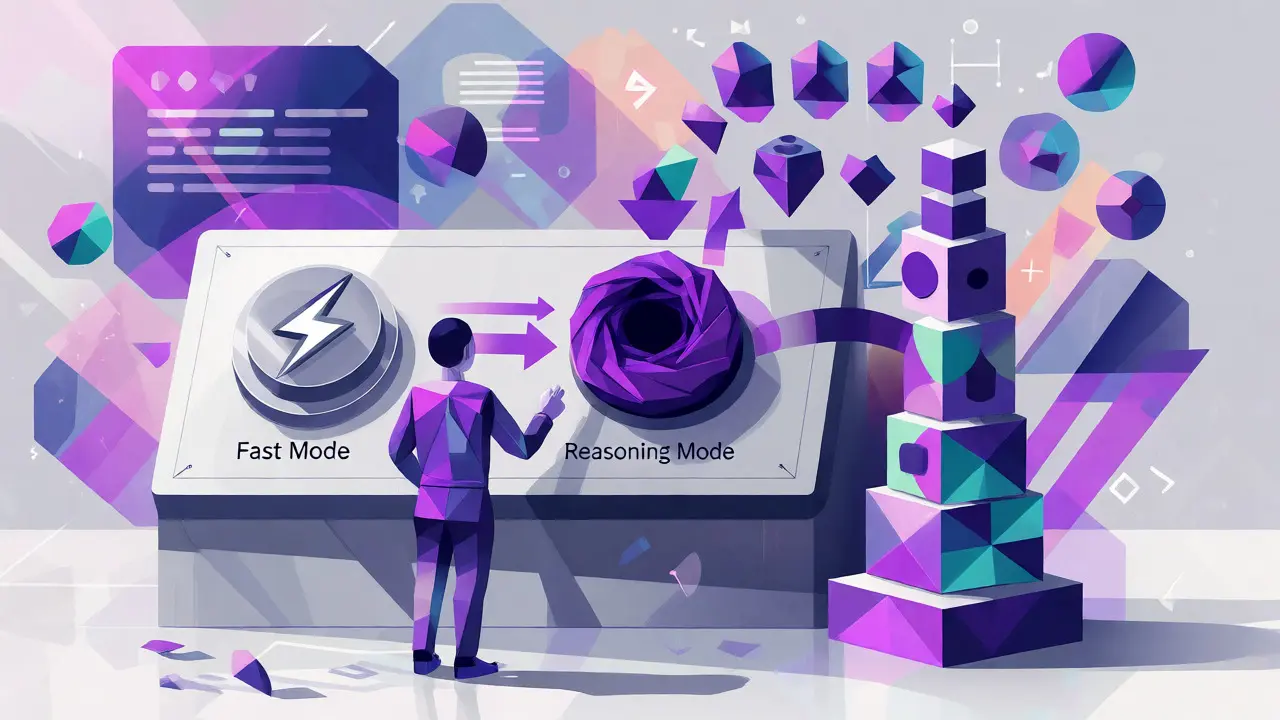
The core mechanism involves chain-of-thought (CoT) prompting embedded directly into the model's weights. When prompted, the model enters a "thinking mode." It generates a sequence of reasoning steps internally. These steps aren't always shown to the user, depending on the API settings, but they happen. The model evaluates potential paths, discards incorrect ones, and synthesizes a final answer. Some newer models, like DeepSeek V3.1, even allow switching between "fast mode" (standard prediction) and "reasoning mode" (deep deliberation). This flexibility lets developers balance latency against accuracy based on the task at hand.

Leading Open-Source Reasoning Models In 2026
The market has exploded with open-source options that rival proprietary giants. Here are the key players defining the current landscape:
- DeepSeek-R1: Released in August 2025, this model shocked the industry. Developed by Chinese tech company DeepSeek with limited hardware compared to Western rivals, it achieved state-of-the-art reasoning performance. Its R1-0528 update boosted AIME 2025 math scores from 70% to 87.5%. It features a 671B parameter MoE architecture with a 128k context window.
- Qwen3 Series: Alibaba's contribution includes the Qwen3-Next 80B-A3B-Thinking variant. It uses hybrid attention mechanisms and sparse MoE to achieve fast inference with high reasoning depth. The larger Qwen3-235B-A22B hits 89.2% on AIME 2025 benchmarks, proving that scale still matters when combined with efficient architecture.
- Mistral Ministral 14B Reasoning: A breakthrough in efficiency. With only 14 billion parameters, it achieves ~85% accuracy on AIME 2025, competing with models five times its size. It’s ideal for resource-constrained environments where deploying massive models isn't feasible.
- Phi-4 Family: Microsoft’s approach focuses on small-scale efficiency. Phi-4-mini-flash offers specialized reasoning capabilities in compact packages, suitable for edge devices and local deployments where privacy and cost are paramount.
Performance Benchmarks And Real-World Impact
How do we measure "thinking"? Standard benchmarks like MMLU test general knowledge. But reasoning models are evaluated on harder tests: AIME 2025 (math), HMMT (logic), HumanEval (coding), and GPQA Diamond (graduate-level science). The gap between traditional and reasoning models is stark here. While a standard LLM might struggle with a multi-step algebraic proof, a reasoning model will solve it by breaking it into ten smaller, verifiable steps.
| Model | Total Parameters | AIME 2025 Score | HumanEval Score | Best Use Case |
|---|---|---|---|---|
| DeepSeek-R1 | 671B (MoE) | 87.5% | N/A | Complex Math & Logic |
| Qwen3-235B-A22B | 235B (MoE) | 89.2% | 91.5% | General High-End Reasoning |
| Ministral 14B | 14B | ~85% | 78.5% | Efficient Local Deployment |
| GPT-OSS-120B | 117B (MoE) | Data Pending | Data Pending | Production Open-Weight |
Notice the trend: efficiency is king. Models like Ministral 14B prove you don't need hundreds of billions of parameters to think deeply. Distillation techniques allow smaller models to inherit reasoning patterns from larger teachers. DeepSeek-R1-Distill-Qwen3-8B, for instance, matches the performance of much larger models on specific tasks while running on a single NVIDIA H100 GPU. This democratizes access to advanced reasoning.
Limitations And Failure Modes
Don't let the hype fool you. Reasoning models fail too. Recent academic surveys identify three systematic failure categories. First, fundamental architectural limits mean some problems remain unsolvable regardless of thinking time. Second, domain-specific weaknesses appear in niche fields like legal interpretation or creative writing, where rigid logic can be a hindrance. Third, robustness issues cause inconsistent results if the prompt varies slightly. A minor wording change might break the chain of thought, leading to a completely different answer.
Also, consider the cost. Internal thinking consumes significantly more compute. A query that takes milliseconds for a standard model might take seconds for a reasoning model. For real-time chat applications, this latency can be unacceptable. Developers must carefully decide when to invoke deep reasoning versus quick prediction.
Strategic Implementation For Developers
If you're integrating these models, start by identifying high-value reasoning tasks. Don't use a reasoning model for simple FAQ retrieval. Use it for debugging code, solving financial projections, or planning agent actions. Implement dual-mode systems: default to fast inference for general queries, and trigger reasoning mode for complex inputs. Monitor your logs for "thinking traces" if available, as they provide invaluable insights into why a model failed. Finally, keep an eye on open-source releases. The pace of innovation is rapid, with new updates monthly that improve accuracy and reduce costs.
What is the main difference between a standard LLM and a reasoning LLM?
Standard LLMs predict the next word based on probability patterns. Reasoning LLMs engage in an internal chain-of-thought process, breaking problems into steps and verifying logic before outputting a final answer. This leads to higher accuracy on complex tasks like math and coding.
Are reasoning models slower than traditional models?
Yes, generally. Because they generate intermediate thinking tokens, they require more computation time. However, many modern models offer dual modes, allowing users to switch between fast inference and deep reasoning based on the task's complexity.
Can I run reasoning models locally?
Yes, especially distilled versions. Models like DeepSeek-R1-Distill-Qwen3-8B or Mistral Ministral 14B can run on consumer-grade GPUs with 40-80GB VRAM. Larger frontier models may require multiple high-end GPUs or cloud infrastructure.
Which benchmark best measures reasoning ability?
AIME 2025 (American Invitational Mathematics Examination) is currently a primary standard for testing multi-step mathematical reasoning. Other key benchmarks include HMMT for logic, HumanEval for coding, and GPQA Diamond for graduate-level scientific reasoning.
Why did DeepSeek-R1 cause such a stir in the AI community?
It demonstrated that state-of-the-art reasoning capabilities could be achieved with limited hardware budgets and open-source licensing. This challenged the assumption that only well-funded Western companies could develop frontier AI, driving down costs and increasing accessibility.
- Oct, 14 2026
- Collin Pace
- 0
- Permalink
Written by Collin Pace
View all posts by: Collin Pace